5 forint 1848

Market Prices
1 saleAbout This Note
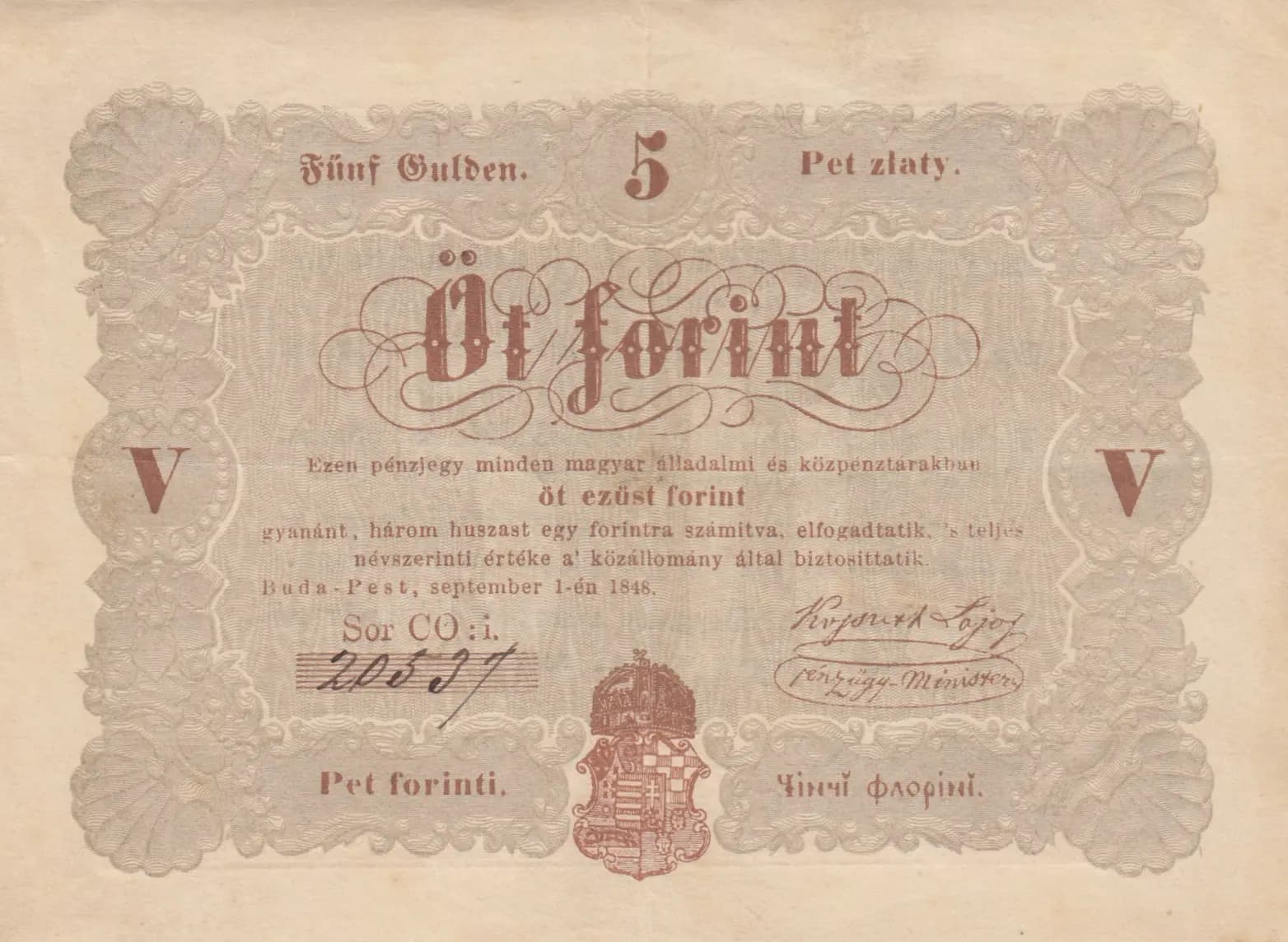
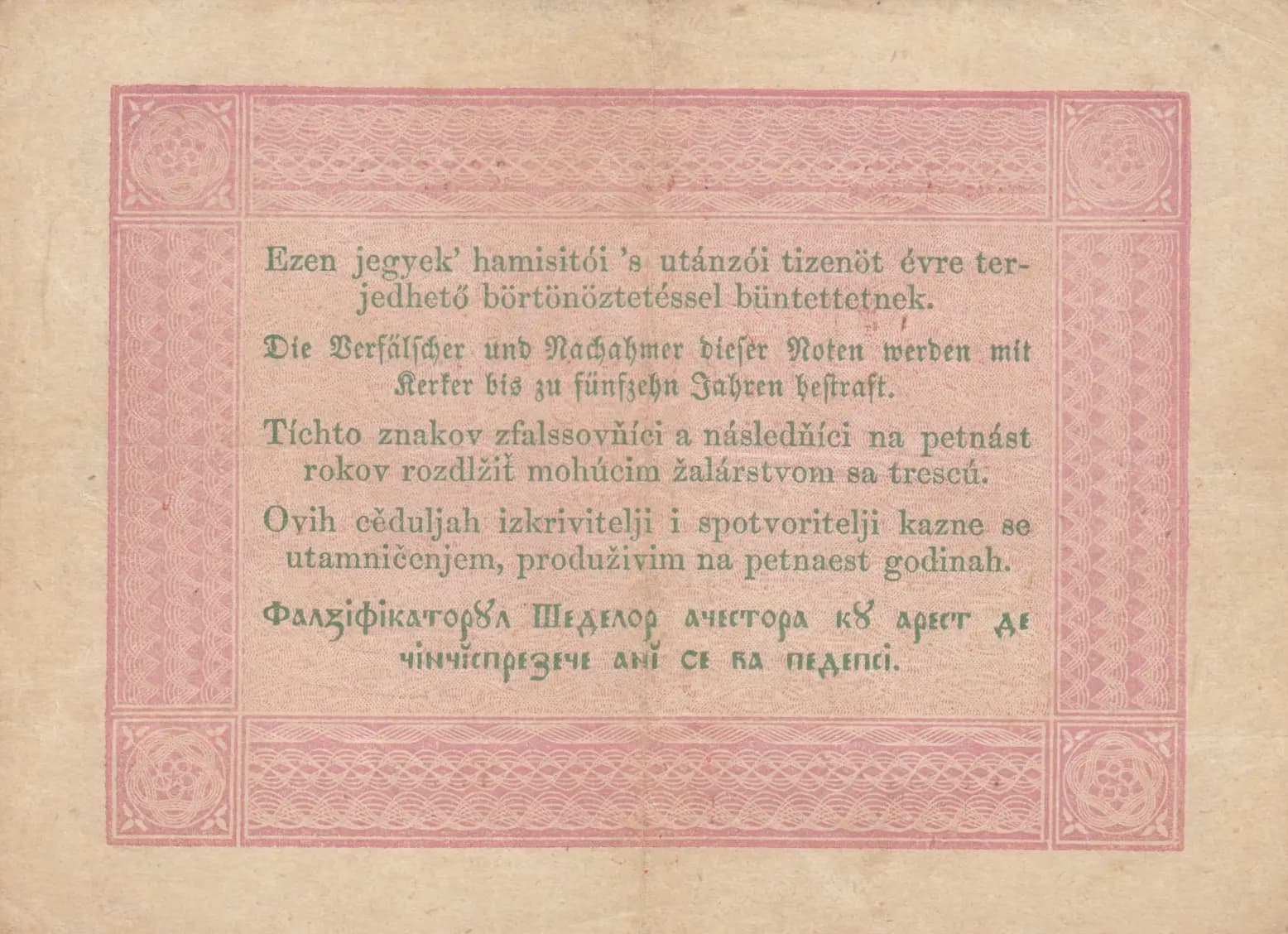
This 1848 Hungarian 5 forint note represents a fascinating artifact from the revolutionary period, issued by the Ministry of Finance under Lajos Kossuth's leadership. The reverse side features an ornate pink and rose-colored decorative border with circular medallions in all corners and geometric patterns, showcasing period-appropriate security printing with multilingual anti-counterfeiting warnings. In VF condition, this note exhibits minimal wear with age-appropriate foxing on the cream-colored background, making it an attractive example of early Hungarian revolutionary currency.
common
Issued during the 1848 Hungarian Revolution against Austrian Habsburg rule, this banknote carries the authority of the revolutionary Ministry of Finance and bears the printed signature of Lajos Kossuth, a central figure in the independence movement. The prominent multilingual forgery warnings in Hungarian, German, Slovak, Serbian/Croatian, and Cyrillic script reflect the ethnically diverse Austro-Hungarian Empire and demonstrate the note's intended circulation across multiple regions. This period of currency issuance was short-lived, as the revolution was ultimately suppressed by 1849, making notes from this era important historical documents of a failed but pivotal uprising.
The obverse features a gray underprint with red-brown coloring and includes the printed signature of Lajos Kossuth as Minister of Finance, establishing governmental authority. The denomination is written out in text with 'Panzjegy' appearing in the first line of small text below. The reverse side displays a striking decorative design with a prominent pink and rose-colored ornamental border frame containing geometric and circular patterns. Circular decorative medallions occupy all four corners, while geometric border patterns run along the top and bottom edges with fine ornamental line work throughout the frame. The center field contains the multilingual anti-counterfeiting text arranged vertically. Green text elements appear on the dark pink underprint, creating visual contrast and enhancing the security design. This combination of decorative elements and multilingual warnings was typical of sophisticated banknote design for the period.
REVERSE (Other Side): Hungarian: 'Ezen jegyek' hamisitói 's utánzói tizenöt évre terjedhetö börtönöztetésséel bünttettetnek.' - 'The forgers and imitators of these notes shall be punished with imprisonment of up to fifteen years.' German: 'Die Verfälscher und Nachaehmer dieser Noten werden mit Kerfer bis zu fünfzehn Jahren bestraft.' - 'The forgers and imitators of these notes will be punished with imprisonment up to fifteen years.' Slovak: 'Tichto znakov zfalsovníci a následující na rok rozdlžit mohúcim zalárstvom sa trescú.' - 'The forgers of these signs and those following will be punished with imprisonment.' Serbian/Croatian: 'Oyih ceduliah izkrivitelji i spotvoritelji kazne se utamničenjem, produžvim na petnaesr godinah.' - 'The forgers and falsifiers of these notes shall be punished with imprisonment for fifteen years.' The inscriptions collectively serve as a strong anti-counterfeiting deterrent, with the penalty clearly stated in the multiple languages of the empire.
This note employed traditional intaglio printing methods characteristic of mid-19th century banknote production, evidenced by the precise geometric patterns, fine line work, and sharp definition of the ornamental border elements. The multiple colored underprints (gray on obverse, dark pink on reverse) combined with overprinted text in various colors (red-brown, green) indicate the use of separate plates and multiple print passes. The circular medallions and detailed geometric patterns are consistent with steel engraving, the standard security printing technique of the era. The printer information for this specific Pick number is not definitively established from available records.
Pick catalog identifies this as P-S116a, where the 'a' designation typically indicates a specific variety within the 5 forint 1848 series. The printed signature of Kossuth as Minister of Finance is a defining characteristic of this variety. No overprints or date variations are noted in the visual analysis. The multilingual text configuration on the reverse appears consistent with the cataloged variety, though additional varieties may exist with different signature types or text layouts within the broader 1848 5 forint emission.