20 pengö 1944
Market Prices
21 salesAbout This Note
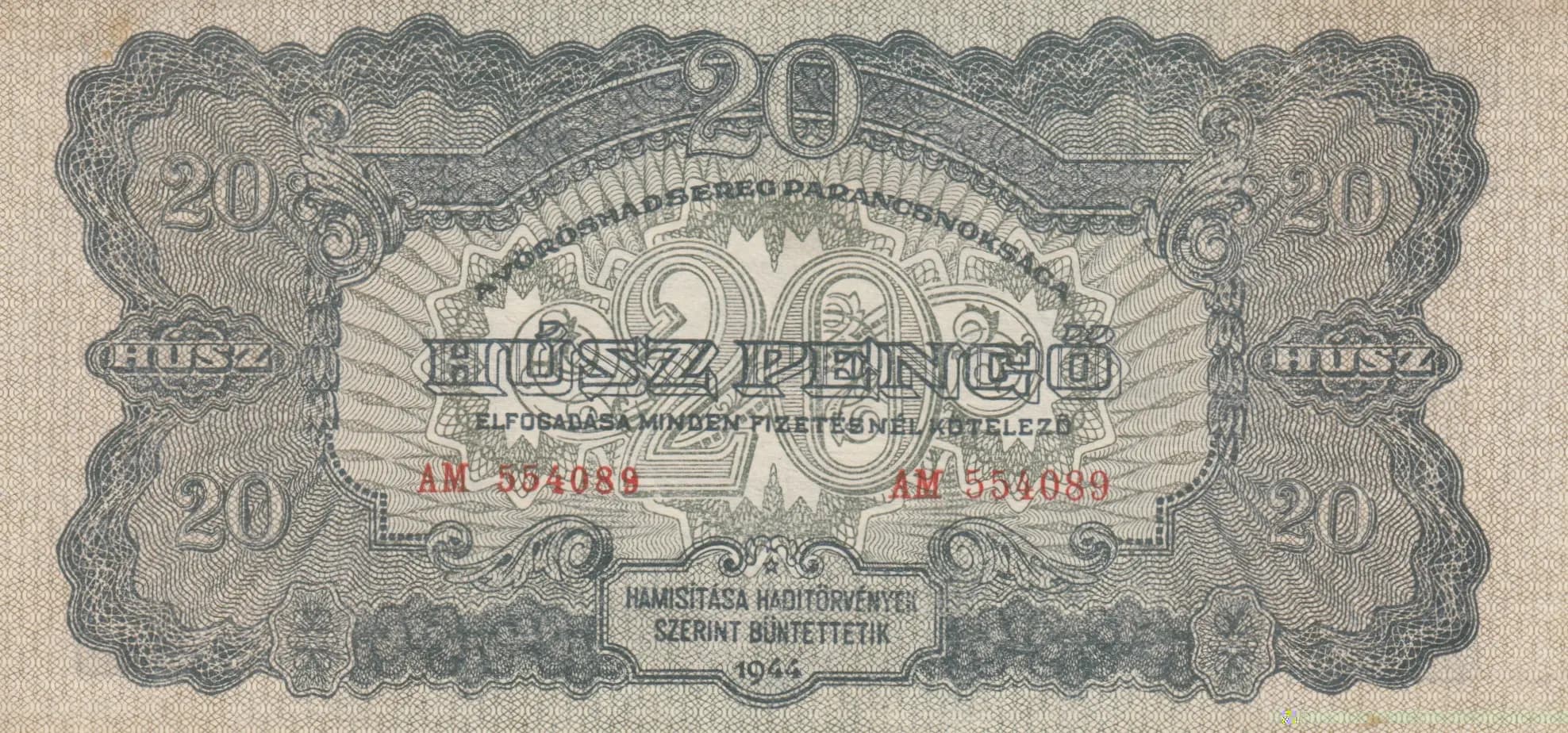
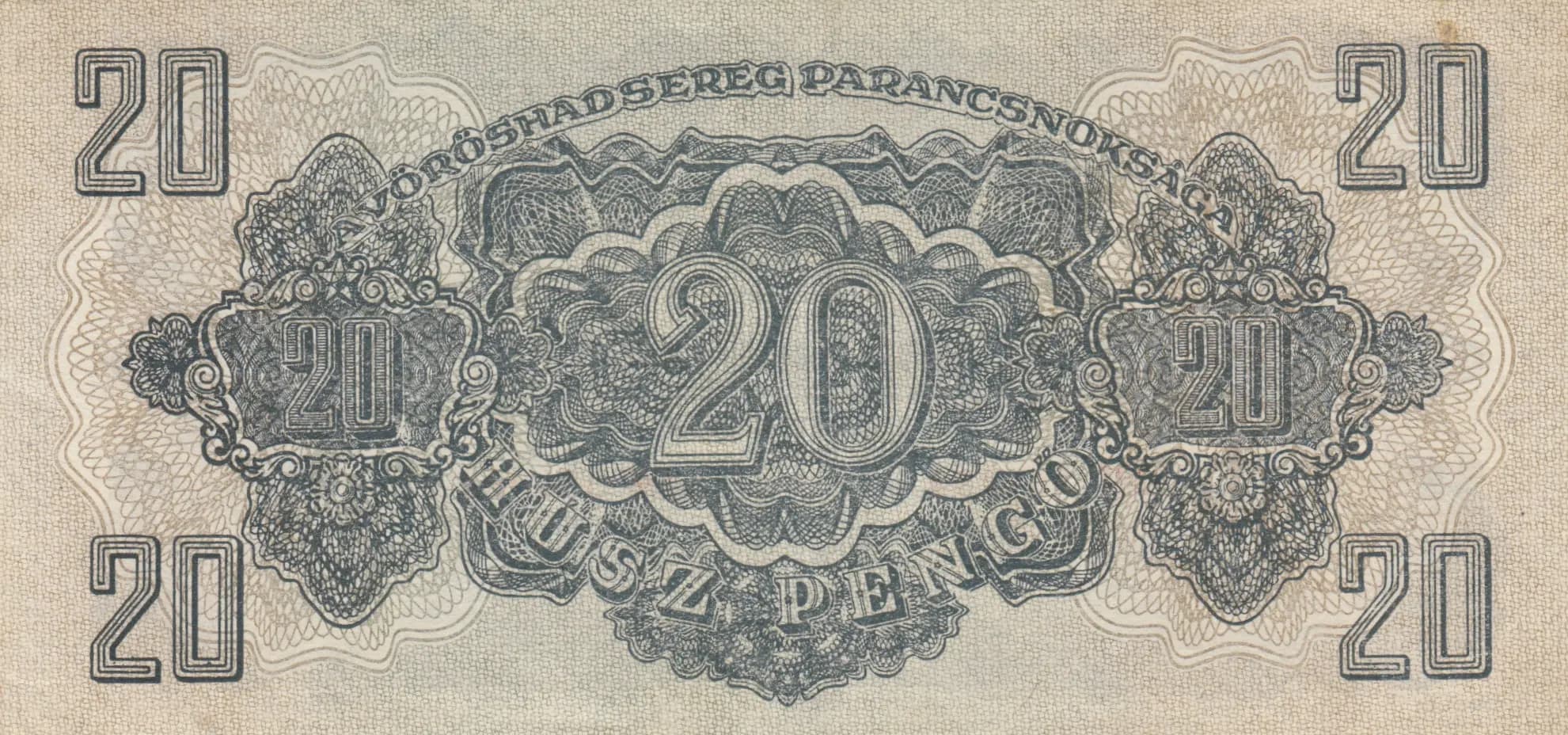
This 20 pengö military payment note from 1944 presents an excellent example of Hungarian wartime currency issued by the Soviet Command (A Vöröshadsereg Parancsnoksaga). The note displays crisp, well-preserved printing with ornate geometric and floral security designs throughout both sides, featuring red serial numbers and the denomination clearly marked in all corners. In AU condition, this example shows minimal wear with sharp print quality and no visible creasing or damage, making it an attractive specimen of this Soviet-issued occupation currency.
Common. Despite being a military payment note from wartime occupation, these 20 pengö notes were issued in substantial quantities for Soviet operational use. eBay market data shows consistent sales activity across multiple condition grades (F through AUNC) over more than a decade, with recent examples selling for $1-$5.50 USD. Catalog values from 2008 list UNC examples at $8, indicating modest collector interest rather than scarcity. The presence of two known serial number varieties and ongoing market circulation confirm these were produced in significant numbers rather than limited military issue runs.
Issued in 1944 by the Soviet Red Army Command during the final stages of World War II and the Soviet occupation of Hungary, this military payment certificate represents a critical transition period in Hungarian monetary history. The inscription 'ORSZÁGPARANCSNOKTÁSA' (By order of the commander) and warnings about counterfeiting 'according to military law' reflect the military administration's assertion of control over occupied territory. These notes were used to supply Soviet forces and facilitate transactions in newly conquered Hungarian lands, representing Soviet economic authority imposed through military occupation.
This military payment note lacks the traditional portraiture found on civilian currency, instead employing purely decorative security elements. The design features symmetrical ornate corner frames containing the numeral '20' within elaborate rectangular cartouches with floral and scrollwork motifs. The obverse centers on a large oval medallion surrounded by intricate scrollwork and botanical patterns, while the reverse presents an elaborate geometric ornamental composition with the denomination prominently displayed. Double-headed eagle designs appear in the corners, a traditional Hungarian heraldic symbol. The extensive fine line work and cross-hatching throughout serves both aesthetic and security purposes, typical of period banknote engraving. The gray-on-dull-olive underprint with red serial numbers indicates careful security printing to prevent counterfeiting of this military currency.
FRONT SIDE: '20' (denomination in corners), 'ORSZÁGPARANCSNOKTÁSA' (By order of the commander), 'HÚSZPENGŐ' (Twenty pengö). BACK SIDE: 'HÚSZPENGŐ' (Twenty pengö), Serial number 'AM 594089', 'FELÜLBÍRÁLÁS MINDEN FIGYELMET IGÉNYELEZ' (Review requires full attention/scrutiny), 'HAMISTÁSA HADITÖRVÉNYEK SZERINT BÜNTETTETIK' (Counterfeiting punished according to military law), '20' (denomination), '1944' (year of issue).
Intaglio engraving (recess printing), the standard security printing method for banknotes of this era. The complex line work, cross-hatching patterns, fine detailed scrollwork, and ornate geometric designs characteristic of intaglio production are evident throughout both sides. The crisp impression and sharp detail visible in the visual analysis confirm professional security printer execution. The printer for this Soviet-issued Hungarian military currency would have been a Soviet state printing facility, likely the All-Union State Security Printing Works in Moscow or a facility in occupied territory.
The catalog notes two serial number varieties exist for this Pick number (P-M6b). The observed specimen shows serial number 'AM 594089' in red on both sides. The 'AM' prefix suggests one of the known varieties, though full variety designation would require comparison with comprehensive variety catalogs distinguishing between known serial number range groupings. The designation 'P-M6b' itself indicates this is a cataloged variety (the 'b' suffix denotes a specific variant within the M6 grouping for this denomination and issuer).