20 korona 1920
Market Prices
38 salesAbout This Note
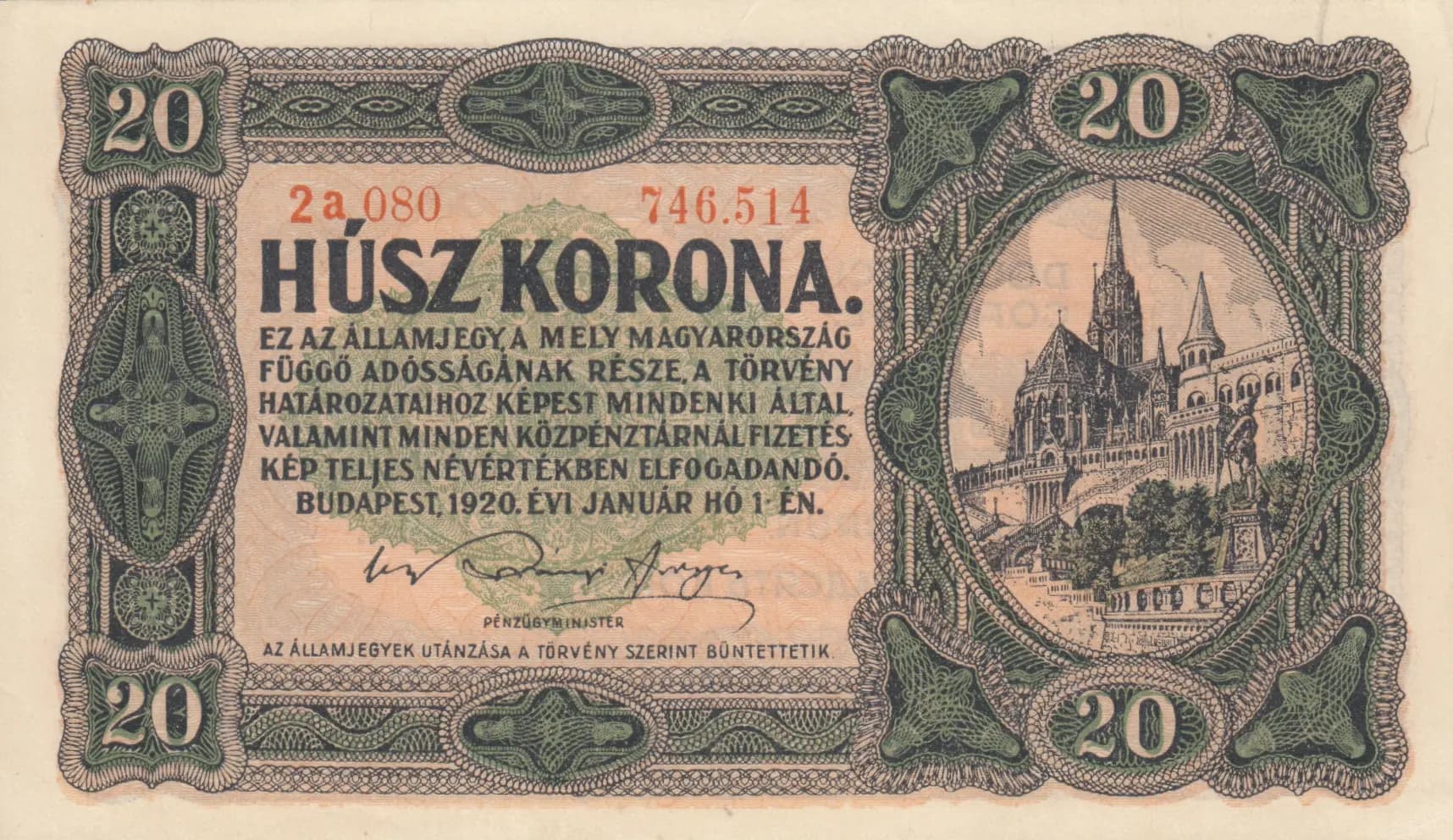
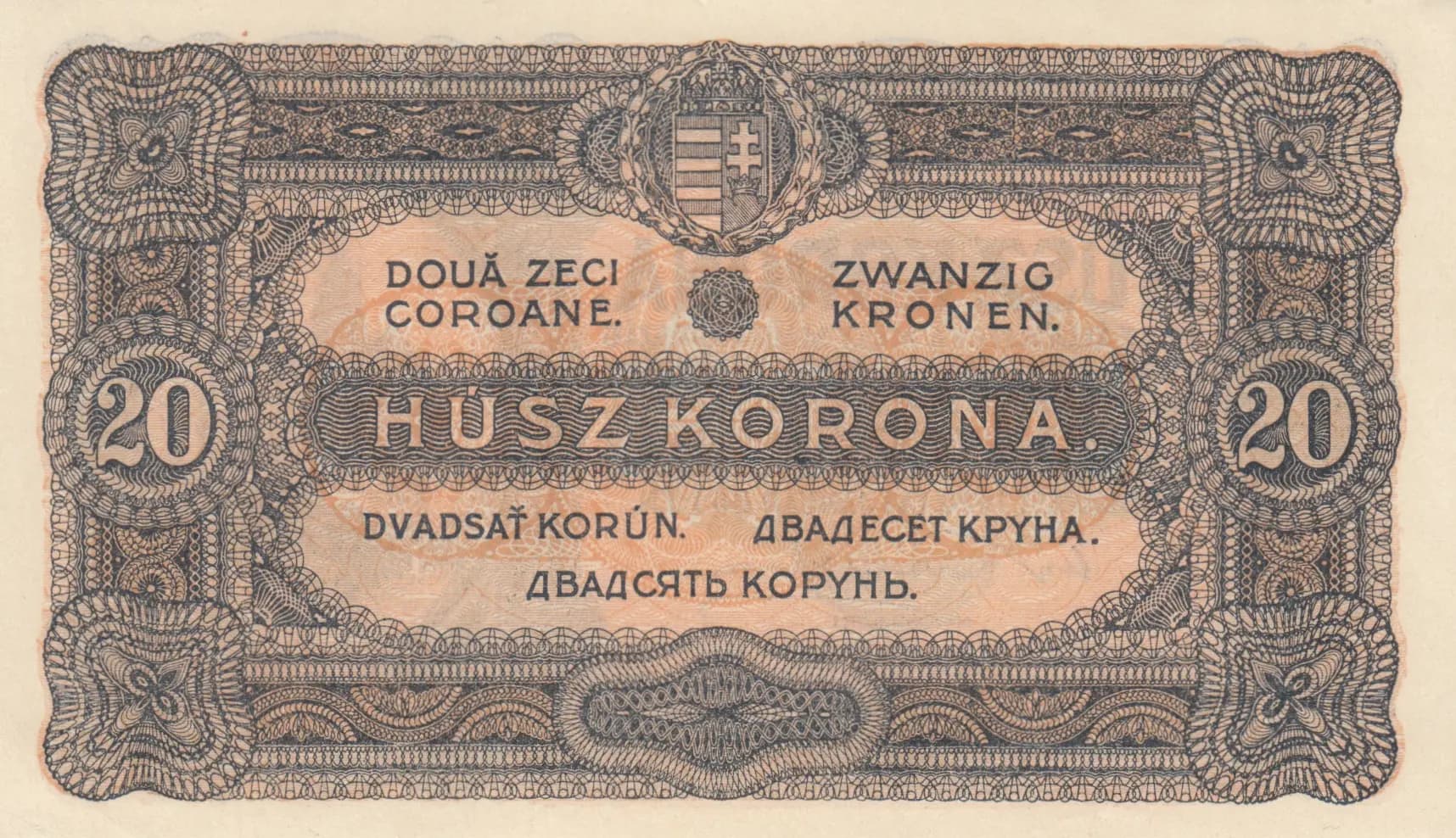
This is an AU-grade Hungary 20 Korona from 1920, a post-WWI currency note issued during Hungary's early interwar period. The note displays the characteristic green and black ornate borders with a striking sepia-toned vignette of Matthias Church in Budapest at center, accompanied by the Hungarian coat of arms on the reverse. Despite visible age-related creasing and discoloration consistent with circulation over a century, the note exhibits no major tears or damage, making it a well-preserved example of early Hungarian monetary history.
Common. eBay market data shows consistent sales of this note in VF-AUNC condition ranging from $2-$12 in recent years, with even PMG-graded examples (64 grade) selling for $22-$66. Print runs for this 1920 issue were substantial, as evidenced by the regular availability on secondary markets. The note's common circulation and survival in multiple condition grades further confirm its status as a widely produced and distributed issue rather than a scarce or rare variant.
Issued on January 1, 1920, this note reflects Hungary's transition from the Austro-Hungarian Empire following World War I and the subsequent Treaty of Trianon. The prominent depiction of Matthias Church—one of Budapest's most iconic Gothic landmarks—symbolized Hungarian national identity and sovereignty during a period of significant political and territorial reorganization. The multilingual text on the reverse (Hungarian, German, Romanian, Slovak, and Russian/Cyrillic) reflects the complex ethnic composition of the newly defined Hungarian state and the broader Central European context of 1920.
The obverse features an ornate rectangular design with intricate engraved borders composed of geometric and floral patterns in green and black on a cream underprint. The central vignette depicts Matthias Church (Mátyás-templom) in Budapest, rendered in sepia and brown tones, showing the distinctive Gothic architecture with multiple spires and towers characteristic of this 14th-century Budapest landmark. The denomination '20' is positioned in all four corners within decorative frames. The reverse displays a simpler composition dominated by the Hungarian coat of arms (a shield with horizontal stripes) positioned at the upper center, surrounded by decorative borders. The reverse text presents the denomination in six different languages and scripts, a security feature intended to serve the multiethnic populations of the post-WWI Hungarian state and surrounding territories.
FRONT: 'HÚSZ KORONA' (Twenty Korona) appears in all four corners. Main text reads: 'EZ AZ ÁLLAMJEGY A MELY MAGYARORSZÁG FÜGGŐ ADÓSSÁGÁNAK RÉSZÉRE, A TÖRVÉNY HATÁROZATAIHOZ KÉPEST MINDEN KI ÁLTAL, VALAMINT MINDEN KÖZPÉNZTÁRNÁL FIZETÉS KÉP TELJES NÉRTÉKBEN ELFOGADANDÓ.' Translation: 'This state note, which is for the dependent debt of Hungary, is according to the law's regulations accepted in full value by all and at every public treasury as payment.' Dated 'BUDAPEST, 1920. ÉVI JANUÁR HÓ 1-ÉN.' (Budapest, January 1, 1920). Signed by 'PÉNZÜGYMINISTER' (Finance Minister). Security text: 'AZ ÁLLAMJEGYEK UTÁNZÁSA A TÖRVÉNY SZERINT BÜNTETTETIK.' (Counterfeiting of state notes is punished according to the law.) BACK: Denomination appears in multiple languages: 'HÚSZ KORONA' (Hungarian), 'DOUÁ ZECI COROANE' (Romanian - Twenty Crowns), 'ZWANZIG KRONEN' (German - Twenty Crowns), 'DVADSAŤ KORÚN' (Slovak - Twenty Crowns), 'ДВАДСЯТ КОРУНЬ' (Russian/Cyrillic - Twenty Crowns).
Intaglio (engraved) printing, evidenced by the fine line work, intricate border patterns, and complex decorative elements visible throughout both sides. The sharp details, precise line spacing in the decorative borders, and crisp inscription rendering are characteristic of high-quality intaglio production typical of early 20th-century European central bank currency. The security features incorporated through elaborate engraved patterns and multiple-language text placement reflect the security printing standards of the Pénzügyminisztérium (Hungarian Finance Ministry).
This note exhibits serial number variety consistent with the catalog notation of '2 serial number varieties' for Pick P-61. The observed example displays serial number components '2 a_080' and '746.514,' indicating one of the known serial number series variants. The specific serial prefix and numbering scheme may distinguish this from other examples of the same Pick number. No signature varieties are evident in this particular specimen.