20 forint 1962
Market Prices
5 salesAbout This Note
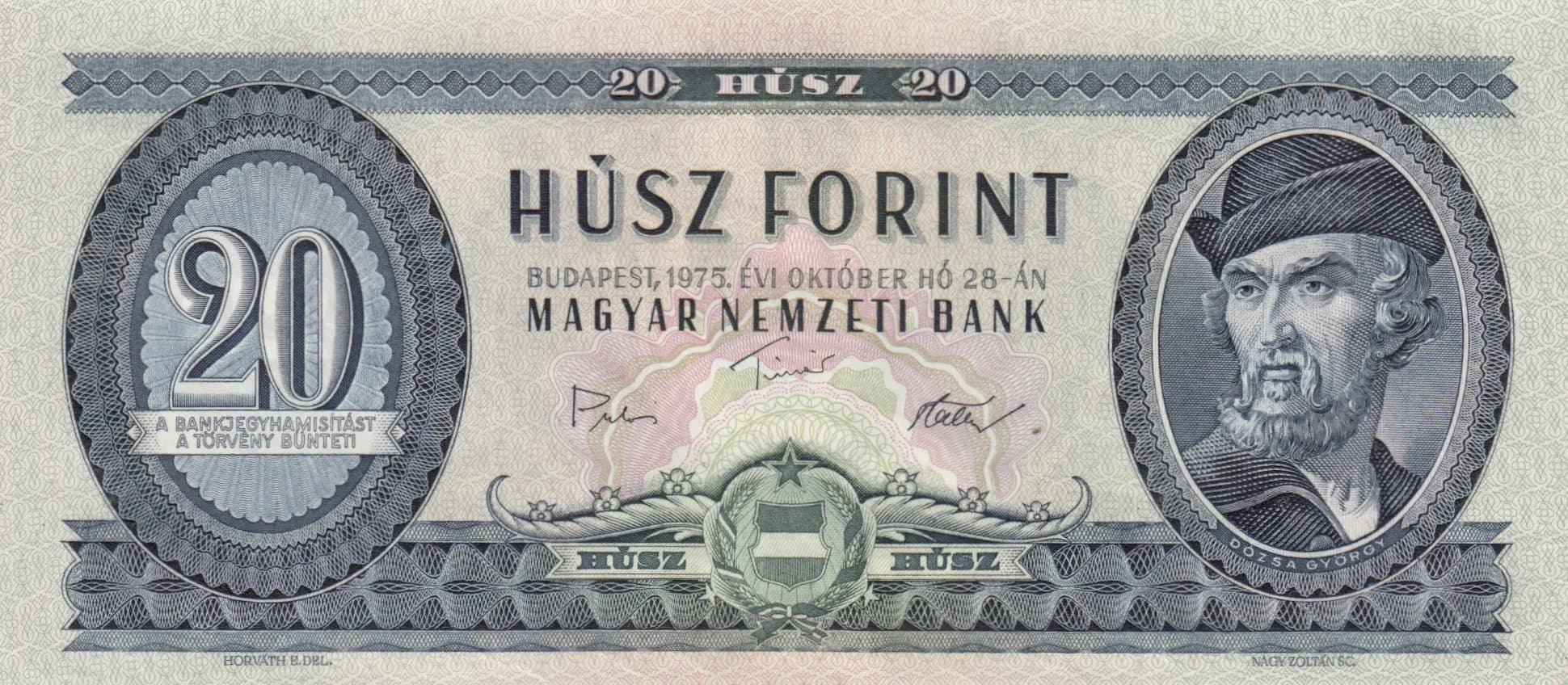
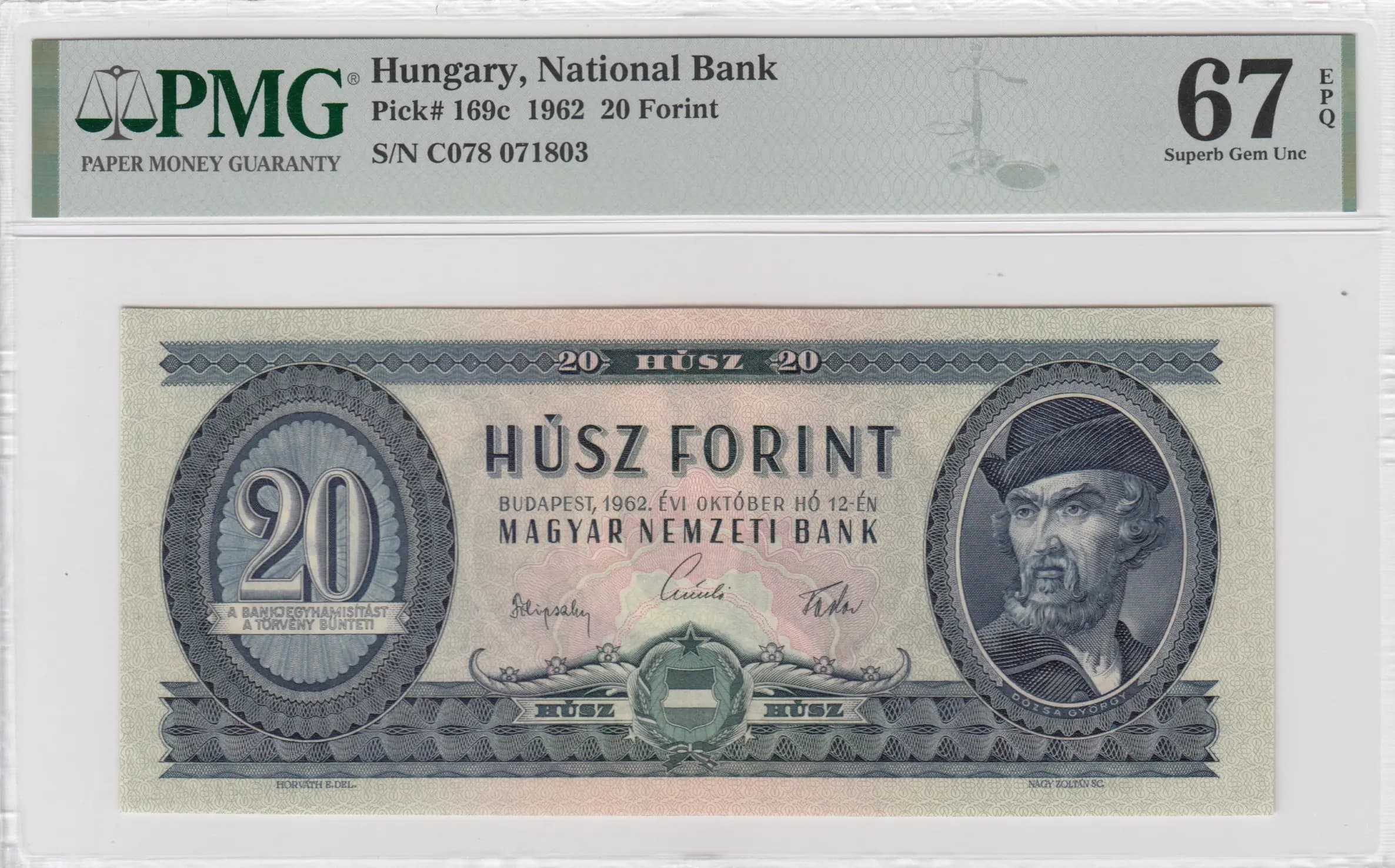
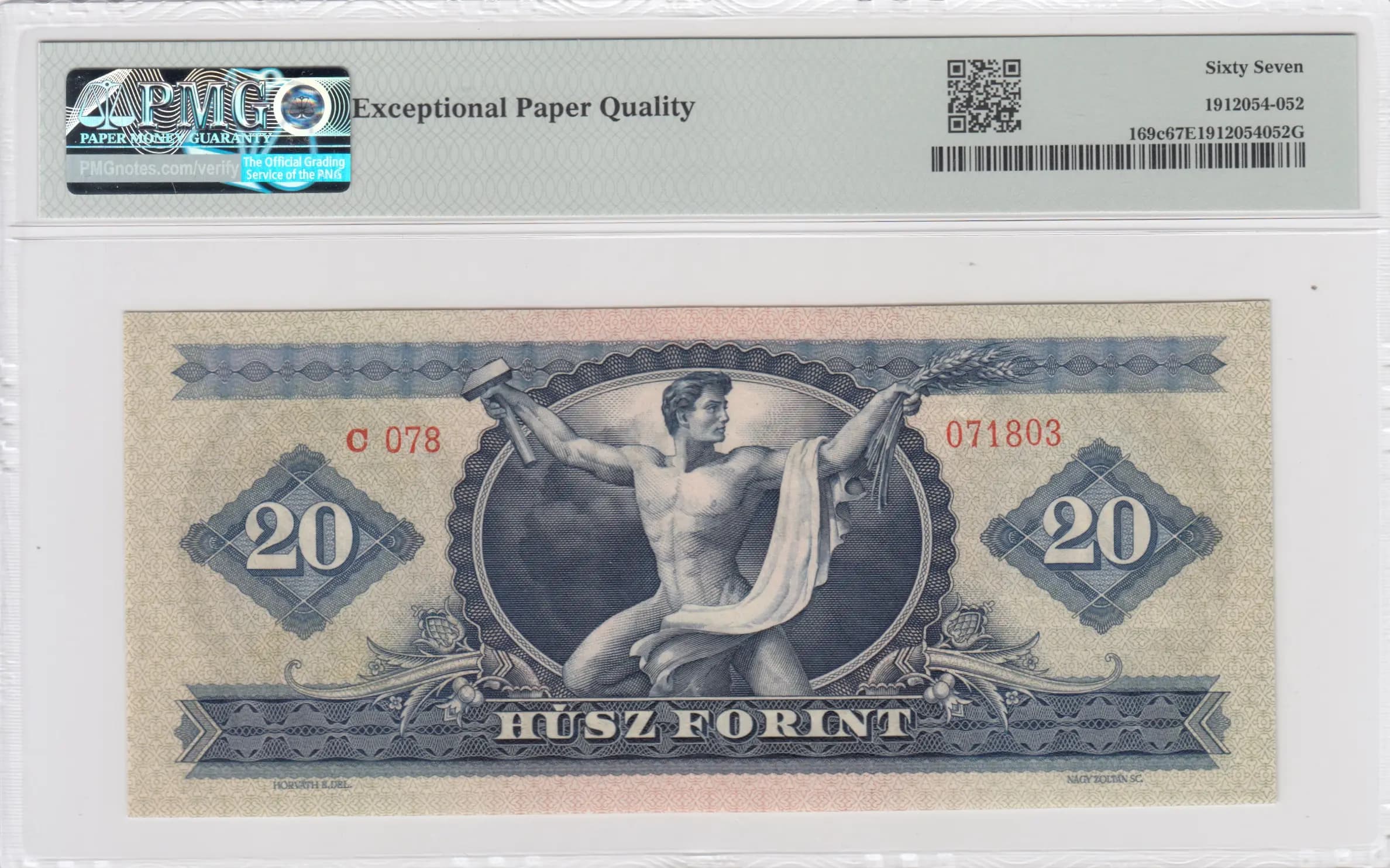
This is a PMG 67 EPQ example of the Hungarian 20 Forint note from 1962 (Pick P-169c), presenting an exceptionally well-preserved specimen of this mid-century Magyar Nemzeti Bank issue. The note displays sharp, crisp printing with no visible wear, creases, or circulation marks, featuring the iconic portrait of György Dózsa on the obverse and an allegorical female figure representing labor and agriculture on the reverse. The excellent condition grade and historical significance of this note—commemorating the 1962 issue date and bearing authentic period engraving—make it an attractive example for collectors of Eastern European currency.
Common. This note circulated widely during its issue period (1957–1980 according to catalog data), and examples regularly appear on the market at modest valuations. eBay sales data shows typical prices in the $1–$9 range for circulated examples, with catalogue values of $2 (VF) to $15 (UNC) in 2019. The PMG 67 EPQ grade elevates the desirability and value of this particular specimen above typical worn examples, but the underlying note type remains common in the Hungarian currency market.
Issued in October 1962 by the Magyar Nemzeti Bank during Hungary's post-1956 recovery period, this note reflects the country's reconstruction and emphasis on industrial and agricultural productivity. The reverse's allegorical female figure holding a hammer and wheat sheaves symbolizes the socialist-era themes of labor and agricultural output that dominated Hungarian state iconography during the Cold War period. György Dózsa, depicted on the obverse, was a 16th-century Hungarian peasant leader, chosen as an iconic figure representing national heritage and popular struggle within the Hungarian communist narrative.
The obverse features György Dózsa (1475–1514), the Hungarian Renaissance-era peasant leader and national hero, depicted in a profile portrait medallion on the right side wearing a period-appropriate cap or hat, rendered in dark blue/navy ink against a cream/beige background. The left side displays a large circular medallion containing the numeral '20' in the denomination. The center features the shield of Hungary with horizontal stripes and text identifying the issuing authority and date. The reverse depicts an allegorical female figure in classical style, reclining and semi-nude, symbolizing Hungary or Liberty. She holds a hammer in one hand (representing industrial labor) and wheat stalks in the other (representing agriculture), positioned within a decorative oval frame. Large '20' numerals appear in diamond-shaped cartouches flanking the central figure, with red serial numbers printed on either side.
OBVERSE: '20 HÚSZ 20' (Twenty Twenty Twenty); 'HÚSZ FORINT' (Twenty Forint); 'BUDAPEST, 1962. ÉVI OKTÓBER HÓ 12-ÉN' (Budapest, October 12, 1962); 'MAGYAR NEMZETI BANK' (Hungarian National Bank); 'A MAGYARORSZÁG BANKJEGYEK A TÖRVÉNY ÁLTAL' (By law, Hungarian banknotes are authorized). REVERSE: '20' (Twenty, appearing in diamond-shaped cartouches); 'HÚSZ FORINT' (Twenty Forint); Serial number prefix 'C 078' and number '071803'.
Intaglio engraving (copperplate printing), the standard security printing method for Hungarian National Bank notes of this era. The sharp detail visible in the geometric borders, fine line work, the intricate rendering of the portrait and allegorical figure, and the multiple color layers all indicate professional security printing characteristic of 1960s Hungarian banknote production. The note was likely printed by the Magyar Nemzeti Bank's authorized security printer.
This note is catalogued as Pick P-169c. The PMG population report indicates at least two other variants exist for this base Pick number (P-169f and P-169s3), likely representing different signature combinations, date variants, or serial number series produced during the 1957–1980 circulation period. The specific variety of this specimen (P-169c) corresponds to one of the standard signature and printing variations issued by the Magyar Nemzeti Bank during the 1962 period. The observed date of October 12, 1962, and serial number prefix 'C 078' are consistent with regular-issue characteristics of this variety.