2 korona 1920
About This Note
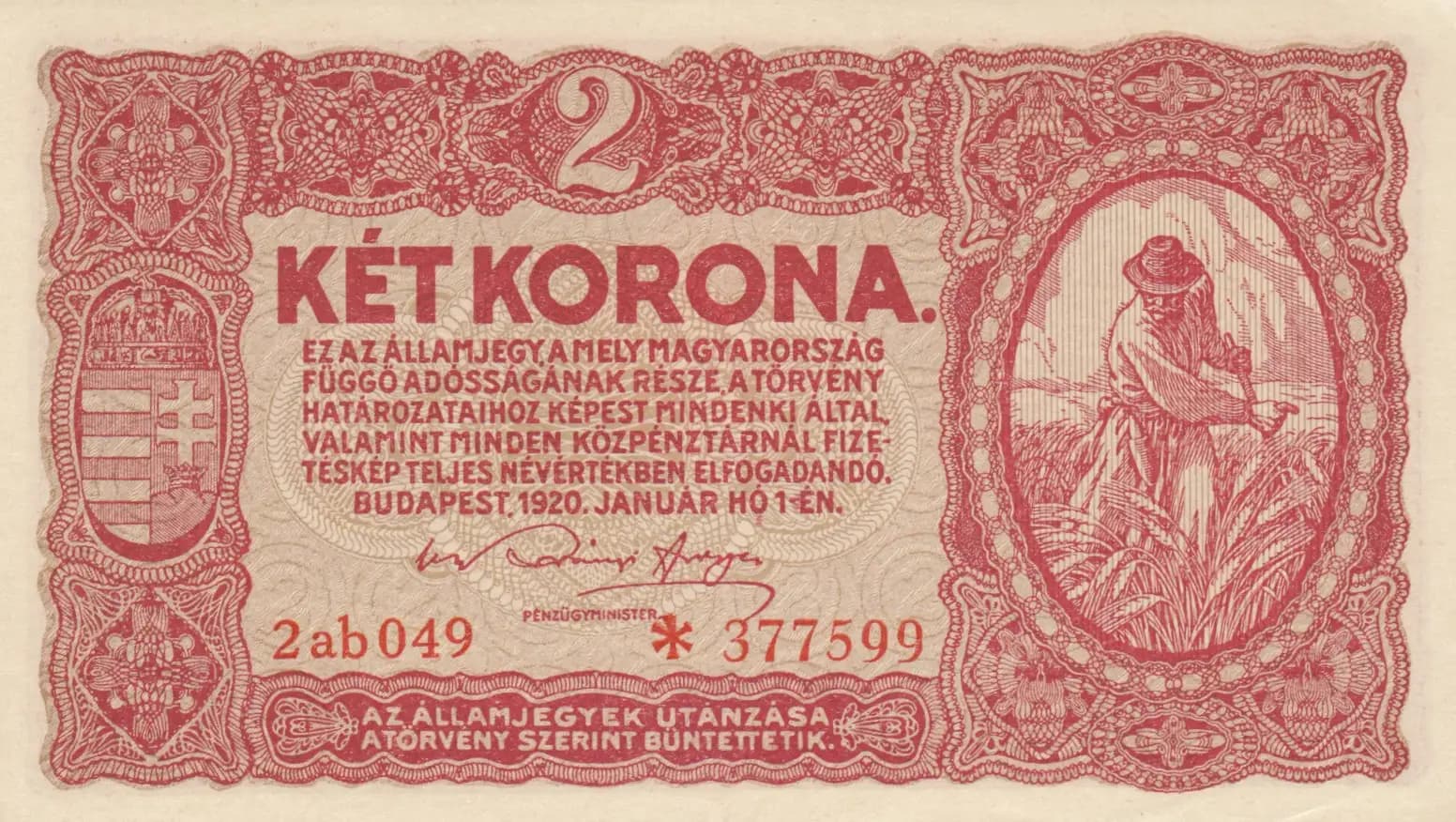
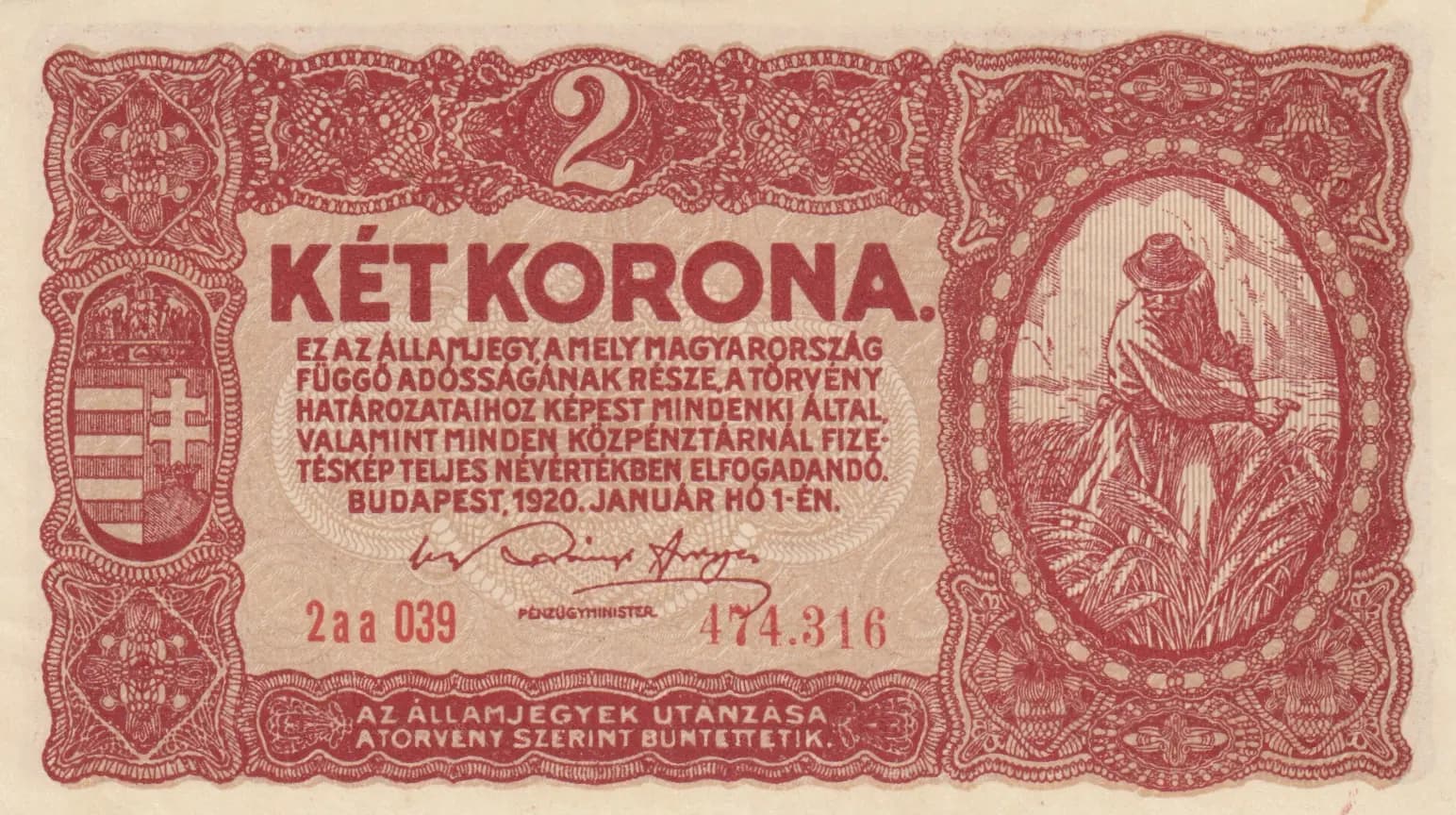
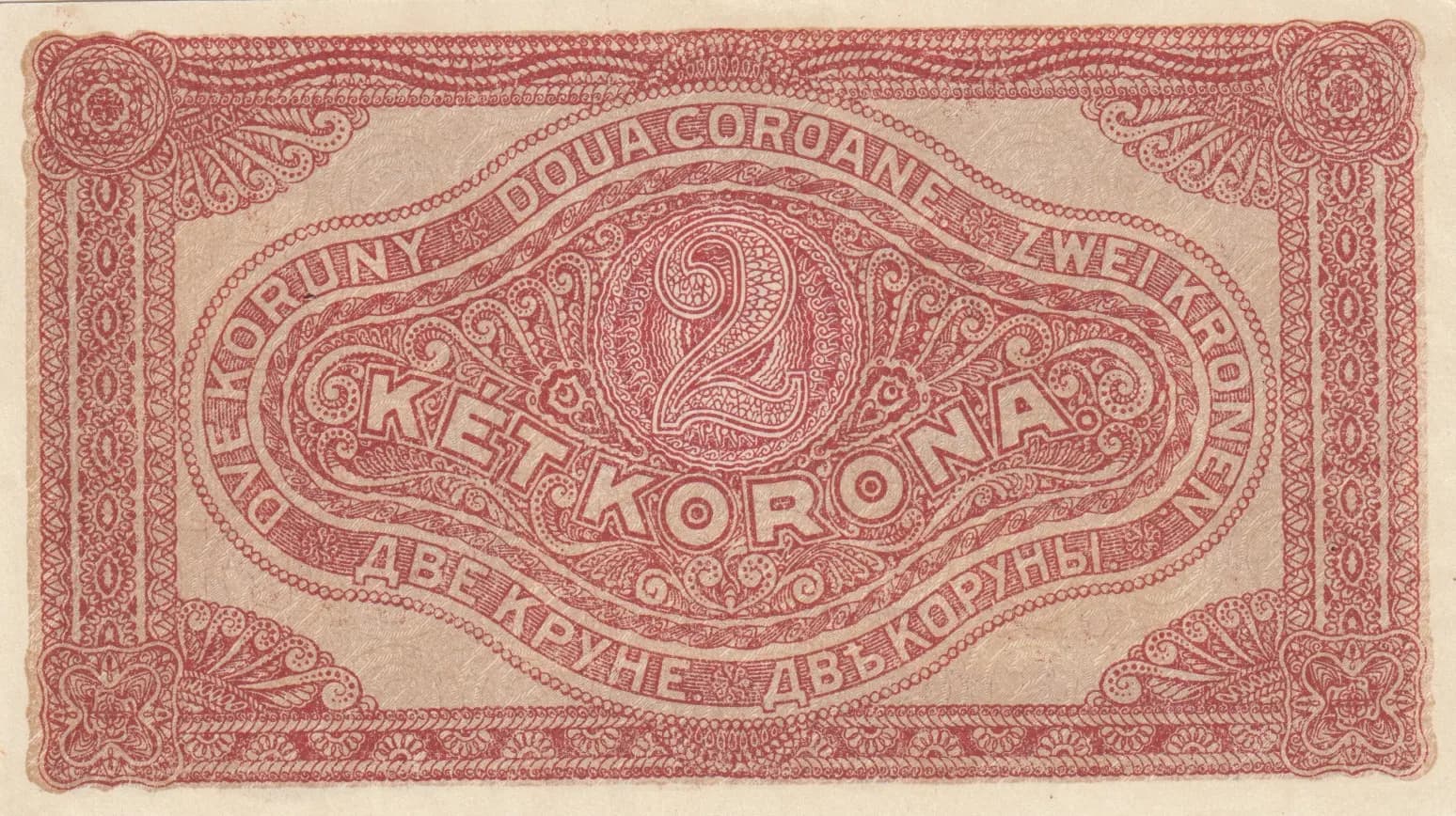
An elegant Hungarian 2 Korona banknote from January 1, 1920, issued by the Pénzügyminiszterium (Ministry of Finance) during the post-WWI reconstruction period. Graded AU, this note displays exceptional preservation with crisp engraving throughout, ornate Art Nouveau-influenced decorative borders, and vibrant red/burgundy coloring on cream stock. The front features Hungary's coat of arms alongside a classical allegorical female figure representing national virtues, while the reverse showcases elaborate floral and scrollwork ornamentation centered on the denomination numeral.
Common. The 2 Korona denomination from this 1920 issue was produced in substantial quantities as part of the currency reform following the dissolution of the Austro-Hungarian monetary union. No significant print run restrictions, recall orders, or variety issues are documented for Pick 58(1) that would elevate it to scarce or rare status. The AU condition grade noted here represents careful preservation by a collector, but the note itself remains readily available in the numismatic market.
This 2 Korona note represents Hungary's monetary reorganization in the immediate aftermath of World War I and the Austro-Hungarian Empire's collapse. Issued on January 1, 1920, under the new Hungarian Republic, the note's legal declaration that it is 'part of Hungary's dependent debt' reflects the nation's complex financial situation during the Treaty of Trianon period. The allegorical female figure and Hungarian coat of arms symbolize the sovereignty and stability the new republic sought to project despite significant territorial losses and economic challenges.
The front of this 2 Korona note presents a balanced compositional design typical of early 20th-century Hungarian currency. On the left side is the Hungarian coat of arms featuring a shield with horizontal stripes and a cross, symbolizing national sovereignty. The right side displays an allegorical female figure in classical Greco-Roman dress, representing Liberty, Justice, or National Virtue—a common motif in Republican-era coinage and currency. The central text 'KÉT KORONA' is surrounded by an extensive legal declaration explaining the note's status as legal tender. The reverse showcases an ornamental design centered on the numeral '2' surrounded by elaborate floral scrollwork, vine patterns, and geometric lattice work executed in fine engraving. The entire note is framed by an intricate lace-like border of repeating decorative elements, creating a sophisticated Art Nouveau aesthetic.
{"front":{"denomination":"KÉT KORONA (Two Korona)","legalDeclaration":"EZ AZ ÁLLAMJEGY A MELY MAGYARORSZÁG FÜGGŐ ADÓSSÁGÁNAK RÉSZÉ A TÖRVÉNY HATÁROZATAIHOZ KÉPEST MINDENKI ÁLTAL VALAMINT MINDEN KÖZPÉNZTÁRNÁL FIZÉTÉSKÉP TELJES NÉVÉRTÉKBEN ELFOGADANDÓ. (This banknote, which is part of Hungary's dependent debt, according to law provisions, shall be accepted by everyone and in all public treasuries at full face value as payment.)","date":"BUDAPEST, 1920. JANUÁR HÓ 1-ÉN. (Budapest, January 1, 1920)","authority":"PÉNZÜGYMINISZTER (Minister of Finance)","counterfeiting":"AZ ÁLLAMJEGYEK UTÁNZÁSA A TÖRVÉNY SZERINT BÜNTETTETIK. (Counterfeiting of banknotes is punishable by law.)","serialNumber":"2a a 039","referenceNumber":"474.316"},"back":{"denomination":"KÉT KORONA (Two Korona)","currency":"A MAGYAR KORONA (The Hungarian Korona)","status":"TÖRVÉNYI EREJŰ FIZETÉSI ESZKÖZ (Legal tender by law)"}}
Intaglio engraving (recess printing) executed with fine line work and detailed geometric ornamentation. The technical execution—visible in the crisp definition of decorative borders, the complex lattice patterns, and the refined portrayal of the allegorical figure—indicates production by a skilled security printer. The Hungarian banknotes of this period were typically produced by the Banknote Printing Works (Állami Nyomda) or contracted European security printers. The multi-color effect (red and cream) was achieved through sequential passes in the engraving press.
This is cataloged as Pick P-58(1), indicating it is the primary variety of the 1920 2 Korona issue. The serial number visible (2a a 039) and reference number (474.316) suggest this is from the standard production run. Variations in this issue may exist related to signature combinations, printer marks, or subtle design differences between printing sessions, but without comparison to documented varieties in specialized Hungarian catalogs, the specific variety designation beyond P-58(1) cannot be definitively established from the images alone.