2 korona 1920
About This Note
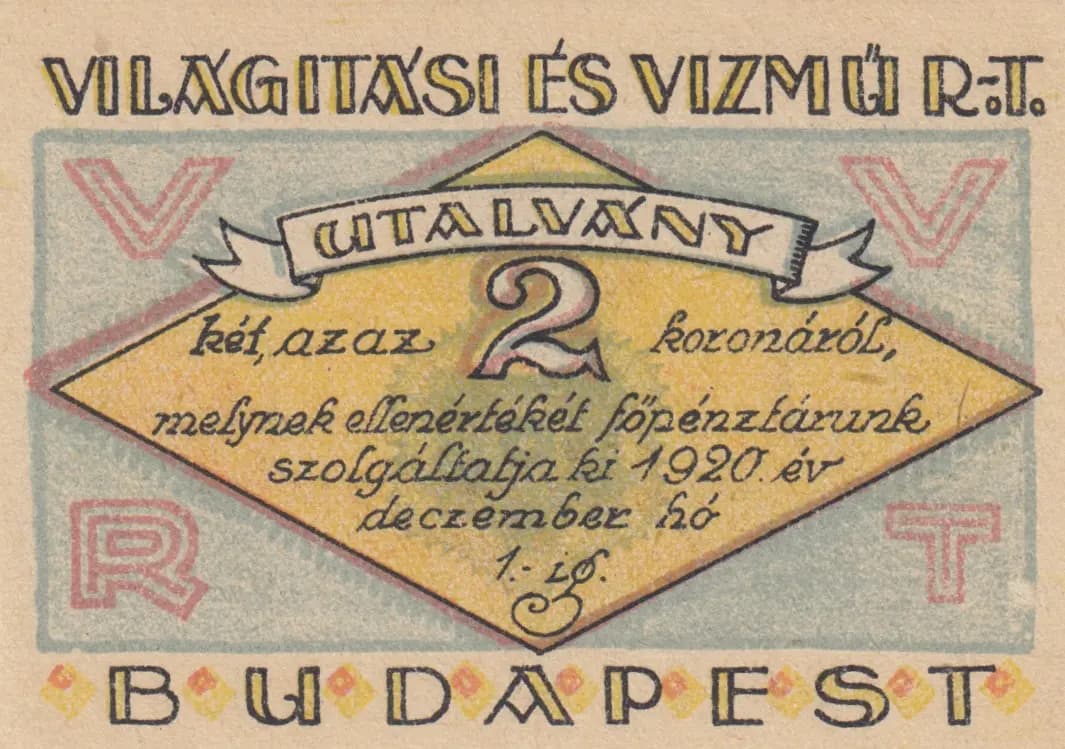
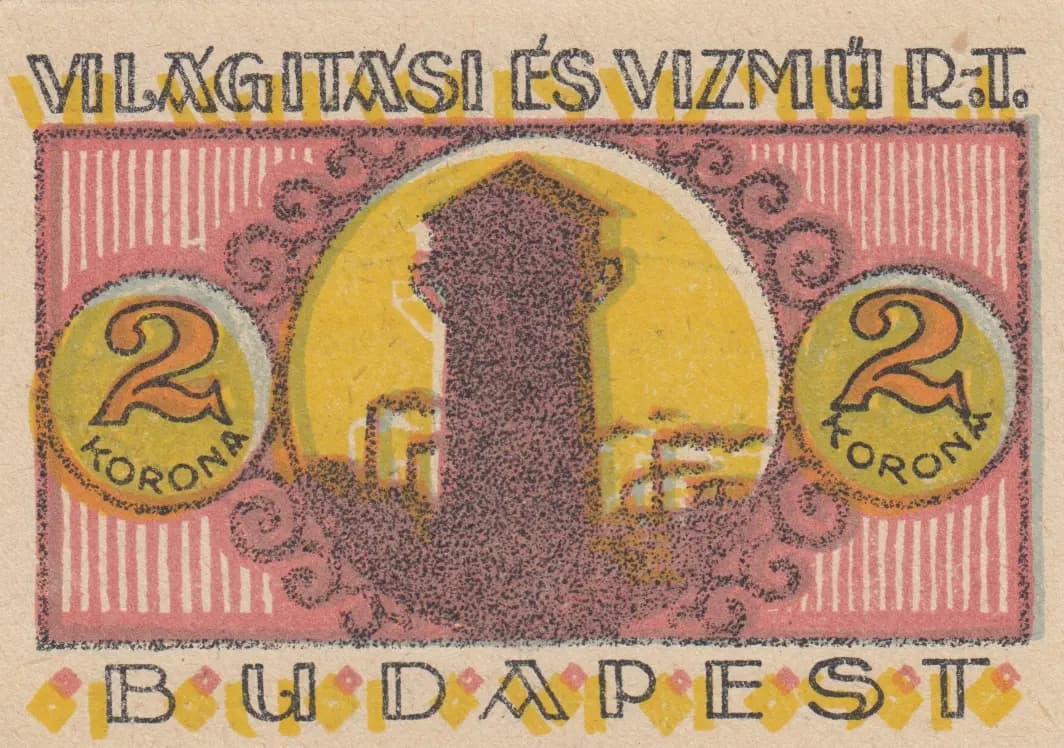
This is a 1920 Hungarian 2 korona emergency issue from the Világitási és Vizmü R.T. (Lighting and Water Works Company) of Budapest, an unlisted Pick catalog number. The front features an ornamental diamond-shaped cartouche in golden yellow against a beige background with red X-pattern corner designs, while the reverse displays a distinctive bell tower or church tower silhouette in dark brown against a golden oval cartouche with flanking denomination medallions. The note exhibits excellent AU condition on the obverse with minimal wear, though the reverse shows age-related foxing and staining consistent with early 20th-century paper stock.
Scarce. This note is an unlisted Pick number issued by a private utility company during an extremely short window (redeemable only until December 1, 1920), meaning it had a very limited circulation lifespan and likely small print run. Private company emergency notes from this period in Hungary were subject to rapid withdrawal and destruction once the redemption deadline passed. The AU condition of the obverse and the fact that examples survive suggest modest circulation before collection, but the scarcity of documented examples and absence from standard catalogs indicates this is not a common note. Most emergency currency notes from post-WWI Hungary were extensively circulated or destroyed, making surviving examples in this condition scarce rather than common.
This note was issued during the economically turbulent immediate post-World War I period in Hungary, when the Austro-Hungarian Empire had recently collapsed and currency was unstable. The Világitási és Vizmü R.T., a Budapest utility company, issued this 2 korona note as emergency currency with redemption guaranteed only until December 1, 1920, reflecting the temporary nature of private company-issued banknotes during the hyperinflationary crisis of 1920-1924. The bell tower depicted on the reverse likely represents an iconic Budapest landmark, connecting the note's imagery to local civic pride during this period of national transition.
The banknote features distinctly Art Nouveau-influenced ornamental design typical of early 20th-century Hungarian currency. The obverse displays a prominent diamond-shaped cartouche with rounded edges in golden yellow, containing the issuer's name and redemption details, framed by decorative ribbon banners and surrounded by ornamental scrollwork. Red X-shaped patterns in the four corners and decorative diamond separators frame the cityname 'BUDAPEST' at the base. The reverse is dominated by a bell tower or church tower silhouette—likely representing a notable Budapest ecclesiastical structure—rendered in dark brown or maroon against a golden yellow oval background. Two circular medallions with the denomination '2 korona' flank the central tower, set against a pink or rose background with vertical striping. The overall design emphasizes local identity and corporate branding rather than state authority, reflecting this note's origin as emergency currency from a private utility company.
FRONT: 'VILÁGITÁSI ÉS VIZMÜ R:T.' (Lighting and Water Works Company Limited); 'két azaz 2 koronáról,' (two namely 2 crowns); 'melynek ellenértékét függénzlárunk szolgáltatája ki 1920.év december hó 1.- ig.' (the countervalue of which our branch office provides until December 1st, 1920); 'BUDAPEST' (Budapest). REVERSE: 'VILÁGITÁSI ÉS VIZMÜ R:T.' (Lighting and Water Works Company); '2 korona' (2 crowns) [repeated in two circular medallions]; 'BUDAPEST' (Budapest).
Based on the observed visual characteristics—the soft color palette, ornamental detail, and the quality of line work visible in the scrollwork and cartouche design—this note was likely produced using multi-color letterpress or stone lithography printing, standard techniques for Hungarian banknotes of 1920. The precise registration of the color separations (beige/tan, golden yellow, red, pink, and black) and the decorative quality suggest lithographic printing, possibly produced by a Budapest-based security printer, though the specific printer is not documented in available Pick catalog references for this unlisted issue.
No signature varieties, serial numbers, or dated overprints are noted in the visual analysis. The note's text specifies December 1, 1920 as the redemption deadline, which is intrinsic to the design rather than a handwritten date. As this is an unlisted Pick catalog issue with no standard cataloging, no recognized varieties have been formally documented. Any variations would likely relate to minor differences in the ornamental design execution or color shade variations typical of period lithographic printing, which would require comparative examination of multiple surviving examples to establish.