1000 pengö 1945
Market Prices
16 salesAbout This Note
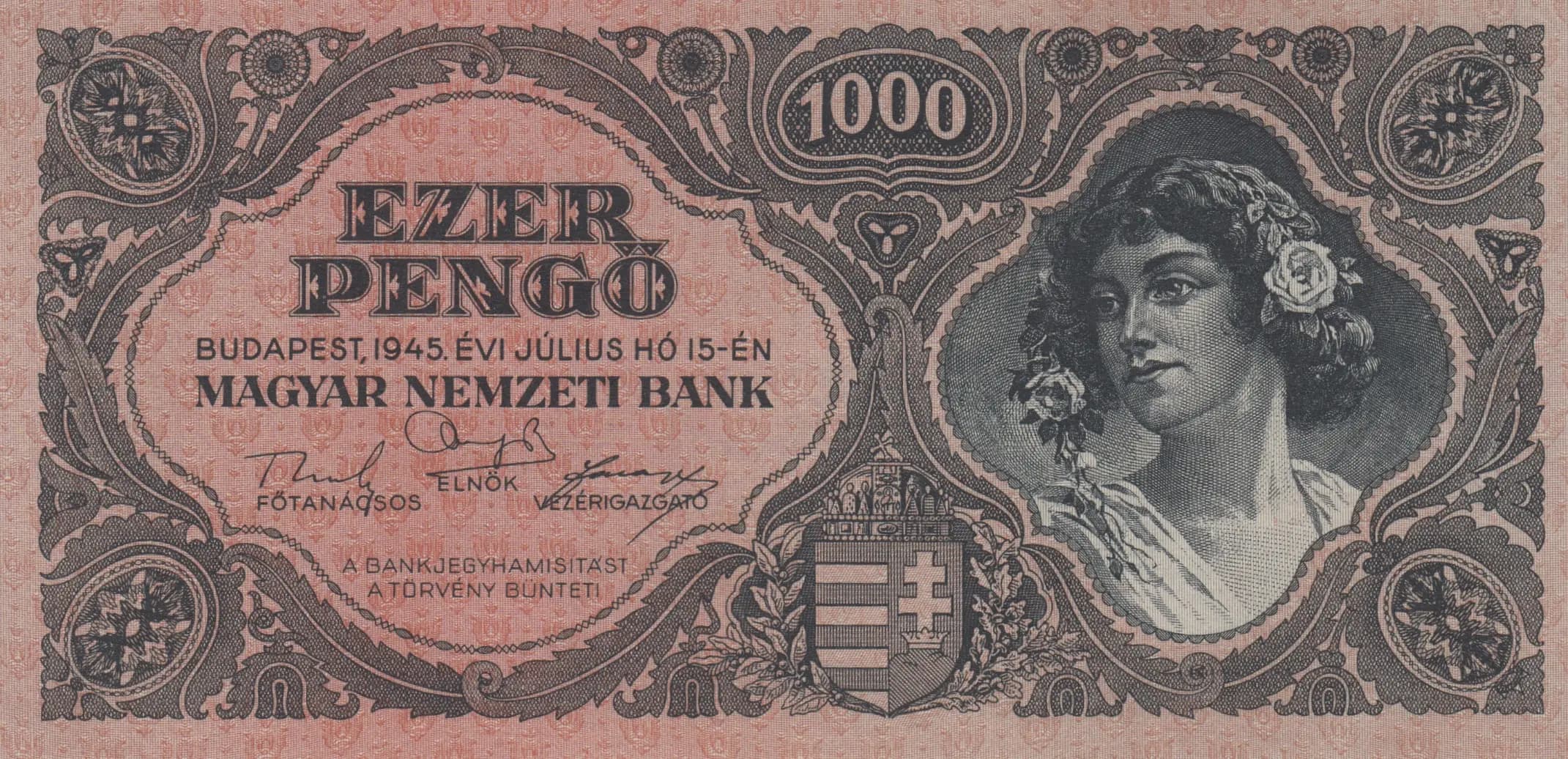
This 1000 pengö note from July 15, 1945, presents an exceptional example of Hungarian interwar currency in AU condition. The obverse features an elegantly rendered portrait of a woman wearing flowers, rendered in fine intaglio against a pink/mauve background with dark gray-black printing. The note exhibits sharp detail throughout with no visible circulation wear, clean margins, and excellent preservation of the intricate decorative borders and security printing.
Common. The eBay market data provided shows consistent sales across multiple condition grades ranging from $0.99 to $4.30 for ungraded circulated examples, with even PMG-graded specimens (PMG 65-66) selling in the $17.50-$95.63 range. The 2016 catalog value for UNC condition is listed at $4.00. These price points and transaction frequency indicate this is a widely available note in the collector market, with substantial print runs having been issued. The denomination and 1945 issue date do not represent a scarce variety.
Issued by the Magyar Nemzeti Bank on July 15, 1945, this note represents Hungarian currency during the final months of World War II and the immediate postwar period. The Hungarian coat of arms visible on the obverse reflects national sovereignty during a period of significant political and economic transition, as Hungary moved from German occupation toward Soviet influence. The denomination and design aesthetic are typical of the pengö currency era, which would be subject to dramatic devaluation in the hyperinflation that followed in 1946.
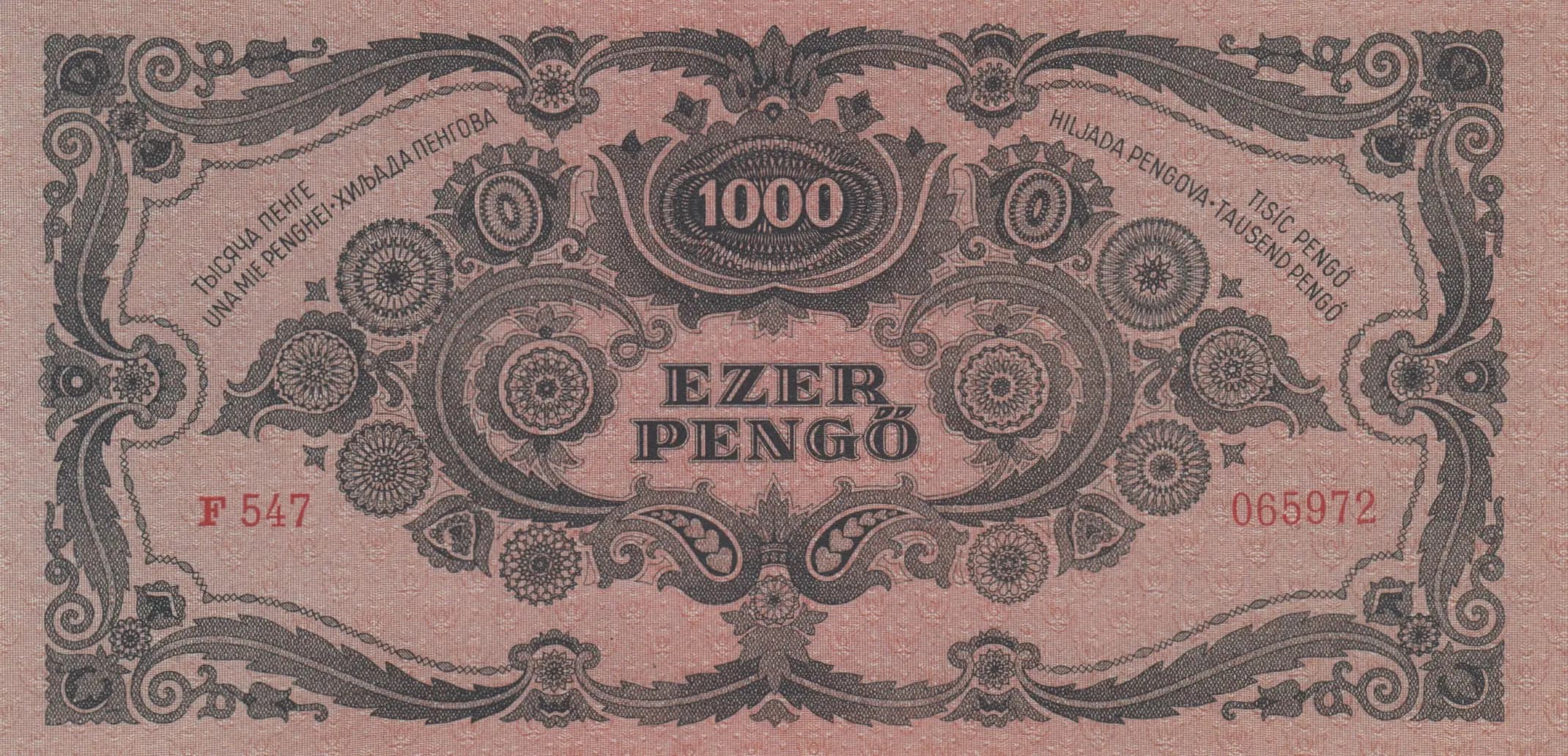
The obverse displays an ornately bordered design with the Hungarian coat of arms (featuring horizontal stripes and cross symbols with crown) positioned in the lower center. A woman's portrait in classical style, facing left with flowers adorning her hair, occupies an oval frame on the right side of the note. The design incorporates elaborate floral rosettes in the corners and extensive ornamental scrollwork and geometric patterns throughout. The reverse presents a fully symmetrical decorative composition with sunburst/flower patterns, repeated floral medallions, and elaborate geometric borders framing a central oval containing the denomination. Red serial numbers appear at the bottom corners of the reverse. The overall design reflects the Art Deco and classical artistic influences common in Central European currency of this period.
FRONT SIDE: 'EZER PENGŐ' (One Thousand Pengö) / '1000' (denomination) / 'BUDAPEST, 1945. ÉVI JÚLIUS HÓ 15-ÉN' (Budapest, July 15, 1945) / 'MAGYAR NEMZETI BANK' (Hungarian National Bank) / 'FŐTANÁCSOS' (Chief Advisor) / 'ELNÖK' (President) / 'VEZÉRIGAZGATÓ' (Director General) / 'A BANKJEGYHAMISÍTÁST A TÖRVÉNY BÜNTETÍ' (Counterfeiting banknotes is punished by law). BACK SIDE: '1000' (denomination) / 'EZER PENGŐ' (One Thousand Pengö) / 'HILDA PENGŐ-ISC PENGŐ-TAUSEND PENGÖ' (Thousand Pengö in Hungarian, German, and other languages) / Serial number prefix 'F 547' with serial number '065972' in red ink.
High-quality intaglio (steel engraving) printing is evident throughout, characterized by the fine line detail, sharp portrait rendering, and intricate decorative elements observable in both the obverse and reverse. The complexity of the border work and the precision of the security printing indicate production by a skilled security printer. The use of multiple ink colors (dark gray/black primary printing with red serial numbers) and the fine linework demonstrate the technical sophistication typical of Magyar Nemzeti Bank note production during this period.
Pick catalog identifies this as P-118a, indicating there are varieties within the 1000 pengö 1945 issue. The visual analysis notes '2 serial number varieties' on RealBanknotes.com reference. The observed specimen shows serial number prefix 'F 547' with serial number '065972' printed in red ink on the reverse. The absence of an adhesive stamp (as noted in the reference data) is consistent with this variety. To definitively identify the specific variety (P-118a versus other variants like P-118b or P-118c), additional documentation would be required, though the format and characteristics align with the documented P-118a cataloging.