1000 korona 1920
Market Prices
6 salesAbout This Note
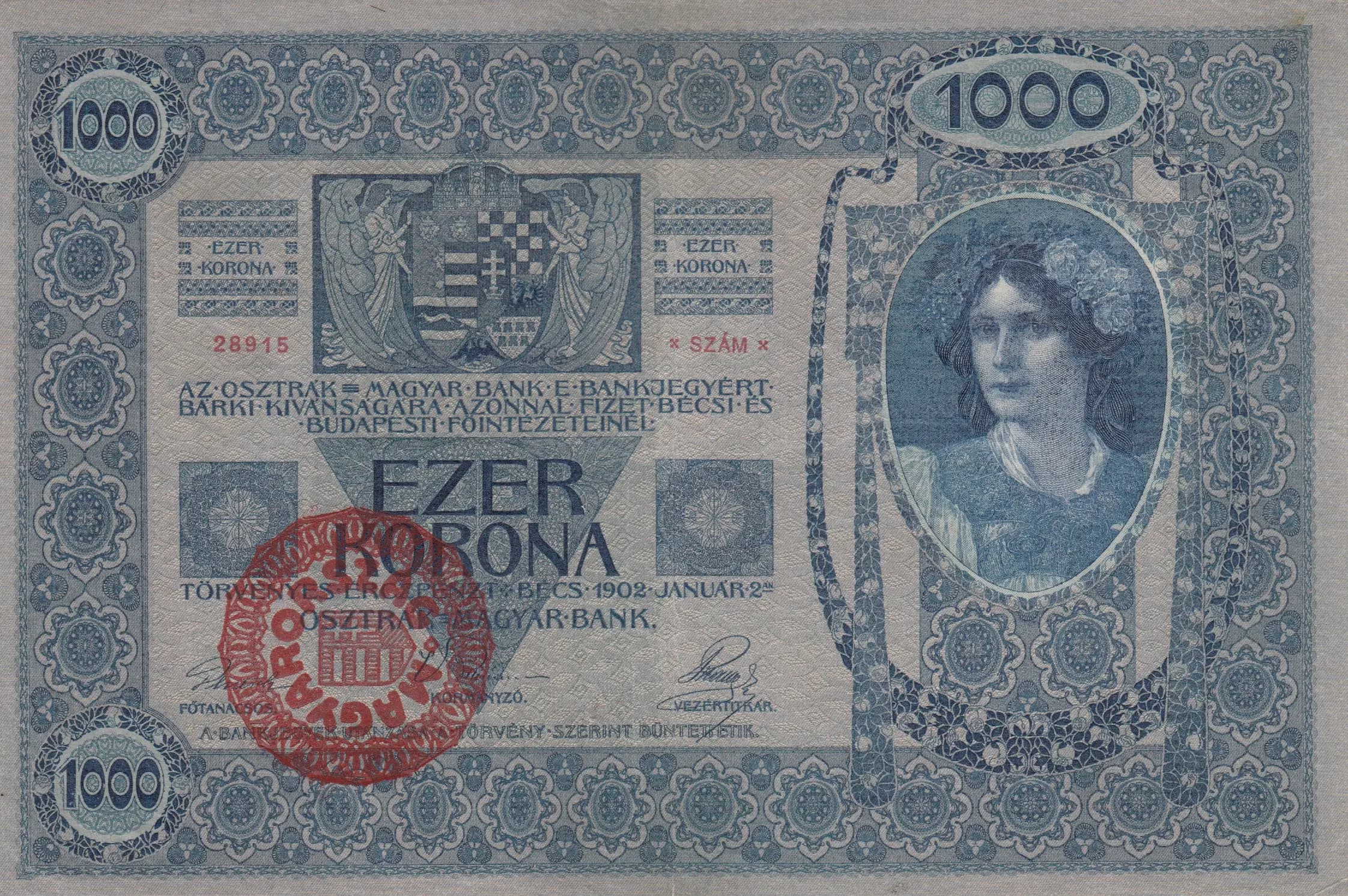
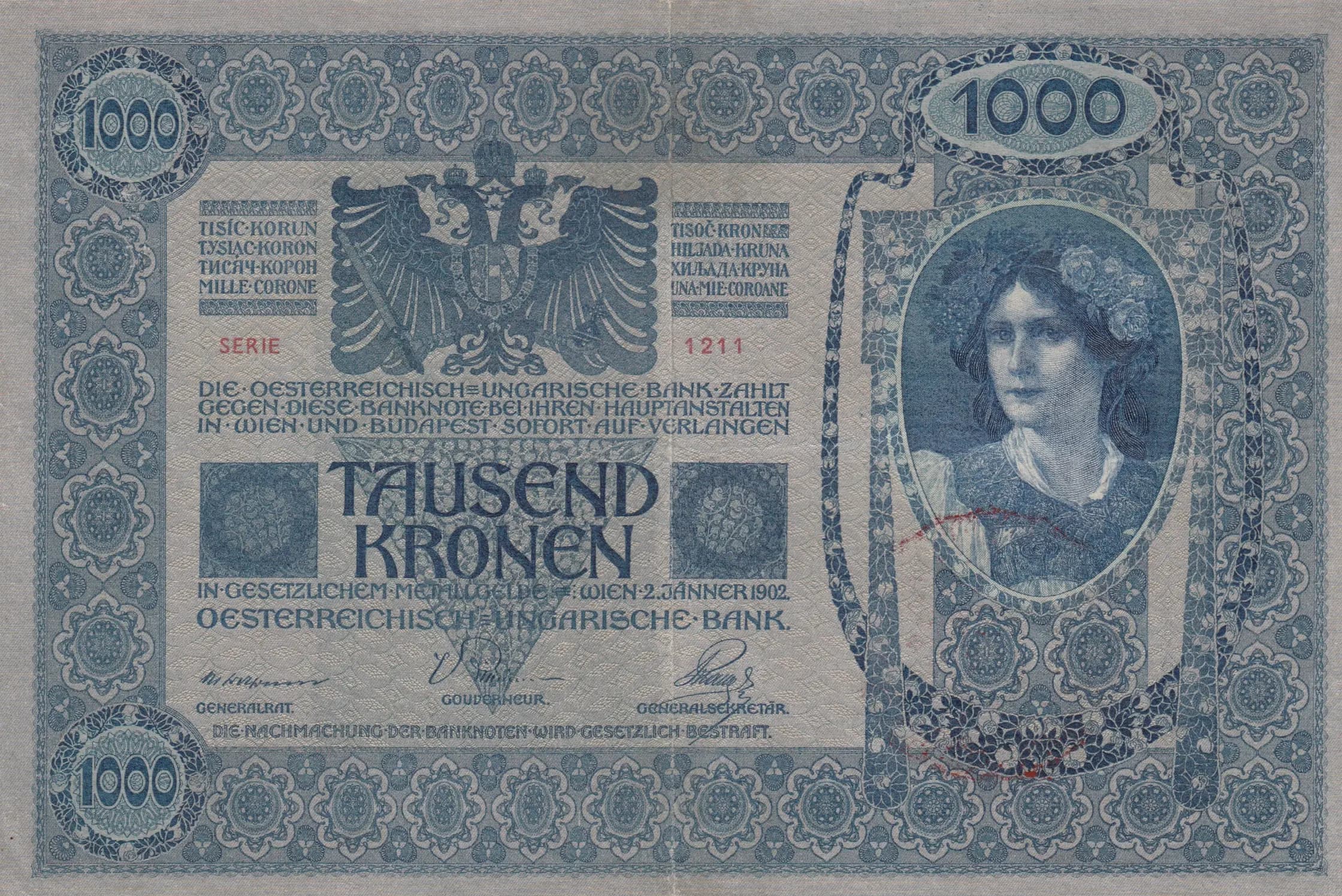
This 1000 Korona note from 1920 (Pick P-31) represents a transitional piece of Austro-Hungarian monetary history, issued during the empire's final years. The note displays characteristic ornamental design with repeated quatrefoil medallions, dual heraldic imagery, and bilingual German-Hungarian text reflecting the dual monarchy's structure. In VF condition, the note shows moderate circulation wear with visible creasing and folds, though the red seal and portrait remain clearly defined; the aged paper patina and circulated appearance are typical for notes over a century old from this era.
Common. The eBay price data provided shows consistent sales in the $2-$28 range depending on condition, with VF-grade examples catalogued at approximately $6 (2016 reference value). The note is not from a recalled series, was issued in significant quantities for regular circulation, and remains readily available in the secondary market. The visible circulation wear and moderate condition grade (VF) are consistent with common notes that saw regular use in post-WWI Austria-Hungary and beyond. No specific print-run scarcity data suggests this Pick number was a standard issue rather than a limited or emergency printing.
Issued by the Austro-Hungarian Bank (Osztrak-Magyar Bank) in 1920—technically after the empire's official dissolution in 1918—this note represents the final phase of Austro-Hungarian currency circulation. The dual heraldic designs (the coat of arms with supporters on the obverse and the double-headed imperial eagle on the reverse) symbolize the political union of Austria and Hungary that defined the empire. The bilingual inscriptions in German and Hungarian, along with additional text in Czech, Romanian, and Italian, reflected the multinational character of the empire and served as a practical solution for currency that circulated across diverse linguistic territories.
The 1000 Korona note features a sophisticated design reflecting the dual-monarchy structure of the Austro-Hungarian Empire. The obverse displays a woman's portrait (facing forward in profile within an oval decorative frame) on the right side, with the imperial coat of arms and supporting heraldic figures positioned on the left. The reverse presents the same female portrait but is dominated by a larger double-headed imperial eagle—the quintessential symbol of Austro-Hungarian sovereignty—rendered in elaborate heraldic detail. Both sides feature an intricate border pattern of repeated quatrefoil and floral medallions in the corners and margins, executed in blue-grey and dark blue tones against a beige/cream base. The denomination 'EZER KORONA' (Hungarian) and 'TAUSEND KRONEN' (German) appear prominently in the center of each side. A red circular seal or stamp is visible on the lower left of the obverse and near the portrait on the reverse, functioning as a validation mark. The comprehensive multilingual text (German, Hungarian, Czech, Romanian, Italian) arranged in formal blocks reflects the polyglot empire's administrative requirements. Serial number 28915 and series number 1211 are printed on the note.
FRONT SIDE: '1000' / 'EZER KORONA' (One Thousand Korona) / 'AZ OSZTRÁK-MAGYAR BANK ÉS BANKJEGYÉRT BÁRKI NYÚLHAT ARRA AZONNAL FIZET BECSI ÉS BUDAPESTI FŐINTEZETEINÉL' (For the Austro-Hungarian Bank and banknotes anyone may obtain immediate payment at its Vienna and Budapest main offices) / 'TÖRVÉNYES FROJÚ BECS 1902 JANUAR 2' (Legal tender Vienna January 2, 1902) / 'MAGYAR BANK' (Hungarian Bank) / Serial number 28915 / Signature lines for 'VEZER' (Director) and 'SZÁM' (Number). BACK SIDE: '1000' / 'TAUSEND KRONEN' (One Thousand Crowns) / 'TISICKORUN TISIC-KORUN TISIC-KORON MILLE CORONE' (One thousand crowns in Czech, Hungarian, and Latin) / 'DIE OESTERREICHISCHE-UNGARISCHE BANK ZAHLT GEGENDIESES BANKNOT BEI IHREN HAUPTINSTITUTEN IN WIEN UND BUDAPEST SOFORT AUF VERLANGEN' (The Austro-Hungarian Bank pays against this banknote at its main offices in Vienna and Budapest on demand) / 'IN GESETZLICHEM GEWICHTE WIEN 2 JÄNNER 1902' (In legal weight Vienna January 2, 1902) / 'OESTERREICHISCHE-UNGARISCHE BANK' (Austro-Hungarian Bank) / 'DIE NACHMASHUNUNG DER BANKNOTEN WIRD GESETZLICH BESTRAFT' (Counterfeiting of banknotes is punishable by law) / Series designation with number 1211 / Signature lines for 'GENERALRAT' (General Council), 'GOUVERNEUR' (Governor), and 'GENERALSEKRETÄR' (General Secretary).
This note was produced using intaglio (engraved) printing, evidenced by the fine line work visible in the heraldic designs, border patterns, and portrait rendering. The sharp detail in the quatrefoil medallions, the crisp lettering, and the dimensional quality of the central imagery are characteristic of intaglio printing, the standard security printing method for Austro-Hungarian currency of this period. The Austro-Hungarian Bank's primary printing facilities in Vienna and Budapest would have produced this note using multi-plate engraved dies, with the dual heraldic and portrait elements carefully registered across obverse and reverse.
The observed note shows serial number 28915 and series number 1211. For this Pick number (P-31, 1000 Korona 1920), the primary variety factors include signature combinations (positions for Director/VEZER on obverse and Governor/GOUVERNEUR, General Secretary/GENERALSEKRETÄR, and General Council/GENERALRAT on reverse) and series numbering. The date inscription consistently shows '2 JANUAR 1902' / '2 JÄNNER 1902' as the original authorization date, though this note was issued in 1920. No major varieties (such as overprints, color variants, or emergency printings) are evident in this specimen. Collectors should note that signature varieties and series numbers can vary; the specific combination present on any given note may affect value marginally among specialists.