100 pengö 1943
Market Prices
About This Note
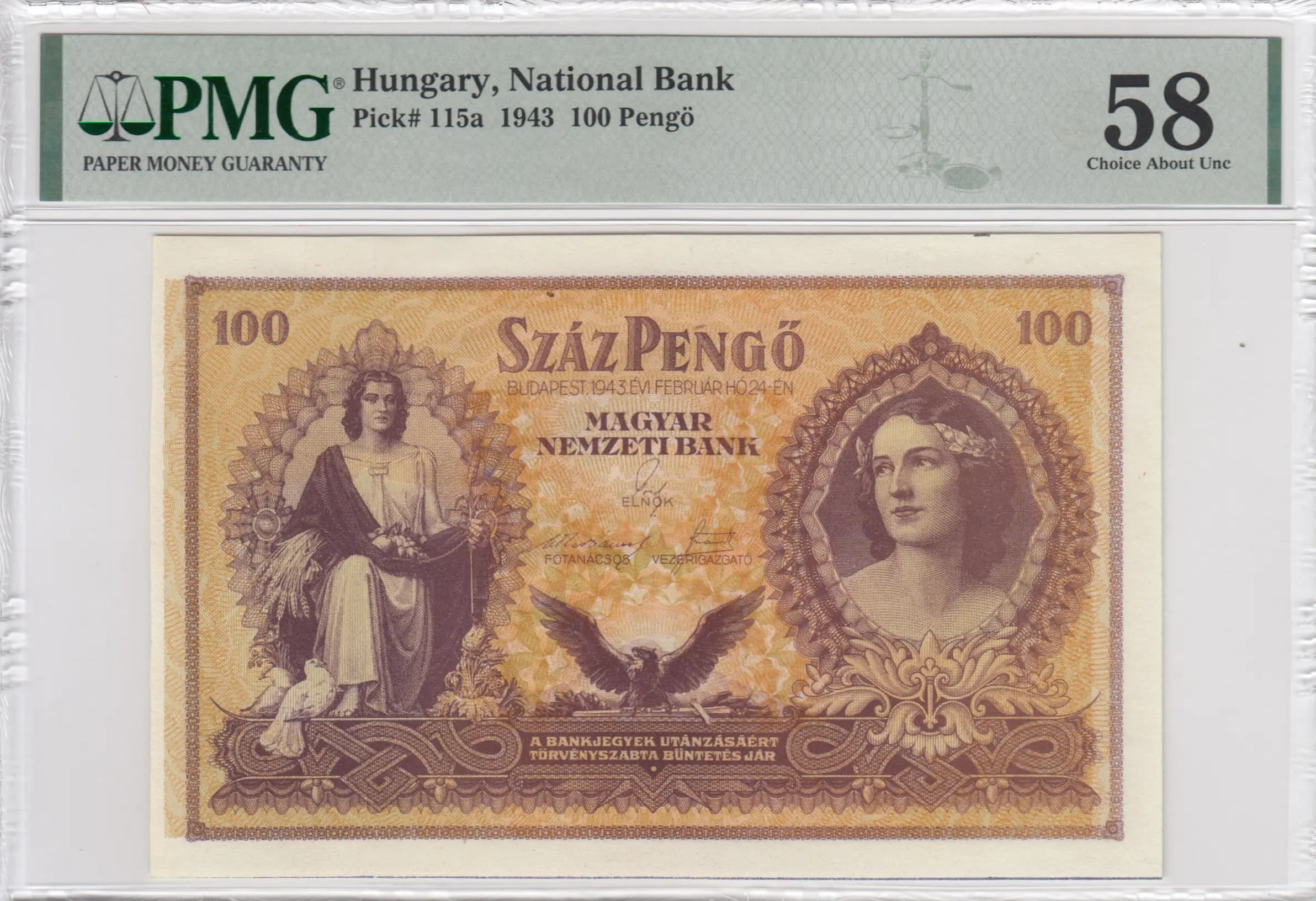
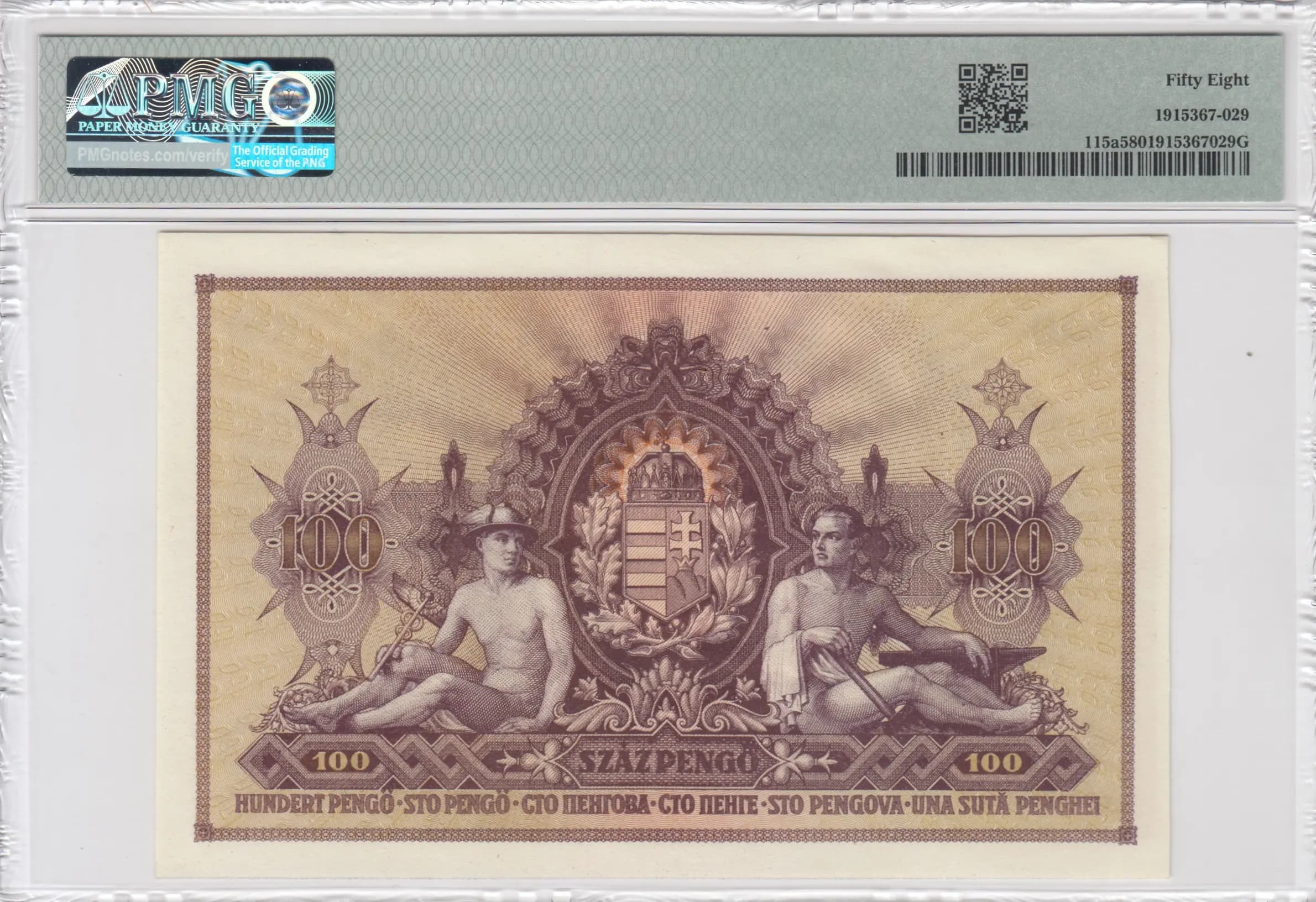
This is a PMG 58-graded Hungarian 100 Pengö note from February 24, 1943, presenting in exceptional near-mint condition with crisp intaglio printing and vibrant ochre-brown coloration. The note features classical allegorical imagery on both sides—a young man with fruits and doves paired with a laureled female portrait on the obverse, and symmetrically positioned male figures flanking the Hungarian coat of arms on the reverse. The excellent preservation and fine security printing details make this an attractive example for mid-war Hungarian currency collectors.
Common. The 1943 100 Pengö (P-115a) remains a common denomination in the numismatic market. Secondary market data from eBay shows numerous sales ranging from $5 to $225, with most uncirculated examples trading in the $50-90 range, indicating steady supply and collector demand without scarcity constraints. The note was issued in significant quantities by the Hungarian National Bank during 1943 and does not derive rarity from limited print runs, recall, or issuer dissolution. PMG population data shows this is a catalogued variant with established grading standards, further confirming regular availability in the collector market.
Issued during World War II under the Hungarian National Bank during the Horthy Regency period, this 100 Pengö note reflects Hungary's continued monetary operations in 1943 despite the nation's military alignment with Nazi Germany. The classical allegorical imagery—including figures associated with prosperity, agriculture, and national identity symbolized by the central coat of arms—represents Hungary's attempt to project stability and cultural continuity during a period of significant political and military upheaval. The multilingual denomination inscriptions on the reverse (Hungarian, German, Italian, Romanian, Croatian, and other languages of the region) reflect the diverse populations within Hungary's historical borders.
The obverse features a classical allegorical composition with a semi-nude young male figure on the left holding fruits and accompanied by doves, symbolizing abundance and peace, paired with a portrait of an idealized female figure on the right within a decorative oval frame, crowned with a laurel wreath representing wisdom and victory. The reverse displays a symmetrical design with two seated male allegorical figures—likely representing labor/industry and commerce or similar virtues—positioned to the left and right of a prominent Hungarian coat of arms at center, surrounded by radiating light effects and flanked by laurel wreaths. Both sides employ ornate decorative cartouches, guilloche border patterns, and classical architectural elements throughout, reflecting the neo-classical design aesthetic favored by interwar and wartime Hungarian currency design.
FRONT SIDE: '100' (numeric denomination), 'SZÁZ PENGŐ' (One Hundred Pengö), 'BUDAPEST, 1943 ÉVI FEBRUÁR HÓ 24-ÉN' (Budapest, February 24, 1943), 'MAGYAR NEMZETI BANK' (Hungarian National Bank), 'ELŐJOG' (Privilege/Right), 'FŐTANÁCSOS' (Chief Counselor), 'VEZÉRIGAZGATÓ' (Managing Director), 'A BANKJEGYEK UTÁNZÁSÁÉRT TÖRVÉNYSZABTA BÜNTETÉS JÁR' (Counterfeiting of banknotes carries statutory penalties). REVERSE SIDE: '100' (numeric denomination), 'SZÁZ PENGŐ' (One Hundred Pengö), Multilingual denomination inscription: 'HUNDERT PENGŐ' (German), 'STO PENGŐ' (Czech/Slovak/Russian), 'GIO DENHORA' (Romanian variant), 'GIO PENGE' (Serbian/Croatian variant), 'STO PENGOVA' (Slavic variant), 'UNA SUTA PENGHEI' (other regional language variant).
Intaglio printing (engraved steel plate printing), evidenced by the exceptionally fine line work, detailed guilloche patterns, and complex background texturing visible throughout both sides. The crisp detail preservation and dimensional quality of the security printing suggest professional manufacture by Hungary's official state security printer, characteristic of Magyar Nemzeti Bank issues of this period. No evidence of lithography or other supplementary techniques; pure intaglio construction throughout.
This specimen represents P-115a per Pick catalog, the standard 1943 100 Pengö issue with issue date of February 24, 1943. No visible overprints, special markings, or distinguishing serial number prefixes that would indicate a sub-variety are apparent in the images. The note appears to be from the regular production run of the 1943 issue. Specific signature combinations or serial number prefixes that might denote sub-varieties cannot be definitively identified from the visual analysis provided, though the 'FŐTANÁCSOS' and 'VEZÉRIGAZGATÓ' signature lines are standard for this issue type.