100 000 adopengö 1946
Market Prices
16 salesAbout This Note
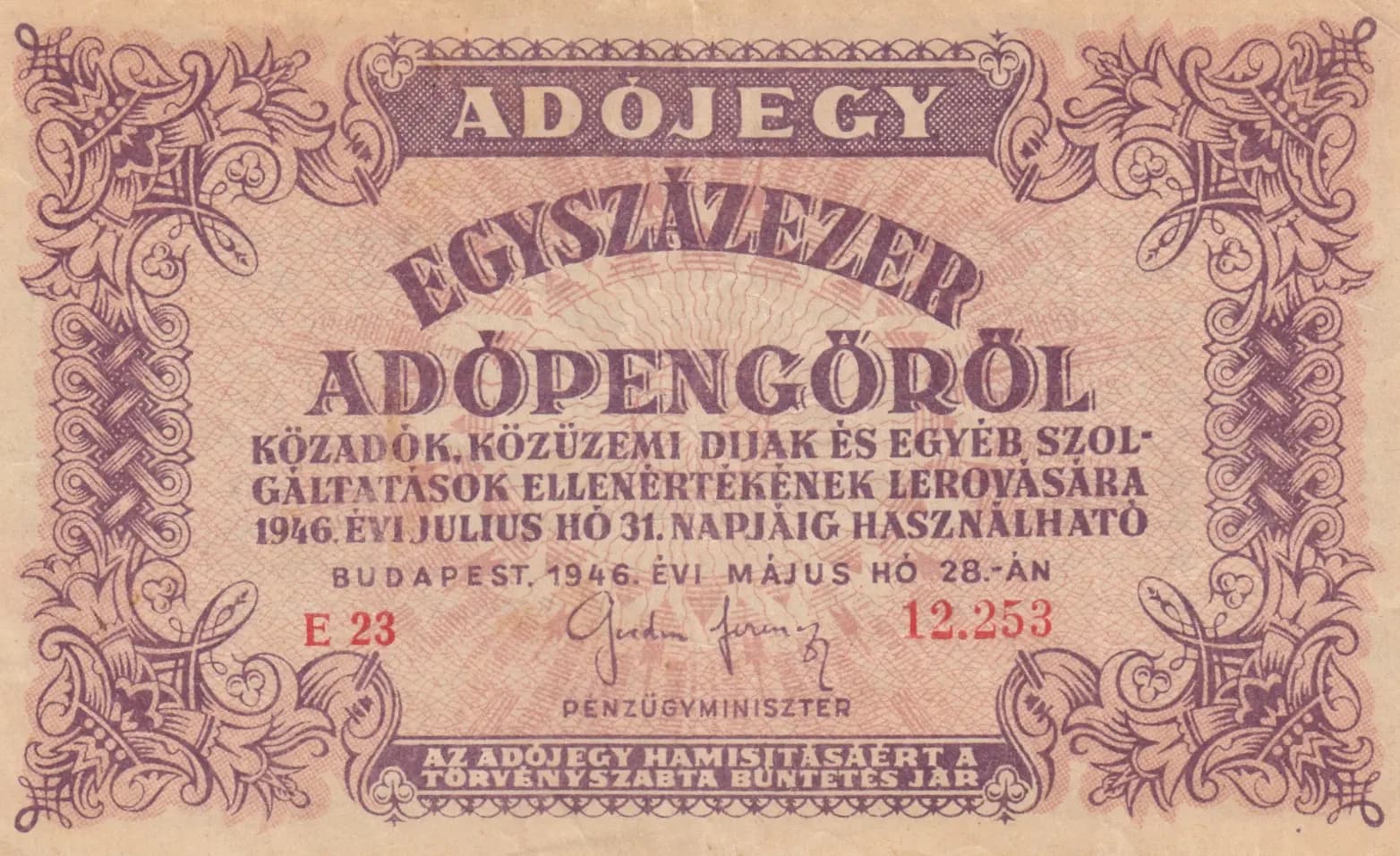
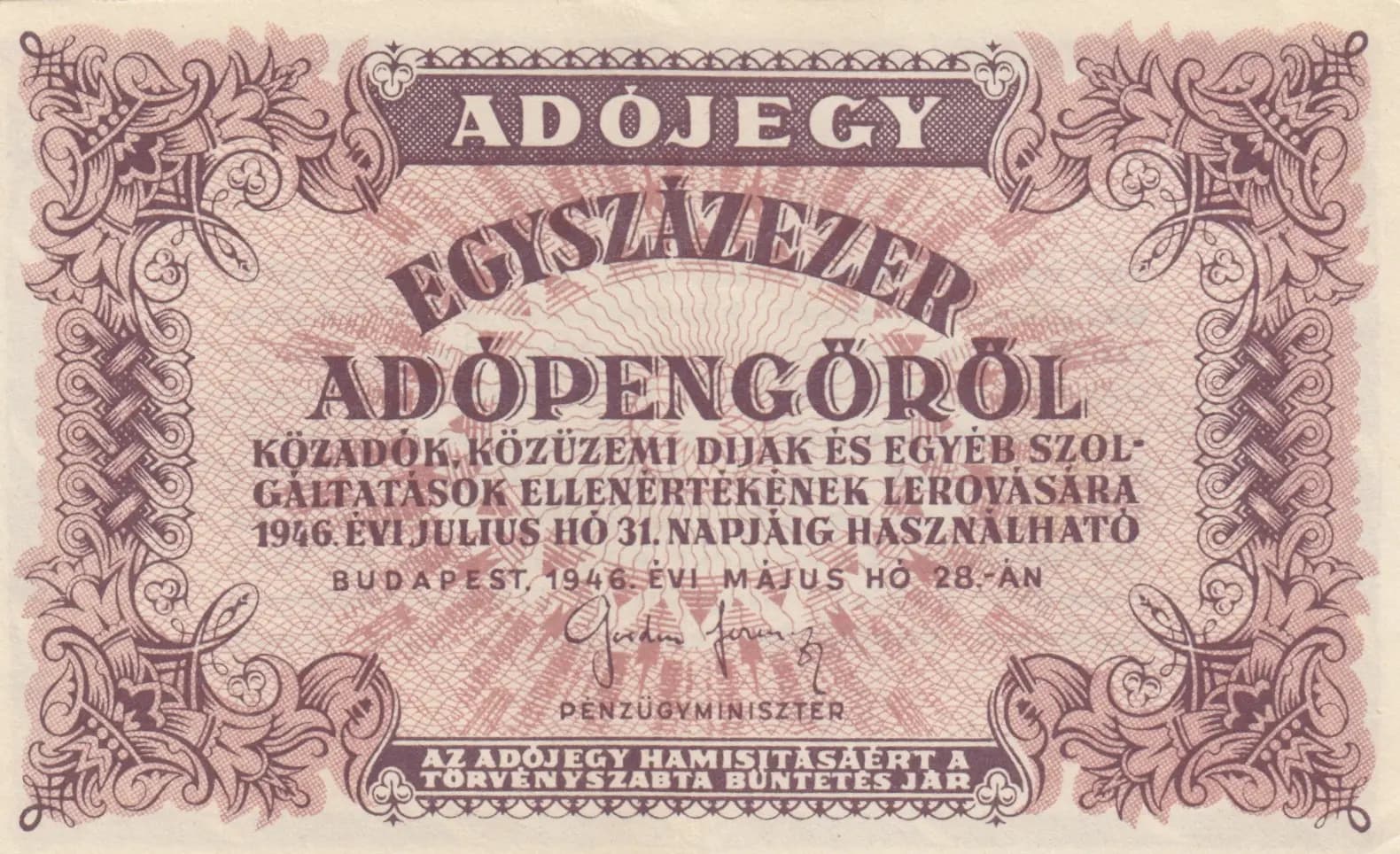
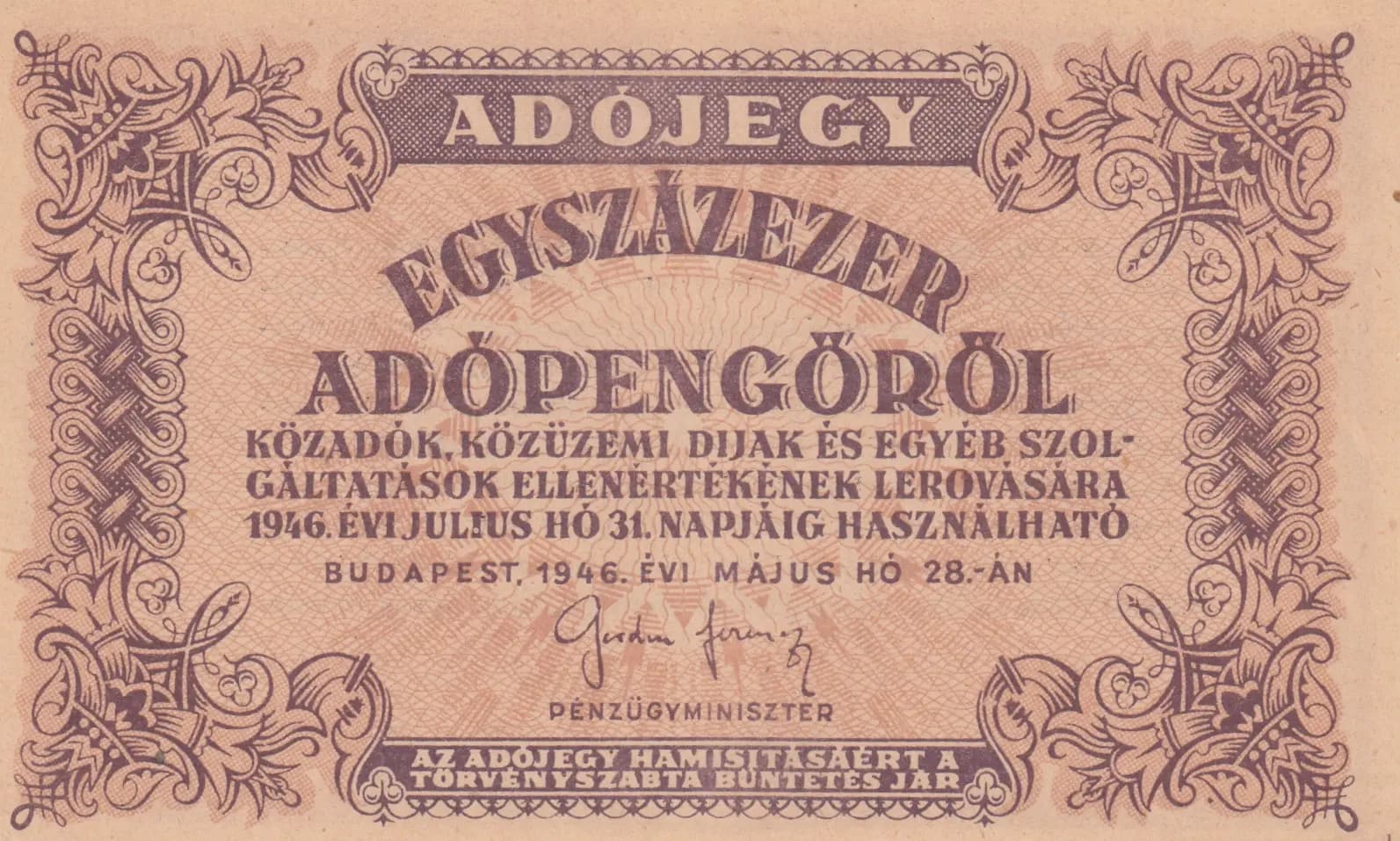
This 100,000 Adópengő tax stamp from May 28, 1946 represents a fascinating monetary emergency during Hungary's post-WWII hyperinflation crisis. The note displays the characteristic beige-tan coloring with purple-brown ornamental borders and scrollwork typical of the period, and despite its 77+ years of age shows only expected foxing and discoloration consistent with UNC grade. As a specialized tax payment voucher rather than circulating currency, this piece offers unique insight into Hungary's desperate fiscal measures during economic collapse.
Common. eBay market data shows consistent sales in the $1-$4 range across multiple condition grades (VF to AUNC) from 2012-2025, with catalog values at $6 for UNC. The regular circulation of examples in various conditions and stable, low market pricing indicates this was a widely printed tax instrument without supply constraints. The absence of serial numbers further suggests mass production for practical tax collection purposes rather than limited issuance.
Issued by the Hungarian Ministry of Finance (Pénzügyminiszterium) during the catastrophic hyperinflation of 1946, this adópengő (tax pengő) was a legally designated tax payment instrument authorized by decree 5.970/1946 M.E. The note's specific validity period until July 31, 1946, and its restriction to public taxes and utility payments reflect the government's attempt to stabilize currency and collect revenue during the pengo's complete devaluation. The ornate decorative design and prominent counterfeiting warnings underscore the state's efforts to maintain monetary control amid economic chaos.
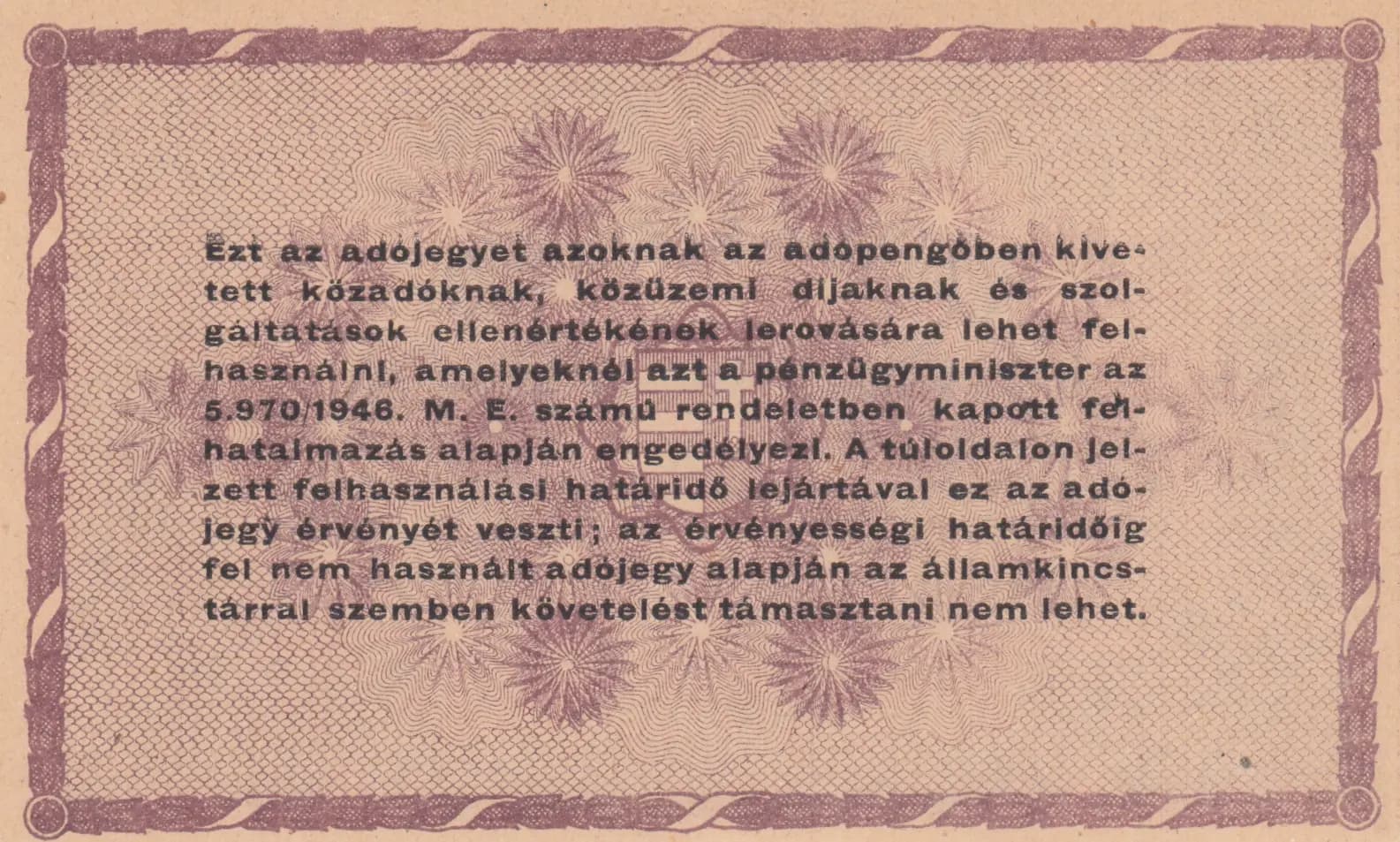
This tax stamp features an elegant, classical design with ornate floral and scrollwork borders framing all four corners in the Art Nouveau tradition. The obverse displays symmetrical decorative geometric patterns and interlaced scrollwork in purple-brown on a cream/beige underprint. The reverse side features a repeating fan or flower motif arranged symmetrically as background decoration, creating a sophisticated pattern behind the legal text. No portraits, landmarks, or heraldic arms are depicted despite the catalog reference to 'Arms' — the design is purely typographic and ornamental, befitting its function as a tax payment instrument. The typography is bold and legible, emphasizing the official nature of the document. The note lacks serial numbers, consistent with tax stamp production methodology.
FRONT SIDE: 'ADÓTECHV' (Tax Collection) banner at top. 'EGYSZÁZEZEZ ADÓPENGŐRŐL' (One Hundred Thousand Tax Pengő). Main text: 'KÖZADÓK, KÖZÜZEMI DÍJAK ÉS EGYÉB SZOLGÁLTATÁSOK ELLENÉRTÉKÉNEK LEROVASÁSÁRA' (For payment of public taxes, public utilities and other services). Validity: '1946.ÉVI JÚLIUS HÓ 31.NAPJÁIG HASZNÁLHATÓ' (Valid until July 31, 1946). Issue: 'BUDAPEST, 1946. ÉVI MÁJUS HÓ 28.-ÁN' (Budapest, May 28, 1946). Authority: 'PÉNZÜGYMINISTER' (Minister of Finance). Warning: 'AZ ADÓJECY HAMÍSÍTÁSA ÉRT A BÜNTETŐ TÖRVÉNYI BÜNTETÉS JÁR' (Counterfeiting tax stamps is punishable by law). REVERSE SIDE: 'Ezt az adójegyet azoknak az adópengőben kivetett közadóknak, közüzemi díjaknak és szolgáltatások ellenértékének lerovasására lehet felhasználni, amelyeknél azt a pénzügyminister az 5.970/1946. M. E. számú rendeletben kapott felhatalmazás alapján engedélyezil. A túloldalon jelzett felhaszálásl határidő lejártával ez az adójegy érvényét veszti; az érvényessegi határidőig fel nem használt adójegy alapján az államkincstárral szemben követelést támasztani nem lehet.' (This tax stamp can be used for payment of public taxes, public utility charges and services levied in adópengő as authorized by the Minister of Finance under decree 5.970/1946 M.E. Upon expiration of the validity period shown on the other side, this tax stamp loses validity; no claims against the state treasury can be made for unused stamps after the validity period.)
Letterpress printing on gray paper, utilizing traditional intaglio-style decorative borders and ornamental elements. The combination of bold display text with fine-line scrollwork suggests multiple passes or careful register alignment typical of official government printing facilities. The watermarked gray paper (as noted for P-144b variant) provided security against counterfeiting, with the watermark serving as an anti-fraud measure. Standard Hungarian state printing office production methods for the 1946 period.
This specimen is the P-144b variant, distinguished by the presence of a watermark in the gray paper stock. The PMG population report identifies two main varieties: P-144b (With Watermark) and P-144e (Without Watermark). The note lacks serial numbers, which is standard for this issue type. The signature visible in the lower left area is characteristic of the Minister of Finance authorization, typical of all examples from this May 28, 1946 issuance.