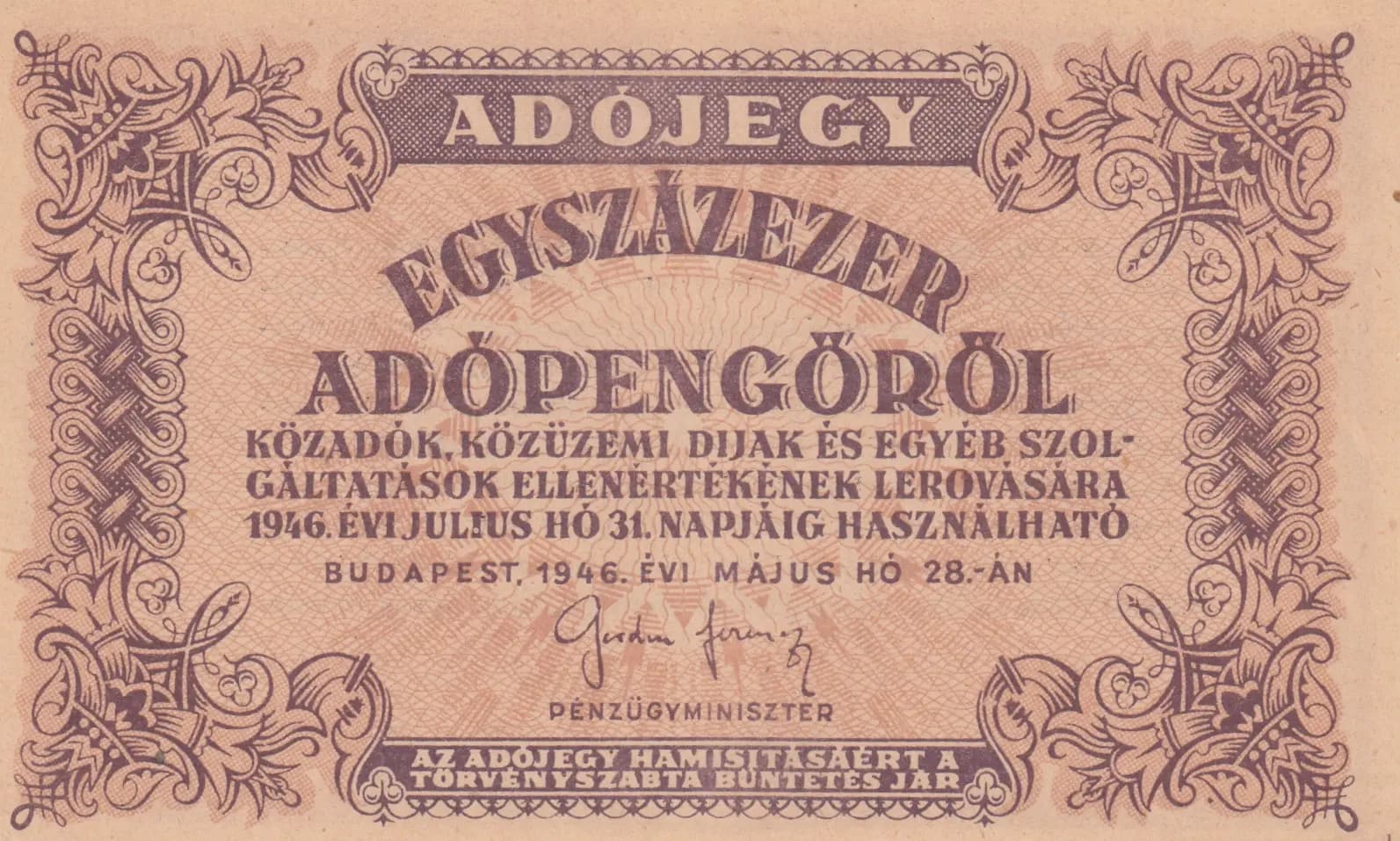
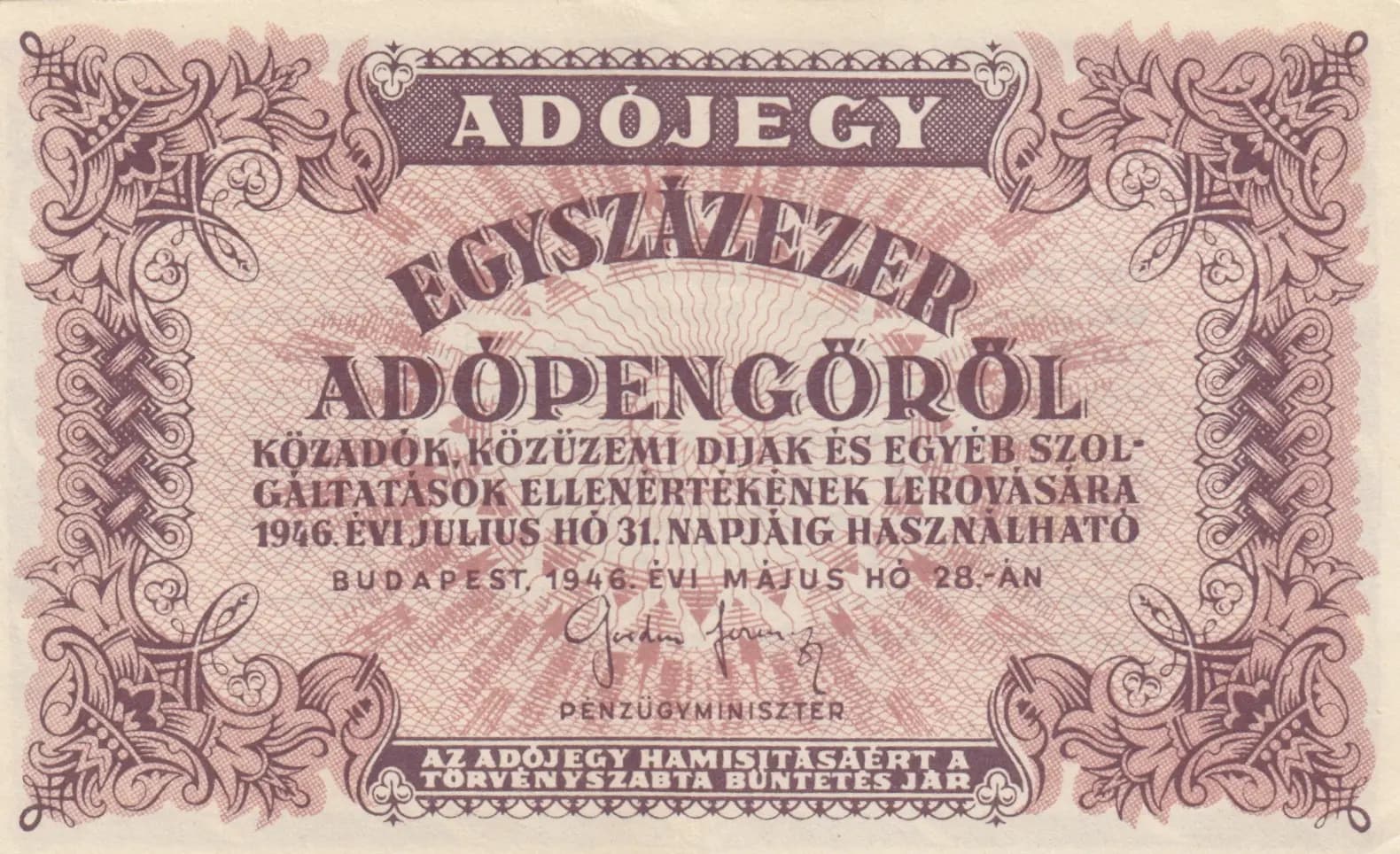
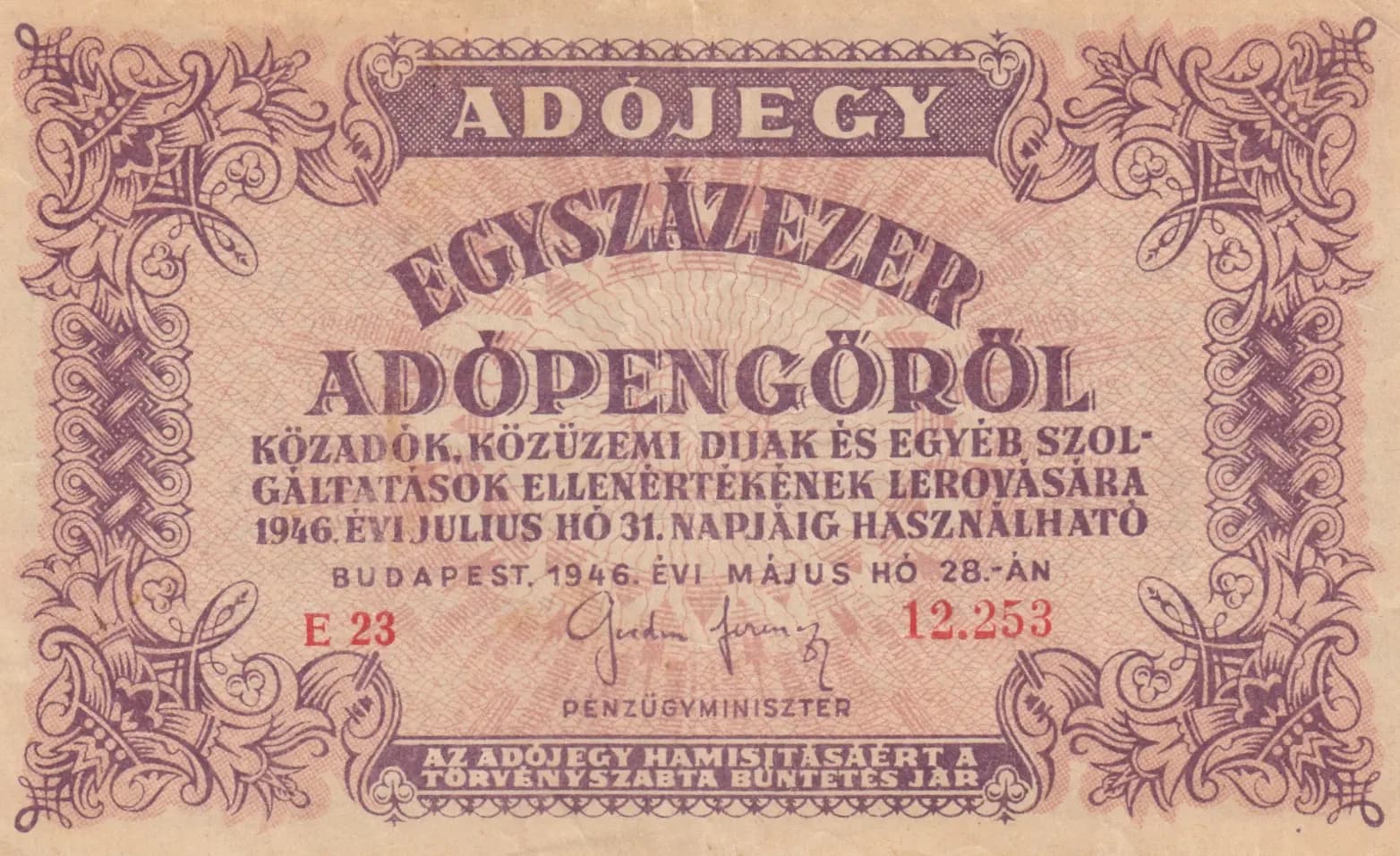
100 000 adopengö 1946
Market Prices
16 salesAbout This Note
This Hungarian 100,000 Adópengö tax receipt from May 28, 1946, is presented in VF condition with strong, clear printing throughout. The note features distinctive ornate decorative borders with scrollwork and floral patterns framing the central text, rendered in purple and tan colors with red accents. This is a fascinating example of Hungary's hyperinflationary currency crisis period, showcasing the government's use of tax receipts as emergency currency denominations.
Common. eBay market data shows consistent sales of this note in the $1-5 range across multiple condition grades (VF averaging $2-4), with numerous recorded transactions from 2010 through 2024. The 2016 catalog valuation of $3 for VF is consistent with observed market prices. The substantial print run required for a tax receipt currency during emergency economic conditions, combined with the low realized prices across a decade-plus of sales, confirms this as a commonly available note in the collector market.
The Adópengö (tax pengö) was an emergency currency instrument issued by the Hungarian Ministry of Finance during the severe hyperinflation of 1946, following World War II and the Soviet occupation. These notes were specifically authorized for payment of public taxes and utilities, reflecting the breakdown of normal monetary circulation and the government's desperate attempt to finance operations. The validity period limited to July 31, 1946, illustrates the temporary nature of these emergency measures during Hungary's economic stabilization period.
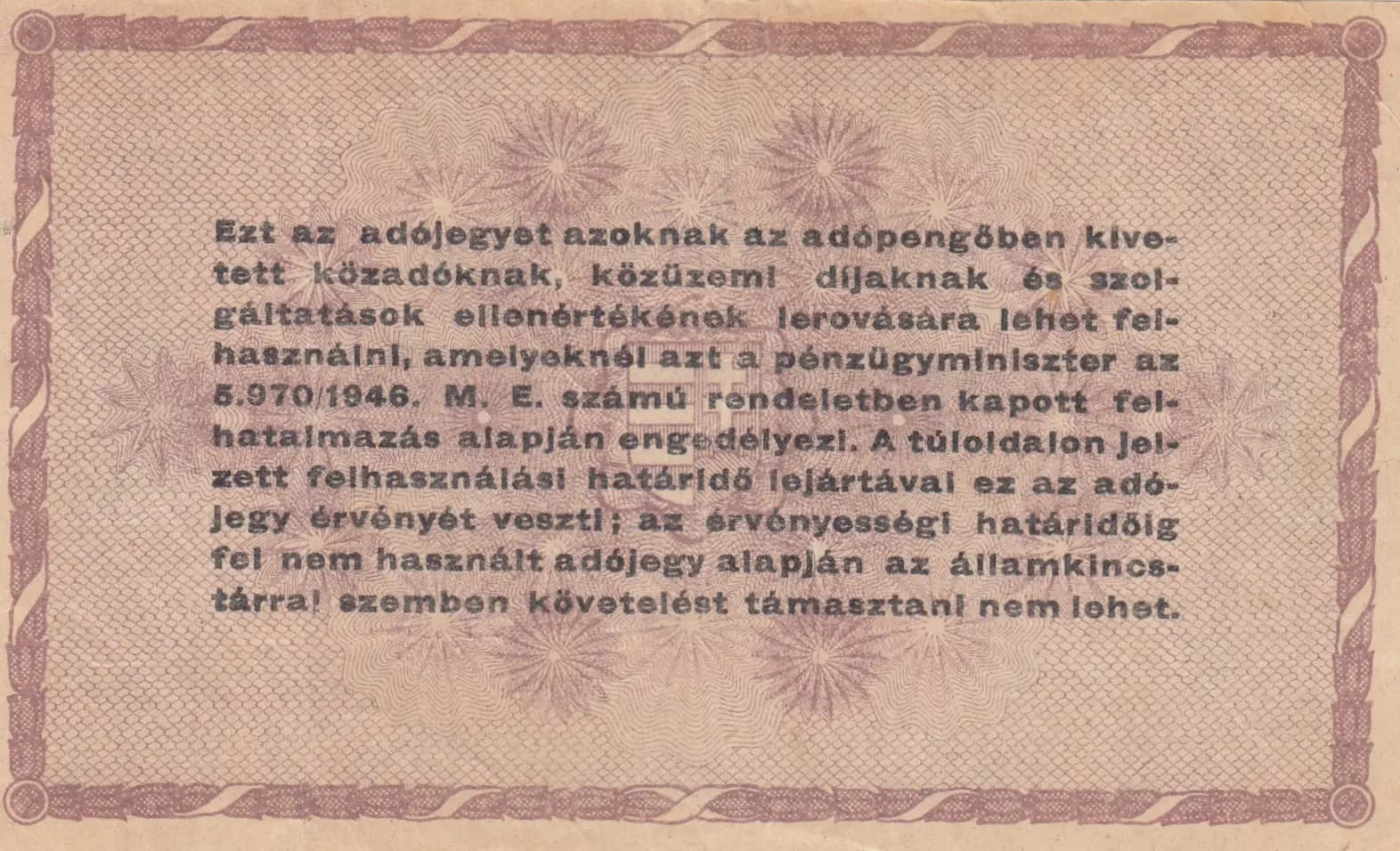
This is a specialized tax receipt note rather than a conventional banknote, featuring an entirely text-based design with no portraits or historical landmarks. The obverse is dominated by the prominent proclamation 'ADOJEGY' in a decorative banner at the top, with 'EGYSZÁZEZER' (100,000) rendered in large, curved lettering as the primary denomination indicator. Elaborate ornamental borders with scrollwork and floral vine patterns frame both the left and right margins, reflecting early 20th-century bureaucratic document aesthetics. The reverse displays a repeating sunburst or radiating star pattern as a background security element, with legal text centrally positioned explaining the note's authorized uses and validity terms. The color scheme of purple/lilac on a tan/beige underprint with red accents creates visual hierarchy while maintaining the appearance of official government documentation.
FRONT SIDE: ADOJEGY (Tax Receipt) - EGYSZÁZEZER (One Hundred Thousand) - ADOPENGÖRÖL (Regarding Tax Pengö) - KÖZADÓK, KÖZÜZEMI DIJAK ÉS EGYÉB SZOLGÁLTATÁSOK ELLENÉRTÉKÉNEK LEROVÁSÁRA (For payment of public taxes, utilities charges and other services) - 1946.ÉVI JÚLIUS HÓ 31. NAPJÁIG HASZNÁLHATÓ (Valid until July 31, 1946) - BUDAPEST, 1946.ÉVI MÁJUS HÓ 28.-ÁN (Budapest, May 28, 1946) - PÉNZÜGYMINISZTER (Ministry of Finance) - AZ ADÓJEGY HAMISÍTASÁÉRT A TÖRVÉNYELŐÍRTA BÜNTETÉS JAR (Counterfeiting this tax receipt carries statutory penalties) - Serial: E 23 12.253. BACK SIDE: Ezt az adójegyet azoknak az adópengöben kivetett közadóknak és szolgáltatások ellenértékének lerovasára lehet felhasználni, amelyekről ezt a pénzügyminiszter az 5.970/1846. MV. E. számú rendeletben kapott felhatalmázás alapján engedejet. A túloldálon jelzett felhasználási határidőd lejarátávál ez az adójegy érvényét veszti; az érvényességi határidőig fel nem használt adójegy alapján az államkincstárral szemben követelést támasztani nem lehet. (This tax receipt may be used for payment of public taxes levied in tax pengö and for services, as authorized by the Ministry of Finance under decree number 5.970/1846 MV. E. This tax receipt loses its validity upon expiration of the usage period indicated on the reverse; no claims against the state treasury may be made for unused tax receipts after the validity period has expired.)
This note was produced using letterpress and possibly offset lithography techniques typical of Hungarian government security printing in the 1940s. The fine crosshatch patterns visible in the background and the sharp reproduction of detailed ornamental borders suggest skilled multi-plate printing. The repeating sunburst pattern on the reverse indicates the use of decorative lithographic plate work. No evidence of modern security features is present, as was standard for emergency currency of this period. The Pénzügyminiszterium (Ministry of Finance) oversaw production, likely utilizing Hungary's state security printing facilities.
This note is cataloged as Pick P-144a. According to PMG population data, there are known variants: P-144b (with watermark) and P-144e (without watermark). The visual analysis indicates the presence of a watermark and serial number on gray paper, consistent with the P-144a designation. The serial number observed is E 23 12.253, with the issue reference 5.970/1946 visible. The specific variety can be further confirmed by examining the presence or absence of watermark features and comparing the serial number prefix designations across known examples.