100 000 000 milpengö 1946
Market Prices
62 salesAbout This Note
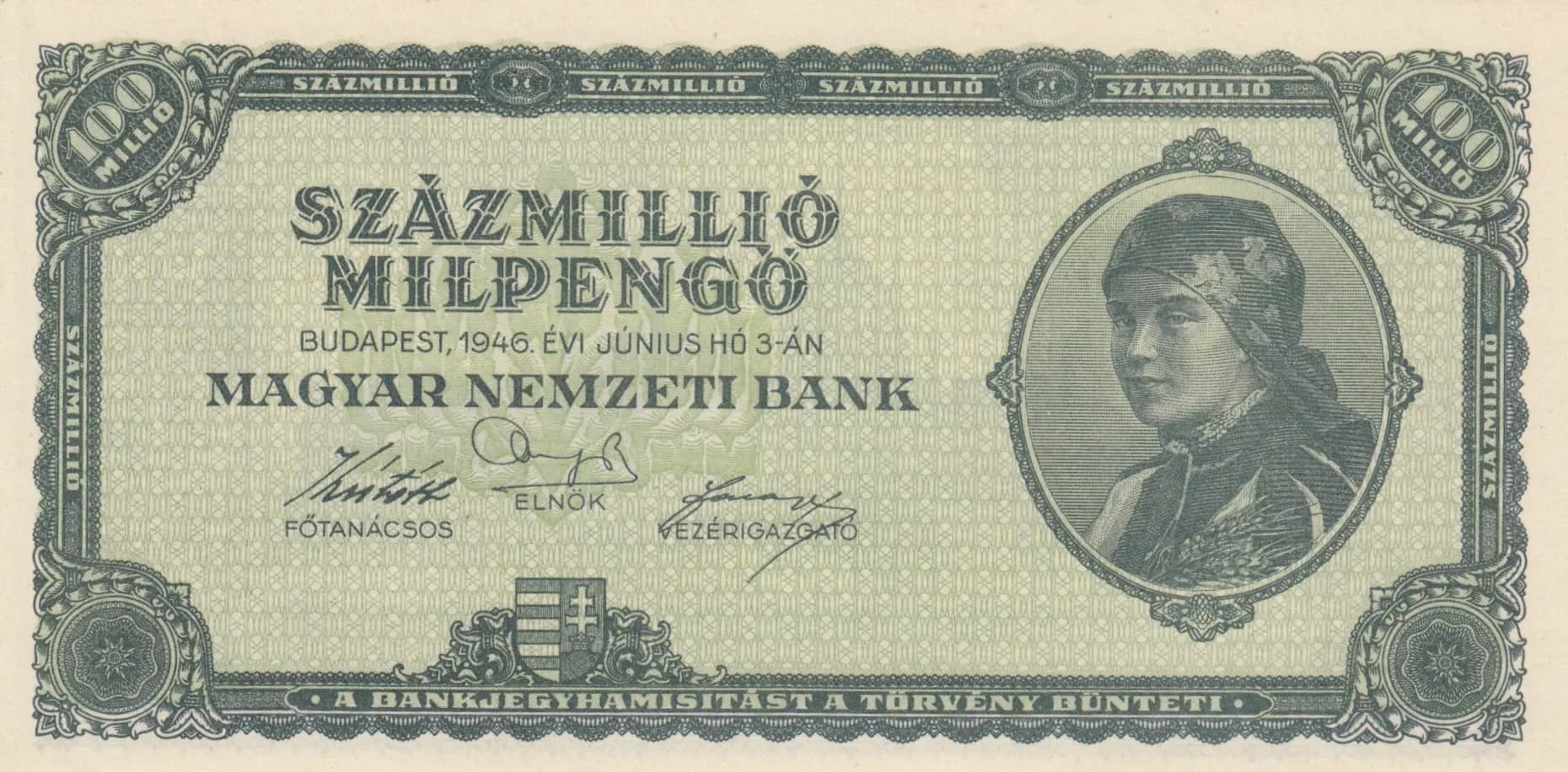
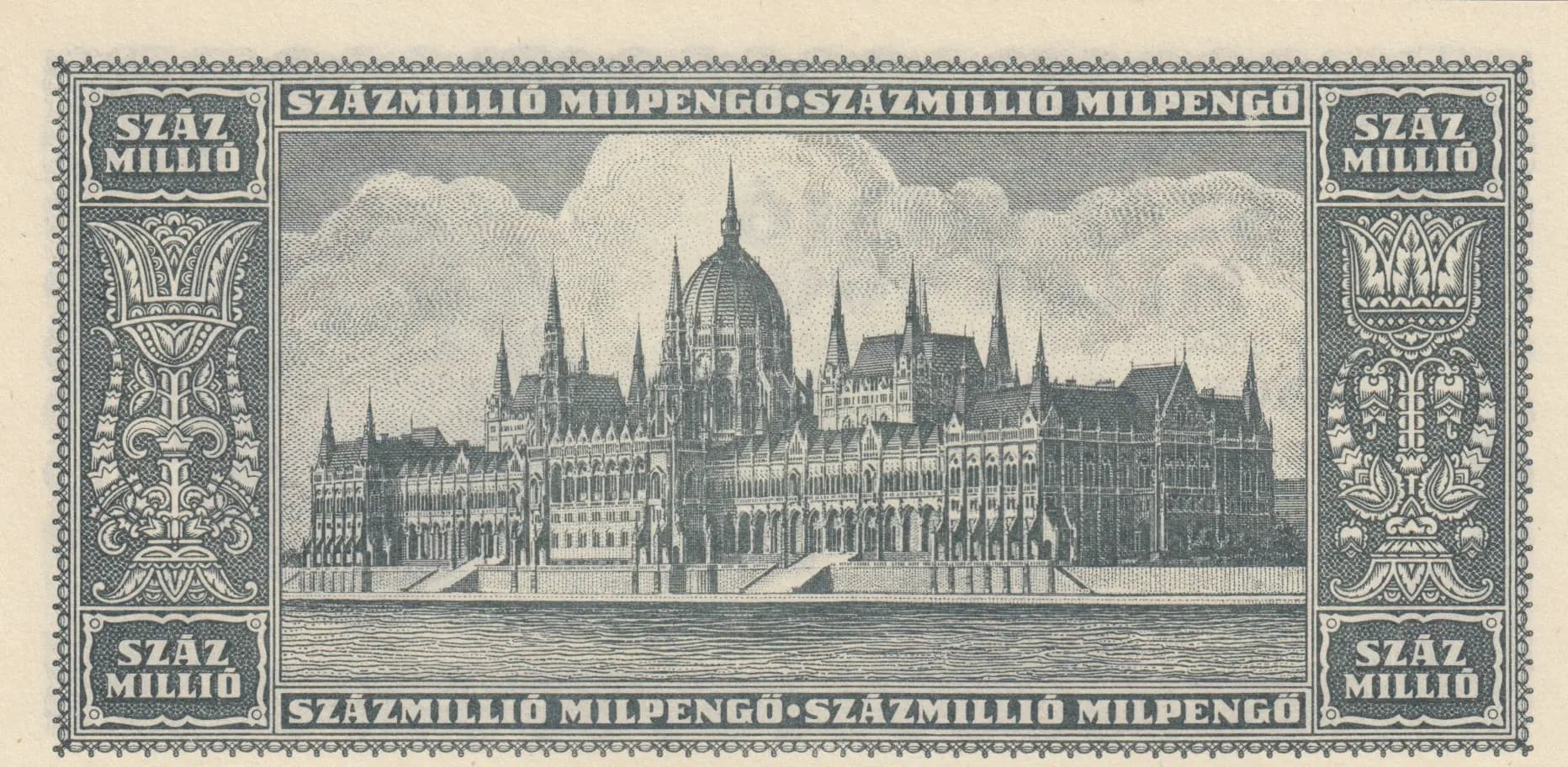
This Hungarian 100 Million Milpengő note from June 3, 1946 is an exceptional example of hyperinflation-era currency, presented in AU (About Uncirculated) condition with crisp, sharp printing and no visible wear. The note features elegant Art Deco design work with a woman's portrait on the obverse and the iconic Hungarian Parliament Building on the reverse, both executed in fine-line engraving. As part of the dramatic currency reforms of post-WWII Hungary, this denomination represents the peak of the pengő hyperinflation crisis before the currency was ultimately replaced.
Common. eBay market data shows consistent sales ranging from $1-$32 USD across all grades and dates in the provided market history, with most examples selling in the $2-$10 range regardless of condition grade. The note was issued in substantial quantities during the final phases of the milpengő crisis and remains readily available to collectors. AU examples typically command modest premiums over lower grades but remain inexpensive and frequently available.
This note was issued during the most severe hyperinflation period in Hungarian history, just months after the end of World War II and the Soviet occupation of Budapest. The 1946 milpengő denominations (millionth of a pengő) were emergency currency issued by the newly reconstituted Magyar Nemzeti Bank to stabilize the economy following the devastating pengő collapse of 1945-1946. The Parliament Building depicted on the reverse served as a symbol of Hungarian national continuity and sovereignty during this traumatic post-war reconstruction period.
The obverse features an allegorical female portrait in profile facing left within an oval frame positioned on the right side of the note, rendered in the classical style typical of interwar and immediate post-war Hungarian currency. The woman wears period-appropriate 1940s clothing and represents prosperity or nationhood. The reverse showcases a detailed engraved architectural view of the Országház (Hungarian Parliament Building) as seen from the Danube River, featuring its characteristic Gothic Revival spires, domes, and riverside elevation. Both sides are framed by ornate Art Deco borders with floral and geometric motifs in all four corners. The Hungarian coat of arms with heraldic shield appears at the bottom center of the obverse. The entire design employs fine-line engraving with complex cross-hatching in background areas, typical of high-security banknote production of this era.
FRONT SIDE: 'SZÁZMILLIÓ MILPENGŐ' (One Hundred Million Milpengő); 'BUDAPEST, 1946. ÉVI JÚNIUS HÓ 3-ÁN' (Budapest, June 3, 1946); 'MAGYAR NEMZETI BANK' (Hungarian National Bank); 'FÖTANÁCSOS' (Chief Counselor); 'ELNÖK' (President); 'VEZÉRIGAZGATÓ' (Director General); 'SZÁZMILLIO' (One Hundred Million); 'A BANKJEGYHAMISÍTÁST A TÖRVÉNY BÜNTETIL' (The law punishes counterfeiting of banknotes). BACK SIDE: 'SZÁZMILLIÓ MILPENGŐ' (One Hundred Million Milpengő - appears twice); 'SZÁZ MILLIO' (One Hundred Million - appears in four corner positions).
Intaglio (engraved) printing on banknote paper, executed with fine-line engraving and complex geometric background patterns for security purposes. The printing exhibits the characteristic sharp detail and crisp impressions of professional banknote production by the Magyar Nemzeti Bank or its authorized security printer. The quality of engraving and printing in this AU specimen shows no deterioration, indicating well-maintained plates.
This note corresponds to Pick P-130, the standard 100 Million Milpengő denomination issued June 3, 1946. No notable varieties (such as different signature combinations, overprints, or date variants) are indicated for this Pick number in the PMG population data or visual analysis. The note exhibits no serial numbers, which is typical for Hungarian emergency currency of this period. The signature blocks correspond to the standard officers of the Magyar Nemzeti Bank at the time of issue.