100 000 000 B- pengö 1946
Market Prices
28 salesAbout This Note
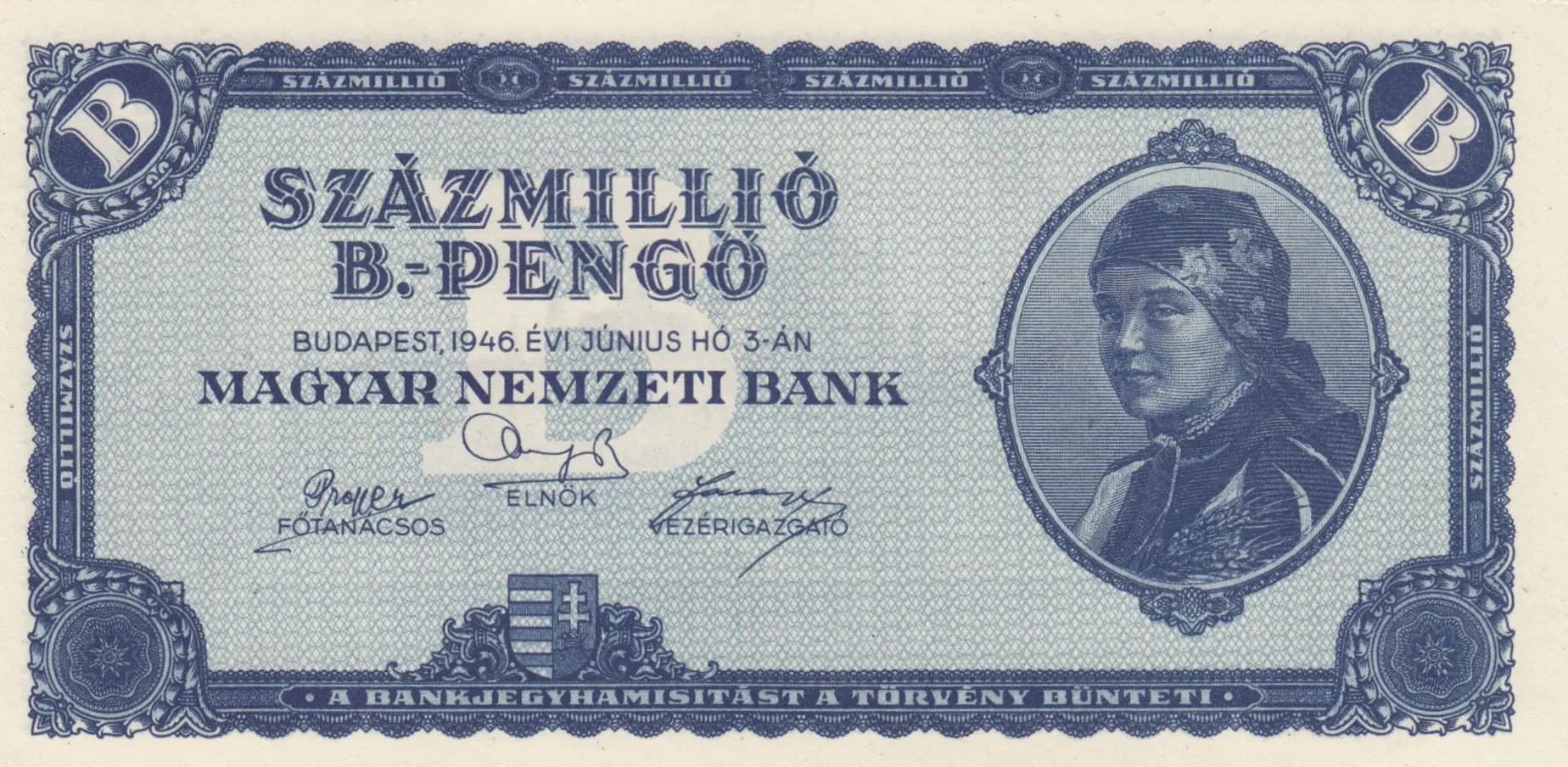
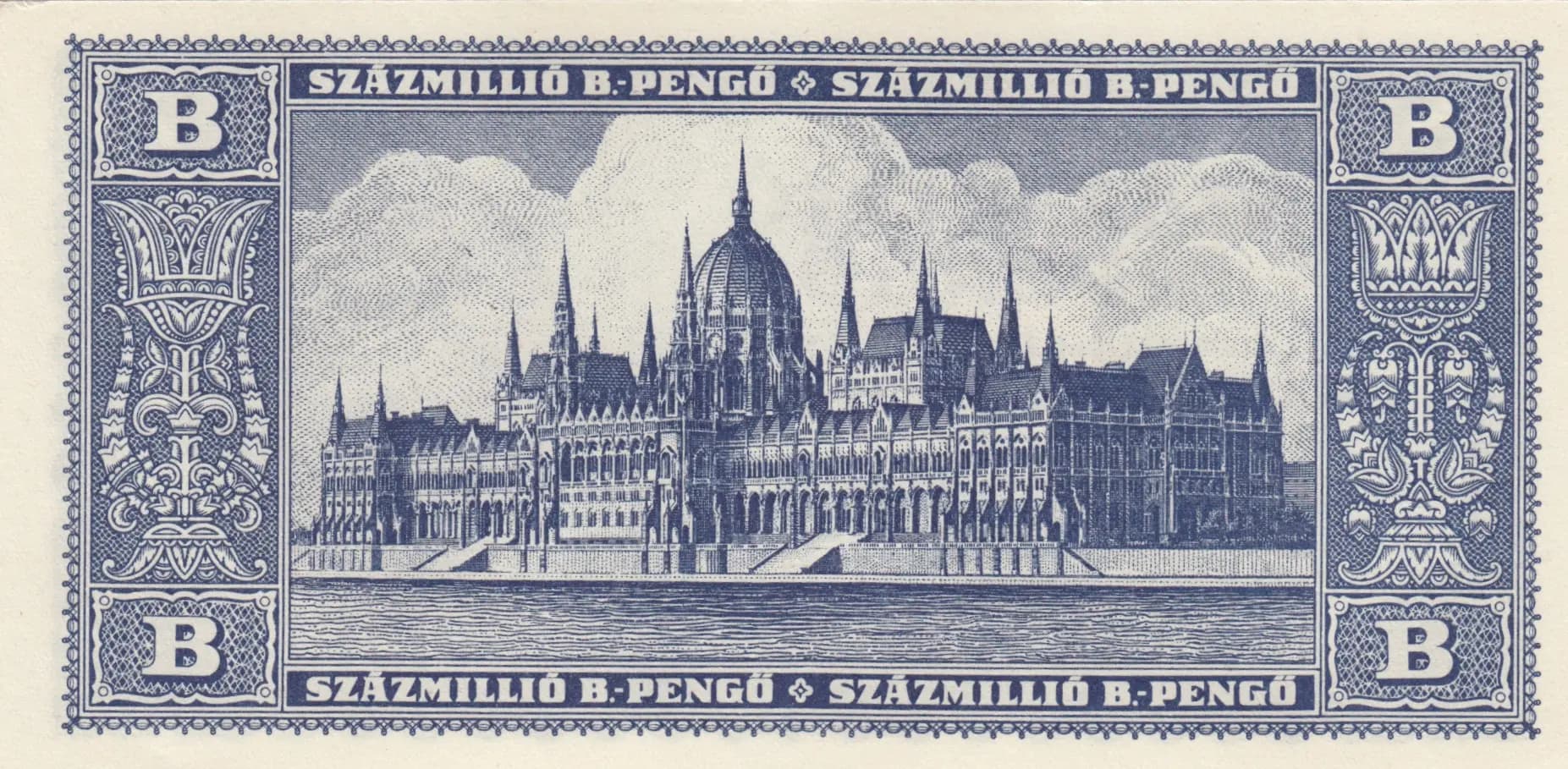
This Hungarian 100,000,000 B-Pengő note from June 3, 1946 exemplifies the hyperinflation era currency of post-WWII Hungary, presented here in pristine AU condition with sharp printing throughout and no visible wear. The obverse features an elegantly engraved portrait of a woman in profile wearing a headscarf, framed within an oval medallion and surrounded by intricate decorative borders, while the reverse showcases a detailed architectural rendering of Budapest's iconic Parliament Building overlooking the Danube. As a hyperinflation-era note with an extraordinarily high denomination representing 100 quintillion pengő in original currency value, it represents a fascinating and historically significant piece of numismatic material from one of the most dramatic currency collapses of the 20th century.
common. The eBay market data provided shows consistent sales activity over an extended period (2015-2024) with prices typically ranging from $21 to $511 depending on condition grade and certification level. Notes in UNC/AU condition sell regularly in the $200-$300 range when graded by PMG, while ungraded examples in similar condition trade for $100-$200. The abundance of sales transactions with moderate bid counts across multiple condition grades indicates substantial surviving population. This is a regular issue with no documented short print run or recall, and the hyperinflation-era B-Pengő notes were produced in quantities sufficient to maintain common status in today's market. The note is historically significant and collectible, but not rare in any grade.
This note was issued during Hungary's catastrophic hyperinflation of 1945-1946, following the Soviet occupation and the country's devastation in World War II. The B-Pengő designation represented an attempt to stabilize currency through revaluation, though this particular 100 million denomination was issued near the peak of the hyperinflation crisis just months before the introduction of the forint in August 1946. The Parliament Building depicted on the reverse symbolized national sovereignty and recovery, even as the astronomical denomination on the obverse underscored the economic chaos of the immediate postwar period.
The obverse features a classically rendered portrait of a woman in left-facing profile, wearing a period headscarf or bonnet, executed in fine engraved style within an oval frame positioned on the right side of the note. The portrait likely represents a personification of Hungary or a historical female figure significant to Hungarian heritage. The reverse showcases the Hungarian Parliament Building (Országház), rendered in meticulous architectural detail with its characteristic Gothic Revival style, multiple pointed spires, central dome, arched windows, and prominent position on the Danube riverbank. Both sides employ elaborate ornamental borders featuring geometric patterns and scrollwork in all four corners, with decorative letter 'B' frames positioned at cardinal points on both sides—these 'B' designations refer to the 'B-Pengő' currency variant. The Hungarian coat of arms appears at the bottom center of the obverse. The color scheme throughout is predominantly dark blue on a cream/beige background with white highlights, creating strong contrast and visual clarity typical of high-security banknote engraving.
FRONT SIDE: 'SZÁZMILLIÓ' (One hundred million) - appears twice at top border and once prominently on face; 'B.-PENGŐ' (B-Pengö, the currency designation); 'BUDAPEST, 1946. ÉVI JÚNIUS HÓ 3-ÁN' (Budapest, June 3, 1946 - issue date); 'MAGYAR NEMZETI BANK' (Hungarian National Bank - issuer); 'FORGÁCS' (signature of Forgács); 'ELNÖK' (President); 'VEZETIGAZGATÓ' (Managing Director); 'A BANKJEGYHAMISÍTÁST A TÖRVÉNY BÜNTETÍ' (Counterfeiting banknotes is punished by law - anti-counterfeiting warning). BACK SIDE: 'SZÁZMILLIÓ B.-PENGŐ' (One hundred million B-Pengö - repeated at top and bottom borders).
This note was produced using intaglio engraving (copperplate engraving), the standard security printing method for Hungarian National Bank currency of this period. The fine line work, intricate cross-hatching, complex decorative borders, and detailed architectural rendering visible throughout both sides are characteristic of master intaglio engraving. The printer for Pick-136 is Magyar Nemzeti Bank's printing facilities; specific private security printers for this issue are not prominently documented in standard catalogs, though Hungarian banknotes of this era were typically produced by the state printing authority or under strict government contract.
Pick catalog number P-136 is documented with one primary variant in the PMG population report. The specific variety observed here is dated June 3, 1946 (BUDAPEST, 1946. ÉVI JÚNIUS HÓ 3-ÁN), with the signature of Forgács (ELNÖK - President) and an unnamed co-signer indicated by 'VEZETIGAZGATÓ' (Managing Director). This note lacks a serial number, which is typical for Hungarian hyperinflation-era currency where serial numbering systems broke down or were omitted entirely due to the rapid succession of new denominations. No distinctive variety markers such as printer initials, overprints, or alternative color variants are noted in standard catalogs for this Pick number.