10 pengö 1944
Market Prices
10 salesAbout This Note
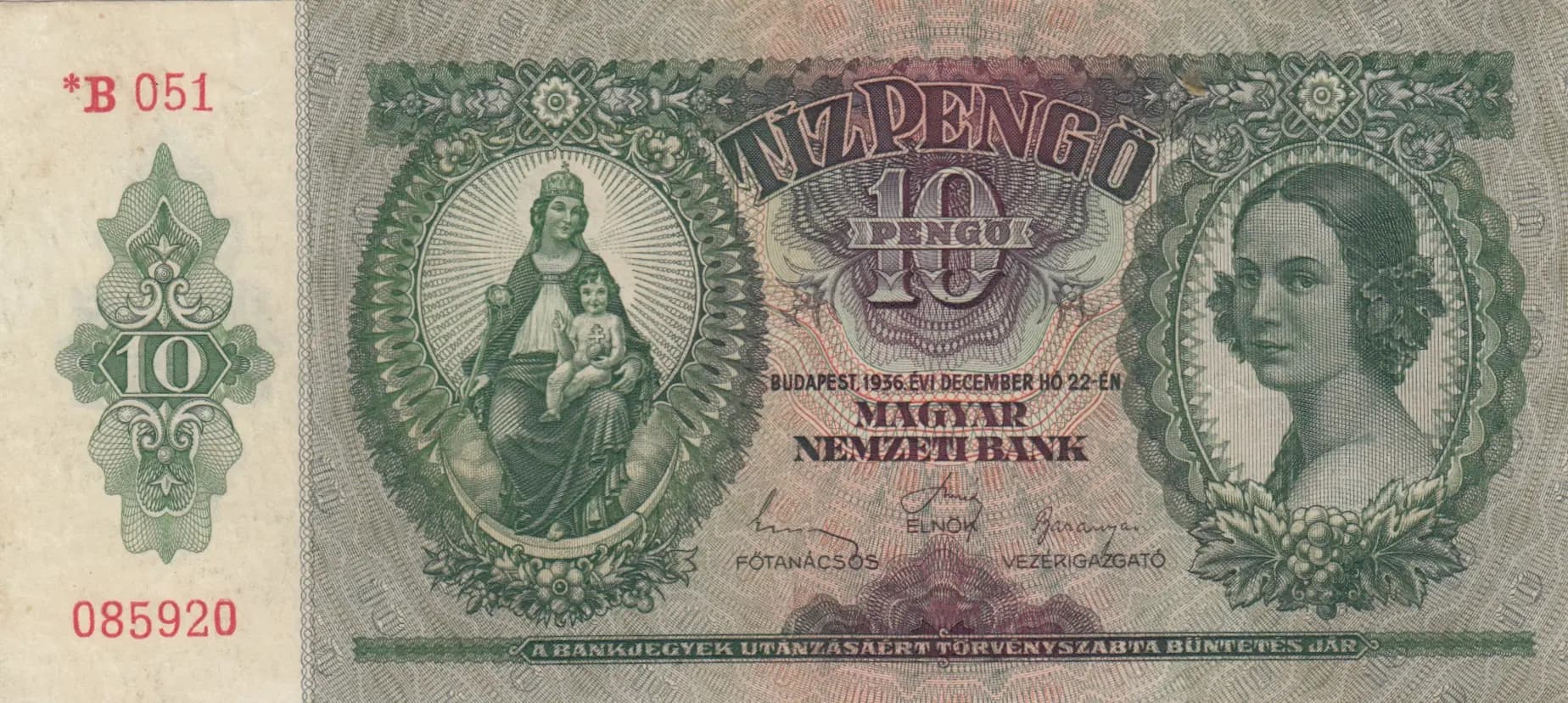
This 10 pengö note from 1944 presents an excellent example of Hungarian interwar currency design, featuring the iconic 'Patrona Hungariae' (Madonna and Child) religious imagery paired with a classical equestrian portrait. The VF-graded specimen exhibits sharp print clarity with minimal wear, displaying the characteristic green and purple color palette with ornate decorative borders typical of the 1936-1945 printing period. The asterisk prefix (*B 051) on the serial number indicates this is from a variant printing run, making it a notable example of Hungary's complex wartime currency history.
Common. The eBay sales history provided shows consistent selling prices in the $1.50-$21.05 range depending on grade, with VF-graded examples selling around $7-$10. Multiple sales across different years (2013-2023) indicate steady availability in the market. This is a standard circulation issue from Magyar Nemzeti Bank with substantial print runs. The asterisk prefix variant noted in the catalog remarks may be slightly less common than non-asterisked versions, but both are readily obtainable. VF-graded specimens are available regularly at modest prices, confirming common status.
This 10 pengö was issued by Magyar Nemzeti Bank during a period of tremendous Hungarian instability, spanning from the original 1936 design through the tumultuous 1944-1945 period. The note's imagery—featuring Patrona Hungariae (the protective Madonna figure central to Hungarian Catholic identity) and the equestrian St. Stephen monument—reflected Hungary's deep historical and religious identity during an era when the nation was increasingly pressured by Nazi Germany. The asterisk notation on the serial number and the December 1956 date reference suggest this note was printed during or after WWII in response to Hungary's fractured political situation and multiple competing authorities.
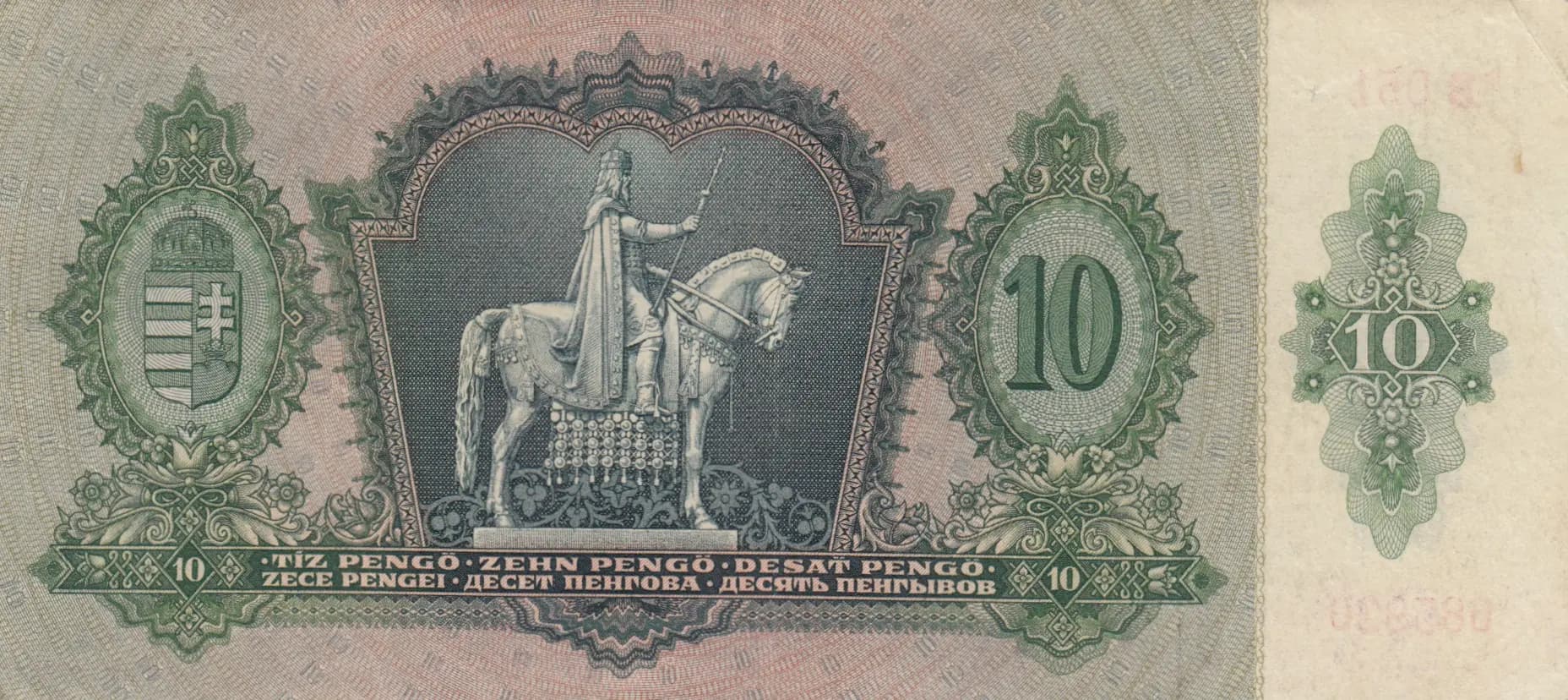
The obverse features the 'Patrona Hungariae' (Madonna and Child) in an ornate oval frame positioned center-left, representing Hungary's religious and cultural identity. To the right is a classical profile portrait of a young woman facing left, embodying the allegorical spirit of the nation. The reverse displays an equestrian monument depicting St. Stephen (Hungary's founding saint-king) mounted on horseback in classical military dress, holding a flag or banner, positioned above a fortified city or castle structure—likely representing Budapest or symbolic Hungarian strongholds. The Hungarian coat of arms (shield with distinctive stripes and crown) appears in the left decorative frame. The multilingual denomination inscriptions (Hungarian, German, Serbian/Croatian, Romanian, and Russian) on the reverse reflect the ethnically diverse territories historically associated with the Austro-Hungarian sphere and post-WWI successor states. Ornate decorative borders with floral and geometric patterns frame all elements, with fine-line engraving providing the primary security detailing.
FRONT SIDE: 'MAGYAR NEMZETI BANK' (Hungarian National Bank); 'TÍZPENGÖ' (Ten pengö); 'BUDAPEST, 1956. ÉVI DECEMBER HÓ 22-ÉN' (Budapest, December 22, 1956); 'FÖTAN ÁCSOS' (Chief Accountant); 'VEZÉRIGAZGATÓ' (Director General); 'A BANKJEGYEK UTÁNZÁSÁÉRT TÖRVÉNYSZABTA BÜNTETÉS JAR' (Counterfeiting banknotes is punishable by law); Serial number '*B 051 085920'. BACK SIDE: Multiple language denominations: 'TÍZ PENGO' (Hungarian: Ten pengö); 'ZEHN PENGO' (German: Ten pengö); 'DESET PENGÖ' (Serbian/Croatian: Ten pengö); 'ZECE PENGEI' (Romanian: Ten pengö); 'ДЕСЯТ ПЕНГОВА' / 'ДЕСЯТЬ ПЕНГЫВОВ' (Russian: Ten pengö); Numeral '10' in framing elements.
Intaglio line engraving on high-quality banknote paper. The intricate decorative borders, fine detail work in portraiture, and complex geometric patterns characteristic of the observation are consistent with traditional steel-plate engraving. The sharp print clarity visible in the VF-graded specimen suggests a well-maintained printing die. Magyar Nemzeti Bank utilized Hungary's established security printing facilities; the printer is not specifically identified in the visible inscriptions, but the technical quality is consistent with pre-WWII Hungarian banknote production standards.
This specimen exhibits the asterisk (*) prefix on the serial number block (*B 051), which the catalog specifically notes distinguishes it from similar notes without the asterisk (referenced as Hungary P-100, issued by the Szálasi government in Veszprém). The date inscription '1956. ÉVI DECEMBER HÓ 22-ÉN' is anomalous—the note's catalog designation is 1944, but the printed date references December 22, 1956, suggesting either a reissue or emergency printing during the post-WWII period. The specific block letter 'B' and the serial number sequence (085920) should be noted for collector identification purposes.