10 korona 1920
Market Prices
37 salesAbout This Note
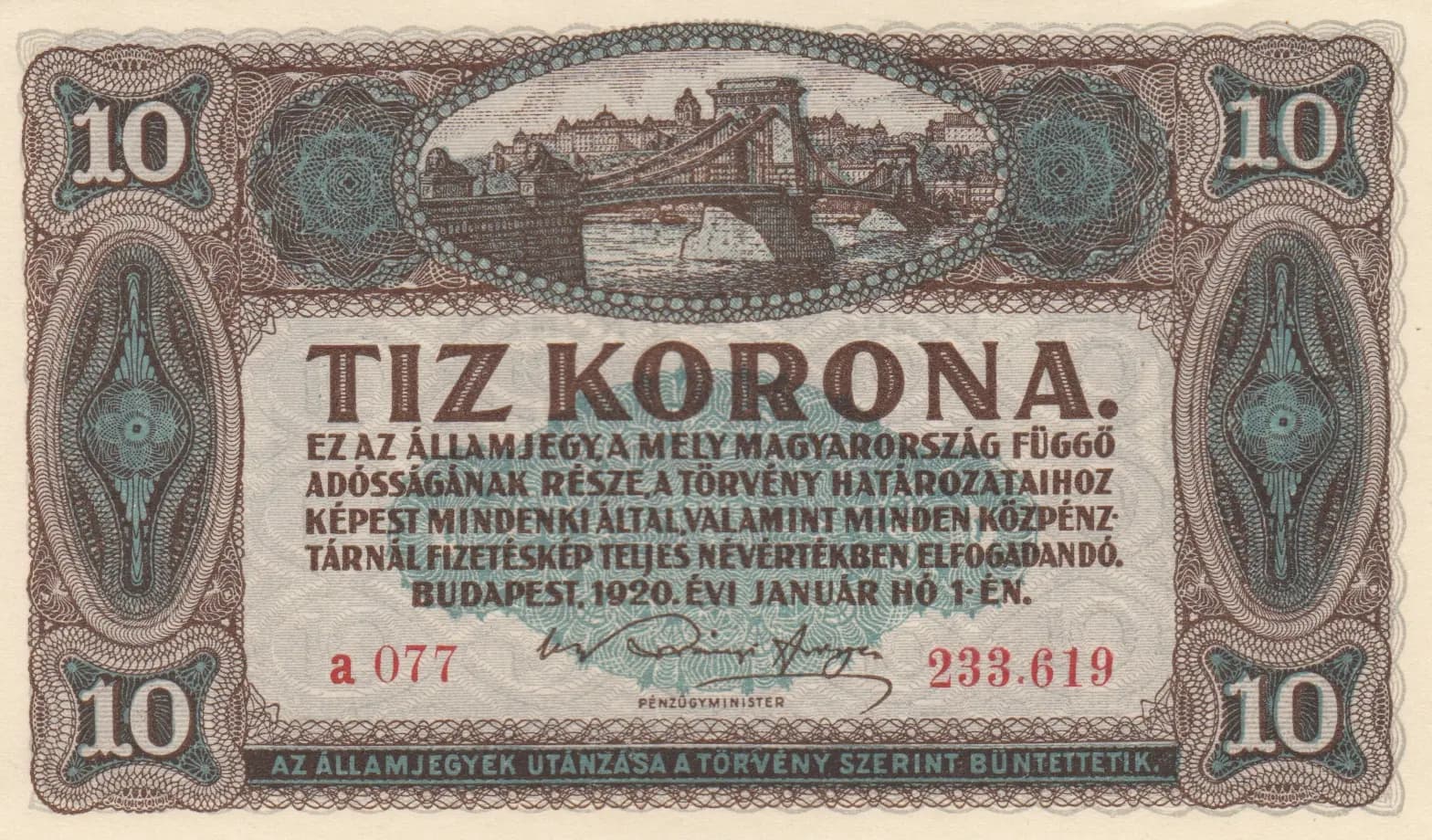
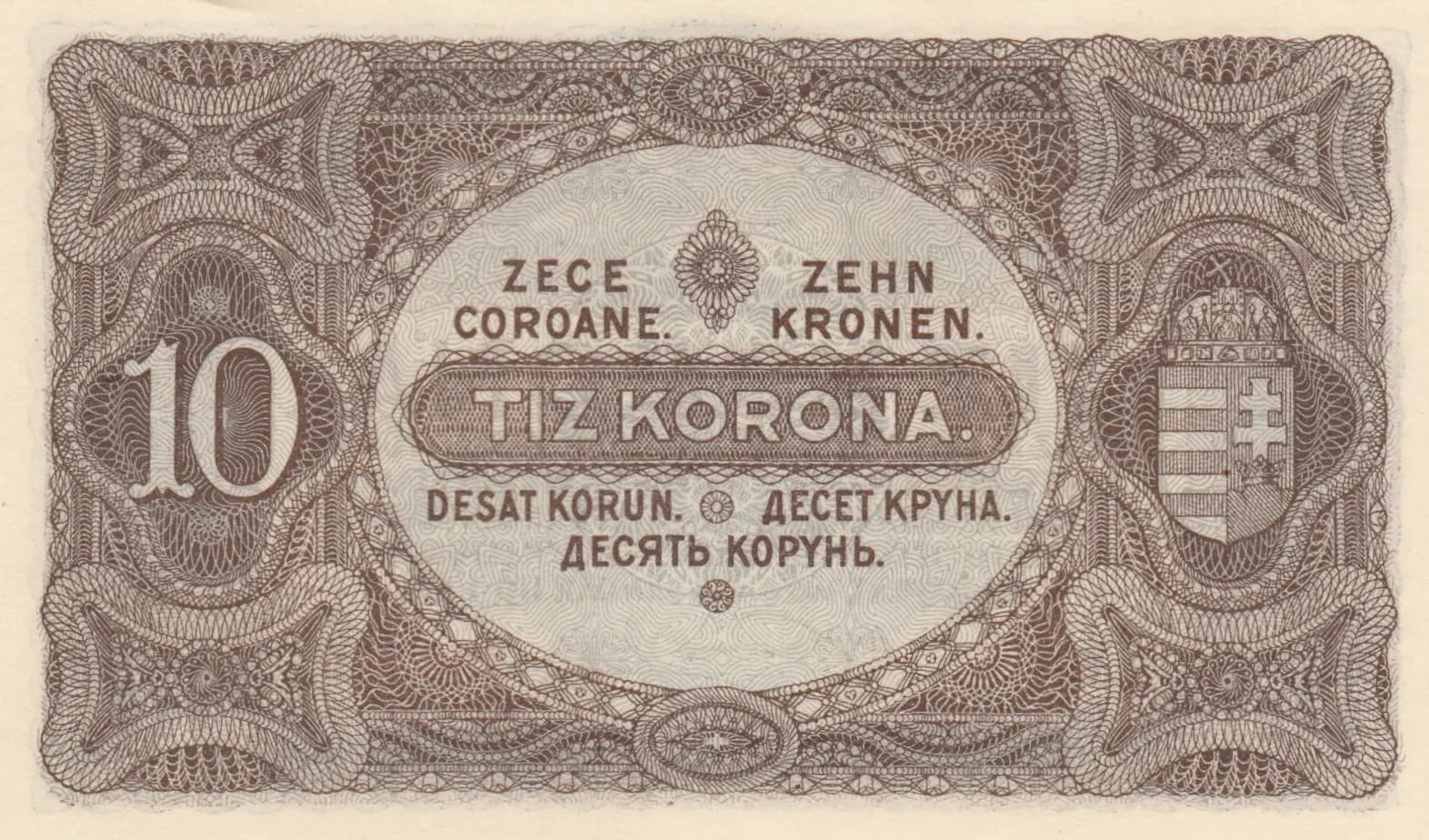
This is an exceptionally well-preserved example of Hungary's 10 korona note from January 1, 1920, graded UNC and representing the post-WWI monetary system. The obverse features a detailed engraved vignette of the Chain Bridge spanning the Danube in Budapest with the cityscape backdrop, rendered in brown and teal/green inks on an ornate decorative border. The reverse displays the Hungarian coat of arms and multilingual denomination text reflecting Hungary's ethnically diverse post-Austro-Hungarian Empire borders, with meticulous geometric security patterns throughout.
Common. eBay market data spanning from 2009 to 2026 shows consistent pricing in the $1–$11.50 range for most conditions, with even high-grade examples (EF/UNC) typically selling for $3–$8.50 unless professionally graded at PMG 65 or higher ($40 recorded once in 2020). The 2016 catalog value for UNC was $4, consistent with observed market performance. Mintage was substantial for a post-WWI state issue, and survival rate is good. This note does not exhibit the characteristics of a scarce or rare issue.
Issued on January 1, 1920, this note represents the newly independent Hungarian state's transition from the Austro-Hungarian crown system to its own korona currency. The prominence of Budapest's Chain Bridge—completed in 1849 and symbolizing Hungarian engineering and national pride—reflects the nation's effort to establish a modern, independent monetary identity. The multilingual inscriptions (Hungarian, German, Romanian, Czech, Russian) acknowledge the complex ethnic composition of post-World War I Hungary and the Austro-Hungarian successor states, a detail directly visible in the reverse's polyglot denomination text.
The obverse depicts the iconic Chain Bridge (Lánchíd) of Budapest, the first permanent bridge spanning the Danube River, rendered in fine detail with suspension cables and stonework clearly visible. The surrounding cityscape includes Budapest's architectural landmarks with a church or cathedral spire prominent in the background, establishing the national capital's significance. The design employs an elaborate border of ornate geometric and floral patterns in brown and teal/green, with decorative corner medallions framing the composition. The reverse features the Hungarian coat of arms—a heraldic shield—positioned prominently on the right side within an ornate circular medallion frame, surrounded by matching geometric border patterns. Both sides employ consistent decorative language emphasizing national sovereignty and institutional authority through intricate ornamental design. The color scheme of brown on blue-green underprint creates visual distinction while maintaining classical banknote aesthetics appropriate to 1920s European monetary standards.
FRONT: Denomination in Arabic numerals: '10' (appears in all four corners). Main text in Hungarian: 'TIZ KORONA.' (Ten Korona). Legal tender declaration: 'EZ AZ ÁLLAMJEGYZET AMELY MAGYARORSZÁG FÜGGŐ ADÓSSÁGÁNAK RÉSZE A TÖRVÉNY HATÁROZATAIHOZ KÉPEST MINDENKI ÁLTALVÁLMINT MINDEN KÖZPÉNZTÁRNÁL FIZETÉSKÉP TELJES NEVERÉKBEN ELFOGADANDÓ.' (This is a state note which forms part of Hungary's outstanding debt and shall be accepted as full payment everywhere and in all public treasuries according to the law's provisions). Issue information: 'BUDAPEST, 1920. ÉVI JANUÁR HÓ 1 ÉN.' (Budapest, January 1st, 1920). Counterfeiting warning: 'AZ ÁLLAMJEGYZYEK UTANZÁSA A TÖRVÉNY SZERINT BÜNTETTETIK.' (Counterfeiting of state notes is punished according to law). Serial numbers visible: 'a 077' and '233.619'. Signature line marked 'PÉNZÜGYMINISTER' (Finance Minister). REVERSE: Denomination in multiple languages: 'TIZ KORONA.' (Hungarian—Ten Korona), 'ZEHN KRONEN' (German—Ten Crowns), 'ZECE COROANE' (Romanian—Ten Crowns), 'DESAT KORUN.' (Czech/Slovak—Ten Crowns), 'ДЕСЯТЬ КОПЫНЬ.' (Russian—Ten Crowns).
Intaglio engraving (line engraving), evidenced by the fine, detailed line work visible throughout the intricate border patterns, vignette, and security designs. The complex geometric lattice patterns, ornamental corner medallions, and finely detailed bridge vignette are characteristic of intaglio security printing used for government financial documents of this era. The multi-color printing process involved separate plates for the brown primary color and teal/green underprint, a standard security technique for the period. This note was produced by the Penzügyminiszterium (Hungarian Finance Ministry) printing facilities.
Serial number variety noted: This example displays 'a 077' with '233.619' as a secondary number identifier. The external reference source indicates two serial number varieties exist for this pick number—those with and without a decimal point within the serial number sequence. The specific variety here appears to be the non-decimal point variant based on the format '233.619'. No other overprints, date variants, or signature varieties are evident in this specimen. The Finance Minister signature line ('PÉNZÜGYMINISTER') is standard for this Pick number.