10 korona 1920
About This Note
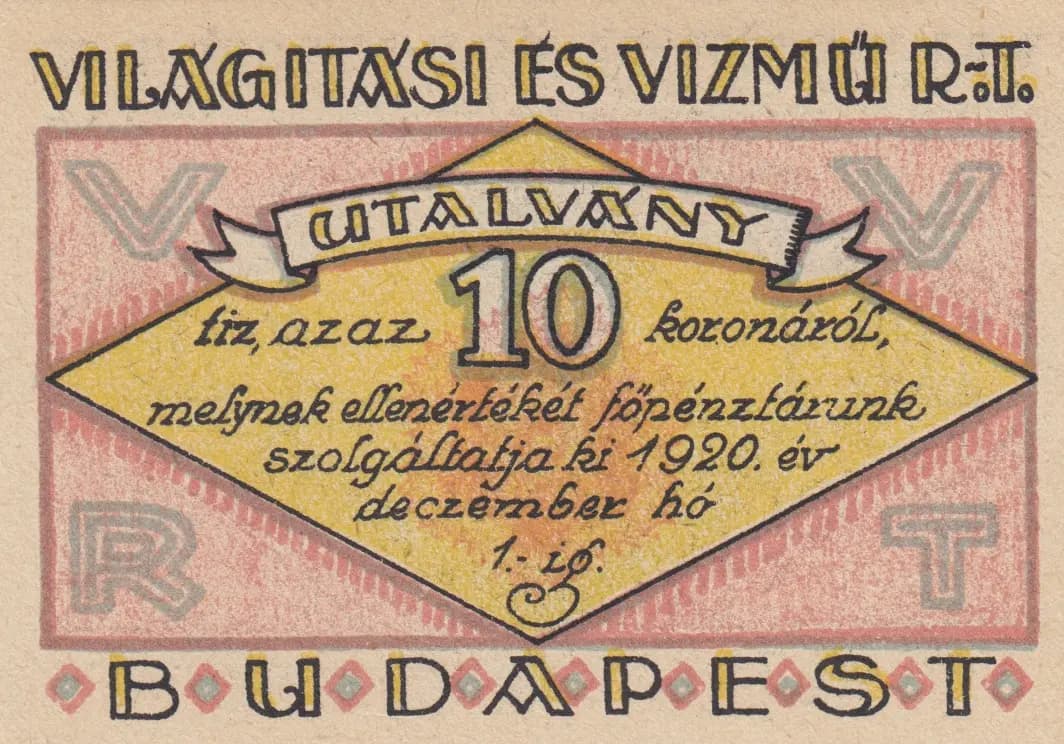
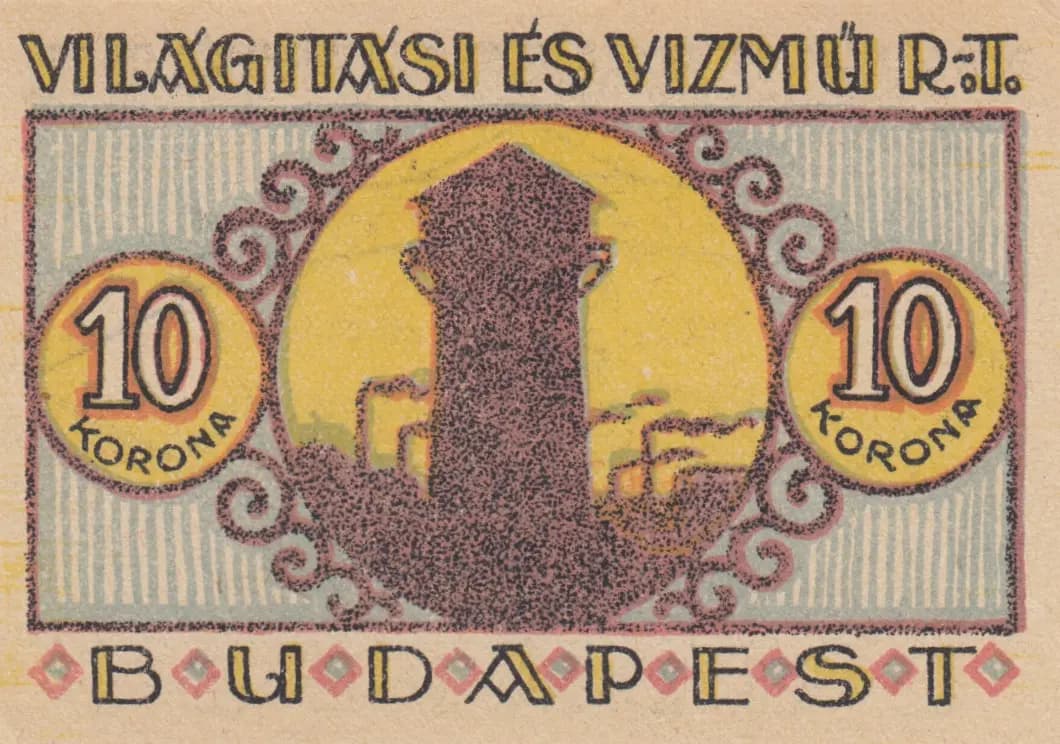
A striking 1920 emergency voucher issued by the Budapest Lighting and Water Works Company (Világitási és Vízműi R.T.), denominated in 10 korona. The note features distinctive Art Deco design elements with a yellow diamond-shaped central cartouche on the obverse and a silhouetted tower on a golden circular background on the reverse, rendered in warm yellows, pinks, and mauve tones. In UNC condition with only minor age-appropriate patina, this unlistednote represents a fascinating example of post-WWI Hungarian industrial scrip during the period of economic transition and currency instability.
Uncommon. This note is unlistened in standard Pick catalogs, indicating it falls outside the primary numismatic cataloging systems, which typically focus on official government issues rather than corporate emergency vouchers. However, these utility company vouchers from 1920 Hungary were issued in functional quantities for local circulation and have moderate survival rates. The UNC condition grade is notable and increases collector appeal, as most surviving examples show more significant age-related wear. While not particularly scarce in lower grades, pristine examples are less frequently encountered.
This voucher was issued in December 1920, during the immediate post-World War I period when Hungary faced severe currency shortages and economic disruption. The Lighting and Water Works Company's issuance of emergency vouchers reflects the period when municipalities and large utility companies issued their own credit notes to facilitate local commerce and worker compensation. The depicted tower—likely representing the company's infrastructure or a Budapest landmark—symbolizes the industrial modernization efforts of interwar Hungary, while the Art Deco styling demonstrates the contemporary design aesthetic of the early 1920s.
The obverse features a vertically-oriented composition dominated by a yellow diamond-shaped cartouche outlined in black, centered within a pink/mauve background. Art Deco geometric border patterns frame the left and right edges in cream and black. A decorative banner with ribbon design crowns the diamond shape. All inscriptions, including the company name, denomination, and explanatory text regarding the voucher's validity, are arranged symmetrically around the central diamond. The reverse presents a contrasting design with a dark brown or purple silhouetted tower (likely a bell tower or clock tower with ornate architectural detailing at its summit) positioned within a large yellow circular medallion. Baroque scrollwork and ornamental flourishes in mauve and gray tones surround the tower above and below. Two circular denomination markers reading '10 KORONA' flank the central tower composition, with the company name and Budapest attribution completing the design. The overall effect blends industrial practicality with contemporary Art Deco and Art Nouveau aesthetic sensibilities.
OBVERSE: 'VILÁGITÁSI ÉS VÍZMŰI R.T.' (Lighting and Water Works Company Ltd.); 'UTTALVÁNY' (Voucher/Receipt); 'íiz azaz 10 koronáról, melynak ellenperzékét függenldrunk szolgáltatja ki 1920 év deczvember hó 1. ízq.' (i.e., for 10 crowns, the counterpart of which we undertake to provide service in December 1920); 'BUDAPEST' (Budapest). REVERSE: 'VILÁGITÁSI ÉS VÍZMŰI R.T.' (Lighting and Water Works Company Ltd.); '10 KORONA' (10 Crowns—appears twice in circular denomination markers); 'BUDAPEST' (Budapest).
Letterpress printing with chromolithic color application, typical of Central European voucher and emergency note production in the immediate post-war period. The distinct color separations (yellow, pink/mauve, black, and cream) and the sharp definition of text and geometric borders indicate professional typographic printing by an established security or commercial printer, likely based in Budapest. No watermark or advanced security features are evident, consistent with the temporary nature of the voucher.
No signature, date variations, or serial number prefixes are discernible from the visual analysis. The note is dated December 1, 1920 ('1920 év deczvember hó 1'), and this specific date appears integral to the voucher's validity statement rather than being variable across different printings. Without access to multiple examples of this issue, no secondary varieties can be confidently identified. The unlistednature of this Pick catalog entry suggests it may not have been comprehensively documented in major numismatic references, potentially indicating limited research into the varieties of Hungarian utility company vouchers from this period.