10 forint 1848
Market Prices
1 saleAbout This Note
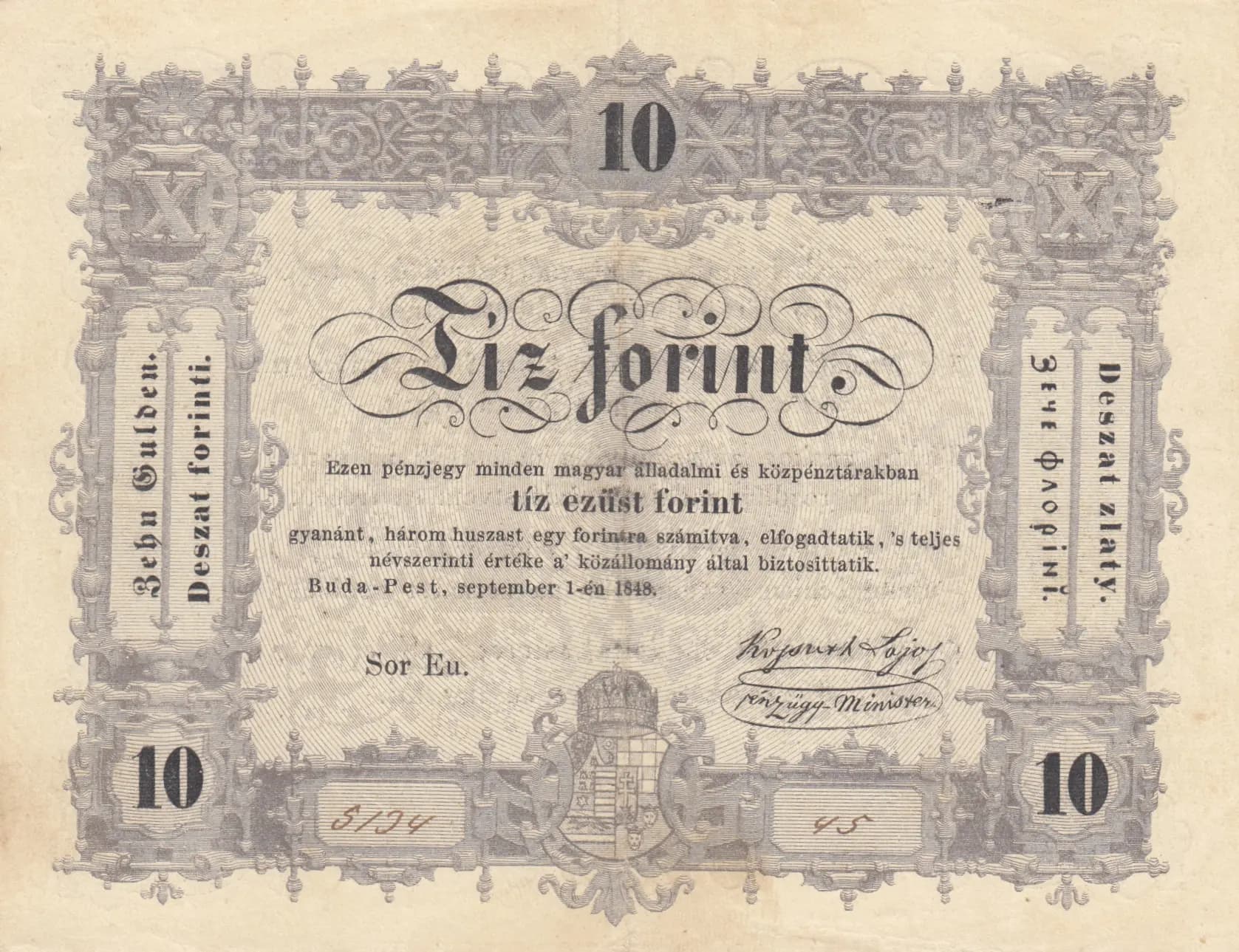
This is a striking example of Hungary's revolutionary 1848 banknote, featuring elaborate baroque-style filigree borders and ornamental script characteristic of the Ministry of Finance emergency issue during the Hungarian Revolution. The note displays a cream-beige coloration with age-appropriate foxing and yellowing, consistent with authentic 19th-century paper stock, and bears the printed signature of Lajos Kossuth as Minister of Finance—a historically significant autograph for this tumultuous period. In VF condition, this example represents an important artifact from one of Europe's pivotal revolutionary moments.
Common. While historically significant as a revolutionary-period note, the 10 forint denomination from this 1848 issue was produced in substantial quantities for circulation across Hungarian territories. The reference eBay transaction showing an F-grade example selling for $26 (June 2025) indicates modest collector demand and accessible pricing typical of common 19th-century banknotes. No evidence of restricted print runs, early recalls, or scarcity in numismatic literature suggests this is a regularly encountered note in international banknote markets, particularly in European collections.
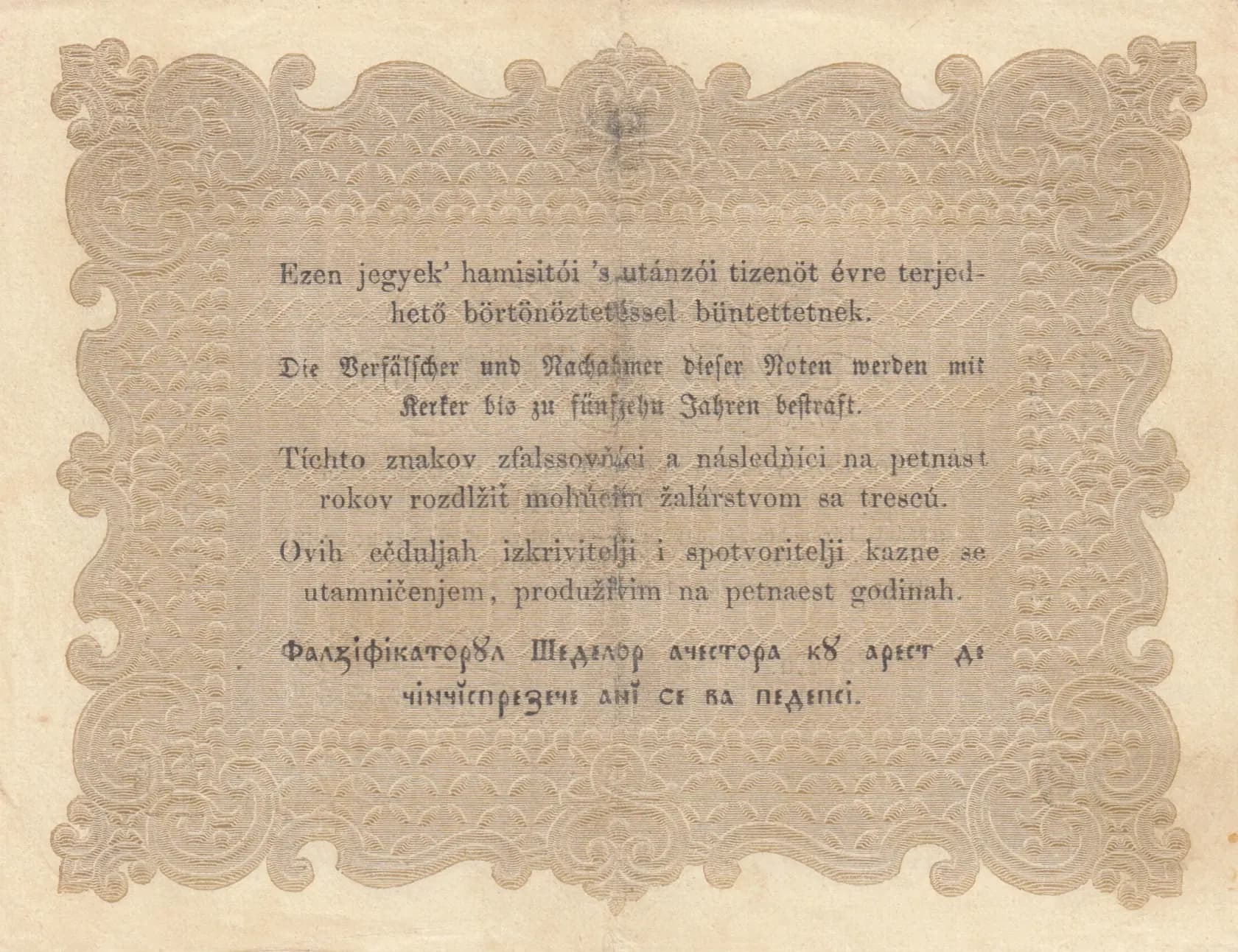
Issued on September 1, 1848, during the Hungarian Revolution and War of Independence, this 10 forint note reflects the nascent Hungarian government's assertion of monetary sovereignty against Habsburg imperial authority. The multilingual reverse (Hungarian, German, Slovak, Cyrillic) emphasizes the note's intended circulation across the ethnically diverse territories of the Hungarian Crown, while the prominent Hungarian coat of arms and reference to 'magyar államdalmi' (Hungarian state) properties underscore the revolutionary government's claim to legitimate statehood. The severe counterfeiting penalties inscribed in multiple languages—up to fifteen years imprisonment—demonstrate the vulnerability of these notes to fraud during a period of political chaos.
The obverse features a gray underprint supporting elegant black-ink engraving throughout. The denomination '10' appears prominently in large numerals at top center and bottom corners, with the written denomination 'Tíz forint' rendered in ornamental script dominating the central area. The Hungarian coat of arms—featuring a crown and shield—is positioned at bottom center, serving as the primary heraldic symbol. Vertical text bands frame the left and right edges, containing regulatory language. Elaborate baroque decorative borders with fine filigree scrollwork and flourishes frame the entire note, serving both aesthetic and security functions. The printed signature of Kossuth as Minister of Finance appears in the lower center area. The reverse maintains the same ornate baroque border aesthetic but replaces denominational elements with multilingual counterfeiting penalties in Hungarian, German, Slovak, and Cyrillic scripts, creating a dense legal-text composition on a dull olive underprint.
FRONT SIDE: The denomination text reads 'Tíz forint' (Ten forint). The primary validation text states: 'This banknote shall be accepted in all Hungarian state and public treasuries as ten silver forints, counting three husks [husks referring to copper coins] as one forint, and its full value is guaranteed by the state treasury.' The note is dated 'Buda-Pest, szeptember 1-én 1848' (Budapest, September 1, 1848) and signed by the Finance Minister. BACK SIDE: The reverse contains anti-counterfeiting warnings in multiple languages: Hungarian: 'The forgers and imitators of these notes shall be punished with imprisonment up to fifteen years.' German: 'Die Verfälscher und Nachahmer dieser Noten werden mit Kerker bis zu fünfzehn Jahren bestraft.' (The forgers and counterfeiters of these notes will be punished with imprisonment up to fifteen years.) Slovak and Cyrillic variants of the same penalty warning appear, reflecting the multi-ethnic composition of the Hungarian territories.
Fine line engraving on steel plates, evidenced by the intricate border patterns, consistent line weights in the filigree, and the sophisticated detail visible in the coat of arms and decorative scrollwork. The printing shows characteristics consistent with Vienna or Budapest security printing facilities of the 1848 period. The complex decorative elements served dual purposes: aesthetic legitimacy and anti-counterfeiting measures, as sophisticated engraving was difficult to reproduce with period counterfeiting technology.
This note is cataloged as Pick P-S117, identifying it as part of the Ministry of Finance's standard 1848 emergency series. While signature varieties may exist depending on which official signed the note, the primary identifying feature is the printed signature of Lajos Kossuth as Finance Minister dated September 1, 1848. The multilingual reverse text is consistent across this denomination and issue. No serial numbers are evident in the visual analysis, which is typical for this emergency issue period. The Panzjegy (pénzjegy—banknote) designation appears in the small text beneath the written denomination on the obverse, as noted in catalog references.