10 forint 1962
Market Prices
28 salesAbout This Note
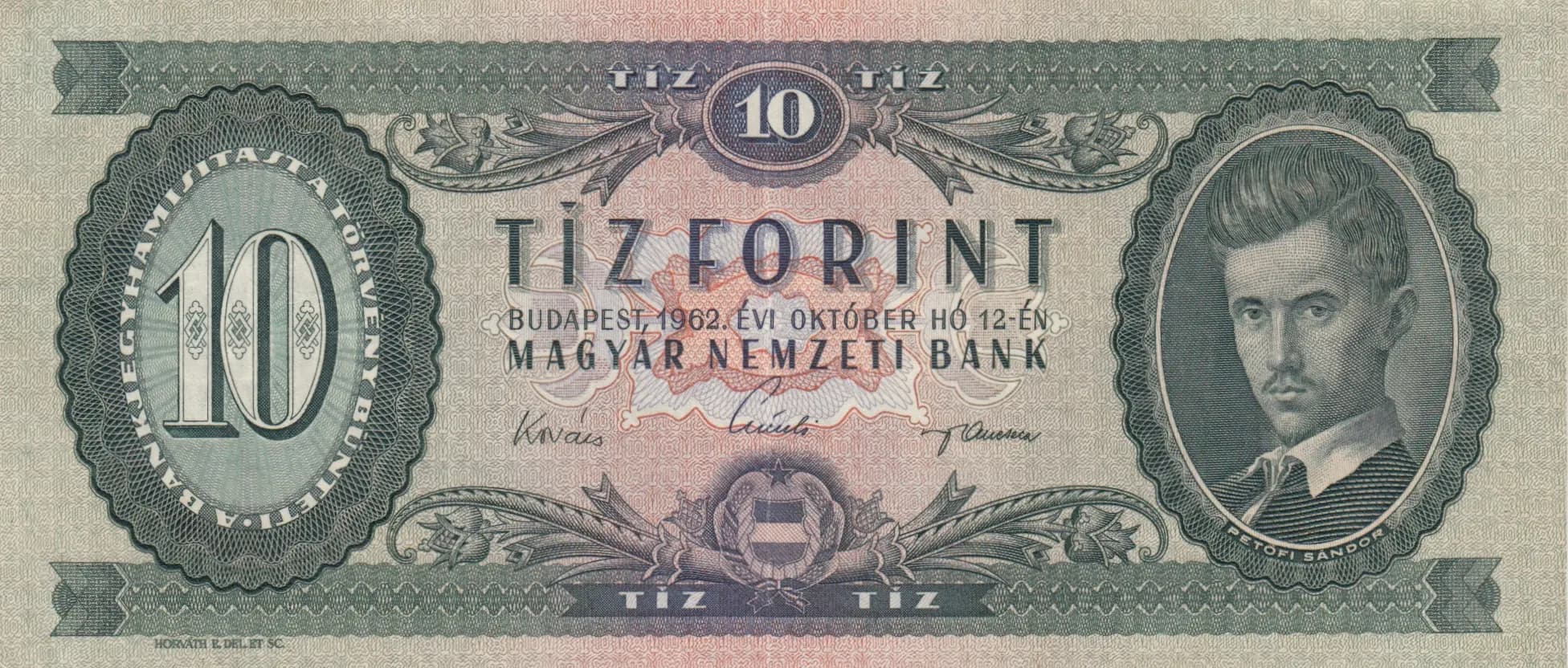
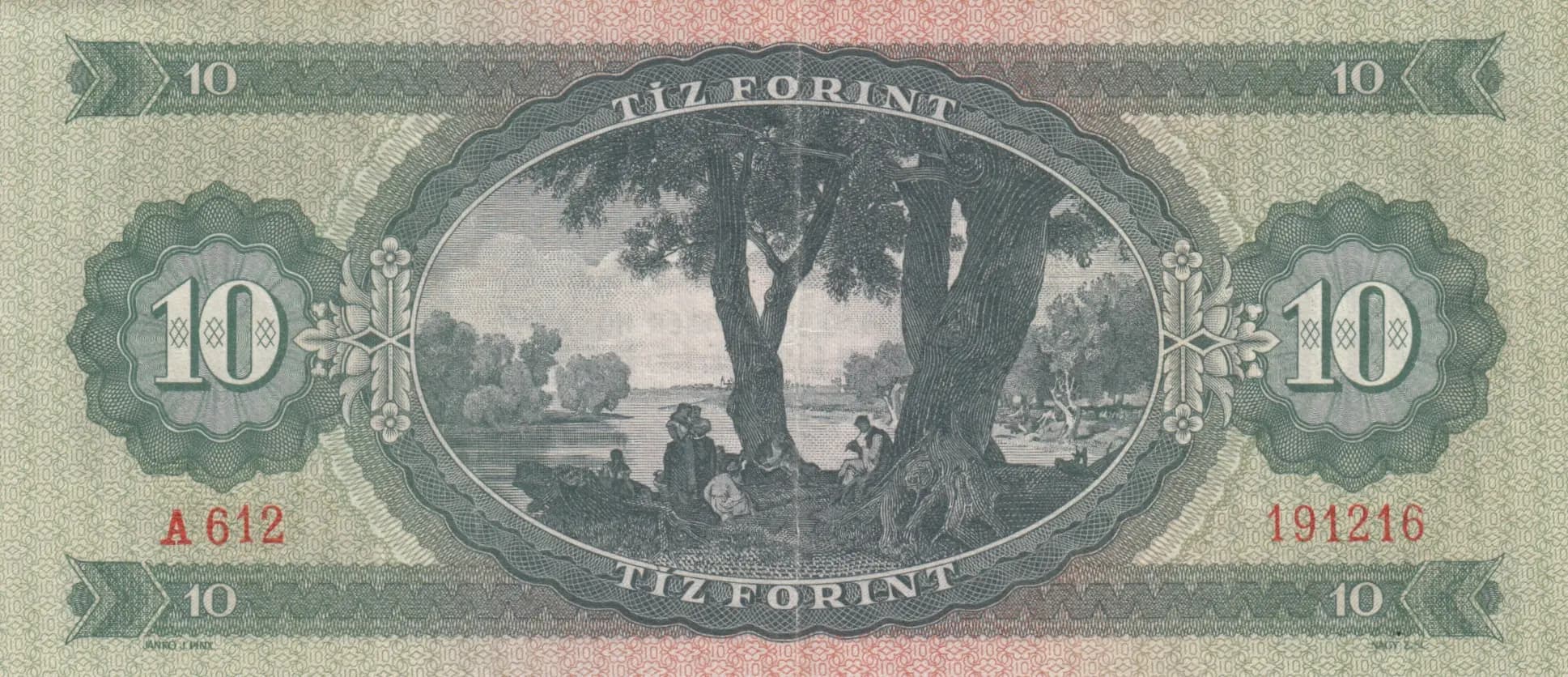
This is a handsome example of the Hungarian 10 forint note from 1962, presented in excellent condition (EF grade) with crisp impression and no visible wear. The note showcases the refined engraving characteristic of Magyar Nemzeti Bank issues from this era, featuring a dignified portrait of Sándor Petőfi on the obverse and a romantic landscape vignette titled 'Birth of the Song' on the reverse. With vibrant green and salmon-pink coloration and intricate guilloche security work throughout, this note represents a classic mid-20th century Hungarian banknote design.
Common. The 1962 Hungarian 10 forint note was part of a long production run (1957-1975 according to catalog data) with substantial circulation. eBay market data shows consistent sales in the $1-5 range for VF and EF grades, with even graded examples (PMG 65-66) reaching only $27-30, indicating no collector premium for rarity. Catalog values (2019) list VF at $2 and UNC at $8, confirming this as a readily available note in the secondary market.
This 1962 issue commemorates Hungary's cultural heritage through its dual imagery: Sándor Petőfi, the revolutionary poet and national symbol of Hungarian independence, appears prominently on the front, while the reverse depicts 'Birth of the Song' (János Jankó), a romanticized scene celebrating artistic creation and the Hungarian landscape. Issued during Hungary's early post-1956 period, this banknote reflects the nation's efforts to reconnect with its cultural identity through numismatic design.
The obverse features a left-facing portrait of Sándor Petőfi (1823-1849), Hungary's most celebrated poet and nationalist hero, rendered in profile within an ornate circular frame. The denomination appears in decorative oval cartouches on both sides. The reverse depicts 'Birth of the Song' by János Jankó—a large, atmospheric landscape composition showing figures gathering beneath a prominent tree beside water, with distant scenery suggesting the Hungarian countryside. The Hungarian coat of arms (shield with characteristic striping) appears at the center bottom of the obverse. Throughout both sides, ornamental scrollwork, heraldic flourishes, and fine decorative borders frame the primary imagery.
Front side: '10' (denomination), 'TÍZFORINT' (Ten forint), 'BUDAPEST, 1962.ÉVI OKTÓBER HÓ 12-ÉN' (Budapest, October 12, 1962), 'MAGYAR NEMZETI BANK' (Hungarian National Bank), 'TIZ TIZ' (Ten Ten). Back side: '10' (denomination), 'TIZ FORINT' (Ten forint), 'A612' (serial number prefix), '191216' (serial number sequence).
Intaglio (engraved line) printing with multicolor offset underprinting. The fine guilloche patterns, intricate line work in the background, detailed landscape vignette, and sharp denomination and text impressions are characteristic of high-quality intaglio security printing employed by Magyar Nemzeti Bank during this period.
This example is cataloged as Pick P-168c (1962 issue). The PMG population report indicates four known varieties for this base Pick number: P-168c, P-168d, P-168e, and P-168s2. Variety distinctions likely relate to signature combinations, date variants, or serial number prefix changes common to Hungarian banknote issues of this era. The observed serial number prefix 'A612' and date of October 12, 1962 (printed on obverse) are consistent with standard P-168c characteristics.