10 000 pengö 1945
Market Prices
33 salesAbout This Note
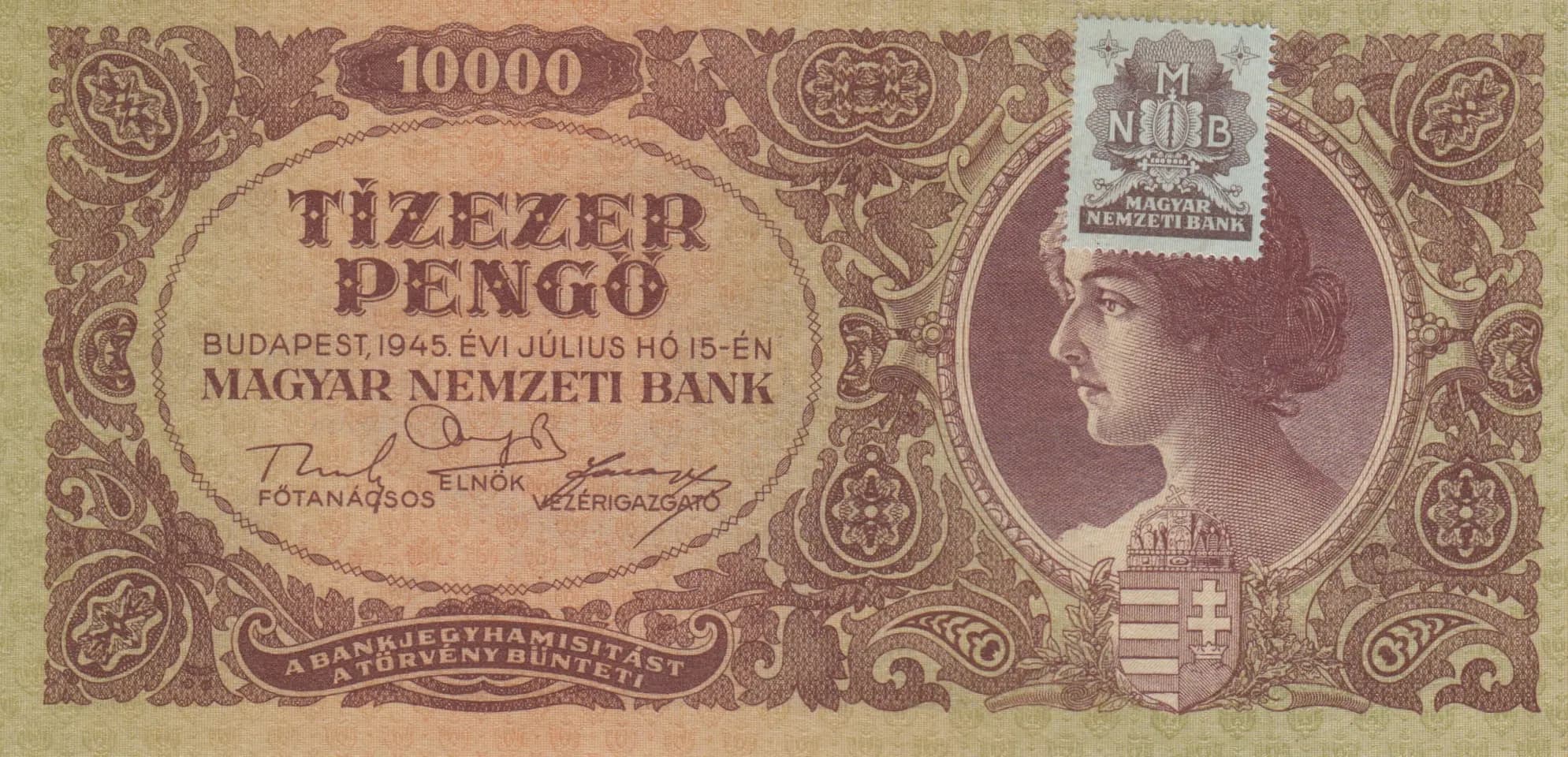
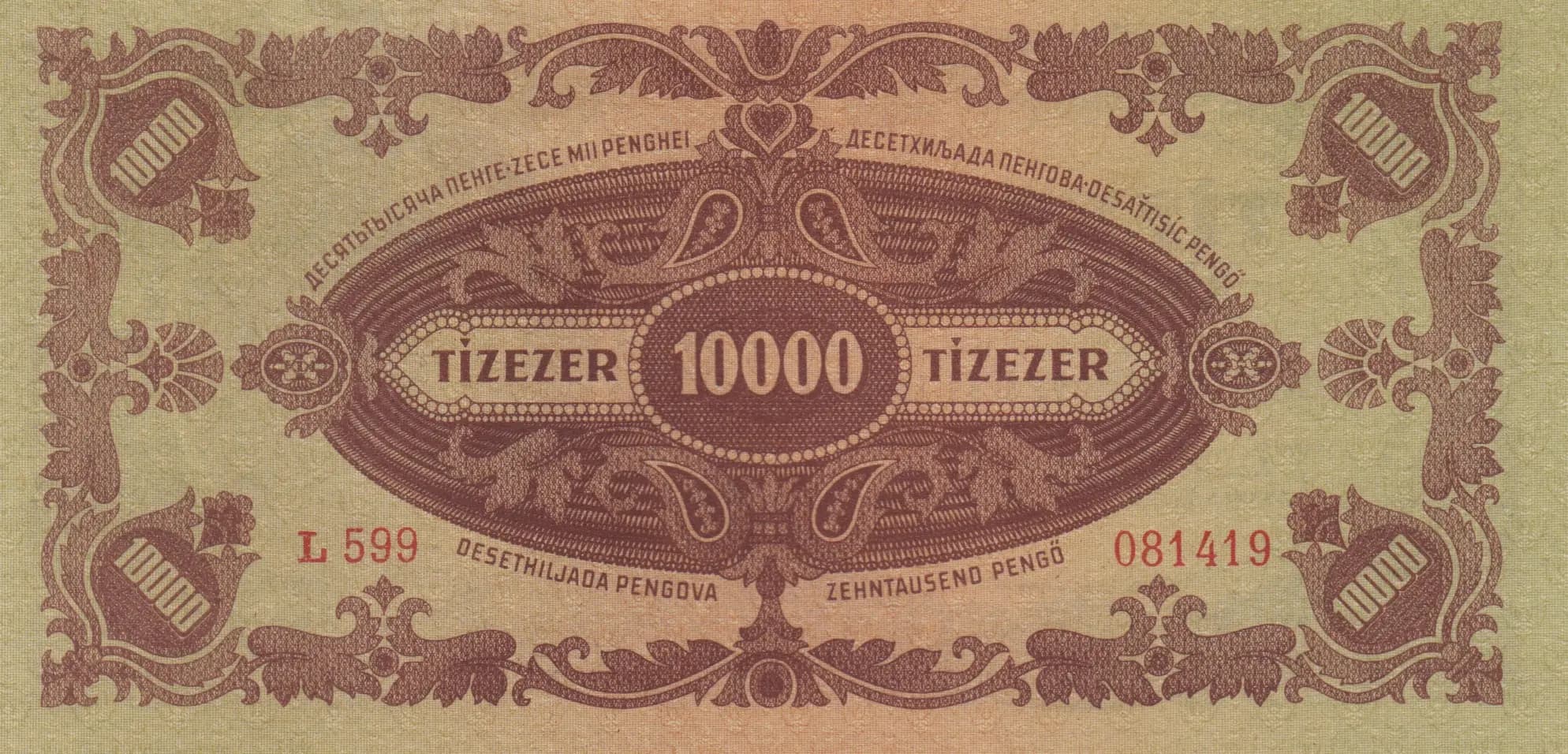
This is a well-preserved Hungarian 10,000 Pengö banknote from 1945, issued by the Magyar Nemzeti Bank on July 15th in the final months of World War II. The note displays excellent condition consistent with a UNC grade, featuring ornate baroque engraving with minimal wear, clear sharp printing, and uniform cream-tan patina. The front showcases a distinguished profile portrait in an oval frame alongside the Hungarian coat of arms, while the reverse displays multilingual denomination text and serial numbering, making it an interesting artifact of Hungary's late wartime currency.
Common. This note circulates frequently in the secondary market with consistent eBay sales averaging $2-5 across multiple condition grades (VF-EF range) over the past decade. The 2016 catalog value of $5 for UNC specimens aligns with observed auction prices, and the extensive sales history demonstrates ready availability. While historically significant as a late-war Hungarian issue, the note was produced in sufficient quantities to remain common in the collector market.
Issued during the twilight of Nazi-occupied Hungary, this 10,000 Pengö note represents the Magyar Nemzeti Bank's final major denomination releases before the pengö's collapse following Soviet occupation and the postwar hyperinflation crisis. The July 1945 date places it mere weeks before Hungary's liberation and the beginning of monetary chaos that would render the pengö worthless by 1946. The multilingual inscriptions (Hungarian, German, Serbian/Cyrillic) reflect the Austro-Hungarian Empire's legacy and the diverse linguistic composition of the pre-war Central European region.
The obverse features an ornate baroque design with a classical profile portrait of a woman facing left, positioned within an oval decorative frame on the right side of the note. The left side contains official signatures and titles of Magyar Nemzeti Bank officers (Chief Counselor, President, and Managing Director). The Hungarian coat of arms—featuring a shield with the distinctive Hungarian cross—appears in the lower right. The entire note is framed by baroque scrollwork and floral motifs in the corners and along borders. The reverse displays the denomination '10000' prominently within an ornamental oval medallion in the center, surrounded by decorative geometric and floral patterns. Multilingual text (Hungarian, German, and Serbian/Cyrillic) appears in curved banners, reflecting the cosmopolitan nature of prewar Central Europe. Serial numbers appear in the lower corners (L 599 / 0814419 in the examined specimen).
FRONT SIDE: '10000' (numerals); 'TÍZEZER PENGŐ' (Ten thousand pengö); 'BUDAPEST, 1945. ÉVI JÚLIUS HÓ 15-ÉN' (Budapest, July 15, 1945); 'MAGYAR NEMZETI BANK' (Hungarian National Bank); 'FŐTANÁCSOS' (Chief Counselor); 'ELNÖK' (President); 'VEZÉRIGAZGATÓ' (Managing Director); Warning text relating to counterfeiting penalties. REVERSE SIDE: '10000' (numerals); 'TÍZEZER' (Ten thousand, repeated); 'L 599 0814419' (Serial prefix and number); 'DESETHILIJAOA PENGOVA' (Ten thousand pengö - variant transliteration); 'ZEUNTAUSEND PENGO' (German: Ten thousand pengö); 'ДЕСЕТИХИЉАДА ПЕНГОВА' (Serbian/Cyrillic: Ten thousand pengö).
Intaglio engraving (recess printing), the traditional security printing method for Hungarian banknotes of this era. The fine line engraving is evident throughout both sides, with intricate decorative borders, ornamental medallions, and detailed portrait work characteristic of high-security currency production. The sharp, crisp printing quality visible in this UNC specimen indicates professional security printer production, likely by the Magyar Nemzeti Bank's own facilities or a contracted European security printer.
This note is cataloged as Pick P-119b, indicating it is the 'b' variety of the 10,000 Pengö series. The Pick catalog recognizes two variants (P-119a and P-119b) for this denomination and year. The specific variety designation typically relates to differences in signatures, overprints, or serial number prefixes. The examined specimen bears the serial prefix 'L 599', which would be relevant to variety identification. Without comparison to P-119a specimens, the exact distinguishing characteristics cannot be definitively stated from the visual analysis alone, but the Pick designation confirms this as the cataloged P-119b variant.