10 000 milpengö 1946
Market Prices
60 salesAbout This Note
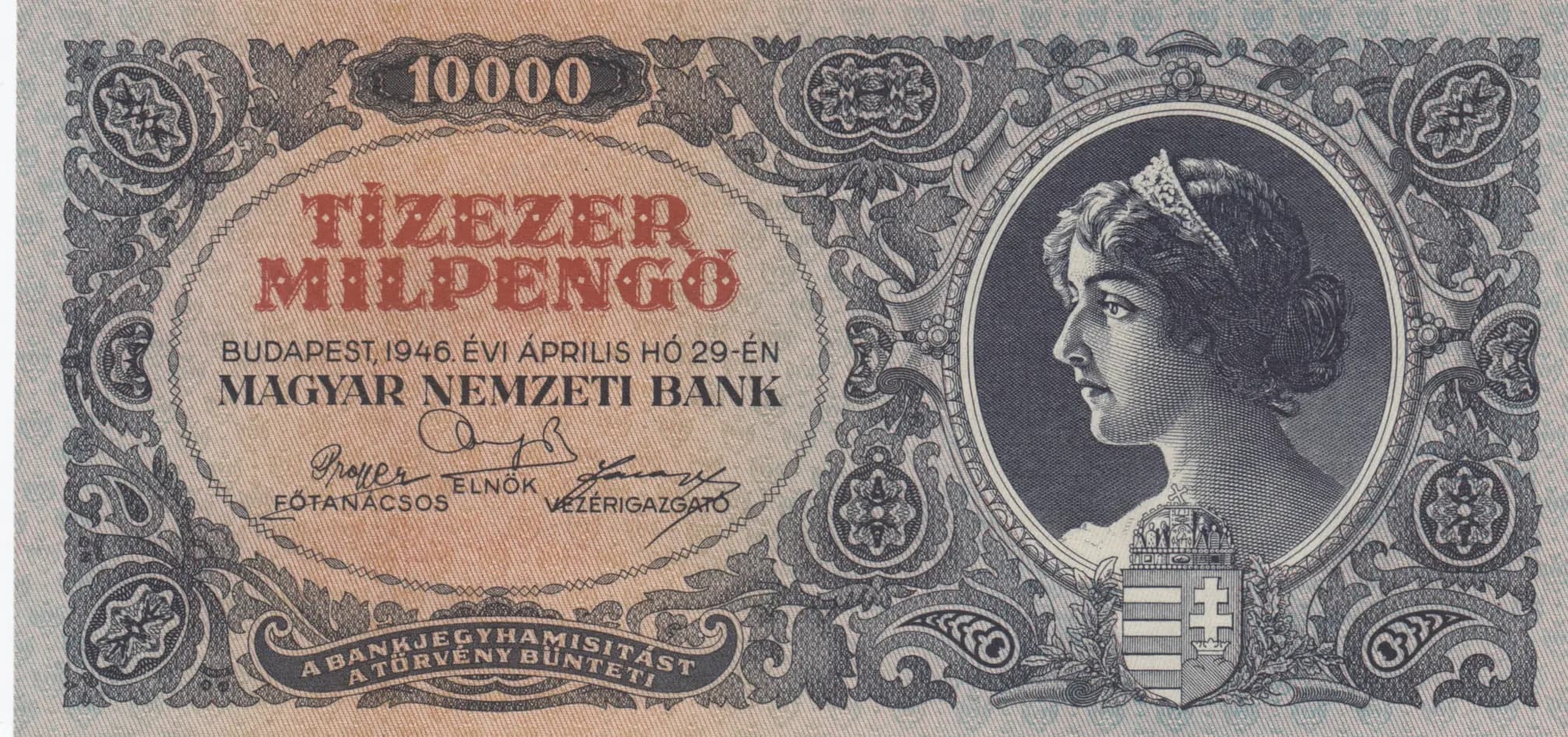
This is a Hungarian 10,000 Milpengö note from 1946, issued by the Magyar Nemzeti Bank on April 29th in the midst of post-World War II hyperinflation. The note displays exceptional preservation in AU condition with sharp, pristine printing throughout and no visible wear, creases, or foxing. The design features an elegant profile portrait of a woman in classical style on the obverse, complemented by ornate guilloche patterns and the Hungarian coat of arms, representing Hungary's attempt to stabilize its currency during one of history's most severe hyperinflationary periods.
Common. The eBay sales history provided demonstrates consistent availability with numerous transactions spanning from 2010 to 2025, with VF and EF specimens regularly selling in the $2-$9 range, well below the $20 threshold that typically indicates rarity. While professionally graded examples (PMG 65-66) command premiums reaching $30-$107, the abundance of ungraded sales and the note's consistent presence on the secondary market establish it as a commonly available issue. The Hungarian hyperinflation period notes were issued in substantial quantities, and this particular denomination remains readily obtainable for collectors.
This banknote was issued during Hungary's catastrophic post-WWII hyperinflation, one of the most severe monetary collapses in modern economic history. The denomination itself—expressed as both 10,000 milpengö and its equivalent 10 billion pengö—reflects the extraordinary devaluation of the pengö currency by 1946. The note's conservative classical design, featuring the Hungarian coat of arms and formal portraiture, was characteristic of Magyar Nemzeti Bank's attempt to project monetary authority and stability during a period of extreme economic chaos that would ultimately lead to currency reform.
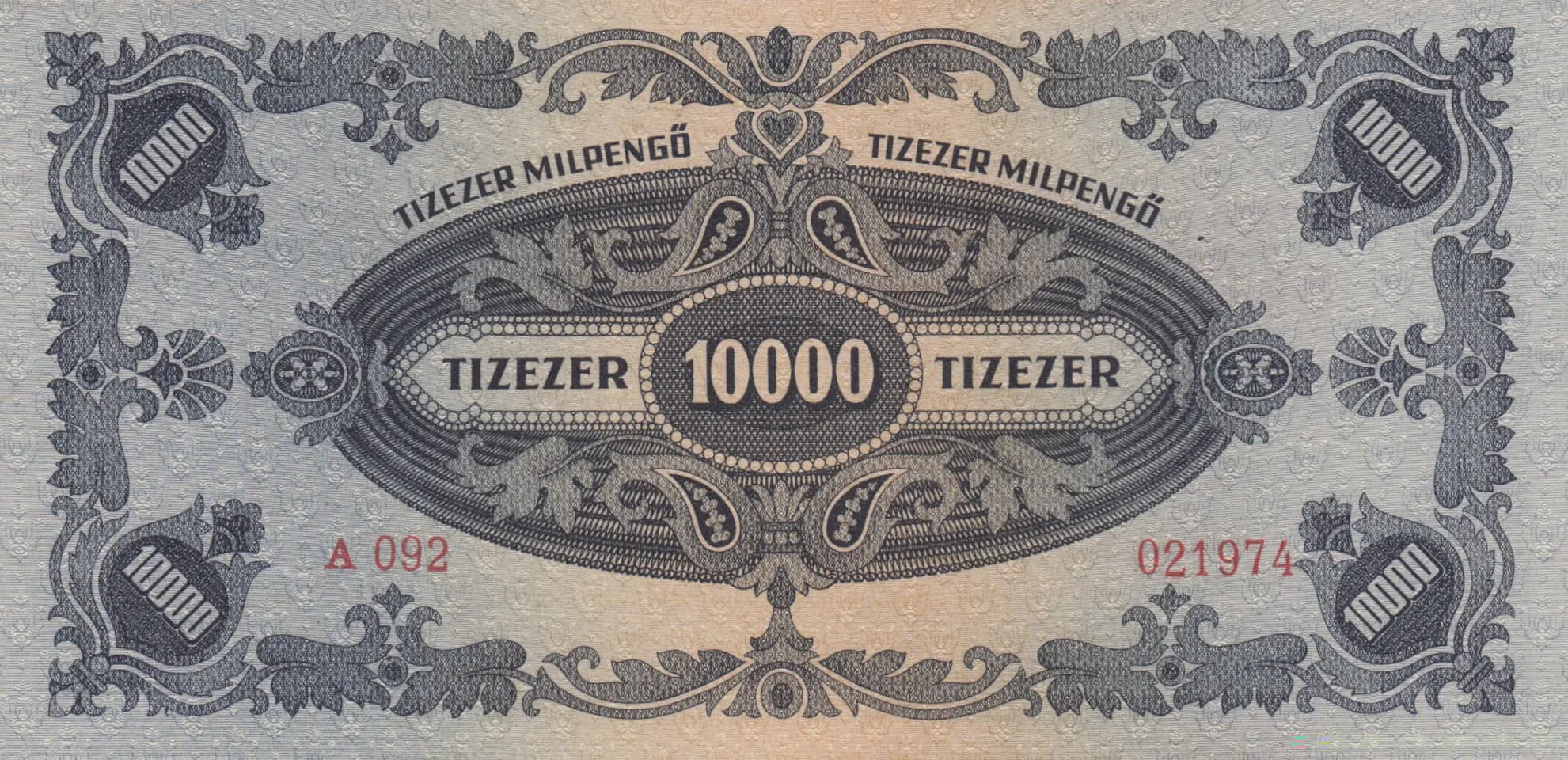
The obverse features a left-facing profile portrait of a woman wearing an ornate tiara or decorative headdress, rendered in fine black engraving within an oval frame positioned on the right side of the note. Below the portrait is positioned the Hungarian coat of arms displaying a shield with characteristic striping and cross motif, symbolizing national authority. The note is dominated by intricate decorative elements including elaborate guilloche patterns, symmetrical scrollwork, floral and vine motifs in the corners and margins, and ornate cartouches framing the denomination text. The reverse presents a large, centrally positioned oval frame containing the denomination, flanked by symmetrical wing designs and additional scrollwork. The color scheme throughout consists of tan/beige paper with dark gray/black engraving and red accents used for text and serial numbers. The overall aesthetic reflects Belle Époque and Art Nouveau design traditions adapted to commemorate Hungarian national identity during monetary crisis.
FRONT: 'TIZEZER MILPENGŐ' (Ten thousand milpengö); '10000' (numerical denomination); 'BUDAPEST, 1946 ÉVI ÁPRILIS HÓ 29-ÉN' (Budapest, 29th April 1946); 'MAGYAR NEMZETI BANK' (Hungarian National Bank); 'EÖTANÁCSOS' (Councillor); 'VEZÉRIGAZGATÓ' (Director General). BACK: 'TIZEZER MILPENGŐ' (Ten thousand milpengö); 'TIZEZER' (Ten thousand); '10000' (numerical denomination); 'A 092' (serial number prefix); '021974' (serial number sequence).
Intaglio (relief) engraving, characteristic of banknote production from this era. The sharp clarity of the fine line work, guilloche patterns, and complex border designs visible in both the front and reverse, combined with the precise registration evident in the color printing (particularly the red serial numbers and text elements), indicate professional banknote engraving executed by the Magyar Nemzeti Bank's printing facilities or authorized security printers. The exceptional quality of impression and definition of decorative elements suggests high-grade intaglio plates and careful press work.
This note is identified as Pick catalog number P-126, representing the standard 1946 issue dated April 29th. The serial number visible on the reverse specimen shown is 'A 092 021974'. Hungarian hyperinflation notes from this period occasionally exhibit variation in serial number prefixes and sequences. No major overprint varieties or significant design variants have been documented for this Pick number in standard references, indicating this represents the primary variety of the issue. The visual analysis confirms this matches the standard design specifications for P-126 with no notable deviations.