10 000 B- pengö 1946
Market Prices
59 salesAbout This Note
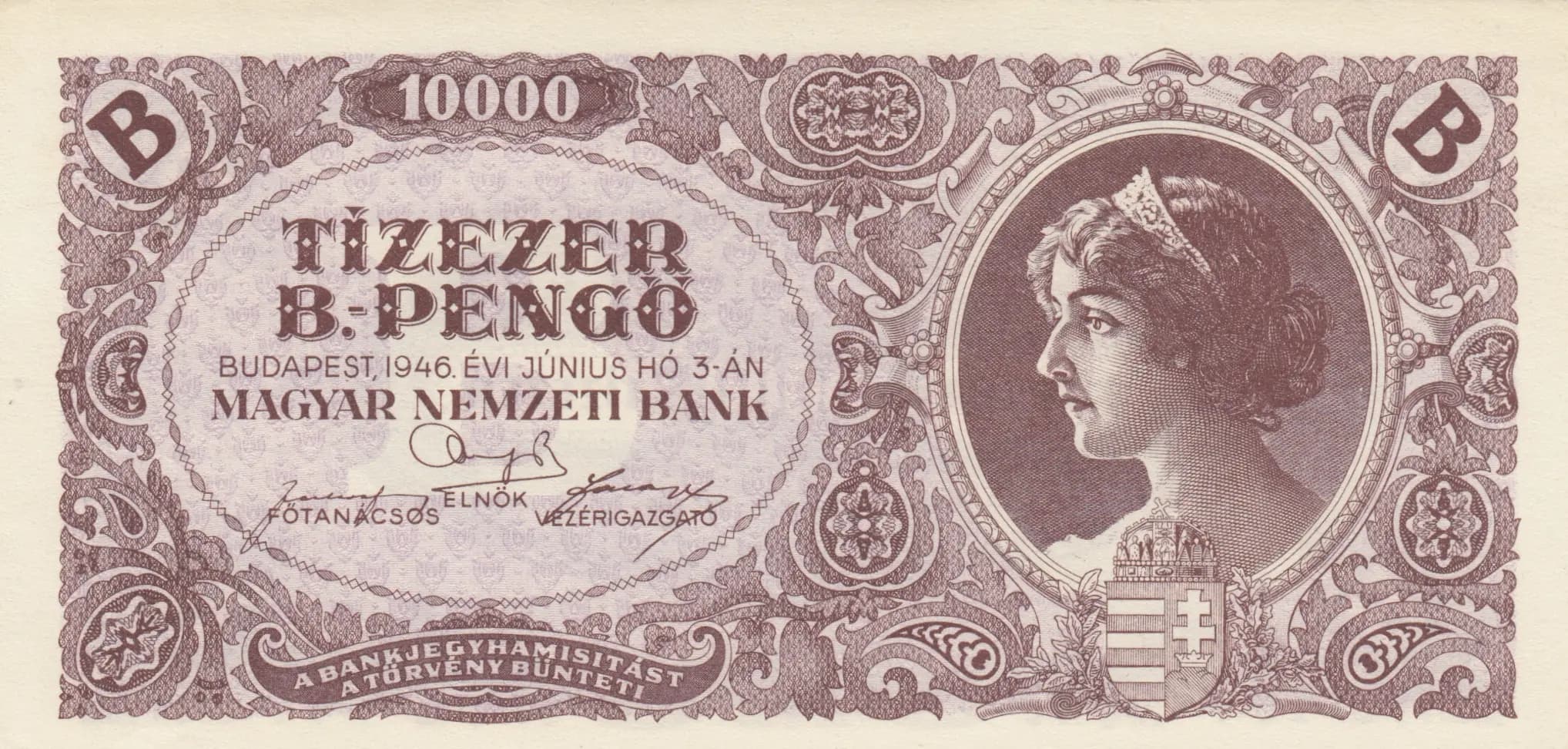
This is an AU-graded Hungarian 10,000 B-Pengö from June 3, 1946, issued by the Magyar Nemzeti Bank during the hyperinflation period following World War II. The note displays exceptional preservation with no visible wear, creases, or folds, featuring an elegant mauve and purple-brown color scheme on cream stock. The classical portrait of a woman in profile, ornate baroque/art nouveau borders, and intricate fine-line engraving exemplify the high-quality craftsmanship of post-war Hungarian currency design.
Common. eBay market data shows consistent sales in the $1-$50 range depending on condition, with the vast majority of transactions below $25. Regular-issue B-Pengö notes from 1946 were printed in substantial quantities to address the hyperinflation crisis. Even graded examples (PMG 64-67) sell in the $15-$70 range, indicating ready supply in the collector market. The note's historical significance relates to the hyperinflation period rather than rarity.
This banknote represents Hungary's monetary crisis in the immediate post-WWII period, when the Pengö experienced catastrophic hyperinflation—necessitating the introduction of the 'B-Pengö' (Billió-Pengö, or billion-Pengö) denomination to represent larger values. The June 1946 issue date places this note at the peak of Hungarian hyperinflation, which would ultimately lead to the complete abandonment of the Pengö and adoption of the Forint in 1927. The classical female portrait and ornamental design reflect Hungary's attempt to maintain aesthetic dignity in its currency despite economic collapse.
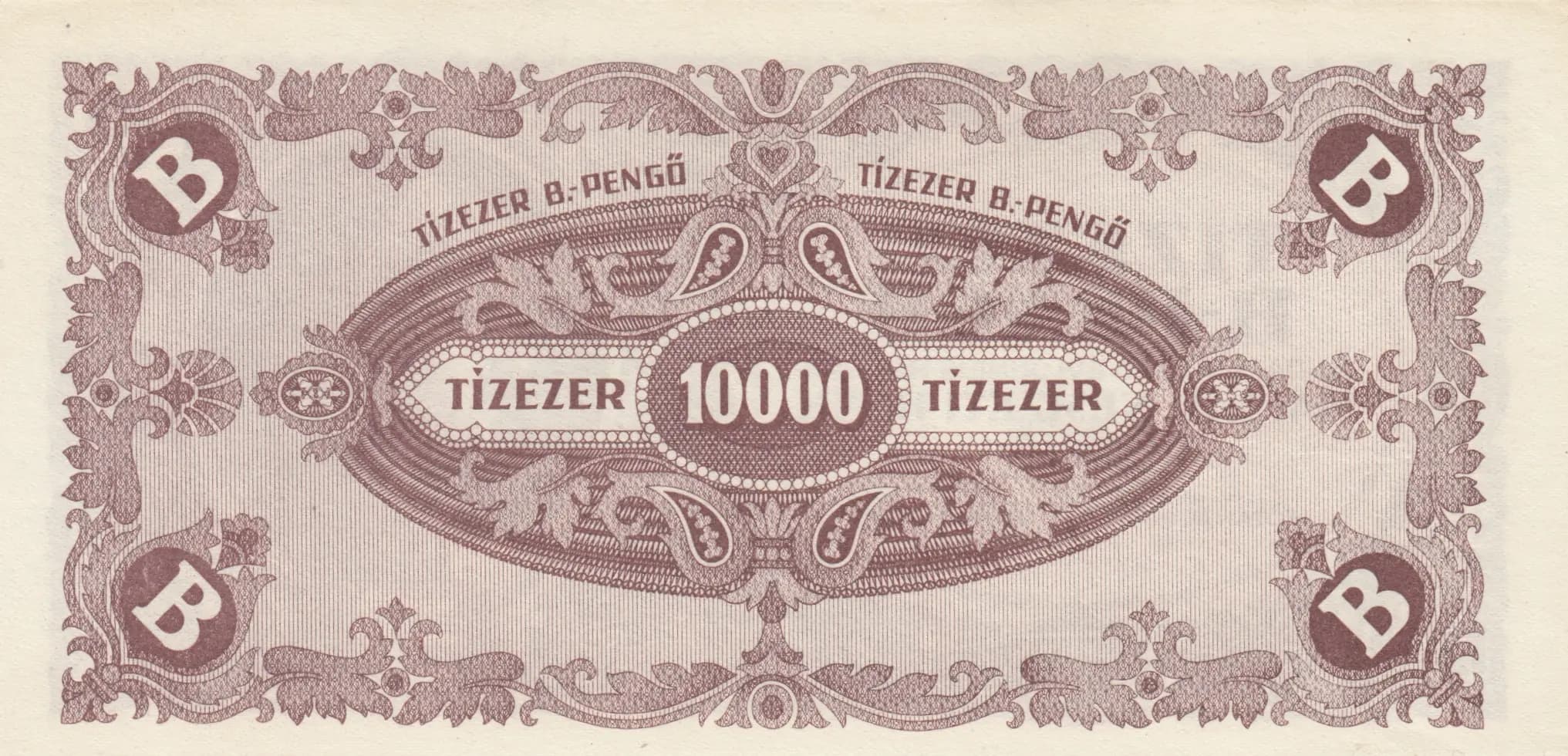
The obverse features a classical female profile portrait positioned in an ornate circular medallion on the right side of the note, rendered in the art nouveau/baroque revival style characteristic of mid-20th century European banknote design. The reverse employs a purely decorative composition with symmetrical ornamental elements, eschewing additional portraiture in favor of intricate scrollwork, floral motifs, and botanical patterns. The Hungarian coat of arms (visible on the front as a shield with cross design) serves as the primary national symbol. Decorative 'B' letters occupy the corners of both sides, emphasizing the B-Pengö denomination. The overall design reflects sophisticated intaglio engraving with fine parallel lines creating texture and depth throughout.
Front: '10000' / 'TÍZEZER B-PENGŐ' (Ten Thousand B-Pengö) / 'BUDAPEST, 1946. ÉVI JÚNIUS HÓ 3-ÁN' (Budapest, June 3rd, 1946) / 'MAGYAR NEMZETI BANK' (Hungarian National Bank) / 'FOTANÁCSÖS' (Chairman) / 'FÖLNÖK' (Governor) / 'VEZÉRIGAZGATÓ' (Managing Director) / 'A BANKJEGYHAMISÍTÁST BÜNTETNI RENDELT SUNTETEI' (Banknote counterfeiting is punishable by law). Back: 'TÍZEZER B-PENGŐ' (Ten Thousand B-Pengö) / '10000' / 'TÍZEZER' (Ten Thousand).
Intaglio (engraved) printing on banknote-grade paper. The note exhibits the characteristic fine-line engraving with complex parallel lines and intricate ornamental patterns typical of professional banknote production. The detailed security features—including the elaborate border designs, fine line work, and multiple signature areas—indicate production by a specialized security printer, consistent with Magyar Nemzeti Bank standards of the period.
Pick catalog P-132 identifies this as the standard 10,000 B-Pengö issue from June 3, 1946. The note is recorded as lacking a serial number, which is consistent with emergency-issue characteristics of the hyperinflation period. The visual analysis confirms no visible serial numbering on this specimen, typical for this variety. PMG population data indicates one catalogued variant for this base Pick number; this note represents the standard variety without distinguishing overprints or date variations.