10 000 adopengö 1946
Market Prices
29 salesAbout This Note
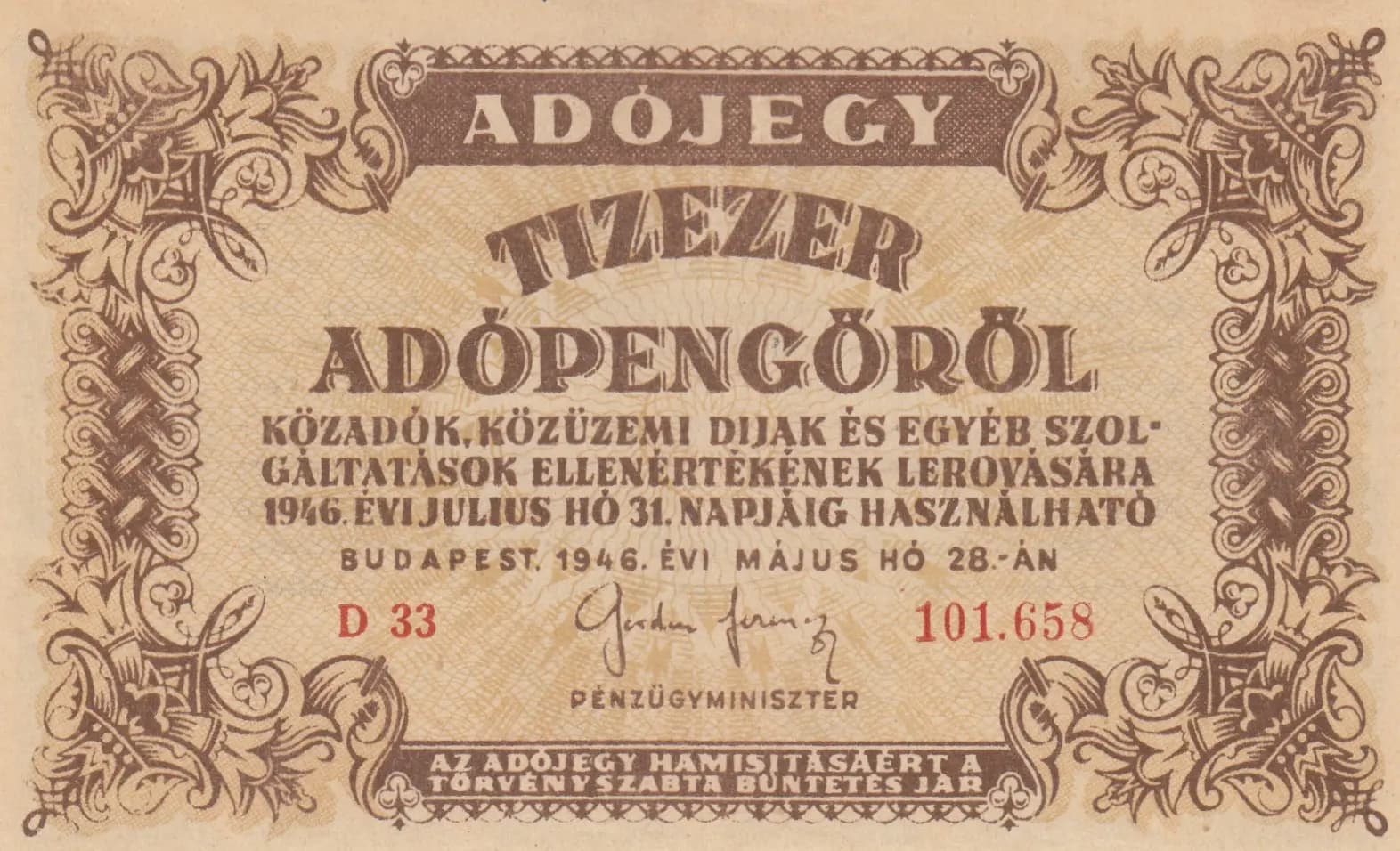
This 10,000 Adópengö tax receipt from May 28, 1946, represents a fascinating artifact of Hungary's post-WWII hyperinflation period. The note exhibits excellent condition (EF grade) with clear printing, minimal creasing, and consistent aging patina appropriate to its 1946 origin. The ornate baroque-style decorative borders and well-preserved red serial number (D 33 / 101.658) make this a visually appealing example of this emergency currency issue.
Common. eBay market data shows consistent sales across a 15-year period (2010-2025) with VF examples typically selling for $1-$6.50 and EF examples for $3.10-$4.56. The 2016 catalogue values list EF at only $6 and UNC at the same price point. The high frequency of sales and low price levels indicate substantial surviving quantities in the collector market. Large print runs of these tax receipts were issued as emergency currency during 1946, ensuring they remain readily available today.
This tax receipt was issued by the Hungarian Finance Ministry (Pénzügyminiszter) during the catastrophic hyperinflation that followed Hungary's liberation from Nazi occupation in 1945. Rather than traditional banknotes, the government issued these Adópengö (tax pengö) documents as payment vouchers for public taxes, utility fees, and services—a desperate measure to manage the collapsing pengö currency. The May 28, 1946 issuance date and July 31, 1946 expiration date reflect the temporary, emergency nature of this currency substitute, which was eventually rendered worthless as the pengö hyperinflation spiraled toward complete monetary collapse.
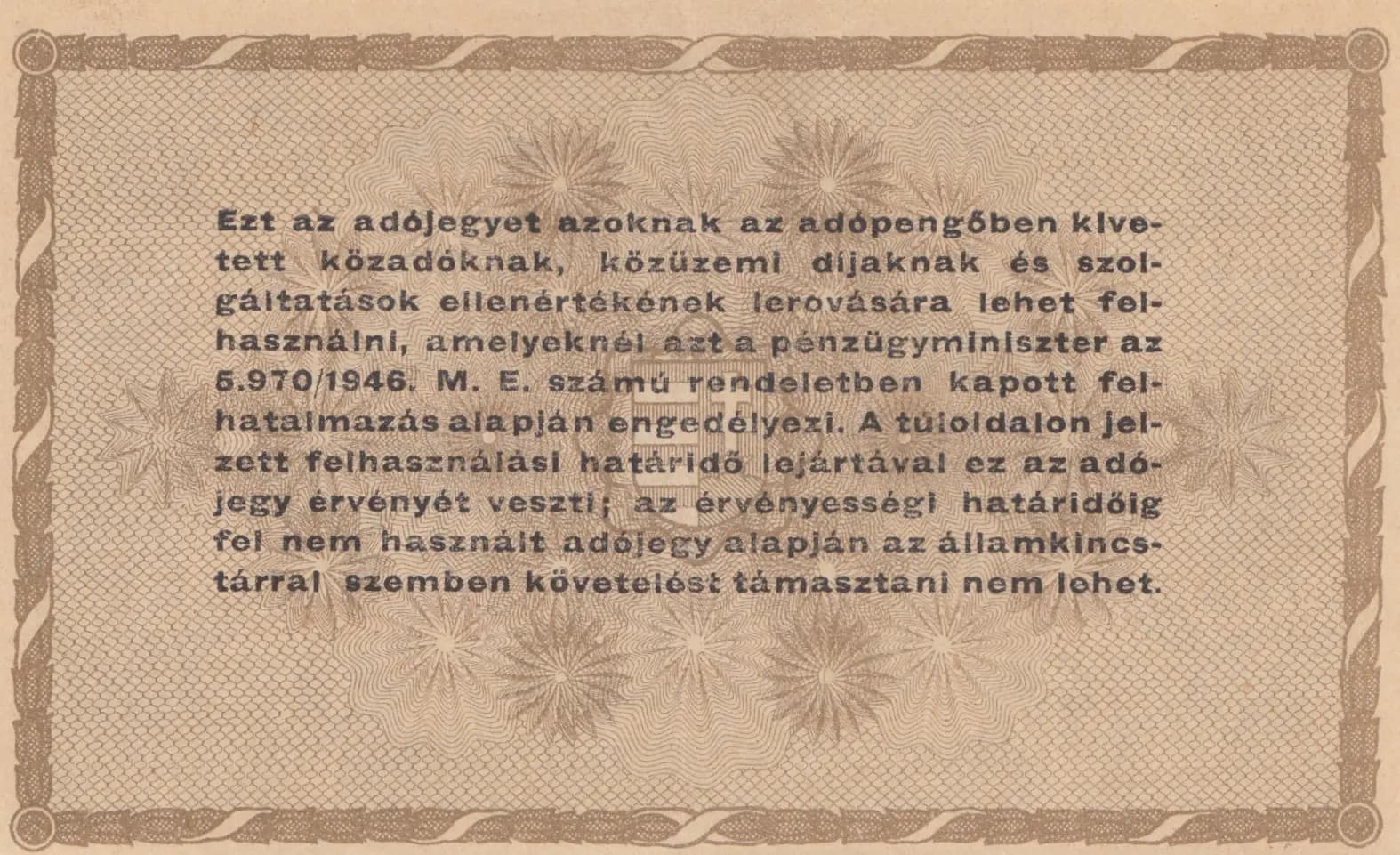
This is not a traditional banknote but rather a tax payment receipt (Adójegy)—a form of emergency currency substitute issued during Hungary's 1946 hyperinflation crisis. The design features symmetrical ornate baroque-style scrollwork and floral patterns in brown/tan ink forming decorative borders on both left and right sides of the front, with corner ornaments on the back. The center of the obverse displays the denomination in large text ('TIZEZER ADÓPENGÖRÖL') with administrative text explaining its use as payment for public taxes and utility fees valid through July 31, 1946. The document includes a printed signature line for the Finance Minister (PÉNZÜGYMINISZTER), serial number combination in red ink (D 33 / 101.658), and comprehensive legal text on the reverse establishing validity conditions and stating that counterfeiting carries statutory penalties. The entire design is rendered in serif typography on tan/beige paper with brown and red inks, consistent with official government documents of the period.
FRONT: 'ADÓJEGY' (Tax Receipt/Tax Document); 'TIZEZER ADÓPENGÖRÖL' (Ten Thousand Adó-pengö); 'For payment of public taxes, utility fees and other service charges, usable until July 31, 1946' (main usage statement); 'Budapest, May 28, 1946' (date and place of issue); Serial numbers: 'D 33' and '101.658'; 'PÉNZÜGYMINISZTER' (Finance Minister); 'Counterfeiting this tax receipt carries penalties prescribed by law.' BACK: 'This tax receipt can be used for payment of public taxes levied in adó-pengö, utility fees and service charges for which the Finance Minister authorized in decree no. 5.970/1946 M. E. Upon expiration of the usage deadline indicated on the document, this tax receipt loses its validity; after the validity deadline, unused tax receipts cannot be used to claim against the state treasury.'
Typographic (letterpress) printing on tan/beige paper stock with brown and red inks. The crisp, clear impression of text and the fine detail in the baroque ornamental borders are characteristic of professional government printing facilities. The serial numbers in red demonstrate multi-color capability. No security features beyond ornamental design and printed signatures are evident, as was typical of emergency tax vouchers issued during monetary crises. The specific printer is not attributed in visible inscriptions.
Pick 143a variety with serial number prefix D 33 and serial number 101.658. The decree reference on the back (5.970/1946 M.E.) is the controlling regulation. Known varieties exist with different serial number prefixes and ranges corresponding to different batches issued throughout May-July 1946. This EF example with serial number in the 101,000 range represents a mid-series issue from the May 28, 1946 release date. No major overprints or signatures variations are apparent on this example.