10 000 000 milpengö 1946
Market Prices
68 salesAbout This Note
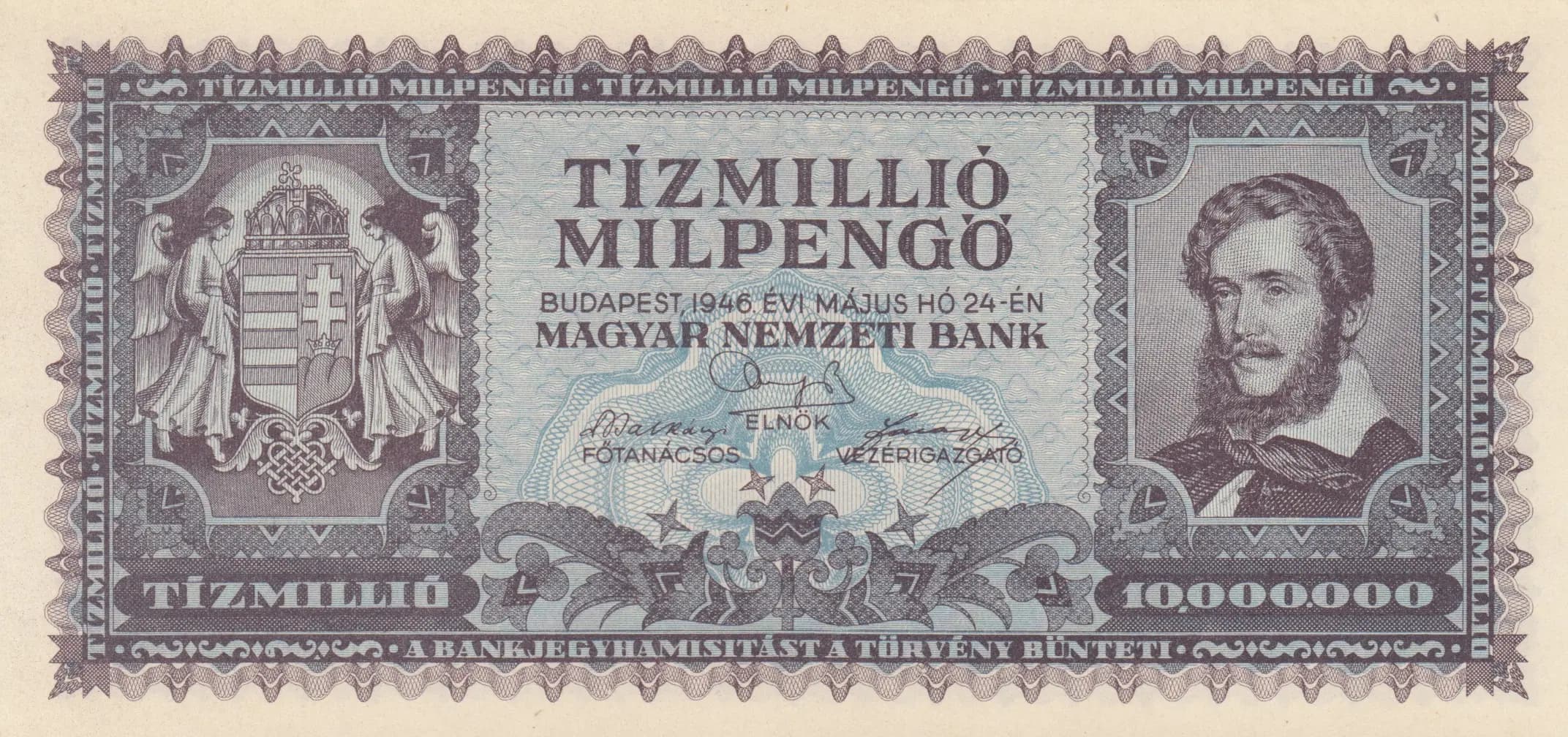
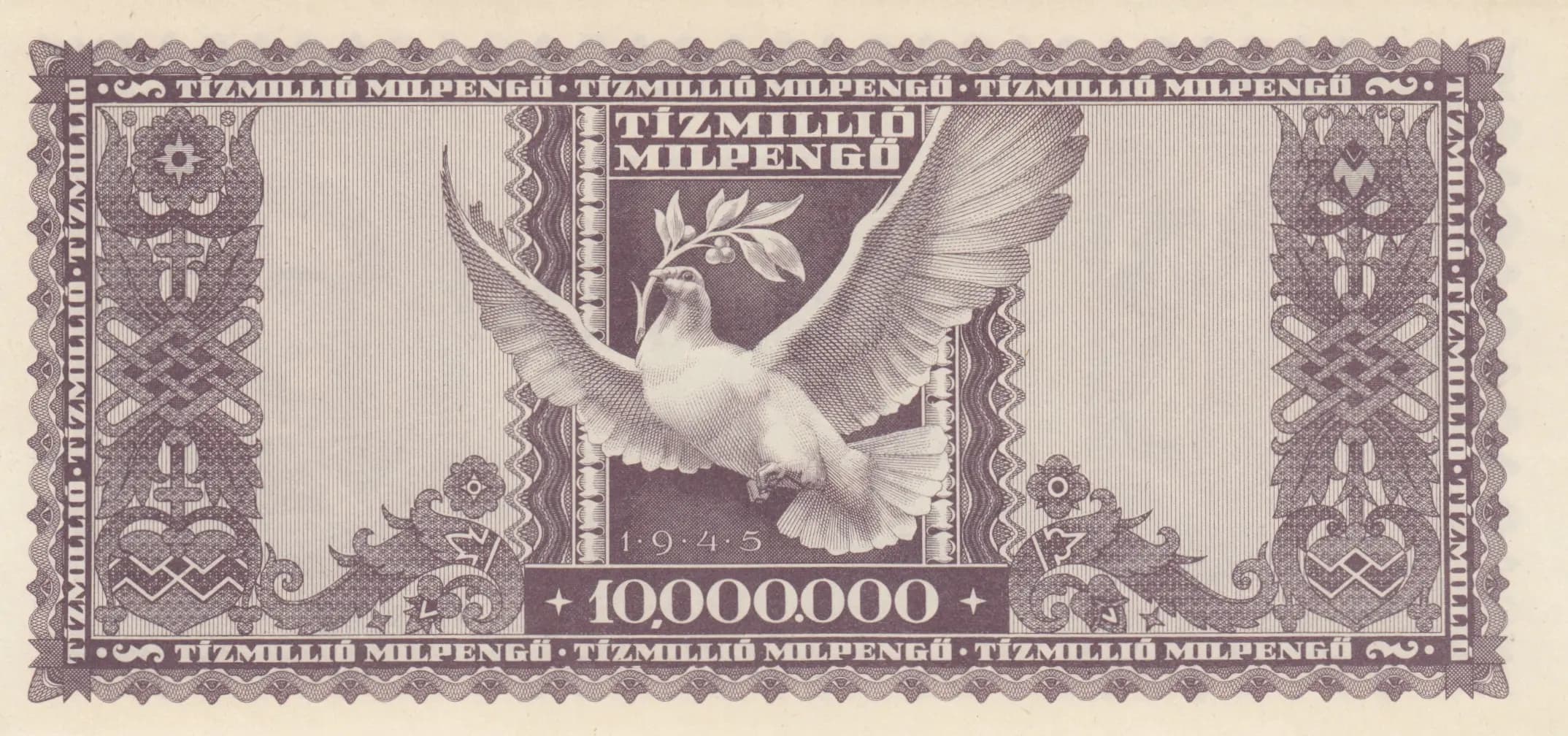
This is a Hungarian 10,000,000 Milpengö note from May 24, 1946, issued by the Magyar Nemzeti Bank during the post-WWII hyperinflation period. The note exhibits AU condition with crisp, bright colors—predominantly purple/violet with light gray and white accents—and shows no visible wear, folds, or damage. The obverse features a finely engraved portrait of Lajos Kossuth in formal dress set against an ornate decorative framework, while the reverse displays a striking white dove carrying an olive branch, symbolizing peace during Hungary's post-war reconstruction.
Common. While historically significant as a hyperinflation-era note, the P-129 10 Million Milpengö is common in the numismatic market. eBay market data spanning 2009-2026 consistently shows this note trading at low prices ($1-$10 for VF-EF grades, with UNC examples reaching $6-$102 but typically under $50), indicating robust supply and modest collector demand. Print runs for these high-denomination emergency issues were substantial to meet the hyperinflationary demand of 1946, and survival rates remain high. The AU condition grade of the present specimen does not significantly elevate rarity, as multiple examples in similar condition have regularly appeared on the secondary market at modest valuations.
This banknote represents one of the most extreme episodes of hyperinflation in modern economic history. Issued in May 1946, it reflects the catastrophic currency collapse that followed Hungary's devastation in World War II, when the pengő became essentially worthless and required ever-larger denominations to represent any real value. The denomination of 10 million milpengö (equivalent to 10 trillion pengö) illustrates the severity of the inflation crisis that ultimately led to the complete currency reform and introduction of the forint in August 1946.
The obverse features a left-facing coat of arms with shield and crown, flanked by two winged allegorical female figures representing Hungary's national symbols, positioned at the center-left. To the right is a formal profile portrait of Lajos Kossuth (1802-1894), the renowned Hungarian nationalist revolutionary and political leader, depicted in 19th-century formal military or state dress, facing right. The reverse showcases a centered white dove in flight with wings spread, carrying an olive branch in its beak, set against a dark background panel—symbolizing hope for peace and national recovery during the post-war period. Both sides are framed by ornate geometric decorative borders with repeating guilloche patterns typical of high-security banknote design.
Front: 'TÍZMILLIÓ MILPENGŐ' (Ten Million Milpengö); 'BUDAPEST 1946 ÉVI MÁJUS HÓ 24-ÉN' (Budapest, May 24, 1946); 'MAGYAR NEMZETI BANK' (Hungarian National Bank); 'ELNÖK' (President); 'FOTANÁCSOS' (Counselor); 'VEZÉRIGAZGATÓ' (Director General); 'A BANKEGYHAMISÍTÁST A TÖRVÉNY BÜNTETI' (Counterfeiting the banknote is punished by law); '10000000' (10,000,000). Border pattern repeats: 'TÍZMILLIÓ MILPENGÚ' (Ten Million Milpengö). Back: 'TÍZMILLIÓ MILPENGŐ' (Ten Million Milpengö); '1 · 9 · 4 · 5' (1945); '10,000,000' (10,000,000). Border pattern repeats: 'TÍZMILLIÓ MILPENGÚ' (Ten Million Milpengö).
Intaglio engraving (line engraving and recess printing), evidenced by the crisp fine-line detail work visible in the portrait rendering, the dove's feather detailing, and the intricate guilloche patterns throughout. The sharp definition of all security features, decorative elements, and text indicates professional banknote security printing, likely executed by the Magyar Nemzeti Bank's printing facility or a contracted European security printer specializing in intaglio work during this period.
No serial number is present on this note, consistent with the catalog description for P-129. The note bears the date '1946 ÉVI MÁJUS HÓ 24-ÉN' (May 24, 1946) on the obverse and '1 · 9 · 4 · 5' on the reverse. PMG records indicate one cataloged variant for the Pick-129 base number. The absence of serial numbering was common for emergency high-denomination issues during Hungary's 1946 hyperinflation, as speed of production took priority over traditional security measures. No overprints or signatures are visible, which is consistent with this series.