1 korona 1920
Market Prices
58 salesAbout This Note
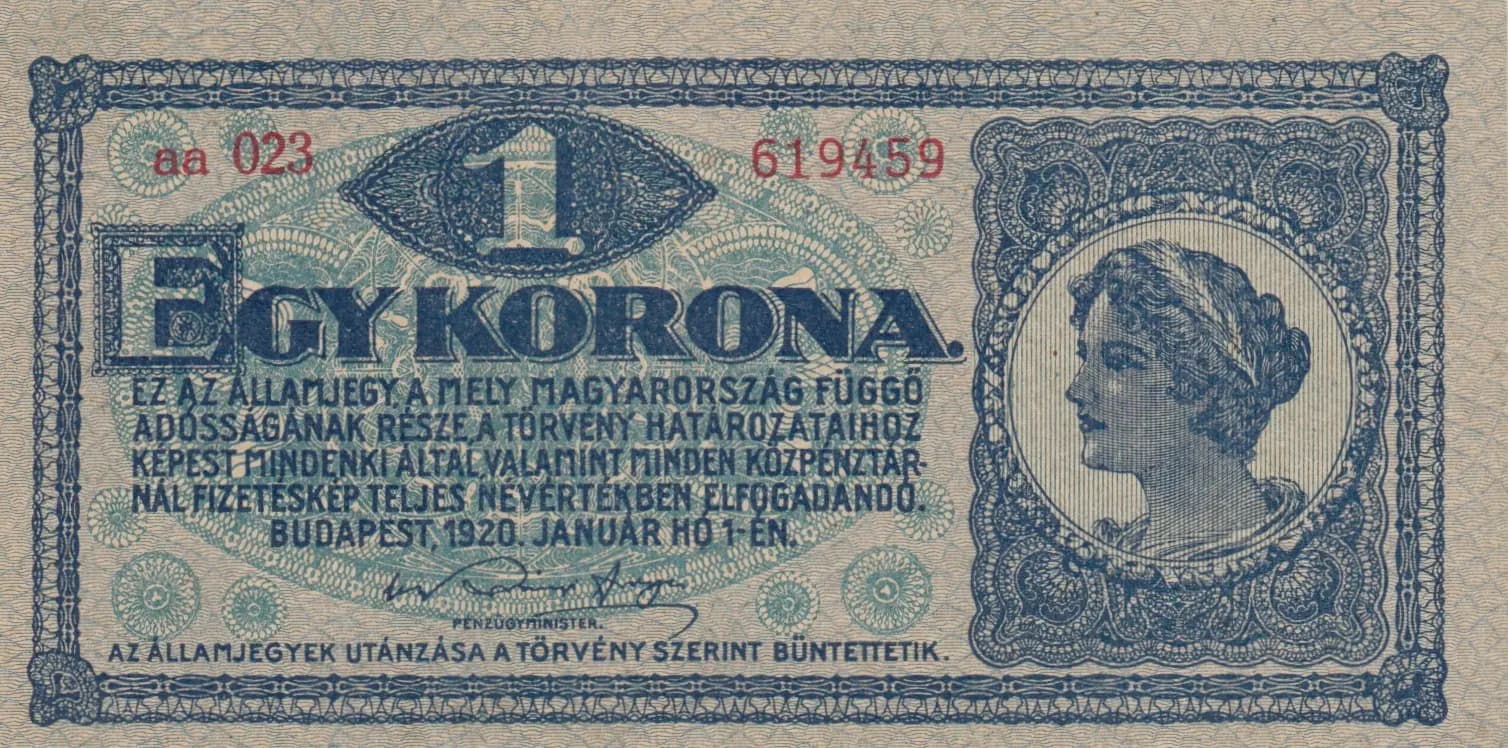
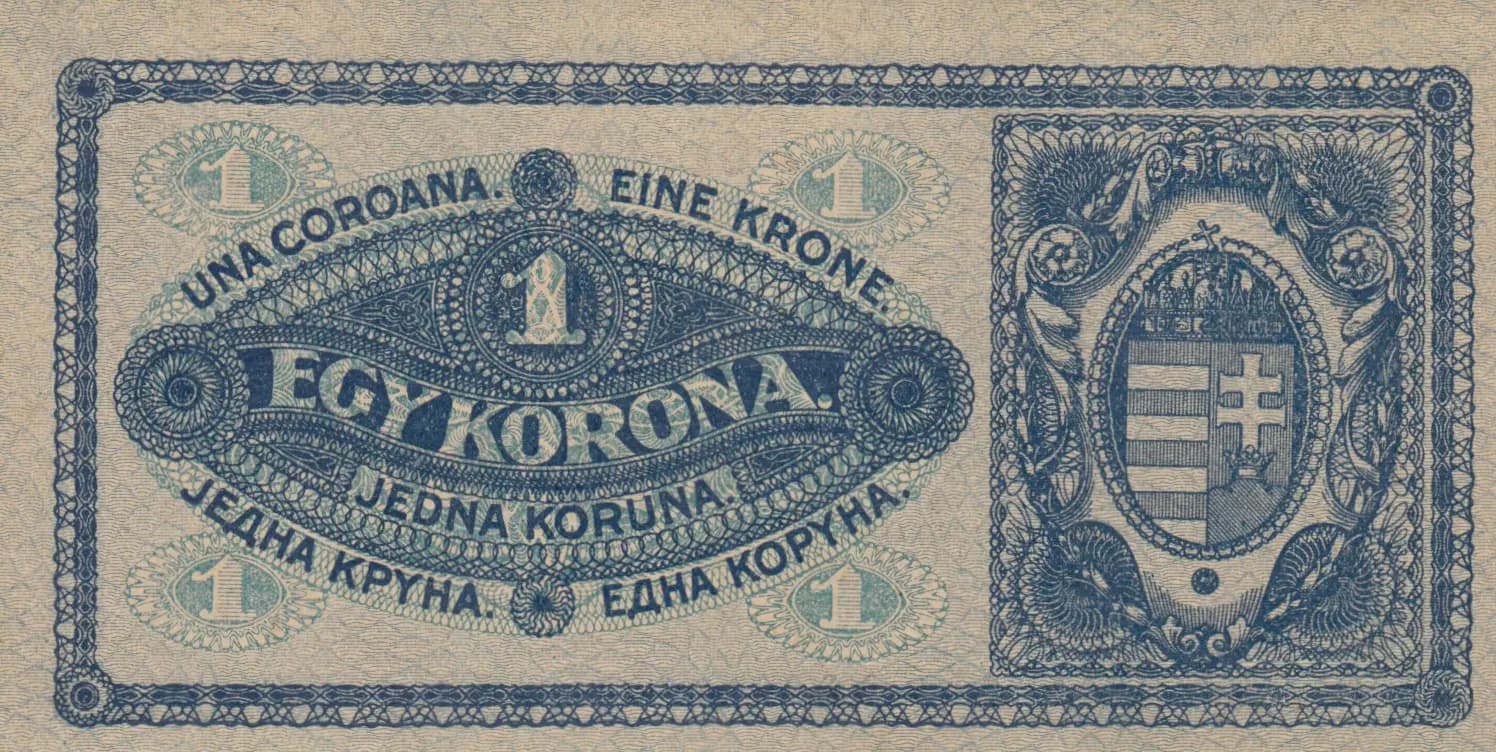
This 1920 Hungarian 1 korona note (Pick P-57) exhibits exceptional uncirculated condition with crisp, clear impressions throughout and no visible wear, folds, or creases. The note features an elegant female portrait in profile on the obverse and the Hungarian coat of arms on the reverse, both rendered in fine engraved detail with ornate geometric and floral borders. This early post-WWI Hungarian currency represents an important transitional period in the nation's monetary history following the Austro-Hungarian Empire's dissolution.
Common. The eBay market data shows consistent sales across multiple condition grades (VF, EF, AU, UNC) from 2009 through 2025, with prices typically ranging from $1–$5 USD for standard circulated grades and $3–$6 for uncirculated examples. The note's steady appearance in auctions with moderate bid counts indicates a healthy supply in the collector market. While the 1920 date represents an interesting historical period, no specific scarcity factors (small print run, recall, or short issue period) are evident. The catalog value of $3 for UNC condition further supports a common classification.
Issued January 10, 1920, by the Hungarian Ministry of Finance (Pénzügyminisztérium), this note represents Hungary's early attempt to establish independent monetary sovereignty after the collapse of the Austro-Hungarian Empire in 1918. The multilingual inscriptions on the reverse (Hungarian, Latin, German, Czech/Slovak, and Serbian/Cyrillic) reflect Hungary's new borders and the diverse populations of the truncated post-war state. The prominent display of the Hungarian coat of arms with crown symbols reinforces national identity during a period of significant political and territorial reorganization.
The obverse features a female portrait in profile facing right, rendered in the neoclassical style typical of early 20th-century European banknote design. The portrait depicts a woman with her hair styled up in period fashion, executed through fine engraved linework characteristic of security printing. The denomination 'EGY KORONA' is prominently displayed in an oval cartouche at the center. Ornate decorative borders with intricate geometric patterns and scattered rosette designs frame the composition, while red serial numbers appear in the upper corners. The reverse displays the Hungarian state coat of arms as the primary design element, featuring a shield with horizontal stripes surmounted by a crown, flanked by double-headed eagle motifs and cross symbols. The denomination is presented in five languages arranged in curved banners around the heraldic centerpiece, reflecting the multilingual character of the post-war Hungarian state. Matching ornamental border treatments with rosettes and geometric designs unify the composition.
FRONT SIDE: Serial number prefix 'aa' with number '023' and '619439'; 'EGY KORONA' (Hungarian: One korona); 'PENZUGYMINISTER' (Hungarian: Finance Minister); Extended legal text reading 'This state note is part of the present debt of Hungary according to the law and is payable at all public treasuries and must be accepted at all public cashiers on all dates mentioned. Budapest, January 10, 1920'; 'AZ ÁLLAMJEGYEK UTANZÁSA A TÖRVÉNY SZERINT BÜNTETTETIK' (Hungarian: Counterfeiting of state notes is punished according to law). BACK SIDE: 'EGY KORONA' (Hungarian: One korona); 'UNA CORONA' (Latin: One crown); 'EINE KRONE' (German: One crown); 'JEDNA KORUNA' (Czech/Slovak: One koruna); 'EDNA KORINHA' (Serbian/Cyrillic: One koruna); Large numeral '1'.
Intaglio (engraving and recess printing), the standard security printing method for European banknotes of this period. The fine linework, detailed rosette patterns, and sharp impressions observed throughout both sides are characteristic of intaglio printing. The printer for this issue was likely the Pósta Takarékpénztári Nyomda or another established Hungarian security printer, though specific attribution would require additional documentation. The geometric and floral patterns serve as built-in security features typical of the era before modern security threads and holograms.
The observed specimen exhibits serial number prefix 'aa' with serial number '619439', indicating this note is from the standard printing. The date 'JANUAR 10-EN' (January 10) is consistent with the Pick P-57 catalog designation. No overprints, color variations, or other distinguishing features indicative of known varieties are apparent. Standard varieties for this issue would include different serial number prefixes and potentially minor signature variations, though the resolution does not permit definitive identification of the signature authority. The AU grade and pristine condition make this example notable within the common classification, but no specific rare variety designation applies.