1 korona 1920
About This Note
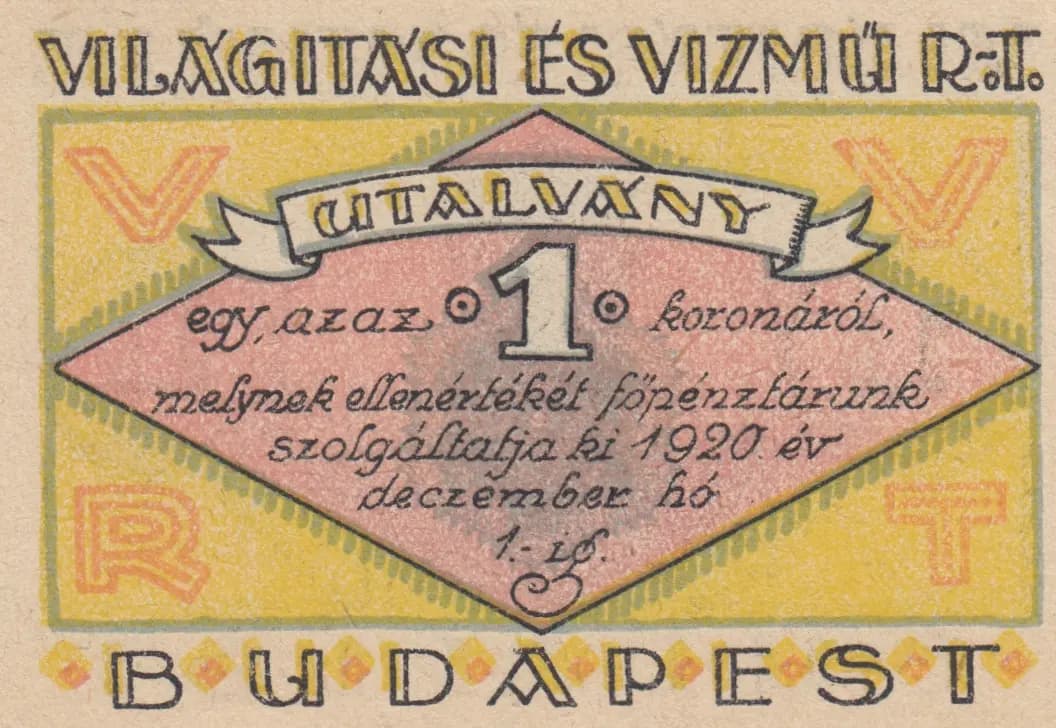
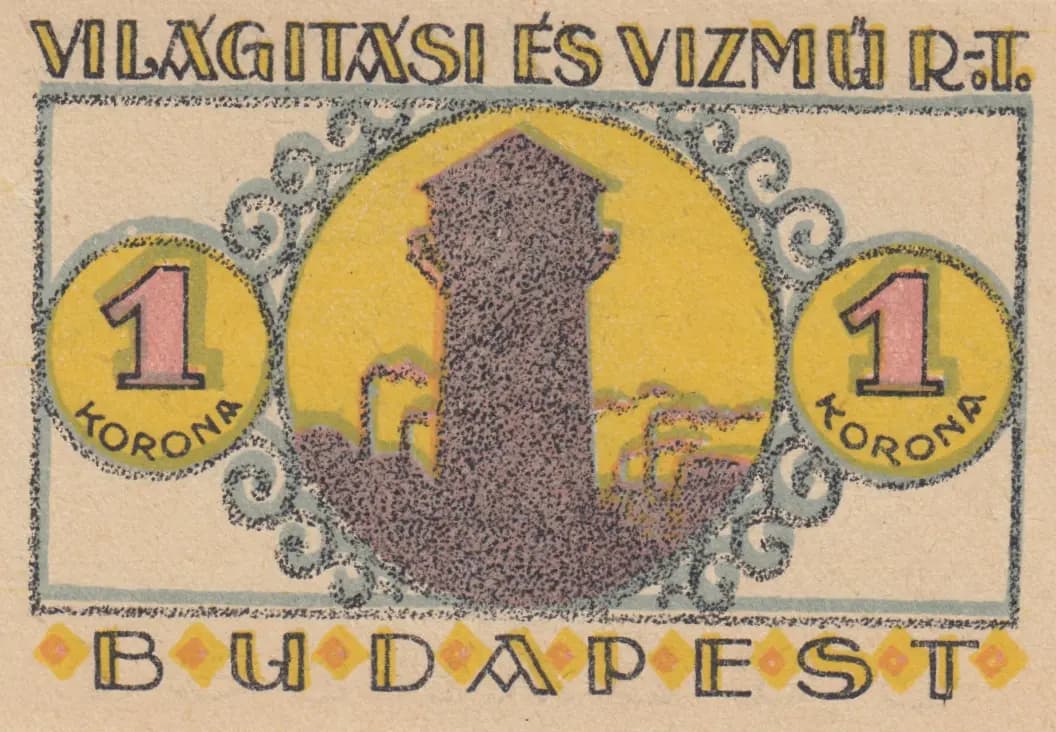
A fascinating Hungarian emergency currency issued by the Világitási és Vizmű R.T. (Lighting and Water Works Ltd.) in Budapest, dated December 1, 1920. The obverse features an ornate yellow and pink diamond-shaped cartouche design with decorative X-patterns, while the reverse displays a distinctive medieval tower or fortification structure in a circular yellow vignette flanked by denomination medallions. This UNC specimen exhibits minimal wear with only light age-related discoloration, preserving the vibrant original color palette of yellows, pinks, and blues characteristic of early 1920s Hungarian municipal currency.
Common. This note represents a municipal emergency currency from a known Budapest public utilities company with a straightforward redemption promise dated December 1, 1920. While not produced in massive quantities like national currency, such municipal scrip from Budapest was issued in sufficient quantities to meet local circulation needs. The denomination (1 korona) was a low-value denomination typically produced in larger quantities. The Pick catalog's 'unlisted' status reflects the specialized nature of such local currencies rather than extreme rarity, and these notes remain accessible to collectors of Hungarian emergency currency and municipal issues.
This note represents a unique period in Hungarian monetary history during the post-World War I transition and the early years of the Hungarian Soviet Republic. The 1920 date places this squarely in the turbulent Trianon period when Hungary faced severe economic disruption, making such municipal and corporate emergency currencies common as official currency became scarce. The Budapest-based Világitási és Vizmű R.T., a public utilities company, issued this currency as a form of emergency scrip to facilitate local commerce and pay workers when conventional money was unavailable.
The obverse presents a highly stylized geometric design centered on a diamond-shaped cartouche rendered in pink/mauve on a yellow field, with the issuer name and redemption promise prominently displayed. Flanking the cartouche are decorative red/orange X-shaped ornamental elements. The reverse features a carefully rendered medieval tower or fortification structure, likely representing a Budapest landmark such as one of the city's historic defensive towers, depicted in dark gray/brown tones set within a circular yellow vignette. Two circular medallions with ornamental scrollwork borders flank the tower, each containing the denomination '1' in pink/red with 'KORONA' in blue text below. The overall design employs warm color harmonies typical of early 20th century Central European currency design, with the tower representing civic pride and municipal authority.
Front side: 'VILÁGITÁSI ÉS VIZMŰ R.T.' (Lighting and Water Works Ltd.) at top center within the diamond cartouche; 'egy azaz 1 koronáról, melyemek ellenértékét fölpenzlárzunk szolgáltatja ki 1920 év december hó 1-én' (one namely 1 corona, whose countervalue we hereby undertake to provide, which will be paid out on December 1st, 1920) in the cartouche; 'BUDAPEST' in large letters at bottom with decorative separators. Back side: 'VILÁGITÁSI ÉS VIZMŰ R.T.' repeated at top; '1 KORONA' appears twice within circular ornamental medallions; 'BUDAPEST' repeated at bottom.
Lithography, the standard printing method for emergency currency and municipal scrip during this period. The multicolor design employing yellow, pink, cream, red, and blue tones, combined with the fine ornamental linework and decorative elements visible throughout both obverse and reverse, is characteristic of color lithographic printing. The crisp text rendering and detailed tower vignette suggest skilled lithographic work, likely produced by a regional Budapest printer specializing in commercial and municipal currency printing.
This specific note lacks visible serial numbers, signatures, or dated overprints that would typically distinguish varieties within a single issue. The inscription date of December 1, 1920, suggests this may be part of a single or limited series issued by the Világitási és Vizmű R.T. for that specific redemption date. No signature varieties or serial number prefixes are evident from the observed imagery. Further research into the company's records and surviving examples would be needed to establish whether multiple printing runs or varieties exist within this 1920 December 1st issue.