1 000 000 pengö 1945
Market Prices
74 salesAbout This Note
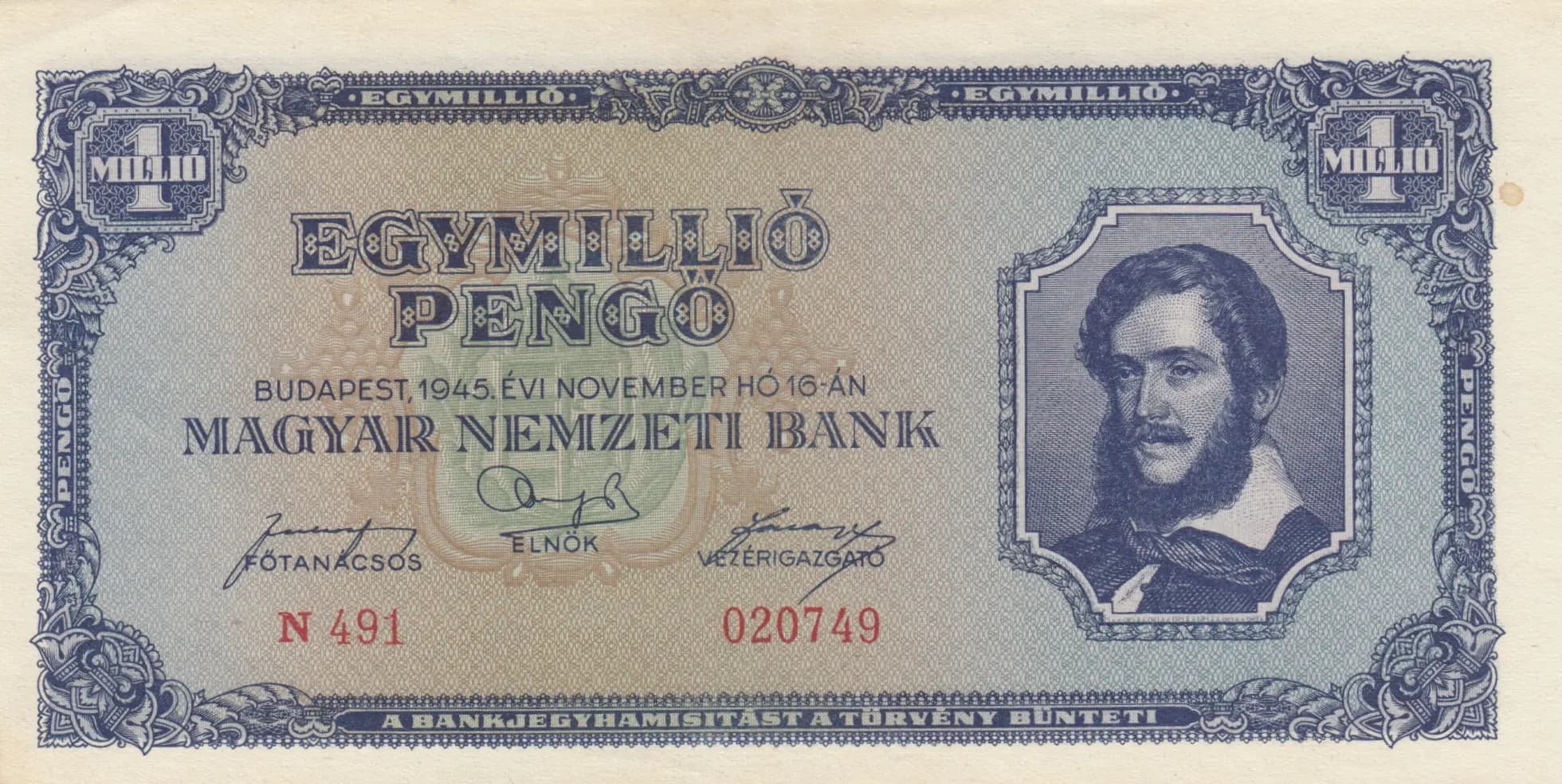
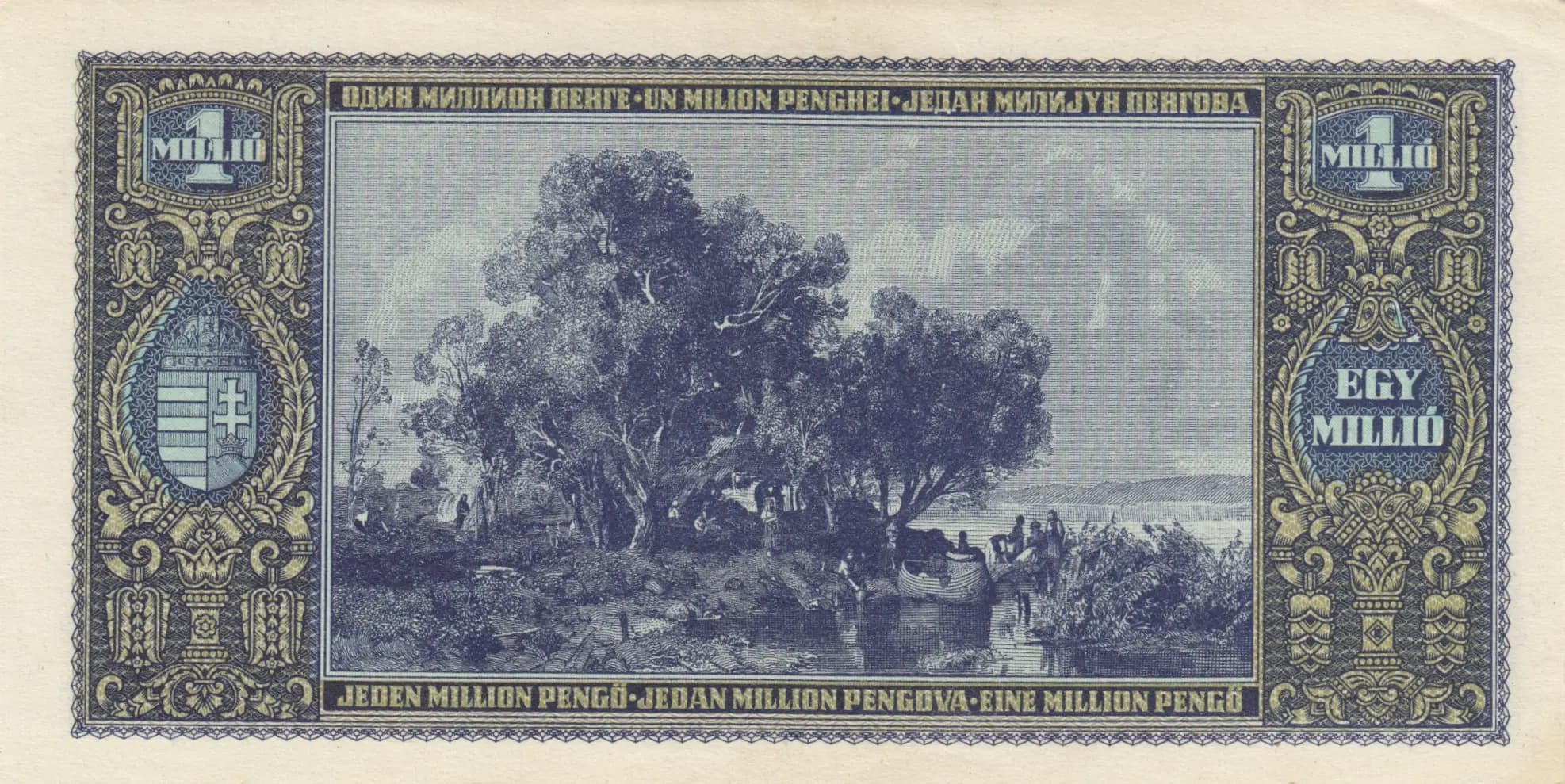
This Hungarian 1,000,000 Pengö note from November 1945 presents in EF condition with well-preserved ornamental borders and clear imagery on both sides. The obverse features a formal portrait of Lajos Kossuth positioned within a decorative frame, while the reverse displays an intricate engraved landscape vignette depicting a pastoral riverside scene at Lake Balaton by artist G. Mészöly. The note exhibits the characteristic blue, brown, and green color scheme with red serial numbers (N 491 020749) and represents a critical period of Hungarian monetary history during post-WWII inflation.
Common. The extensive eBay sales history spanning over a decade shows consistent market availability with numerous examples selling regularly between $0.99-$6.50 for VF and EF grades, with occasional graded examples (PMG 64-67) commanding $12-$122.50. This denomination was issued in substantial quantities as part of the hyperinflation currency crisis of 1945-1946, making examples readily available in today's market. The 2016 catalog value of $4 UNC reflects common status. EF condition examples typically realize $2.40-$5.50 in ungraded sales, consistent with common-grade pricing.
Issued November 16, 1945, by the Magyar Nemzeti Bank during Hungary's severe post-war hyperinflation crisis, this denomination reflects the currency's rapid devaluation following World War II. The portrait of Lajos Kossuth, the 19th-century Hungarian revolutionary leader and symbol of Hungarian nationalism, was chosen to represent Hungarian identity during a period of national reconstruction and Soviet occupation. The multilingual reverse inscriptions (Hungarian, Russian, French, German, Serbian/Croatian) reflect Hungary's position as a Soviet-occupied satellite state with a diverse, contested border region.
The obverse features a dignified three-quarter portrait of Lajos Kossuth (1802-1894), the foremost Hungarian revolutionary and statesman of the 1848-49 Hungarian Revolution, depicted with characteristic beard and historical formal attire positioned within an ornate rectangular frame on the right side of the note. The reverse displays an engraved pastoral landscape vignette by G. Mészöly depicting the shoreline of Lake Balaton—Hungary's largest lake and a symbol of Hungarian natural heritage—rendered with detailed trees, vegetation, and human figures in a romantic 19th-century aesthetic. Both sides are framed by intricate ornamental borders featuring fine line-work, heraldic elements, and floral decorative motifs in dark blue and gold/tan coloration. The multilingual inscriptions on the reverse emphasize the note's international recognition and Hungary's postwar geopolitical position.
FRONT: 'EGYMILLIO PENGO' (One Million Pengö) / 'MAGYAR NEMZETI BANK' (Hungarian National Bank) / 'BUDAPEST, 1945. ÉVI NOVEMBER HÓ 16. ÁN' (Budapest, November 16, 1945) / 'ELNÖK' (President) / 'FŐTANÁCSOS' (Chief Counselor) / 'VEZETRIGAZGATÓ' (Managing Director) / Serial numbers: N 491 020749. BACK: 'EGY MILLIO' / 'MILLIO' (One Million / Million in Hungarian) / 'ОДИН МИЛЛИОН ПЕНГЕ' (One Million Pengö - Russian) / 'UN MILLION PENGHEI' (One Million Pengö - French) / 'JEDAN MILION PENGOVA' (One Million Pengö - Serbian/Croatian) / 'EINE MILLION PENGÜ' (One Million Pengö - German) / 'JEBEN MILLION PENGÜ' (variant language inscription).
Intaglio engraving (recess printing), evidenced by the fine detail work visible in the ornamental borders, the landscape vignette, and the portrait. The sharp line definition, particularly in the decorative frames and the pastoral scene details, is characteristic of high-quality security printing from this era. The note was produced by the Magyar Nemzeti Bank printing facilities; no evidence of other security printers is indicated in the catalog data.
This specific example bears serial number prefix N 491 with sequence 020749. No overprints or major varieties are evident from the visual analysis. The note conforms to Pick P-122 standard design with the standard three-language (Hungarian, Russian, and multilingual) reverse inscriptions characteristic of this issue. The November 16, 1945 date is standard for this denomination. No significant printing varieties (such as color variations or security feature differences) are visible in the observed example, which appears to be a standard circulation strike from the initial printing run.