1 000 000 000 milpengö 1946
Market Prices
70 salesAbout This Note
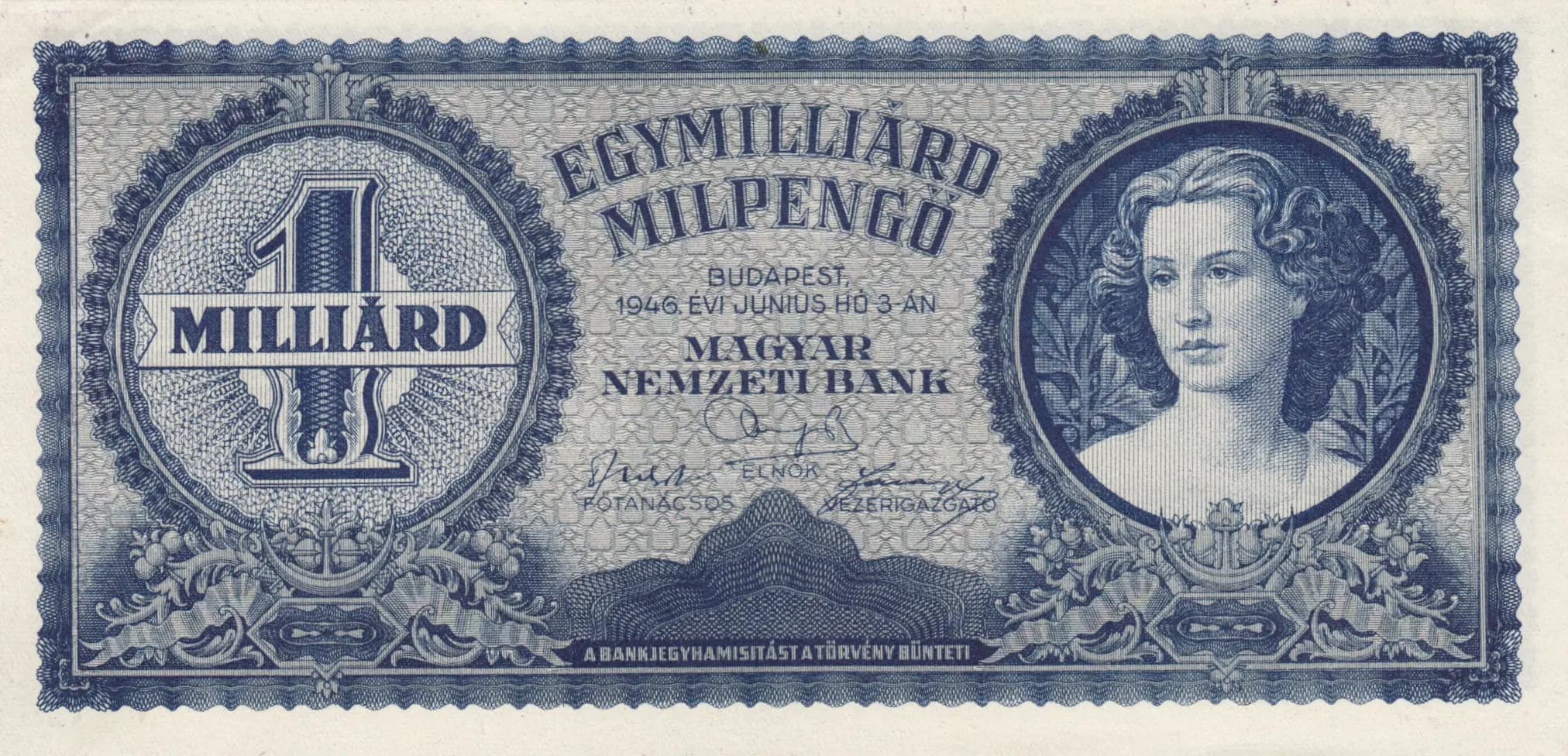
This Hungarian 1 Milliárd Milpengö note from June 3, 1946 is an exceptional example of hyperinflation-era currency, presented in AU condition with no visible wear, creases, or damage. The note features an elegant design with a woman's portrait in profile within a circular medallion on the right side, complemented by intricate ornamental engraving throughout. This denomination represents the extreme monetary crisis that gripped Hungary in the immediate post-WWII period, making it a historically significant artifact of one of the most severe hyperinflation episodes of the 20th century.
Common. This note is abundantly available in the numismatic market, as evidenced by consistent eBay sales data spanning over a decade with prices typically ranging from $2 to $200 depending on condition. Multiple sales occur regularly across various grade levels, from F to UNC, indicating a large surviving population. The print run for this denomination was substantial, and these notes have not been recalled or withdrawn from circulation in ways that would create scarcity. While hyperinflation-era notes are historically significant, the 1 Milliárd Milpengö is one of the most commonly encountered Hungarian notes from this period.
Issued during Hungary's devastating hyperinflation of 1945-1946, this note exemplifies the desperate monetary measures taken by the Magyar Nemzeti Bank (Hungarian National Bank) following World War II. The June 3, 1946 date places this near the end of the pengő era, just days before the introduction of the forint as Hungary's new currency on August 1, 1946. The billion-unit denomination reflects the complete collapse of the pengő's value, with prices doubling every 15 hours at the height of the crisis, making such astronomical denominations necessary for even basic transactions.
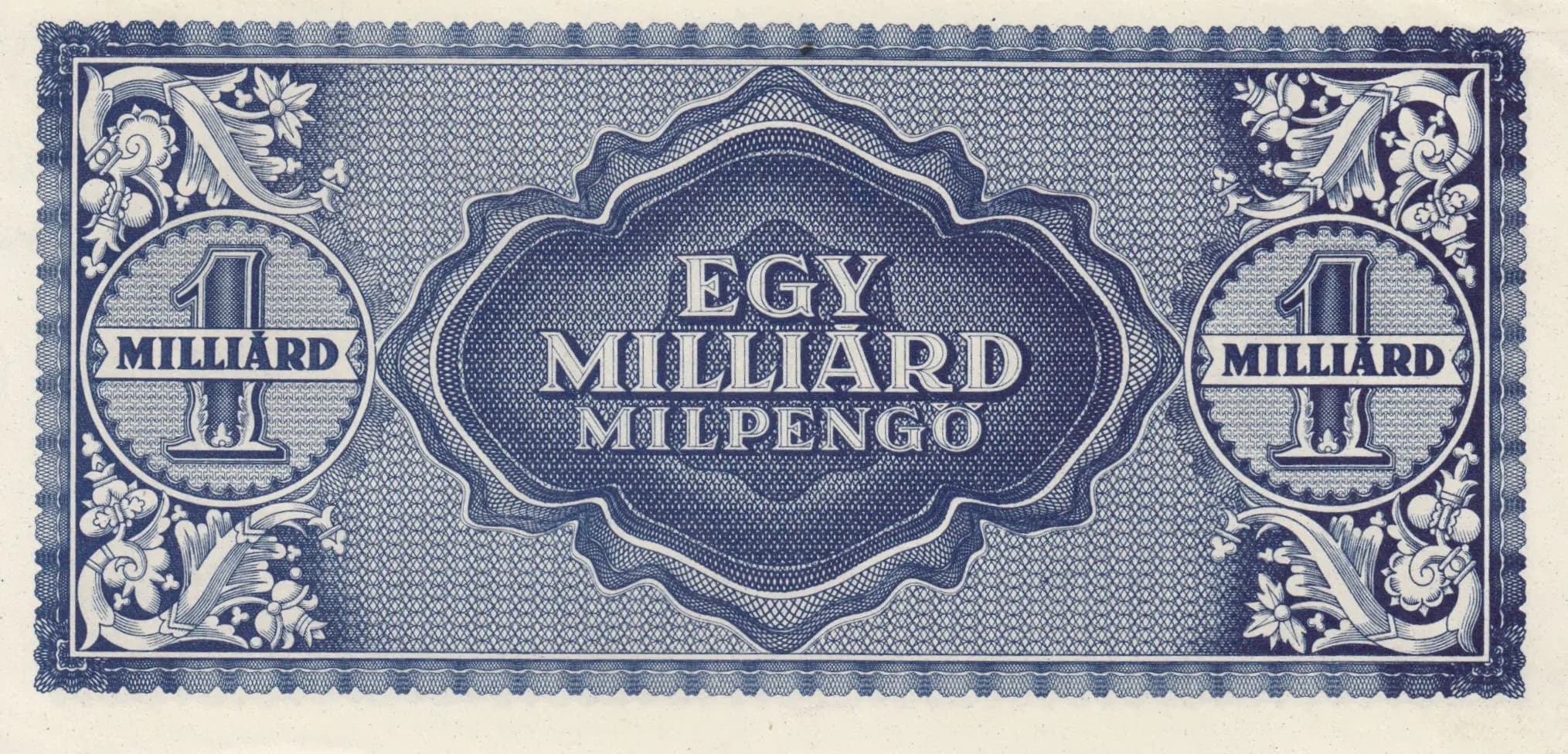
The front features a prominent circular ornamental frame on the left containing a large numeral '1', with the denomination text 'EGYMILLIÁRD MILPENGO' positioned centrally. The right side displays a woman's portrait in profile within a circular medallion, identified from catalog data as Lendvay Lucia from Székesfehérvár. A mountain or peak is visible in the center background, contributing to the note's scenic composition. The back employs a symmetrical design with two circular frames containing numerals '1' flanking a large central oval frame. All four sides feature elaborate floral and scroll motifs, with extensive filigree patterns and crosshatch security engraving throughout, demonstrating sophisticated anti-counterfeiting measures typical of Magyar Nemzeti Bank productions.
FRONT: '1 MILLIÁRD' / 'EGYMILLIÁRD MILPENGO' (One billion milpengö) / 'BUDAPEST' / '1946.ÉVI JÚNIUS HÓ 3-ÁN' (June 3, 1946) / 'MAGYAR NEMZETIBANK' (Hungarian National Bank) / 'PÓTBANÁCSOS' (Deputy Governor) / 'VEZÉRIGAZGATÓ' (General Director) / 'A BANKHEGYHAMISTÁT TÖRVÉNY RÜNTETI' (Counterfeiting is punishable by law). BACK: 'EGY MILLIÁRD MILPENGO' (One billion milpengö) / '1 MILLIÁRD' (1 billion) [repeated in circular frames].
This note was produced using intaglio (engraved) printing, characterized by the fine line work, intricate background patterns, complex filigree detailing, and the distinctive quality of impression visible in the visual analysis. The ornamental borders, security crosshatching, and detailed portrait engraving are hallmarks of high-security banknote production. The Magyar Nemzeti Bank employed leading European security printers for their currency production during this period, and the technical quality evident in this design suggests professional banknote printing standards.
The catalog notes that this issue was printed without serial numbers, which is the standard variety for Pick-131. No signatures are visible in the visual analysis, which aligns with typical administrative signature placement on Hungarian banknotes of this era. The June 3, 1946 date is the sole dated issue of this denomination, with no known date varieties. The portrait variety remains that of Lendvay Lucia throughout all printings. No overprints, serial number prefixes, or other distinguishing varieties have been documented for this Pick number.