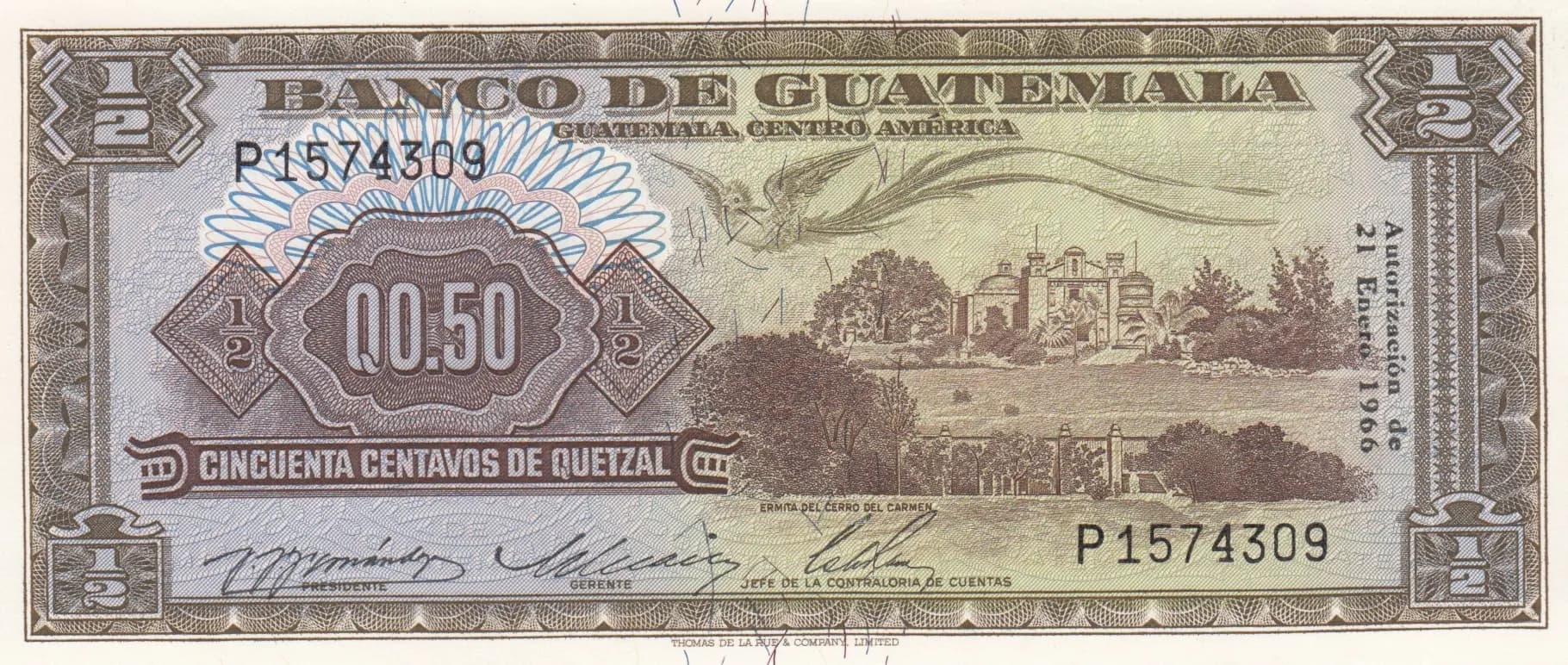
50 centavos 1971
Market Prices
4 salesAbout This Note
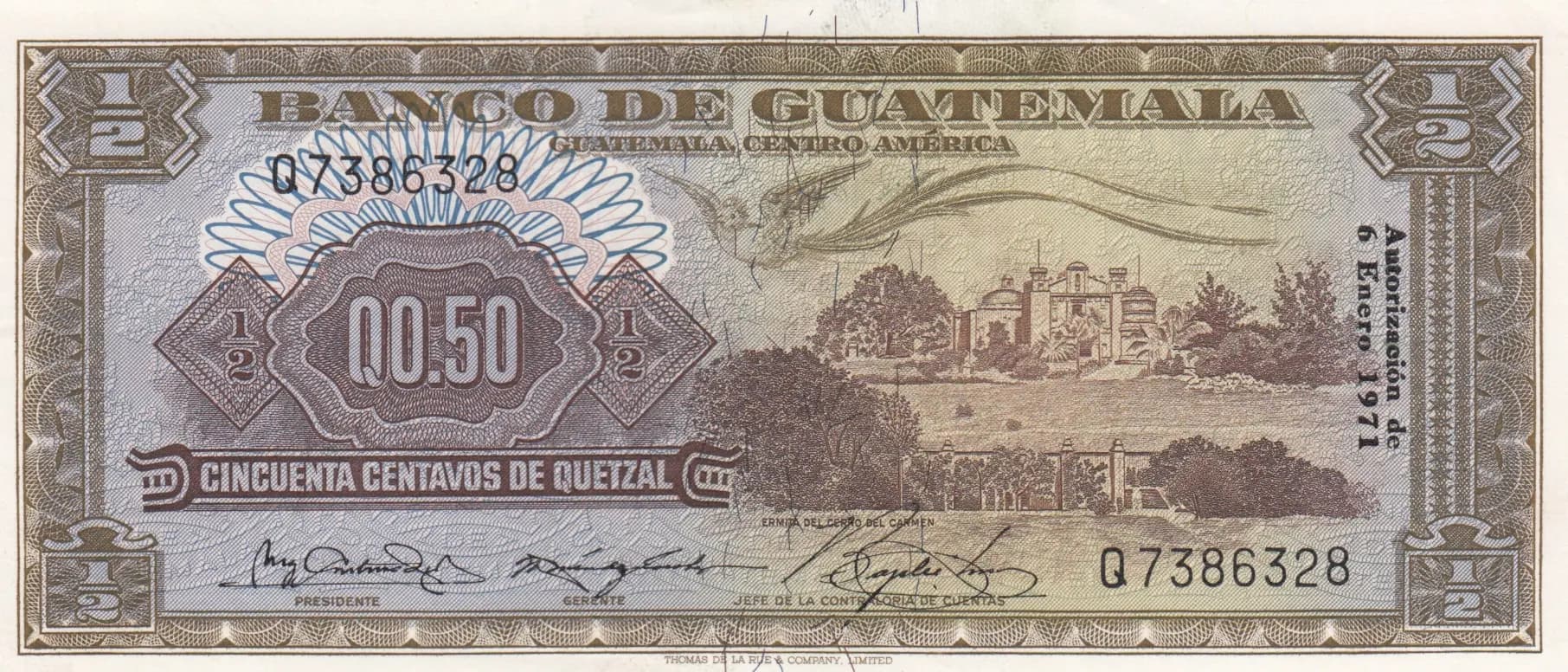
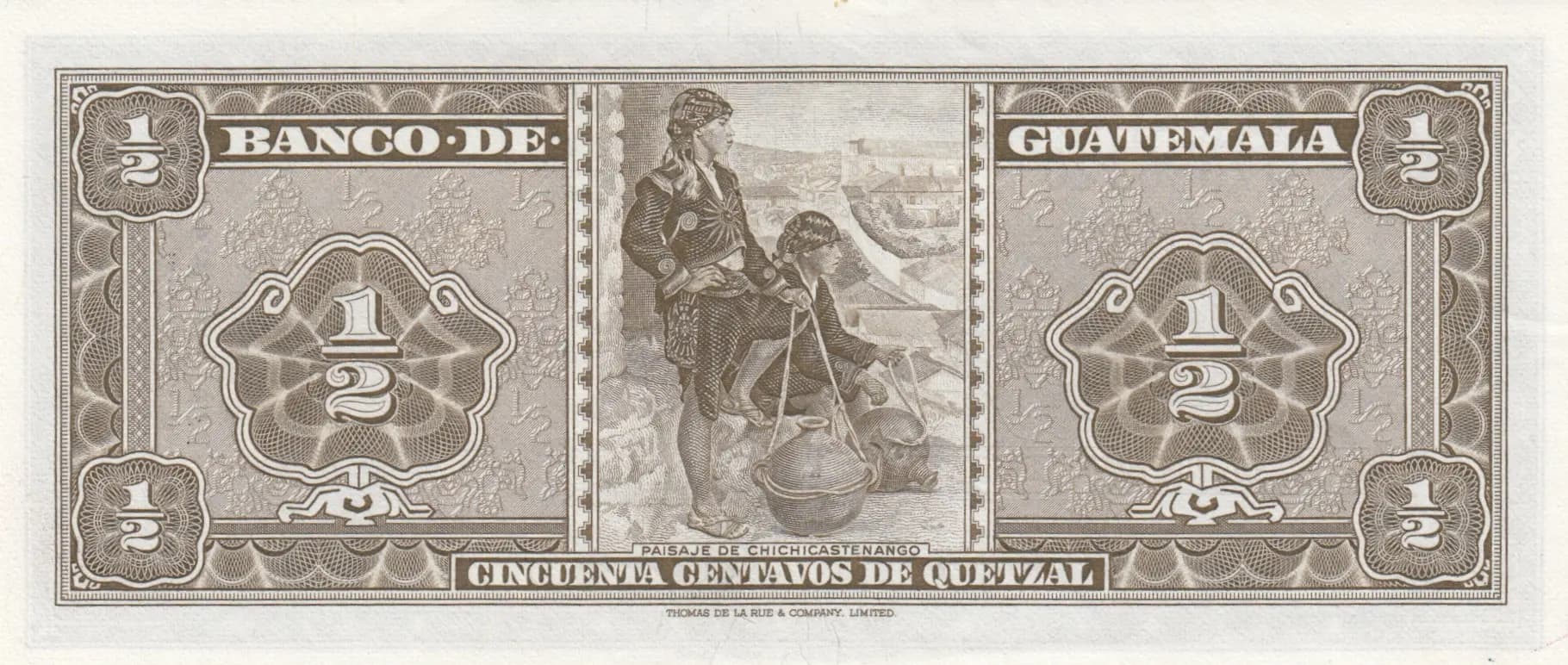
This is a Guatemalan 50 Centavos de Quetzal note from 1971 (Pick P-51h), printed by Thomas de la Rue and issued by Banco de Guatemala. The obverse features the Hermitage of Cerro del Carmen in brown and multicolored tones with ornamental sunburst framing, while the reverse depicts two historical figures from Chichicastenango in fine line engraving. The note shows some age-related wear including creasing and blue handwritten markings, placing it between Fine and VF condition rather than the UNC grade indicated by the source data.
Common. eBay market data shows UNC specimens selling for approximately $40-180 (2019-2024), with Fine condition notes consistently available for under $12. The note was part of a standard currency series printed in large quantities from 1964-1972, and multiple examples appear regularly in the market. The Pick P-51h designation indicates this is a catalogued variant within an established series, not a scarce or limited issue. High supply and consistent availability at modest price points confirm common classification.
This note was issued during a period when Guatemala's central bank was modernizing its currency design through contracts with internationally recognized security printers. The imagery reflects Guatemala's cultural and architectural heritage—the Cerro del Carmen hermitage representing colonial religious architecture, and the Chichicastenango figures depicting indigenous Mayan cultural traditions central to Guatemalan identity. The 1971 date marks this as part of a standardized currency series that remained in circulation from 1964-1972.
The obverse features the Hermitage of Cerro del Carmen, a colonial-era religious building depicted in the right portion of the note, surrounded by landscaped grounds with trees and foliage rendered in brown and tan tones with light purple-blue tinting. An ornamental sunburst design dominates the upper center, with a large denomination frame displaying '00.50' flanked by decorative corner elements marked with the numeral '2'. Serial number 'Q7386328' appears in both upper left and lower right positions. The reverse displays an engraved vignette of two male figures in historical dress—one standing in military or official attire with a plumed headdress, the other seated or kneeling—set against a landscape background with mountains and architectural elements. Ornamental corner frames with geometric and floral patterns frame the central scene on both sides, with decorative shields bearing the numeral designation. The entire design employs fine line engraving characteristic of Thomas de la Rue's security printing work.
Front side: 'BANCO DE GUATEMALA' (Bank of Guatemala), 'GUATEMALA CENTRO AMERICA' (Guatemala Central America), '00.50' (fifty cents denomination), 'CINCUENTA CENTAVOS DE QUETZAL' (Fifty Centavos of Quetzal), 'PRESIDENTE' (President), 'GERENTE' (Manager), 'JEFE DE LA CONTABILIDAD DE CUENTAS' (Head of Accounting Accounts), 'Autorizado por Acuerdo Bancario 1971' (Authorized by Banking Agreement 1971), 'THOMAS DE LA RUE & COMPANY LIMITED' (printer identification). Back side: 'BANCO DE GUATEMALA' (Bank of Guatemala), 'CINCUENTA CENTAVOS DE QUETZAL' (Fifty Centavos of Quetzal), 'PAISAJE DE CHICHICASTENANGO' (Landscape of Chichicastenango), 'THOMAS DE LA RUE & COMPANY LIMITED' (printer identification).
Intaglio engraving (fine line engraving) on multicolored underprint, printed by Thomas de la Rue & Company Limited, London. The note exhibits the classical combination of multicolor underprinting with brown-dominant intaglio engraved imagery typical of mid-20th-century currency security printing. Multiple signature lines and ornamental patterns show the precision characteristic of professional bank note engraving.
This note is identified as P-51h per the Pick catalog, representing one of several variants of the 50 Centavos de Quetzal design from the 1964-1972 issue period. The serial number 'Q7386328' is visible on this example. While PMG records indicate P-51f as a documented variant, the specific characteristics of P-51h (vs. earlier variants such as P-29, P-40, and P-41 printed by Waterlow) relate to the Thomas de la Rue printing period. Signature varieties and potential overprint differences may distinguish individual variants, but detailed variety attribution would require comparison with reference standards for other P-51 sub-variants.