1 peso 1920
Market Prices
1 saleAbout This Note
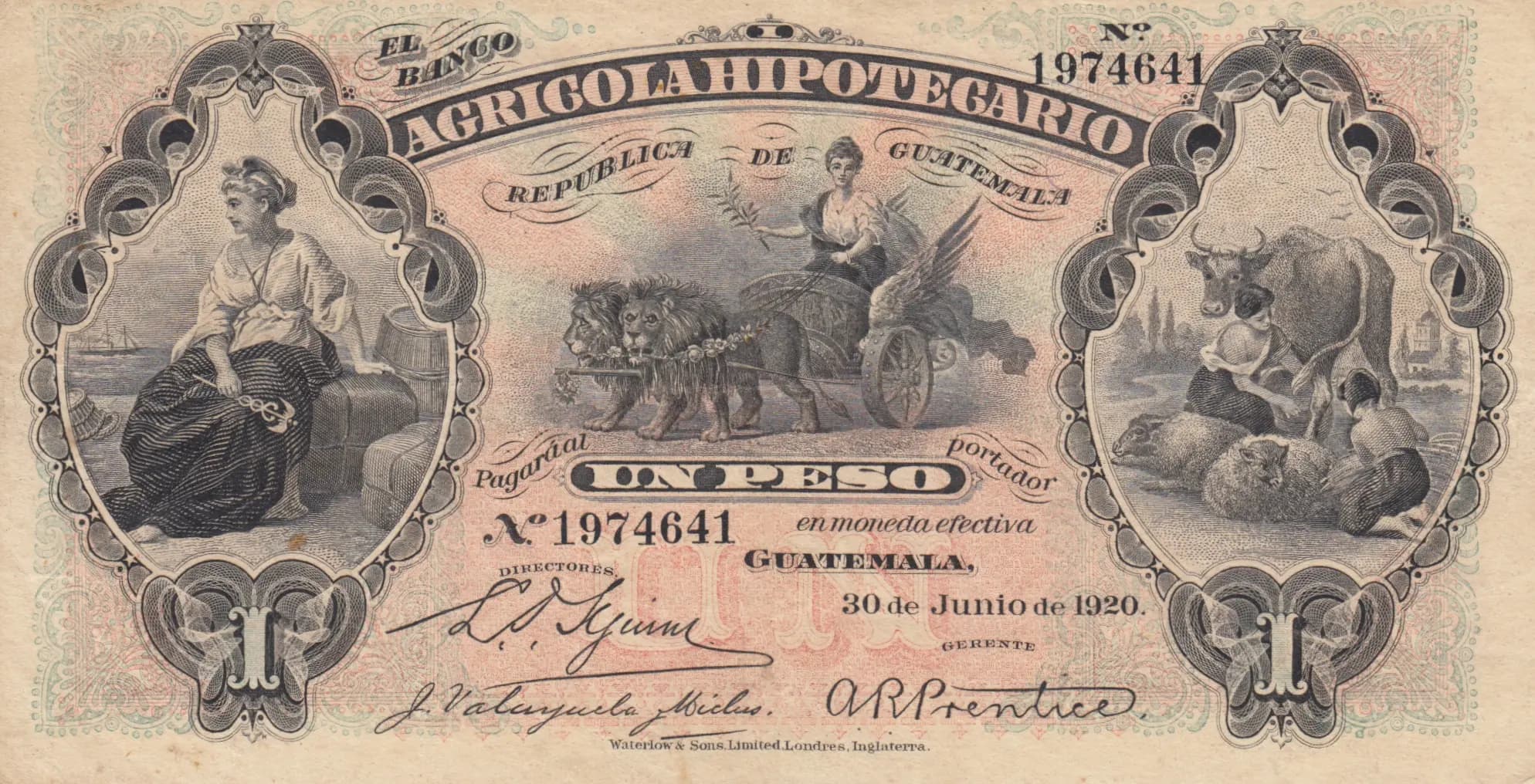
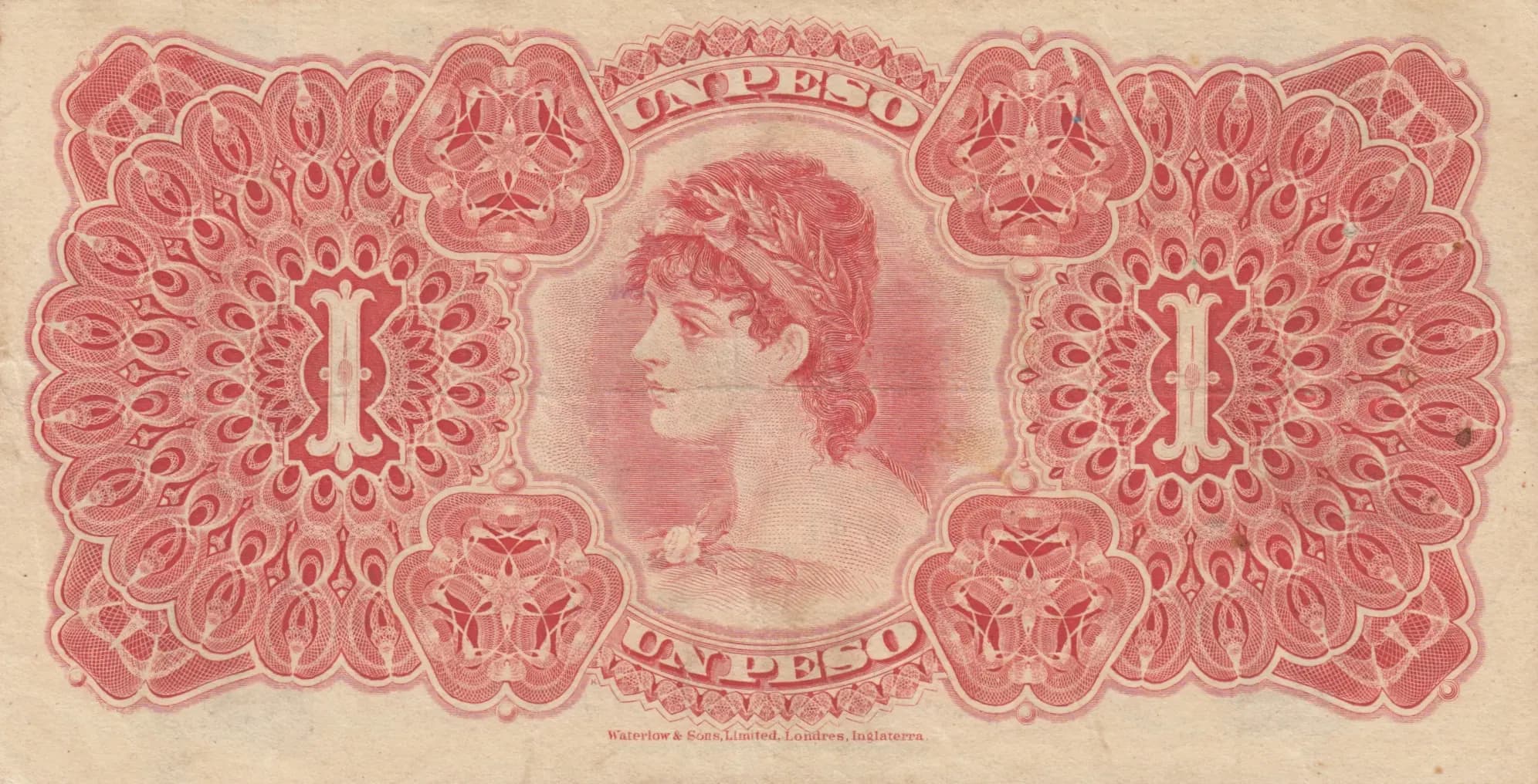
This 1920 Guatemalan 1 Peso from Banco Agricola Hipotecario is an attractive example of early 20th-century Latin American banknote design, featuring allegorical classical figures representing commerce, agriculture, and maritime trade. The obverse displays vibrant imagery with a woman in a lion-drawn chariot alongside seated and standing figures amid agricultural scenes, while the reverse presents an elegant classical male portrait in profile surrounded by intricate peacock-feather ornamental patterns. In VF condition, the note shows expected aging with foxing and discoloration but retains sharp engraved detail and no major damage, making it a desirable specimen for collectors of Guatemalan currency or classical allegorical banknote design.
common. The eBay market data showing an F-graded specimen selling for $42.13 in June 2024 (with only 16 bids) indicates modest collector demand and availability. There is no evidence of a small print run, recall, or short-lived issuing authority for this note. The Banco Agricola Hipotecario operated for an extended period and issued currency in reasonable quantities. The presence of two cataloged varieties (P-S101a and P-S101b) suggests multiple printings or states exist, further supporting that these notes were produced in quantities sufficient to make them common in the collector market. Notes of this age and type typically sell in the $30–50 range when they do appear, consistent with common-grade material.
Issued during Guatemala's early republican period, this note reflects the nation's agrarian economy through the Banco Agricola Hipotecario (Agricultural Mortgage Bank), an institution designed to support agricultural development and land finance. The allegorical imagery—featuring a woman in a chariot pulled by lions (symbolizing power and commerce), alongside depictions of maritime commerce and pastoral agriculture—visually communicates the bank's mission to finance the agricultural sector that formed Guatemala's economic foundation in the 1920s. The use of classical female figures represents Progress and Prosperity, common iconographic choices for banking institutions seeking to convey stability and modernity during the early twentieth century.
The obverse features an elaborate allegorical composition organized in three principal vignettes representing different economic sectors. On the left sits a classical female figure (likely representing Commerce or Maritime Trade) with a ship visible in the background, symbolizing Guatemala's international trade connections. The central composition dominates the design with a woman in classical drapery riding in a chariot drawn by two lions, holding what appears to be an olive or laurel branch—a classical representation of Progress, Victory, or Prosperity. On the right is another allegorical female figure surrounded by agricultural produce, livestock (cattle and sheep), and crops, directly representing the agrarian wealth that the Banco Agricola Hipotecario was established to finance. The entire obverse is framed by ornate heraldic emblems in decorative cartouches at each corner and bordered by elaborate scrollwork typical of Waterlow & Sons' sophisticated engraving style. The reverse presents a classical male portrait in strict profile facing right, wearing a laurel wreath, centered within an intricate geometric and floral ornamental design featuring symmetrical peacock-feather-like patterns and repeating classical architectural motifs. The color scheme of black on pink and blue underprint on the obverse, with red and cream on the reverse, creates visual distinction between sides while maintaining the note's elegant aesthetic.
FRONT: 'EL BANCO AGRICOLA HIPOTECARIO' (The Agricultural Mortgage Bank); 'REPÚBLICA DE GUATEMALA' (Republic of Guatemala); 'UN PESO' (One Peso); 'Pagadal Portador' (Payable to Bearer); 'en moneda efectiva' (in effective currency); 'No 1974641' (Serial Number 1974641); 'GUATEMALA' (Guatemala); '30 de Junio de 1920' (June 30, 1920); 'DIRECTORES' (Directors); 'GERENTE' (Manager); 'Waterlow & Sons Limited. Londres, Inglaterra' (Waterlow & Sons Limited. London, England). BACK: 'UN PESO' (One Peso); 'Waterlow & Sons, Limited. Londres, Inglaterra' (Waterlow & Sons, Limited. London, England).
Intaglio engraving (line engraving and steel plate printing) executed by Waterlow & Sons Limited of London, England, one of the world's premier banknote security printers. The fine detail visible in the portraits, the intricate decorative scrollwork, the complex symmetrical patterns on the reverse, and the sharp definition of the allegorical vignettes are all characteristic of high-quality intaglio production. The multicolor printing effect (black with pink and blue underprint on obverse; red and cream on reverse) was achieved through separate plate impressions, standard practice for Waterlow & Sons during this period.
Cataloged as Pick P-S101b, with a known variant P-S101a also existing for the 1 Peso denomination from this issuer and year. The specific variety designation 'b' likely relates to differences in signatures, serial number ranges, text placement, or printer's marks compared to variant 'a'. The observed serial number 1974641 and the June 30, 1920 date are consistent with the issue specification. Without direct comparison to P-S101a or access to detailed Pick catalog notes on the specific distinguishing characteristics, the exact nature of the variety distinction cannot be definitively stated from visual analysis alone, but both variants represent regular issues from the same 1920 emission.