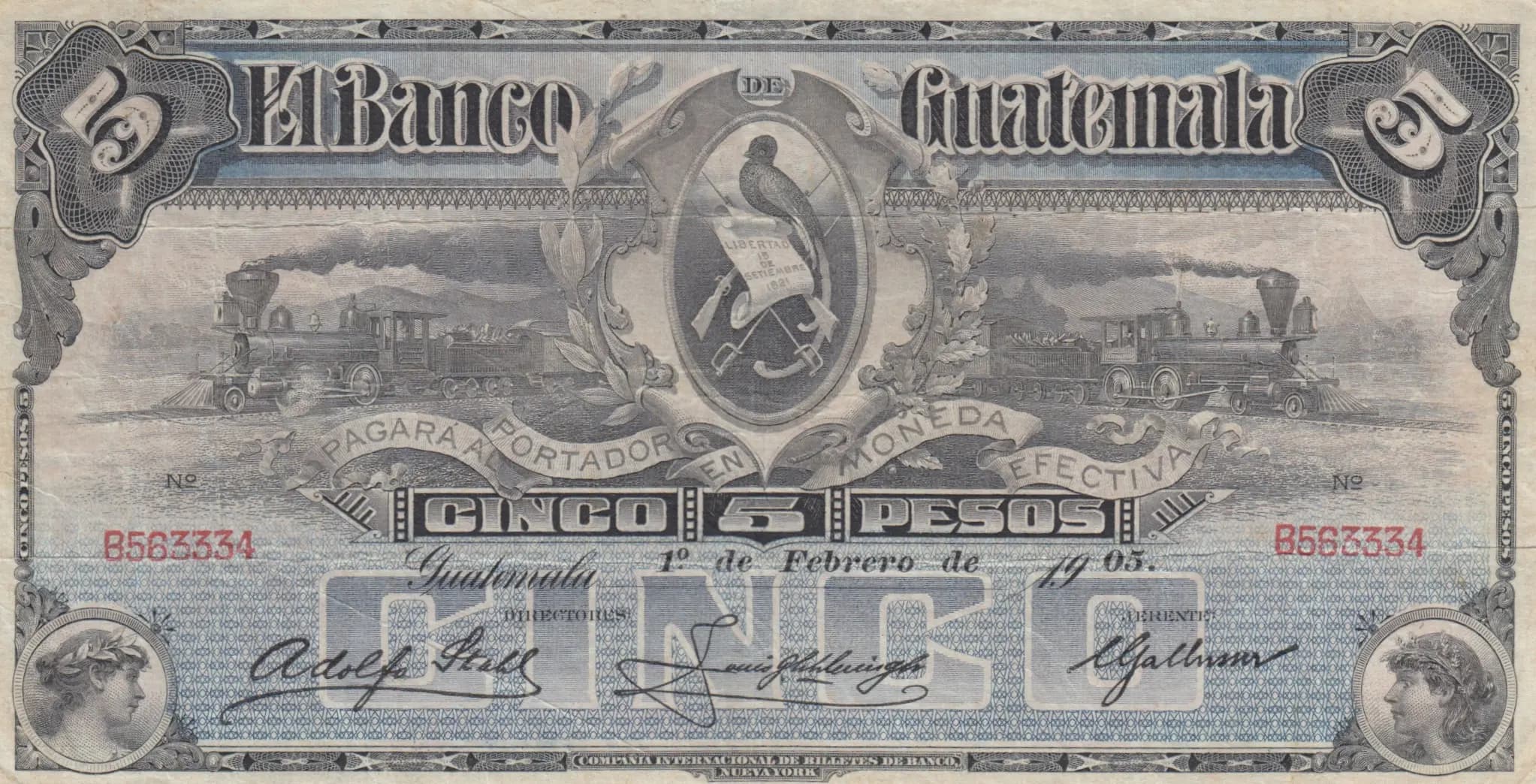
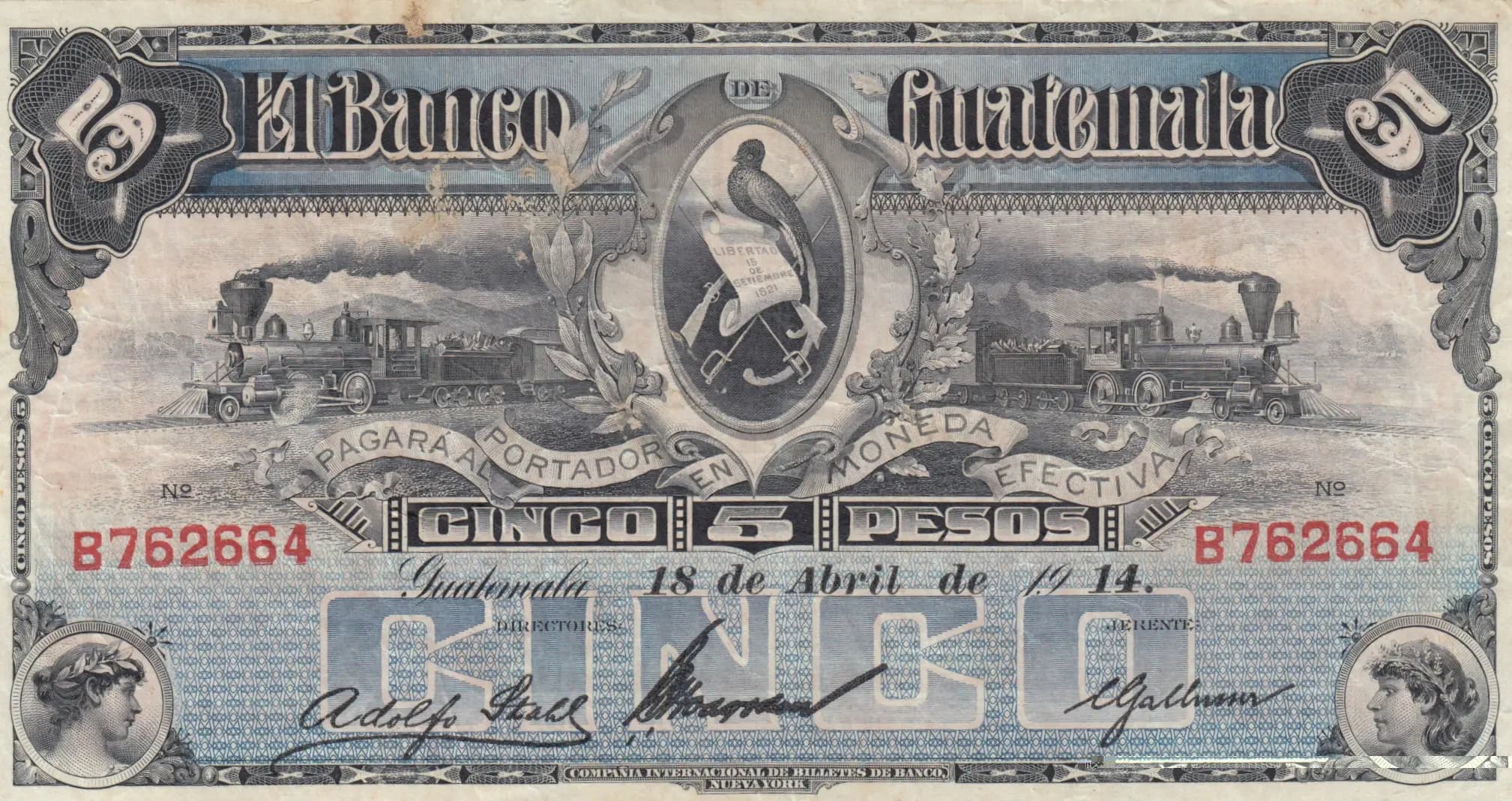
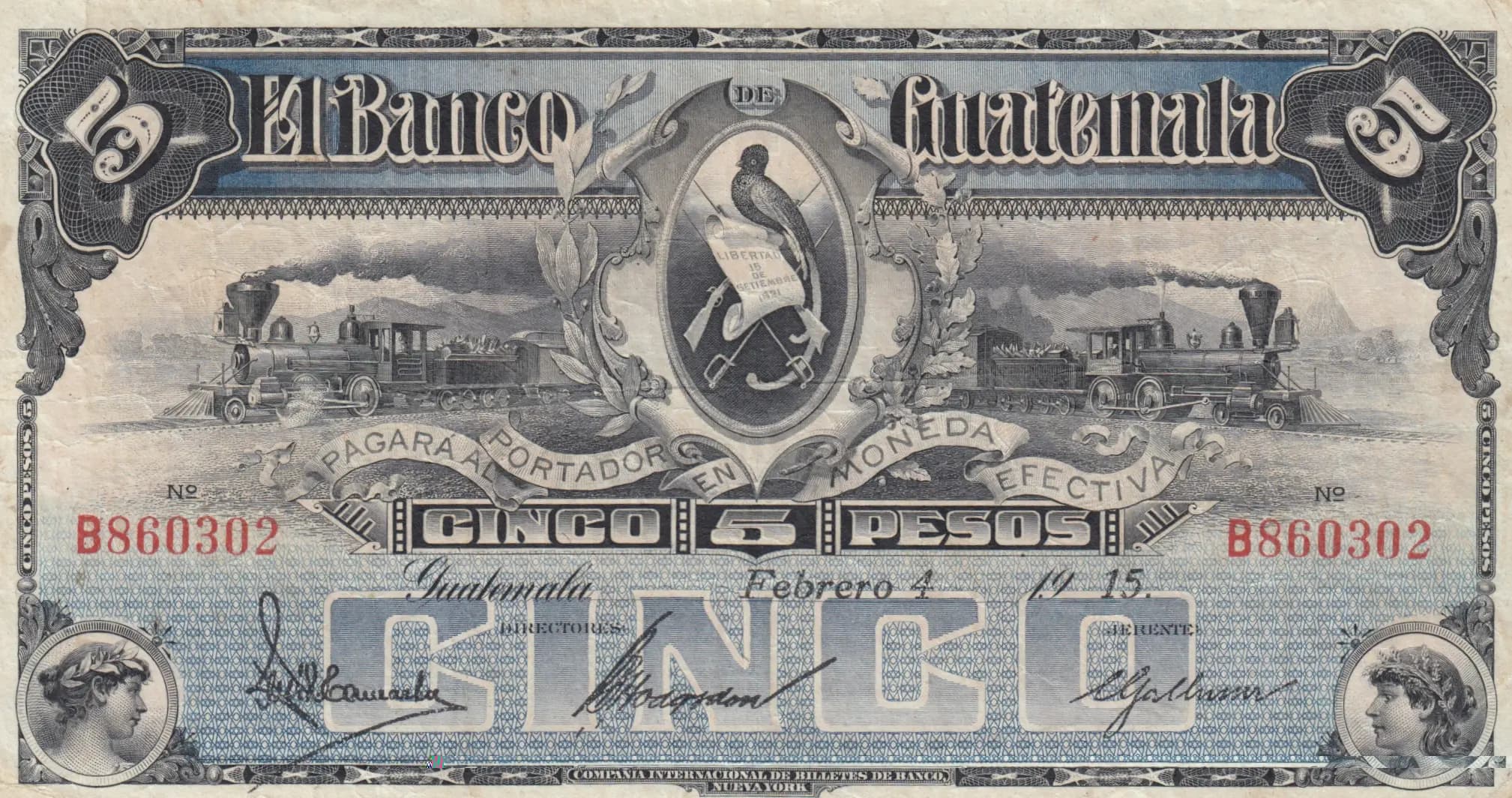
5 pesos 1914
“17.04.14”
Market Prices
1 saleAbout This Note
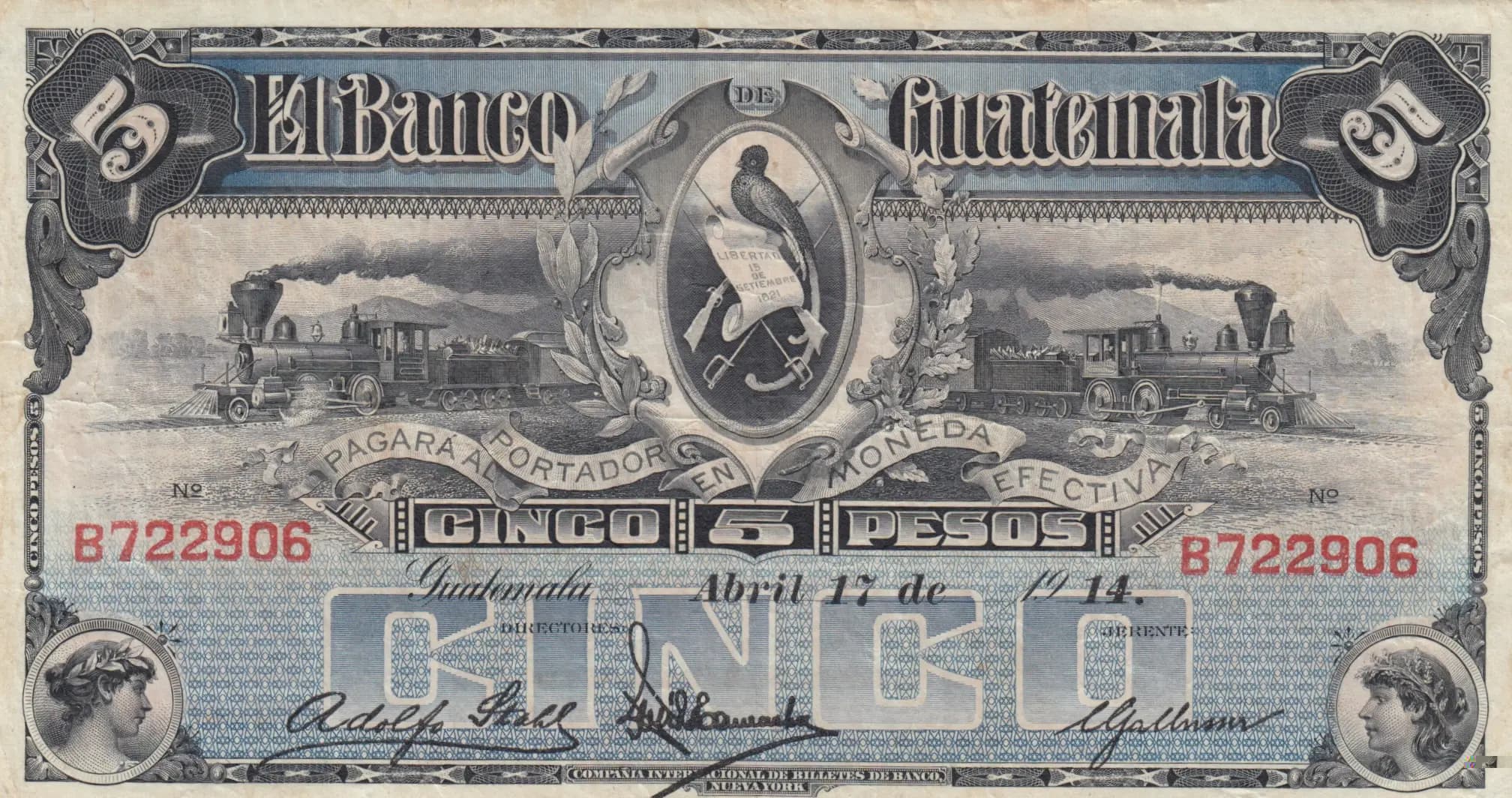
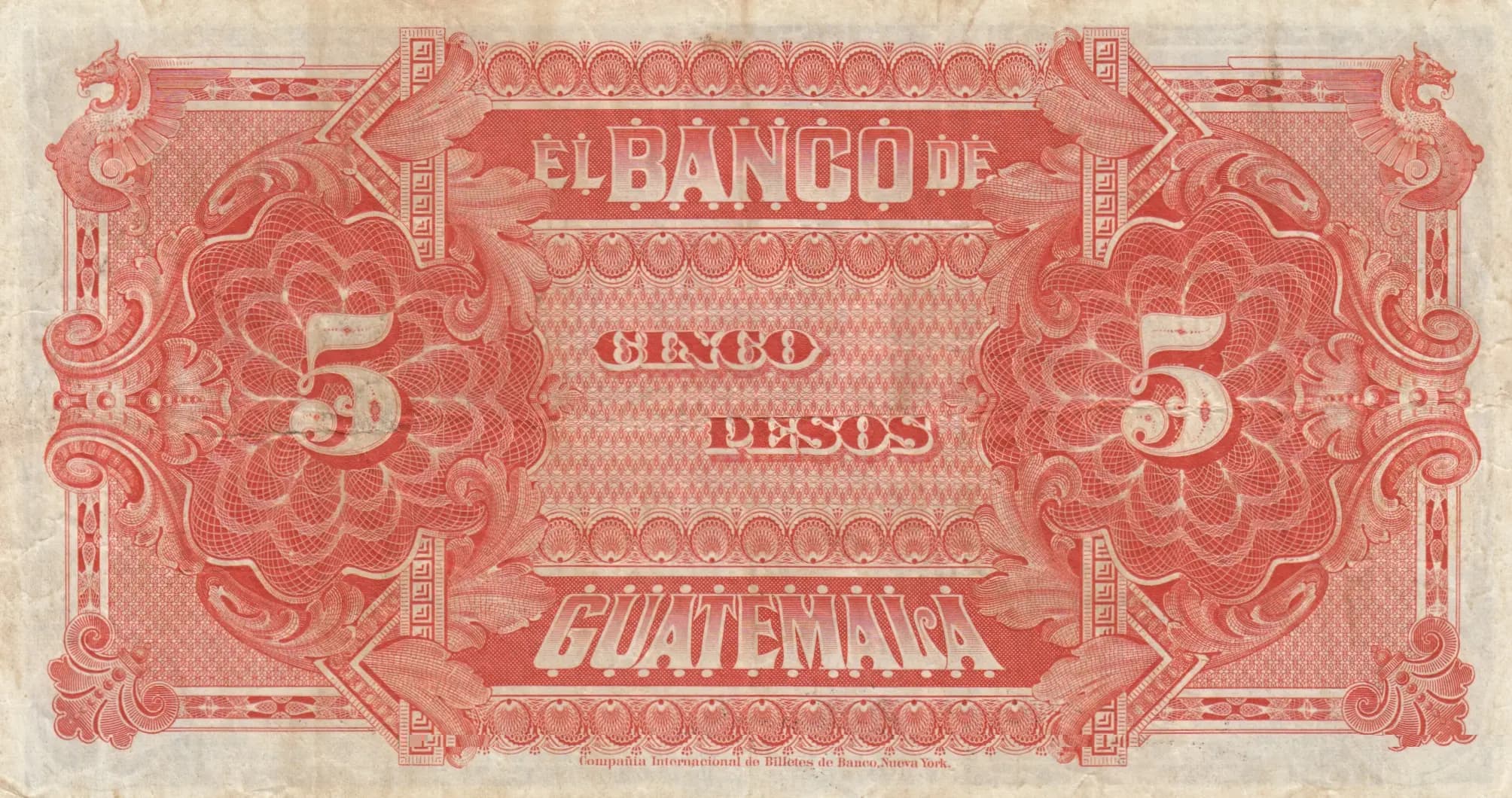
This 1914 Guatemala 5 Pesos note presents a handsome example of early 20th-century Central American currency design, graded VF with visible age patina and circulation wear. The obverse features two facing steam locomotives flanking a central quetzal bird medallion—reflecting Guatemala's pride in industrial progress and national symbolism—with female portraits in the lower corners and a large red serial number (B7229906). The reverse displays the characteristic red-orange coloring with elaborate geometric and floral patterns typical of International Bank Note Company work, showing expected fading and creasing consistent with its 110-year age.
Common. While this is a 110-year-old banknote from Guatemala's early banking era, the recent eBay transaction data showing a VF specimen selling for $78 with moderate bidding activity (18 bids) indicates consistent collector demand at modest price levels. Early 20th-century Latin American banknotes of this type were typically printed in substantial quantities by international security printers, and the Banco de Guatemala's 5 Pesos denominations remain regularly available in the market. The VF grade represents a mid-range condition for surviving examples; neither exceptionally scarce nor particularly elusive.
This note was issued during a pivotal period in Guatemalan banking history, when the Banco de Guatemala (established 1914) sought to modernize the nation's currency through professional security printing by the International Bank Note Company of New York. The imagery of steam locomotives prominently featured on both sides of this design symbolized Guatemala's aspirations toward industrial development and modernization in the early 20th century, while the national quetzal bird underscored sovereign identity during a period of significant political and economic change in Central America.
The obverse features an ambitious design centered on industrialization imagery: two steam passenger locomotives face each other across the note's width, with the national quetzal bird (Pharomachrus mocinno) displayed prominently in an oval medallion at center, holding a banner inscribed with 'LIBERTAD Y ETERNIDAD' (Liberty and Eternity). Female profile portraits appear in circular medallions at both lower corners, representing allegorical figures of virtue or prosperity common to currency design of the era. The entire composition is framed by ornate decorative borders with fine geometric patterns and floral motifs in black and blue ink. The reverse shifts to a predominantly red-orange palette with an elaborate symmetric design dominated by large corner numerals '5' with dragon or serpent-like embellishments, intricate geometric patterns incorporating Greek key designs, and dense engraved ornamental flourishes throughout. The back text is centered and clearly identifies the issuer and denomination.
FRONT SIDE: 'El Banco de Guatemala' (The Bank of Guatemala); 'CINCO 5 PESOS' (FIVE 5 PESOS); 'Abril 17 de 1914' (April 17, 1914); 'PAGARA AL PORTADOR EN MONEDA EFECTIVA' (WILL PAY TO BEARER IN EFFECTIVE CURRENCY); 'DIRECTORES' (DIRECTORS); 'GERENTE' (MANAGER); 'LIBERTAD Y ETERNIDAD' (LIBERTY AND ETERNITY); Serial number: B7229906. BACK SIDE: 'EL BANCO DE GUATEMALA' (THE BANK OF GUATEMALA); 'CINCO PESOS' (FIVE PESOS); 'Compañia Internacional de Billetes de Banco, Nueva York' (International Bank Note Company, New York).
Intaglio engraving on high-quality banknote paper, executed by the International Bank Note Company (IBNC) of New York, as credited on the note itself. The multiple colors (black and blue on obverse, red-orange on reverse) were achieved through sequential intaglio passes, a standard and secure method for currency production of this period. The fine line engraving, intricate geometric patterns, and complex decorative borders visible throughout serve both aesthetic and security functions, making the note difficult to counterfeit with period technology.
This specimen is cataloged as Pick P-S143c, representing one of two known variants for the base Pick number (P-S143b and P-S143c are both cataloged by PMG), both with IBNC as printer. The specimen displays the issued date of 'Abril 17 de 1914' (April 17, 1914) on the obverse and features the large red serial number B7229906, characteristic of P-S143c varieties. The red coloring of the serial number on the obverse and the red-orange reverse coloring are distinguishing features of this particular variety within the Guatemalan 5 Pesos 1914 issue.