50 centavos 1966
Market Prices
4 salesAbout This Note
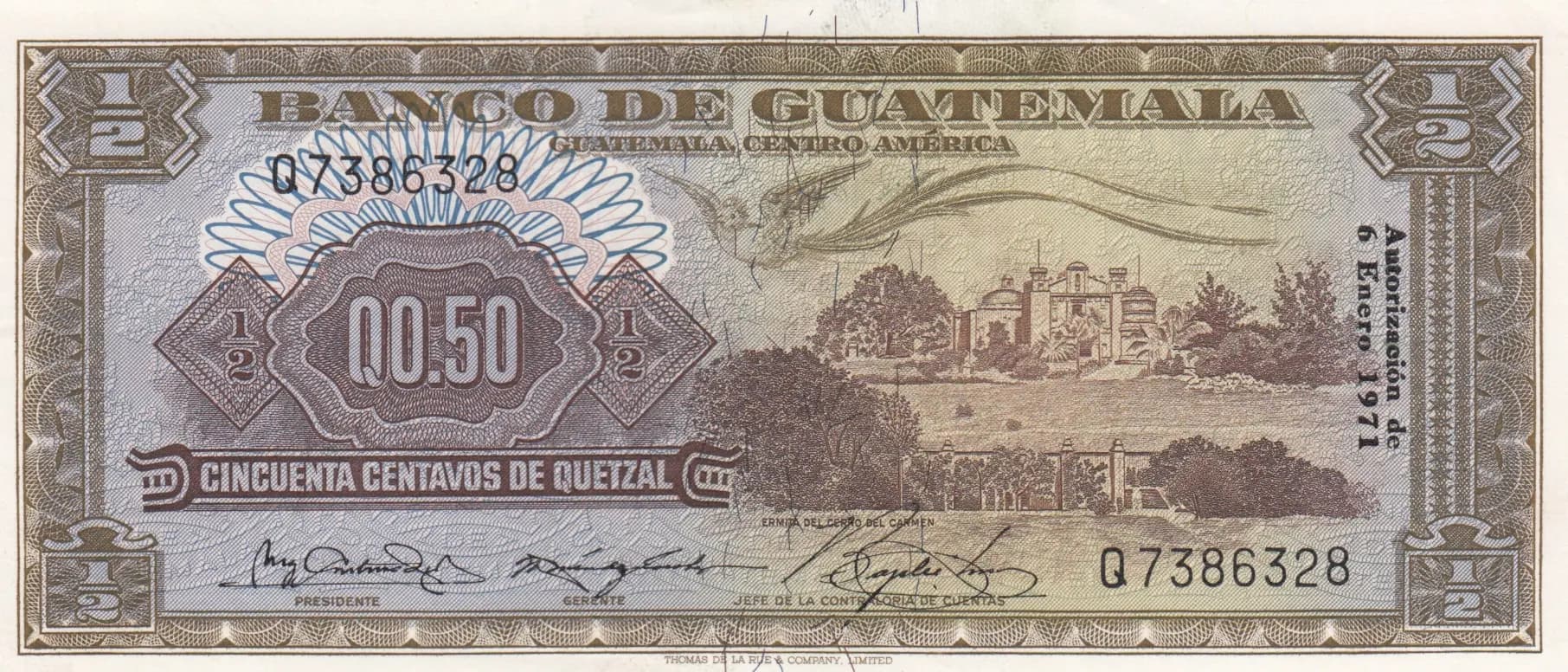
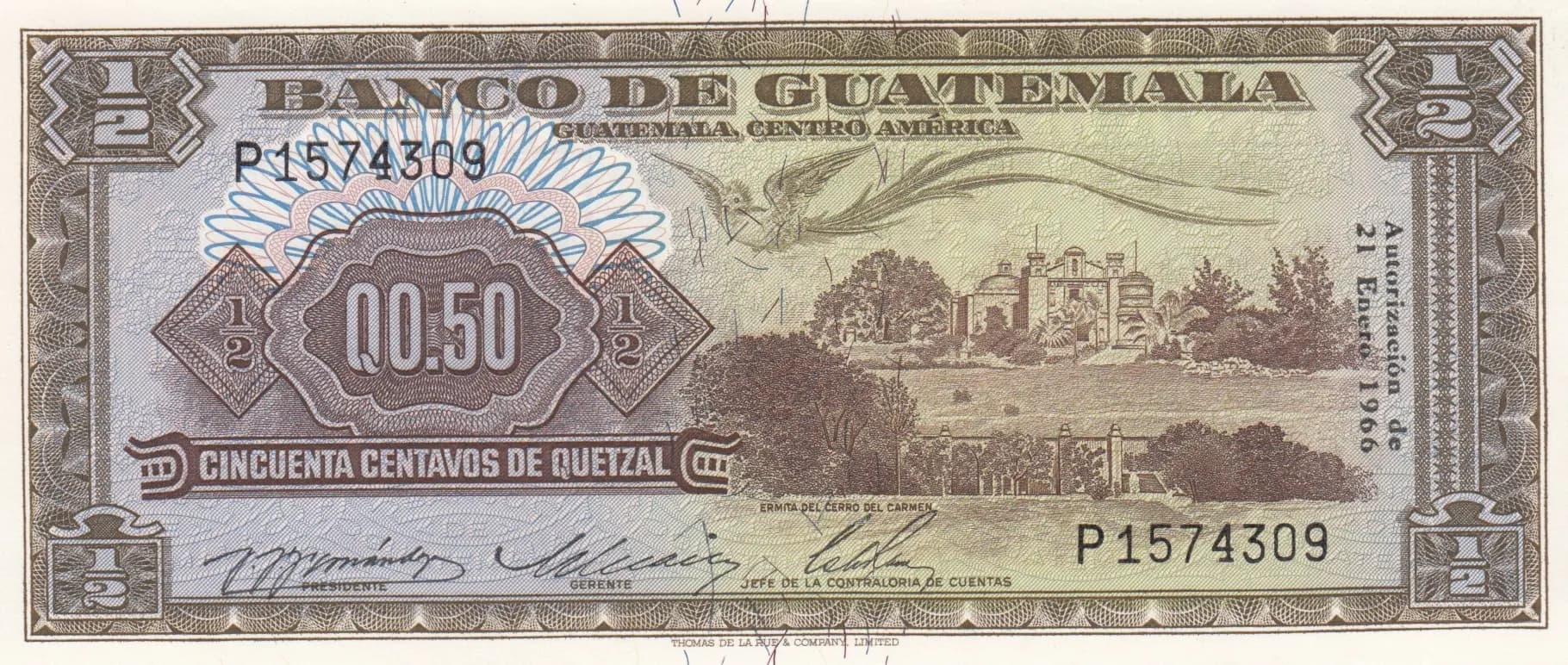
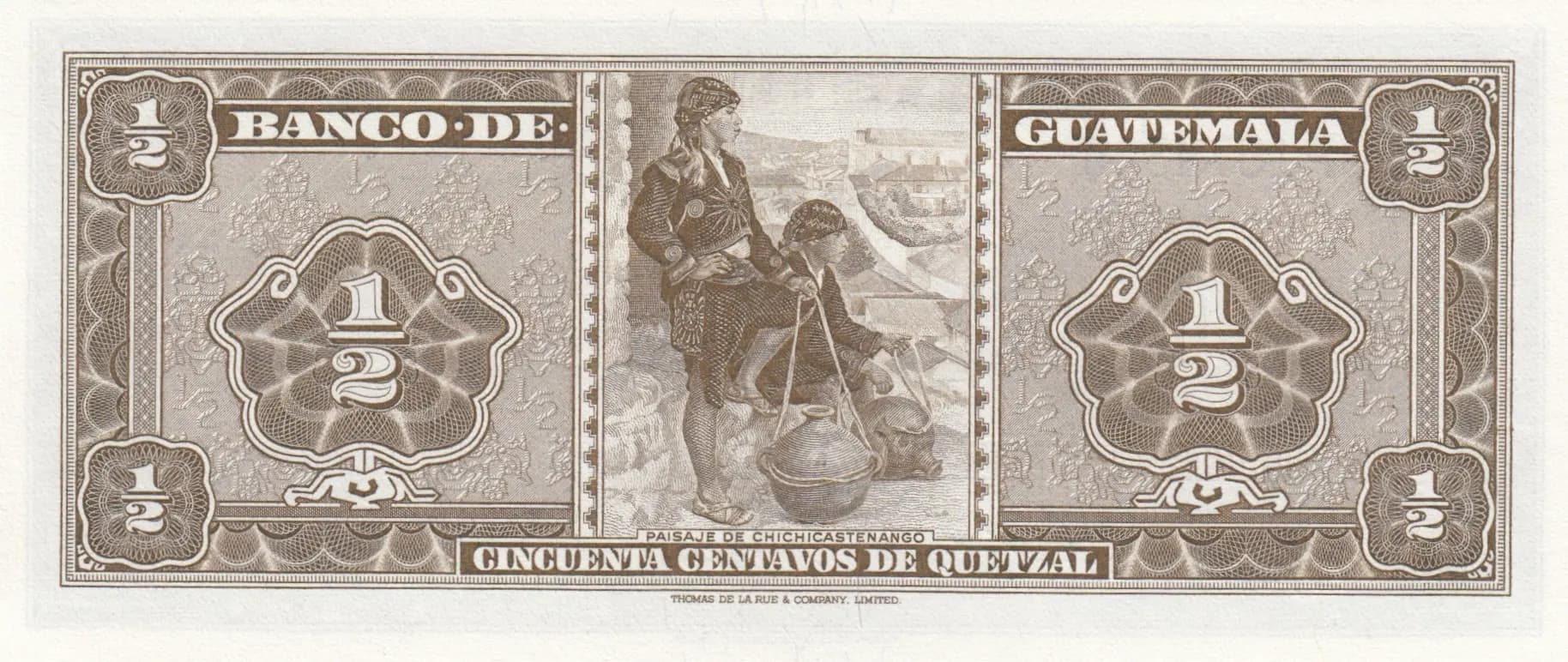
A handsome example of Guatemala's 1966 50 centavos note printed by Thomas de la Rue, featuring the iconic Ermita del Cerro del Carmen on the front and figures from Chichicastenango on the reverse. The note displays the fine line engraving characteristic of De la Rue's work, with intricate border patterns and ornamental corner cartouches. The specimen shows evidence of archival handling with manuscript annotations, placing it in the UNC grade despite minor handling marks—a desirable example of mid-20th century Guatemalan currency design.
Common. This note circulated widely as part of a 1964-1972 issue series with presumably substantial print runs by a major security printer. Secondary market evidence from eBay sales shows regular circulation of examples in F to VF grades at $8-15, with UNC examples cataloging at $40 (2019 values). The absence of any rarity notation in Pick or other major catalogs, combined with market availability and pricing consistent with common mid-20th century Latin American currency, indicates this is a readily available note despite its historical and artistic merit.
This note was issued during a period of relative stability in Guatemala under the series 1964-1972 authorization from Banco de Guatemala. The depicted scenes—the Cerro del Carmen hermitage and the Chichicastenango landscape with indigenous figures—represent Guatemala's cultural and religious heritage, reflecting the nation's identity during the 1960s. The note's imagery emphasizes both colonial architectural legacy and indigenous presence, serving as visual propaganda for national unity during this politically complex period.
The obverse features a colonial-era fortification identified as the Ermita del Cerro del Carmen, rendered in detailed engraving on the right side of the note, with landscaped grounds, foliage, and a water feature in the foreground. The denomination is prominently displayed in a decorative diamond-shaped cartouche in the center. The reverse depicts two indigenous or colonial-period figures from Chichicastenango—one in standing military or official dress in the upper portion, and another in a seated or laboring posture below—rendered against a mountainous landscape background. All four corners feature matching ornamental cartouches with scallop shell designs and geometric patterns. The color scheme throughout is predominantly beige, tan, and brown on multicolored underprinting, with fine line engraving providing intricate security detailing.
FRONT: 'BANCO DE GUATEMALA' (Bank of Guatemala) | 'GUATEMALA, CENTRO AMÉRICA' (Guatemala, Central America) | '00.50' / 'CINCUENTA CENTAVOS DE QUETZAL' (Fifty centavos of quetzal) | 'ERMITA DEL CERRO DEL CARMEN' (Hermitage of Cerro del Carmen) | 'JEFE DE LA CONTRALORIA DE CUENTAS' (Chief of the Accounting Office) | Serial number: P1574309. BACK: 'BANCO DE GUATEMALA' (Bank of Guatemala) | '1/2' / 'CINCUENTA CENTAVOS DE QUETZAL' (Fifty centavos of quetzal / One-half) | 'PAISAJE DE CHICHICASTENANGO' (Chichicastenango landscape) | 'THOMAS DE LA RUE & COMPANY, LIMITED' (printer attribution).
Intaglio engraving (fine line engraving) executed by Thomas de la Rue & Company Limited, London. The note exhibits the characteristic fine cross-hatching, detailed architectural ornaments, and complex geometric border patterns typical of De la Rue's security printing. Watermark elements are visible in the upper left with radiating line patterns. The multicolored underprinting suggests the use of color separation plates in addition to primary engraved elements.
Pick catalog lists this as P-51c, with notation of at least one other variant (P-51f) in the PMG population report. The visual analysis shows serial number P1574309, indicating the standard circulation series. No overprints, significant signature variants, or printing variations are apparent in the observed specimen. The note's archival markings and manuscript annotations suggest this may be from an official or institutional collection rather than standard circulation.