5 quetzales 1969 specimen
Market Prices
4 salesAbout This Note
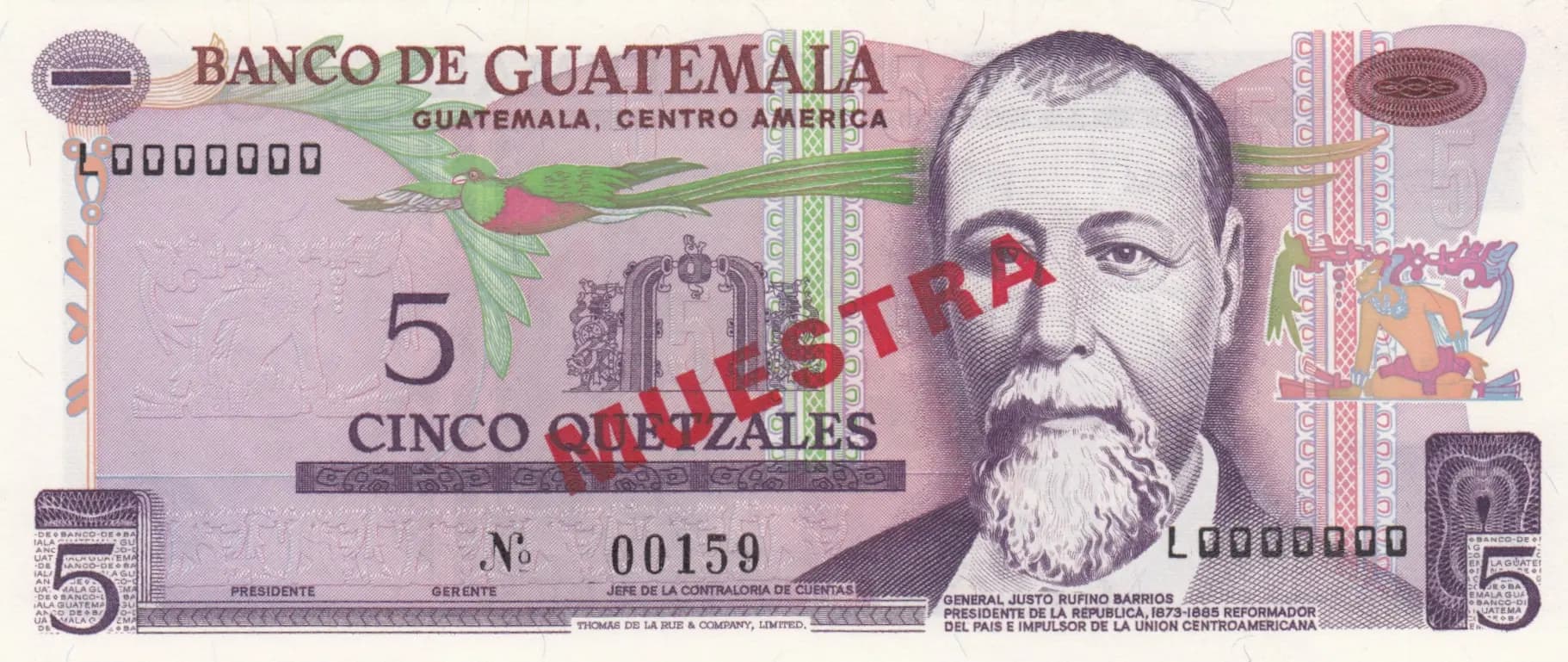
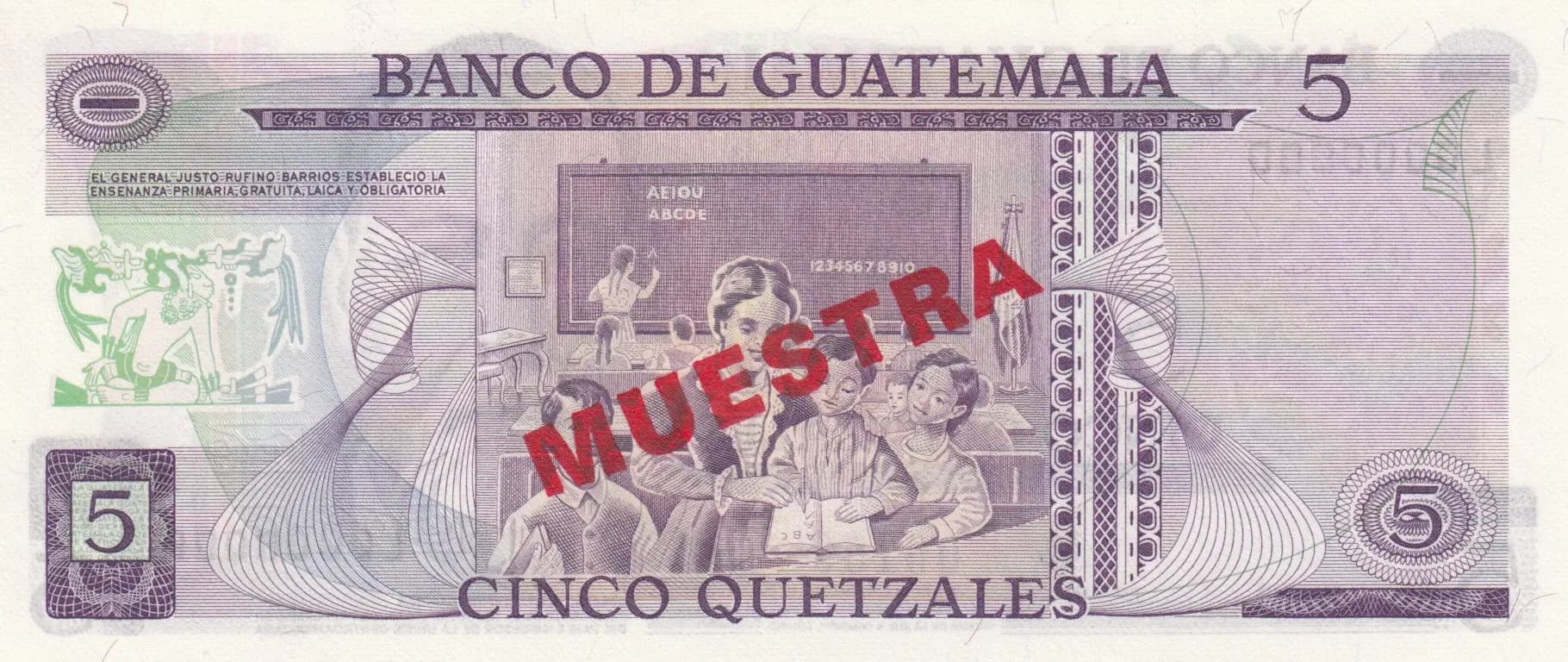
This is a 1969 Guatemala 5 Quetzales specimen note (Pick P-60s) issued by Banco de Guatemala and printed by Thomas de la Rue. The note features General Justo Rufino Barrios on the obverse with a quetzal bird symbol, and an educational classroom scene on the reverse—both themes reflecting Barrios's legacy as a national reformer. As a specimen note, it bears a red 'MUESTRA' overprint and exhibits the characteristic preservation of archival handling with minor age-related discoloration, making it a desirable item for Central American currency collectors.
Common. Specimen notes from the 1969-1983 issue period of this 5 Quetzales denomination appear regularly in the market. eBay price data shows comparable UNC examples selling for approximately $107.50, with professionally graded higher-condition specimens reaching $177.50-$207.50. The 2019 catalogue value listed as $10 for UNC condition, combined with the modest secondary market prices and the fact that this is a specimen variant (which tend to have higher survival rates than circulated notes due to archival preservation), indicates this is a commonly available note among collectors of Guatemalan currency. Thomas de la Rue produced this design for over a decade (1969-1983), supporting high mintage levels.
This banknote commemorates General Justo Rufino Barrios, who served as President of Guatemala from 1873-1885 and is celebrated on the note as both a 'Reformer of the Country and Promoter of Central American Union.' The reverse design depicts an educational scene and includes text crediting Barrios with establishing free, secular, and compulsory primary education—a cornerstone of his modernization agenda. The note was issued during the period 1969-1983, well after Barrios's death, reflecting Guatemala's continued veneration of this 19th-century leader as a symbol of national progress and institutional development.
The obverse features a right-facing portrait of General Justo Rufino Barrios, a bearded man in formal 19th-century attire, positioned at the right side of the note. Above the portrait, the national symbol of Guatemala—a quetzal bird rendered in green with pink accent markings—is prominently displayed at upper center, symbolizing the nation's heritage and dignity. The note is framed by ornamental guilloche borders and decorative geometric patterns in purple, pink, and green. The reverse depicts an educational scene central to Barrios's legacy: an adult woman (teacher) reading to two children in an interior classroom setting, reinforcing the historical narrative of educational reform. Both sides display multiple security seals with radiating lines and rectangular denomination markers bearing the numeral '5'. The specimen overprint 'MUESTRA' in red diagonal text across both sides indicates this is a non-circulating specimen or proof note.
Front side: 'BANCO DE GUATEMALA' (Bank of Guatemala); 'GUATEMALA, CENTRO AMERICA' (Guatemala, Central America); 'CINCO QUETZALES' (Five Quetzals); 'MUESTRA' (Specimen); 'No. 00159'; 'PRESIDENTE' (President); 'GERENTE' (Manager); 'JEFE DE LA CONTRALORIA DE CUENTAS' (Chief of the Comptroller of Accounts); 'GENERAL JUSTO RUFINO BARRIOS'; 'PRESIDENTE DE LA REPUBLICA 1873-1885 REFORMADOR DEL PAIS E IMPULSOR DE LA UNION CENTROAMERICANA' (President of the Republic 1873-1885, Reformer of the Country and Promoter of Central American Union); 'THOMAS DE LA RUE & COMPANY, LIMITED'. Back side: 'BANCO DE GUATEMALA' (Bank of Guatemala); 'CINCO QUETZALES' (Five Quetzals); 'MUESTRA' (Specimen); 'ÁRBOL' (Tree); 'EL GENERAL JUSTO RUFINO BARRIOS ESTABLECIO LA ENSEÑANZA PRIMARIA GRATUITA LAICA Y OBLIGATORIA' (General Justo Rufino Barrios established free, secular, and compulsory primary education).
This banknote was produced using intaglio (engraved) printing by Thomas de la Rue & Company, Limited, London—indicated by the printer's name on the obverse. The extensive guilloche patterns, fine line work, microprint patterns visible in the background, and the multi-color security seals are characteristic of high-security intaglio production. The complex decorative borders and the fine detail in both the portrait and the classroom scene reflect the advanced engraving capabilities that Thomas de la Rue was renowned for during this period.
This is the P-60s variant, specifically identified as a specimen note ('s' designator). The PMG population report indicates two catalogued variants for this base Pick number: P-60b and P-60s. The 's' designation confirms this as a specimen issue, distinguished by the 'MUESTRA' overprint and the serial number format (L 00000000). The visual analysis confirms specimen characteristics including the red diagonal 'MUESTRA' overprint on both obverse and reverse, and the presence of specimen-specific serial number formatting. The note's archival condition and lack of circulation wear are consistent with specimen preservation practices.