1 quetzal 1972 specimen
Market Prices
3 salesAbout This Note
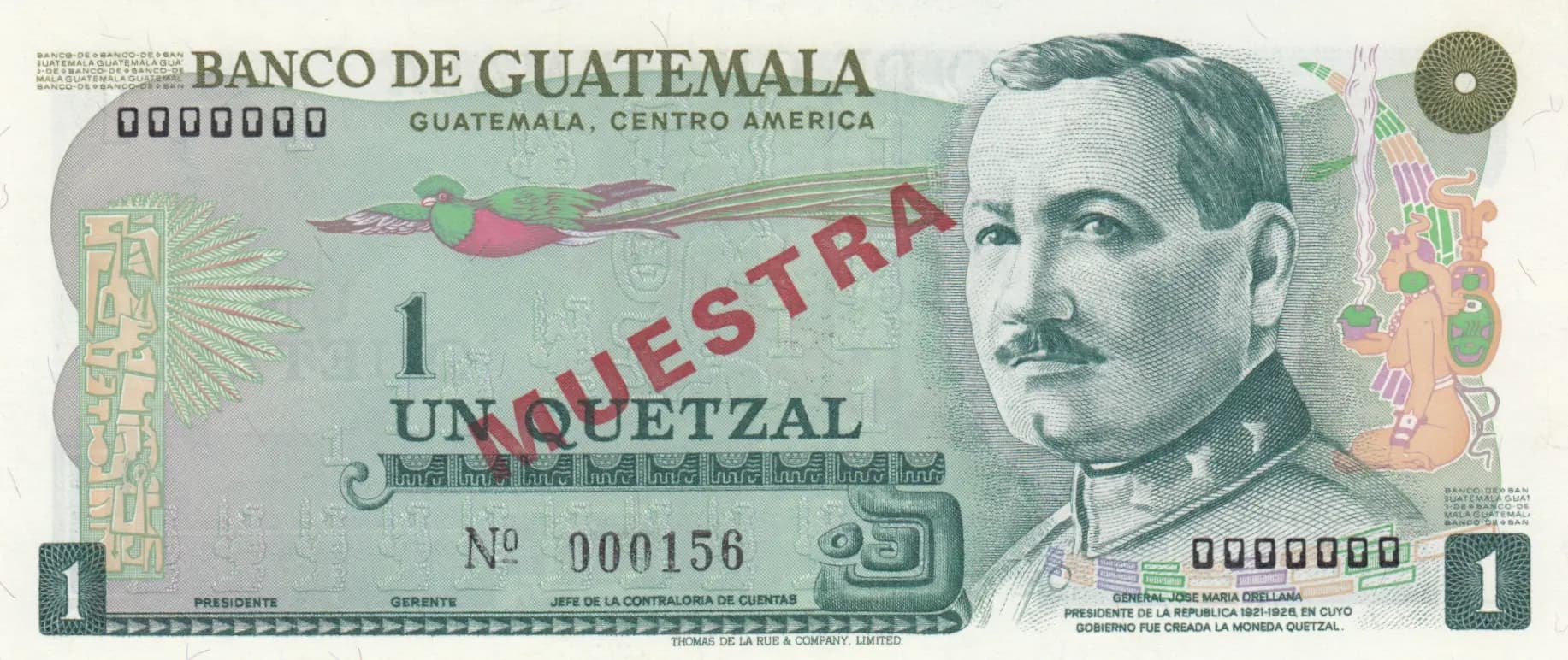
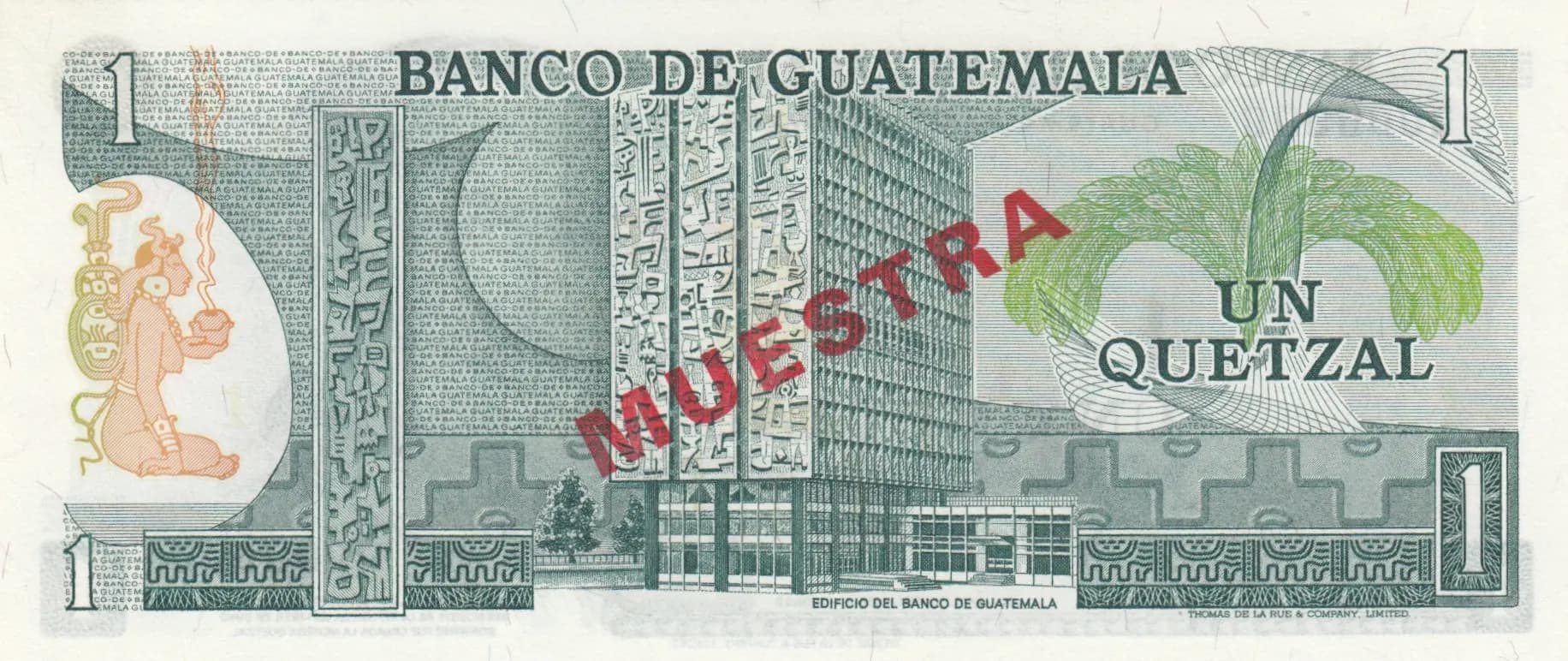
This is a 1972 specimen note from Banco de Guatemala, printed by Thomas de la Rue and graded UNC. The note features a striking design with General José María Orellana's portrait on the obverse and the Banco de Guatemala building on the reverse, both complemented by vibrant Mayan geometric patterns and the iconic red-and-green quetzal bird motif. As a specimen note with the diagonal 'MUESTRA' overprint and serial number 000156, this is a specialized collector item that represents the issuing bank's official presentation version, and recent market sales data shows specimen examples in PMG 65 condition commanding prices in the $150–$200 range.
Common. While this is a specimen note (which makes it a specialized collector item as opposed to circulating currency), specimen notes from this 1972–1983 series were produced in quantities sufficient to make them readily available in the collector market. The catalog reference value of $10 for UNC specimens and recent eBay sales data showing PMG 65 examples selling in the $150–$200 range (likely reflecting premium pricing for professional grading rather than extreme rarity) confirm that this note is not scarce. Specimen notes by definition were created for official presentation and archival purposes, often in modest but deliberate quantities, making them common relative to regular circulating issues of the same type.
The 1 Quetzal note issued from 1972 onwards commemorates General José María Orellana, who served as President of Guatemala from 1921–1926—precisely the period when the Quetzal currency was established as the national monetary unit. The incorporation of Mayan cultural elements (geometric patterns, glyphs, and the sacred quetzal bird) reflects Guatemala's indigenous heritage and national identity during the mid-20th century modernization of the country's financial institutions. The depiction of the Banco de Guatemala building on the reverse symbolizes the nation's economic sovereignty and institutional stability during this era.
The obverse features a right-facing portrait of General José María Orellana, the statesman who established the Quetzal as Guatemala's currency during his 1921–1926 presidency. Above the portrait flies a stylized quetzal bird rendered in red and green, symbolizing national pride and Guatemala's connection to its Mayan heritage. The left side of the note is adorned with Mayan geometric patterns and glyphs, representing the indigenous cultural foundation of the nation. A circular rosette pattern in the upper right and decorative rectangular frames with fine geometric work provide sophisticated security and aesthetic elements. The reverse displays the modern Edificio del Banco de Guatemala as its focal point—a multi-story institutional building with regular horizontal bands and window patterns, conveying stability and progress. The left reverse features an oval vignette containing Mayan cultural imagery in gold and tan tones, further emphasizing the nation's pre-Columbian heritage. Both sides maintain a predominantly light green background with darker green and tan accents, creating a cohesive and professional appearance consistent with Thomas de la Rue's high-security banknote standards.
FRONT SIDE: 'BANCO DE GUATEMALA' (Bank of Guatemala); 'GUATEMALA, CENTRO AMERICA' (Guatemala, Central America); 'UN QUETZAL' (One Quetzal); 'MUESTRA' (Specimen); 'Nº 000156' (Number 000156); 'PRESIDENTE' (President); 'GERENTE' (Manager); 'JEFE DE LA CONTRALORIA DE CUENTAS' (Chief of the Comptroller of Accounts); 'GENERAL JOSÉ MARÍA ORELLANA' (General José María Orellana); 'PRESIDENTE DE LA REPÚBLICA 1921-1926 EN CUYO GOBIERNO FUE CREADA LA MONEDA QUETZAL' (President of the Republic 1921-1926 in whose government the Quetzal currency was created); 'THOMAS DE LA RUE & COMPANY, LIMITED' (Thomas de la Rue & Company, Limited). BACK SIDE: 'BANCO DE GUATEMALA' (Bank of Guatemala); 'UN QUETZAL' (One Quetzal); 'MUESTRA' (Specimen); 'EDIFICIO DEL BANCO DE GUATEMALA' (Building of the Bank of Guatemala); 'THOMAS DE LA RUE & COMPANY, LIMITED' (Thomas de la Rue & Company, Limited).
Intaglio printing (engraving and recess printing) executed by Thomas de la Rue & Company, Limited, London—one of the world's premier security printers. The fine line work evident in the architectural rendering, the intricate geometric patterns, and the detailed portraiture are characteristic of intaglio production. Security features include extensive microprinting throughout the background (repetitive 'BANCO DE GUATEMALA' text), fine-line geometric patterns, and elaborate decorative borders with precision detail work. The multicolored design (light green, dark green, red, black, pink/magenta, and tan) was achieved through multiple-pass intaglio printing, a standard technique for high-security currency of this era.
This is specifically identified as a specimen note variant (Pick 59s, where 's' denotes specimen status). The diagonal 'MUESTRA' (Specimen) overprint in red is the defining characteristic of this variety. The serial number format shown as 'Nº 000156' is consistent with specimen numbering conventions. No signature varieties or date variations are visible on this particular specimen, though the catalog data indicates the design was used across multiple actual issue dates from 1977–1983. The specimen variant was produced for the Banco de Guatemala's official records and presentation purposes, distinguishing it from the regular circulation note (Pick 59).