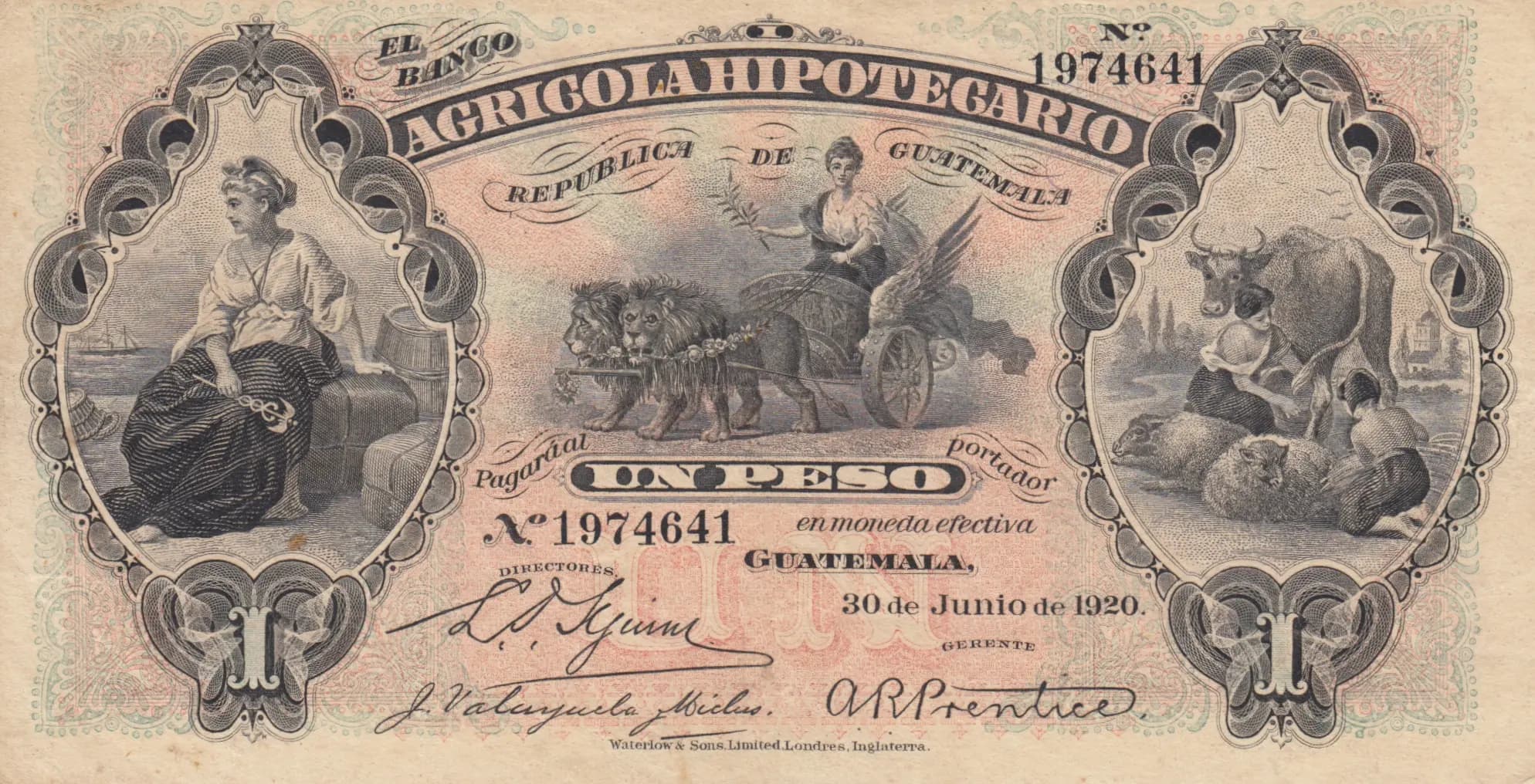
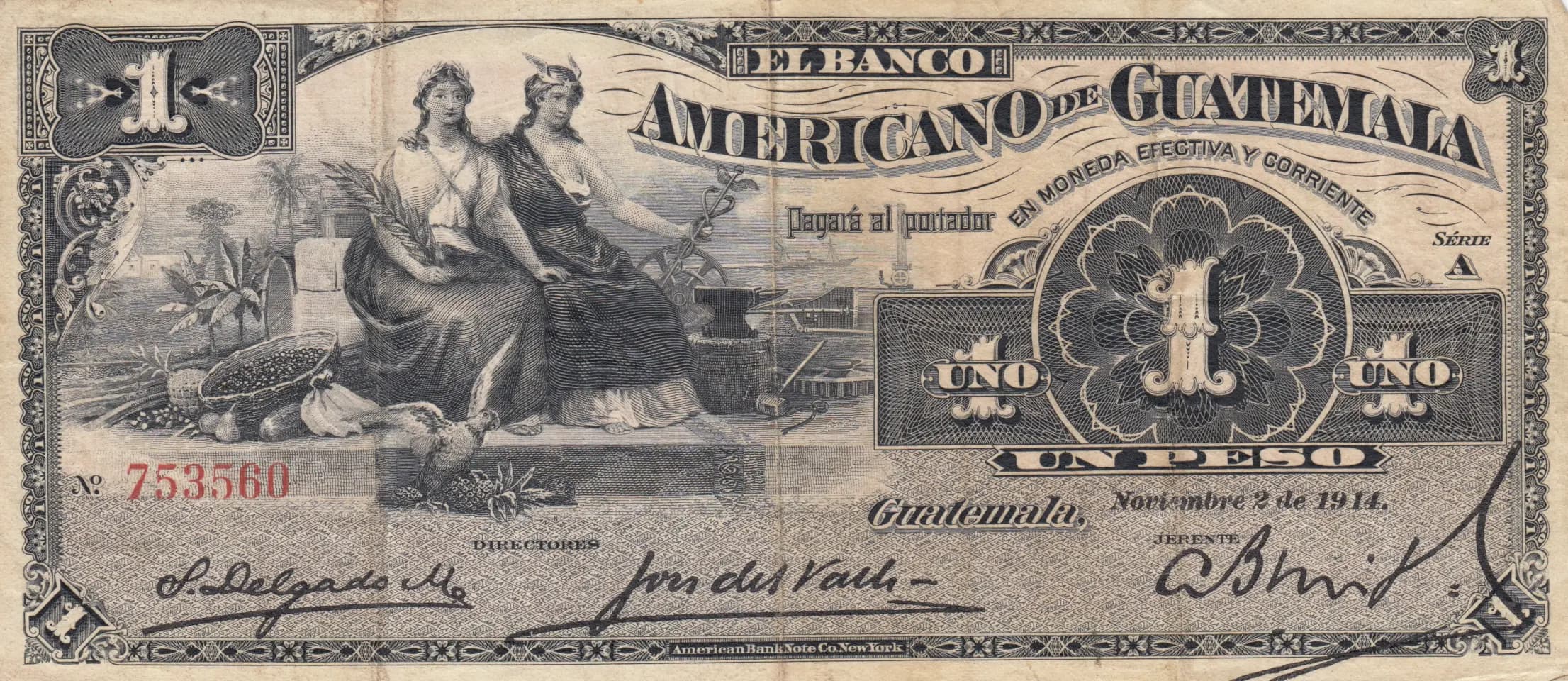
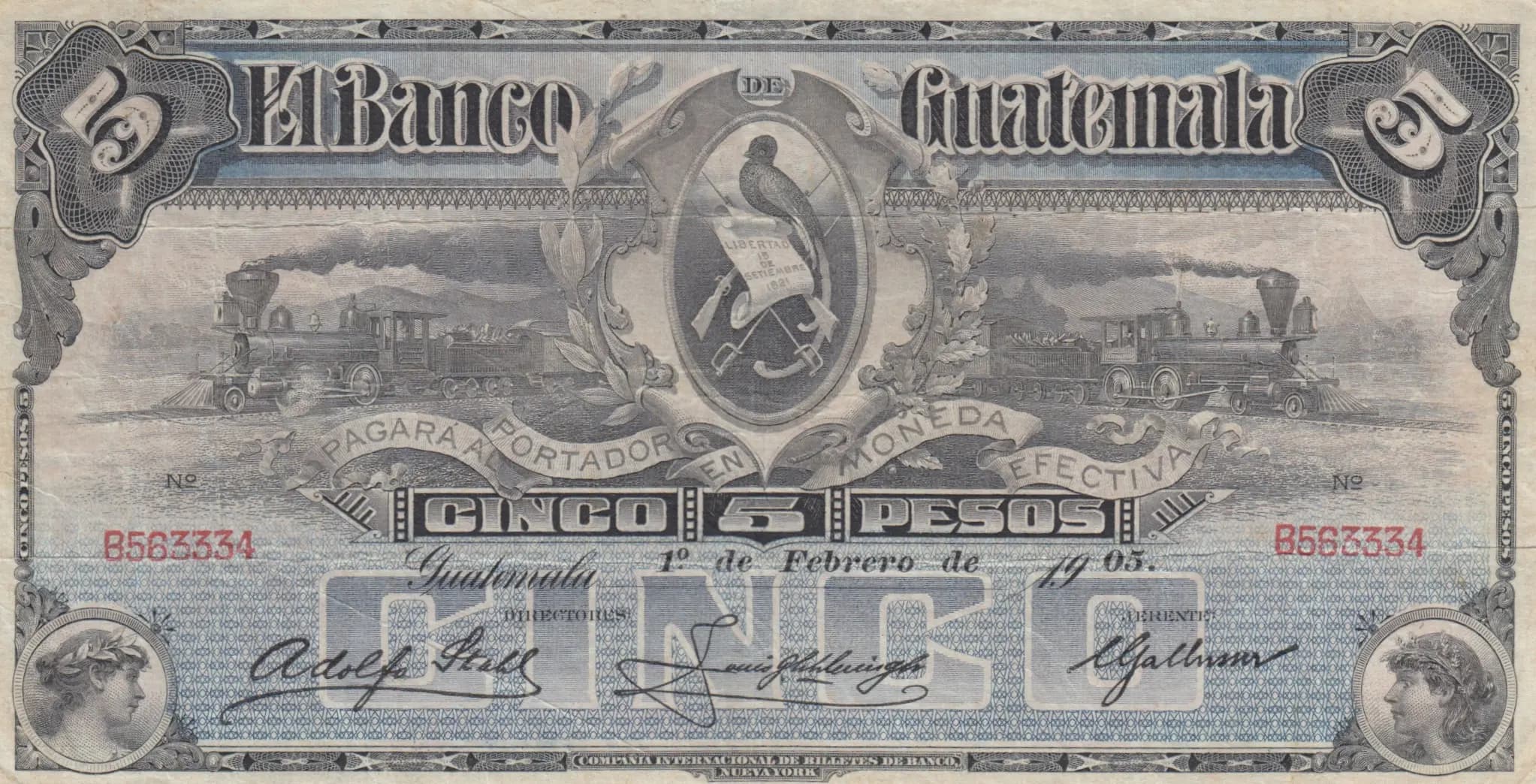
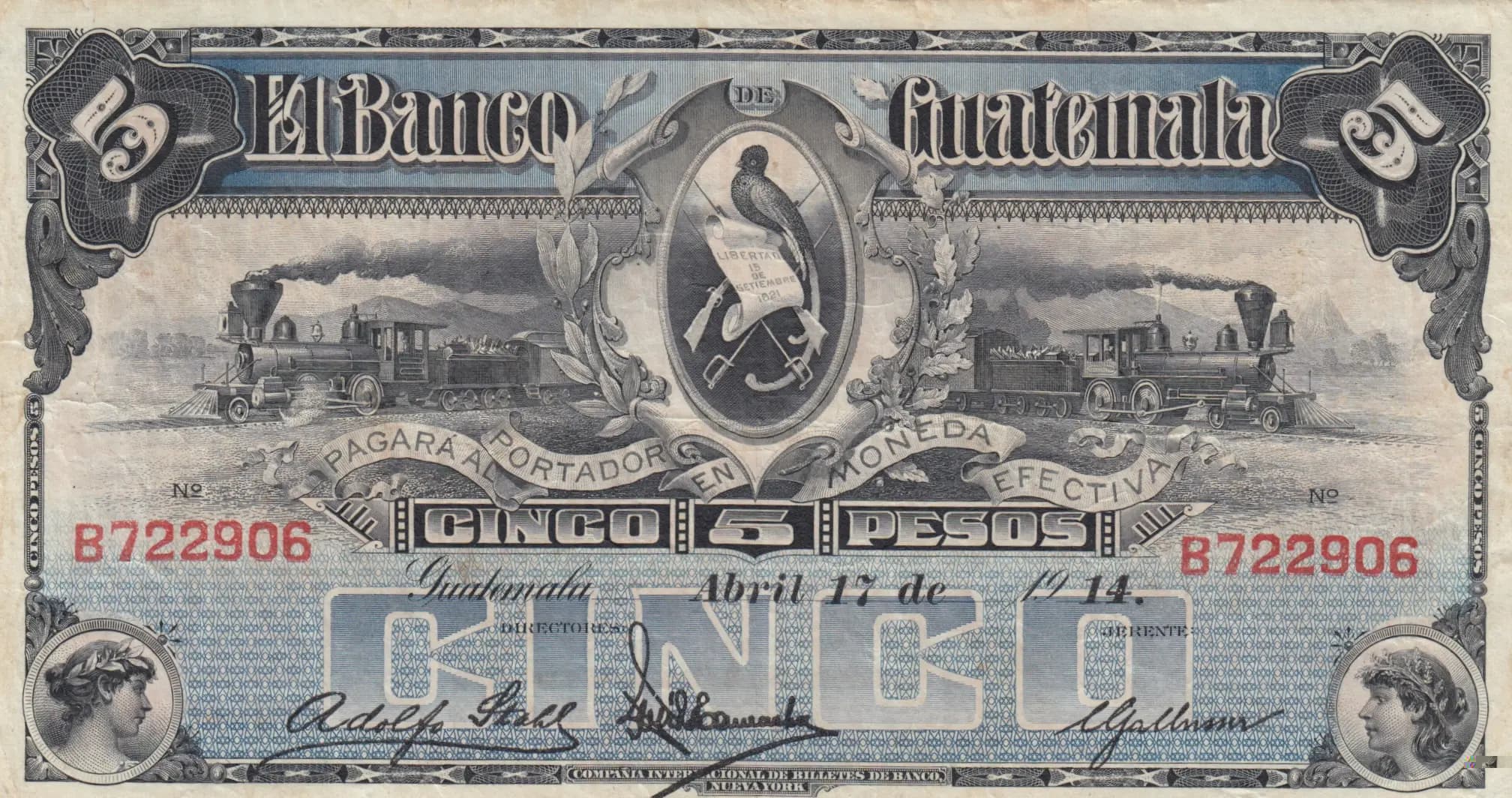
1 peso 1923
Market Prices
About This Note
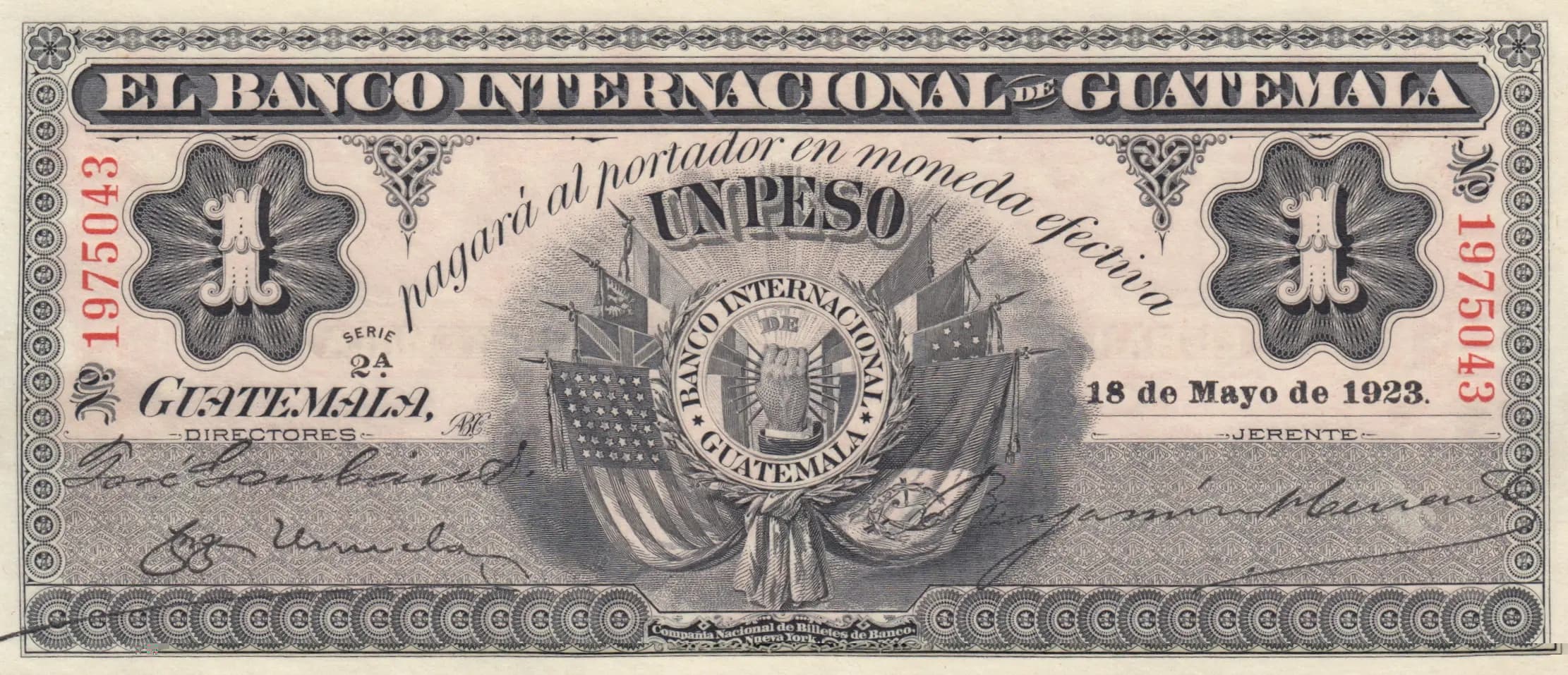
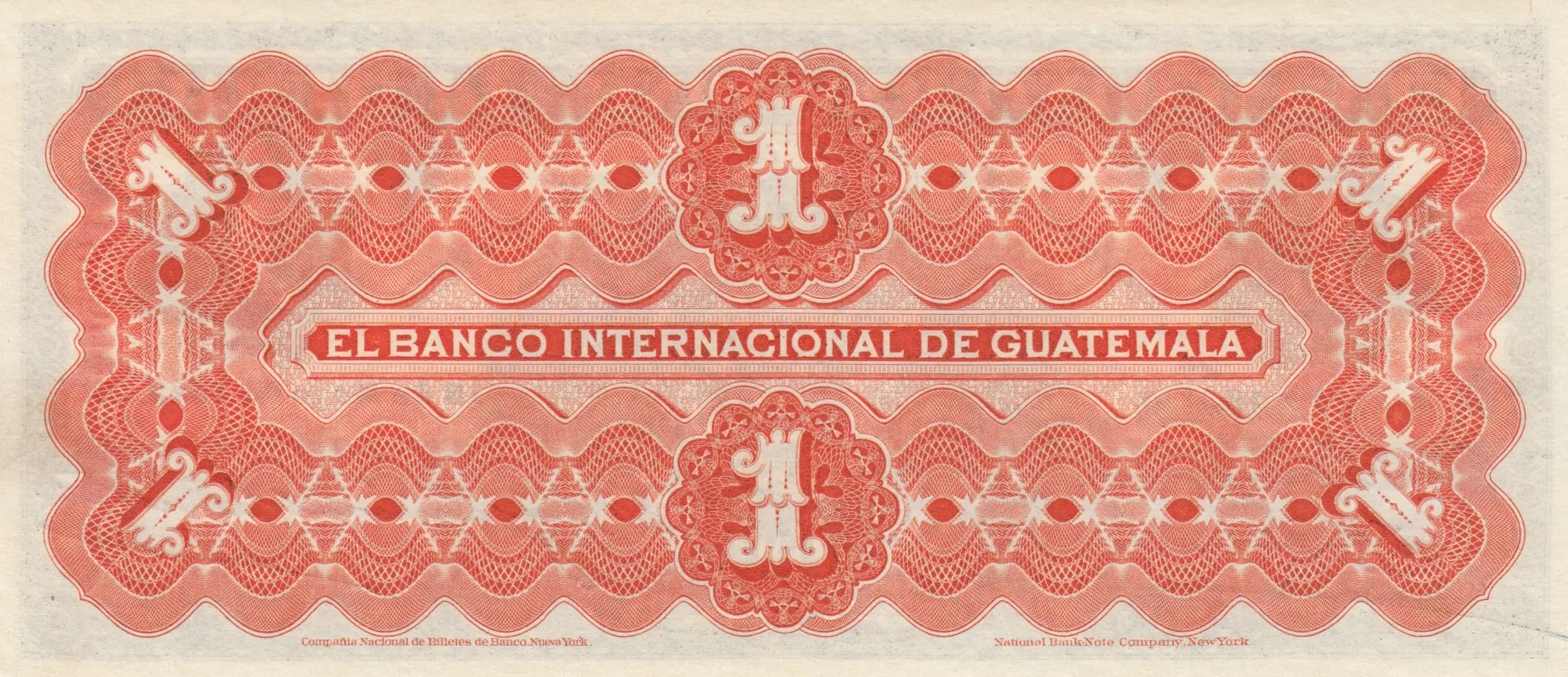
This is an exceptionally well-preserved 1923 Guatemalan 1 Peso note from the Banco Internacional de Guatemala, graded UNC with no visible signs of wear, creases, or circulation. The front features a striking patriotic design centered on an eagle with spread wings clutching a shield, flanked by flags in black and red ink on a cream background. The back showcases intricate red and white geometric patterning characteristic of early 20th-century security printing, making this an attractive example of Central American currency design from the post-WWI era.
Common. While this is an early 20th-century note from a Central American bank that no longer operates, eBay market data shows consistent sales across multiple condition grades with prices ranging from $25 to $672, with most VF and circulated examples selling in the $135–$195 range. The wide availability of listings and price variability suggest adequate surviving supply. The 1923 issue date and the Banco Internacional de Guatemala's operational history indicate a reasonable original print run. This particular series (2A) does not appear to be documented as scarce or recalled in standard catalogs.
This note was issued on May 18, 1923, during a period of economic modernization in Guatemala under the Banco Internacional de Guatemala. The prominent eagle-and-shield motif reflects Guatemalan national symbolism, while the inclusion of what appears to be an American flag alongside the Guatemalan flag reflects the economic ties and influence of the United States in Central America during this period. The National Bank Note Company of New York, credited on the reverse, was one of the leading security printers for Latin American currencies in the early 20th century.
The obverse features Guatemala's national heraldic eagle with fully spread wings as the central motif, positioned above or within a shield bearing the Guatemalan flag. Two flags—one representing Guatemala and one the United States—flank the eagle, emphasizing diplomatic and economic relationships. The design is framed by ornate borders composed of repeating circular and floral patterns with four-pointed star designs in the corners, all executed in black ink with red accents. The reverse employs an all-over security pattern of interlocking diamonds and scale-like geometric motifs in red/coral and white, a sophisticated anti-counterfeiting technique typical of National Bank Note Company production. The color scheme of cream/beige with black and red ink is characteristic of 1920s Central American currency design.
FRONT: 'El Banco Internacional de Guatemala' (The International Bank of Guatemala) / 'Un Peso' (One Peso) / 'Pagará al portador en moneda de curso legal' (Will pay the bearer in legal tender currency) / 'Serie 2A' (Series 2A) / 'Guatemala' / 'Directores' (Directors) / '18 de Mayo de 1923' (May 18, 1923) / 'Gerente' (Manager) / Serial numbers: 1975043 and 0943. BACK: 'El Banco Internacional de Guatemala' (The International Bank of Guatemala) / 'Compañia Nacional de Billetes de Banco, Nueva York' / 'National Bank Note Company, New York'
Intaglio engraving (steel plate engraving), the standard security printing method employed by the National Bank Note Company of New York. The fine line work, intricate repeating patterns on the reverse, and sharp detail visible throughout—particularly in the ornamental scrollwork and geometric designs—are hallmarks of professional intaglio production. The multi-color printing (black, red, and cream) was achieved through separate passes through different engraved plates, a labor-intensive but highly secure method that made counterfeiting extremely difficult.
This specimen is identified as series 2A, as clearly marked on the note. The Pick catalog designation P-S153b indicates this is the 'b' variety of the 1923 1 Peso issue—likely differing from variety 'a' in signature variants, date variations, or other minor design elements typical of multi-signature banknotes of this era. The serial number 1975043/0943 is specific to this individual note. Without access to comprehensive documentation of all signature combinations and series variants for this issue, the exact nature of the 2A designation versus other series cannot be definitively stated, but series letters were commonly used to denote different printings or signature configurations.