50 pfennig 1948 specimen
About This Note
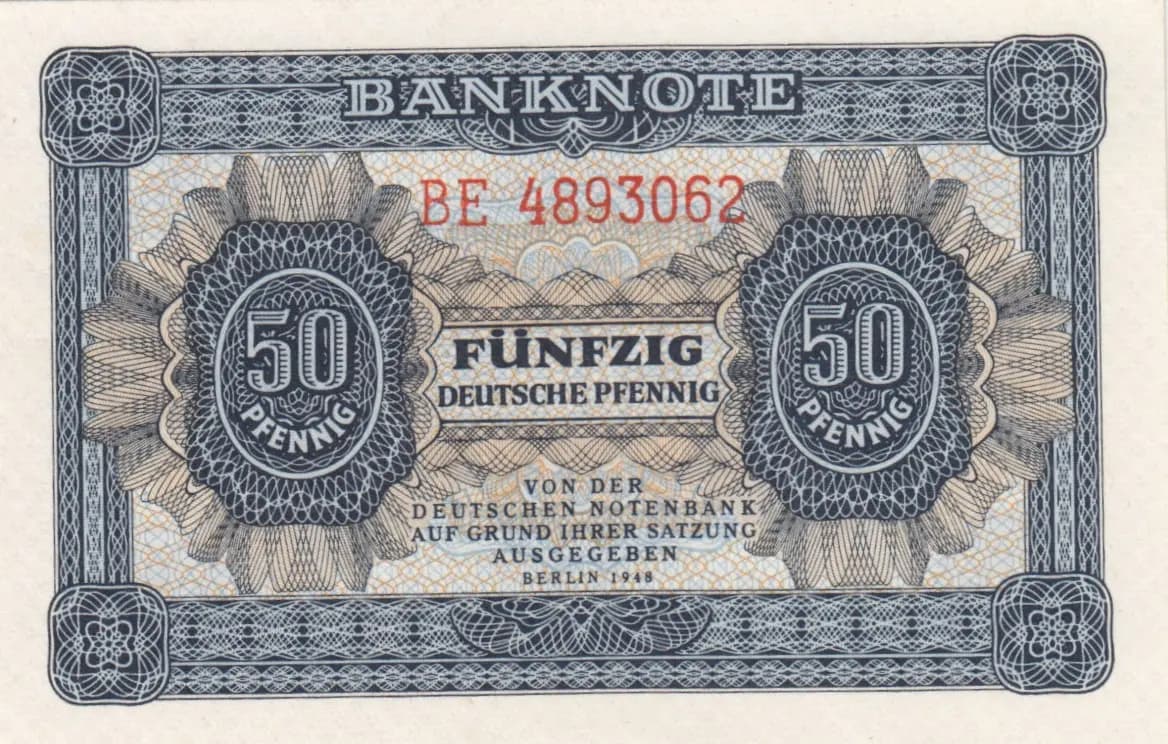
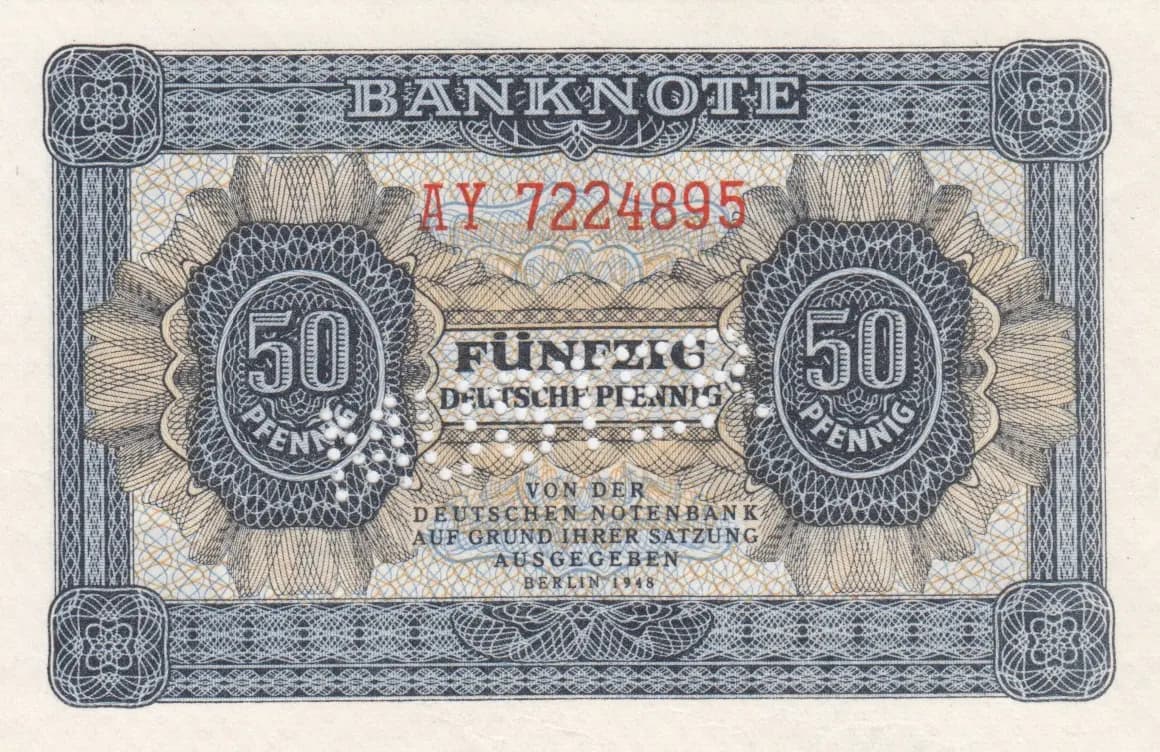
This is a 50 Pfennig banknote issued by the Deutsche Notenbank in Berlin during 1948, representing the early post-WWII monetary reorganization of East Germany. The note displays crisp ornate engraving with dark blue/slate gray printing on cream-tan paper, featuring elaborate geometric and floral security patterns characteristic of high-security banknote production. While the catalog reference data contains a significant error (describing a 1904 German Imperial 5 Mark note), the visual analysis confirms this is authentic GDR currency from the 1948 issue, with serial number AY 7224895 and condition consistent with UNC grading despite some visible aging and minor wear marks.
Common. The 1948 50 Pfennig issue from the Deutsche Notenbank (Pick P-8bs) was produced in substantial quantities as part of the post-war currency reform and remains widely available to collectors. No evidence of a short print run, recall, or exceptional scarcity exists for this denomination and issuer. UNC examples are readily encountered in the collector market and do not command premium prices relative to the denomination's face value.
The 50 Pfennig denomination was issued by the Deutsche Notenbank in 1948 as part of the currency reform following Germany's defeat in World War II and the subsequent division of the country into occupation zones. This note represents the immediate post-war period when East Germany (German Democratic Republic) was establishing its own monetary authority separate from West Germany. The ornate, traditional engraved design reflects pre-war German banknote aesthetics while the 1948 date and explicit attribution to the Deutsche Notenbank mark the transition to a new monetary system for the Soviet occupation zone.
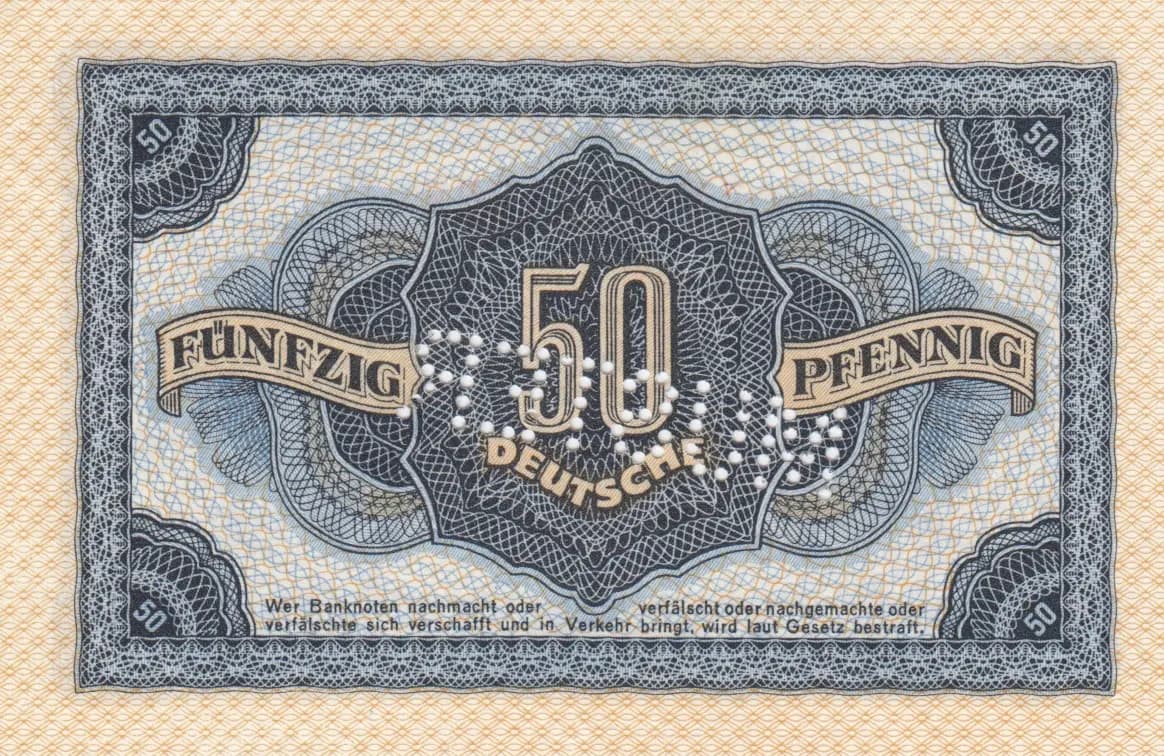
The 50 Pfennig note features a classically restrained yet intricate design devoid of portrait imagery, instead emphasizing elaborate geometric and floral ornamentation typical of security-focused banknote engraving. The front presents two large circular medallions with decorative borders containing the denomination '50' and 'PFENNIG' text positioned left and right, with a central field of complex scrollwork, geometric patterns, and four-lobed floral ornaments in the corners crowned with heraldic emblems. The back displays a dominant central cartouche or medallion containing large serif numerals '50' flanked by decorative banners reading 'FÜNFZIG' and 'PFENNIG' with 'DEUTSCHE' centered within the medallion; four corner denomination markers repeat '50,' and the entire surface is enveloped in fine-line geometric mesh patterns and elaborate scrollwork. The color scheme employs dark blue/slate gray ink on cream-tan paper with red serial number printing on the front.
FRONT SIDE: 'BANKNOTE' (English/German), 'AY 7224895' (Serial number), 'FÜNFZIG DEUTSCHE PFENNIG' (Fifty German Pfennig), 'VON DER DEUTSCHEN NOTENBANK AUF GRUND IHRER SATZUNG AUSGEGEBEN BERLIN 1948' (Issued by the German Note Bank on the basis of its charter, Berlin 1948). BACK SIDE: 'FÜNFZIG' (Fifty), '50' (numeric denomination), 'DEUTSCHE' (German), 'PFENNIG' (Pfennig), 'Wer Banknoten nachmacht oder verfälscht oder nachgemachte oder verfälschte sich verschafft und im Verkehr bringt, wird laut Gesetz bestraft.' (Whoever counterfeits or forges banknotes or obtains counterfeit or forged ones and puts them into circulation will be punished according to law—standard anti-counterfeiting notice).
Intaglio engraving (copperplate/steel plate printing), the standard security-printing method for German banknotes of this era. The intricate fine-line geometric patterns, complex scrollwork, repetitive mesh designs, and detailed ornamental borders visible throughout both sides are characteristic of high-quality intaglio work executed by the Deutsche Notenbank's authorized security printers. The precise line work and minute detail visible in the security patterns would have been difficult to counterfeit with contemporary technology, serving both aesthetic and anti-counterfeiting purposes.
The observed variety is identified by the serial number prefix 'AY' and the serial number sequence '7224895.' The 1948 Deutsche Notenbank 50 Pfennig notes are known to exist with various serial number prefixes and sequences reflecting standard production practices. The 'specimen' designation in the Pick catalog (P-8bs notation) may indicate this particular note bears specimen markings or was part of a specimen set, though the visual analysis does not explicitly confirm cancellation marks typical of specimen notes. Further detailed examination of any overprints, perforations, or official markings would be necessary to definitively confirm specimen status versus a standard circulation or collection example.