2 mark 1948
About This Note
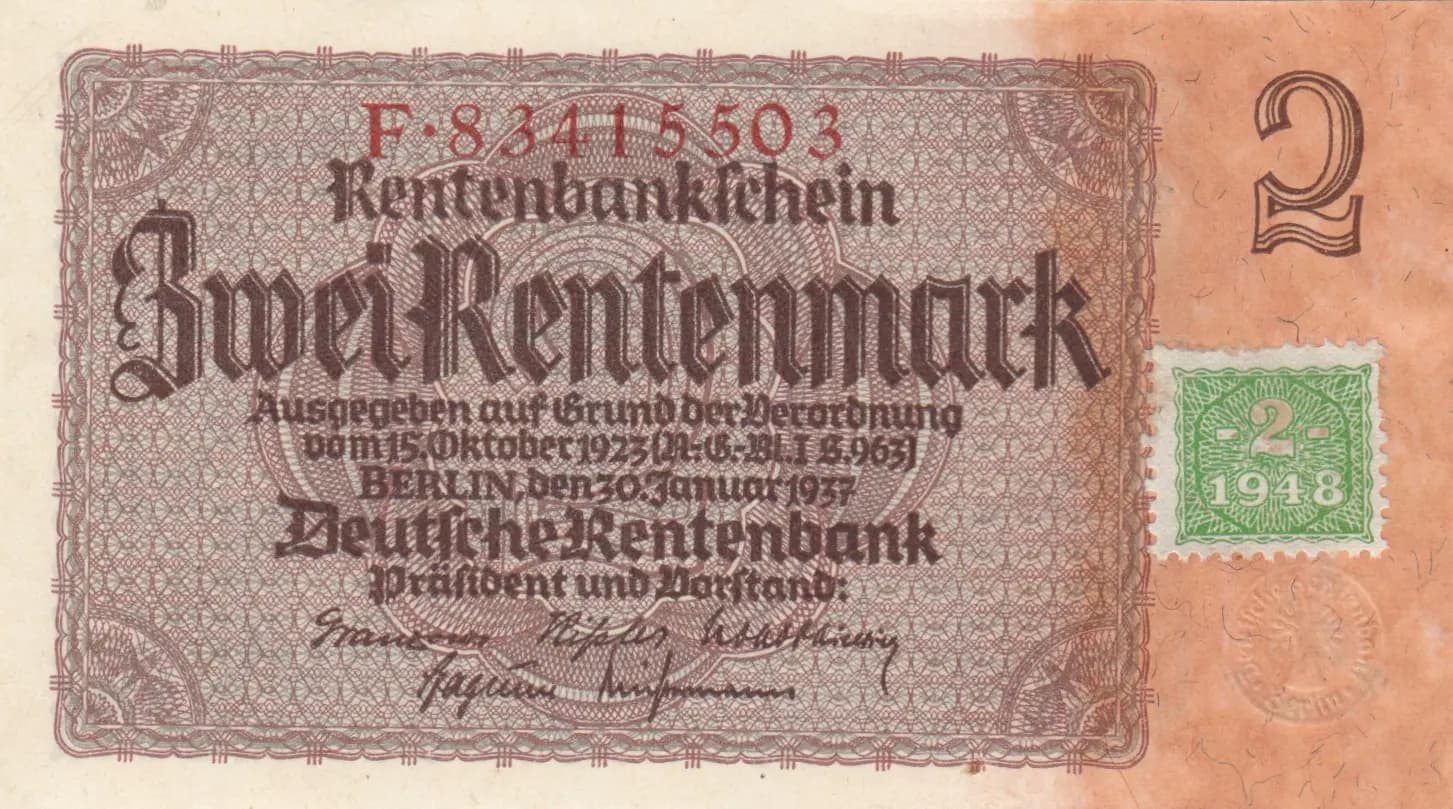
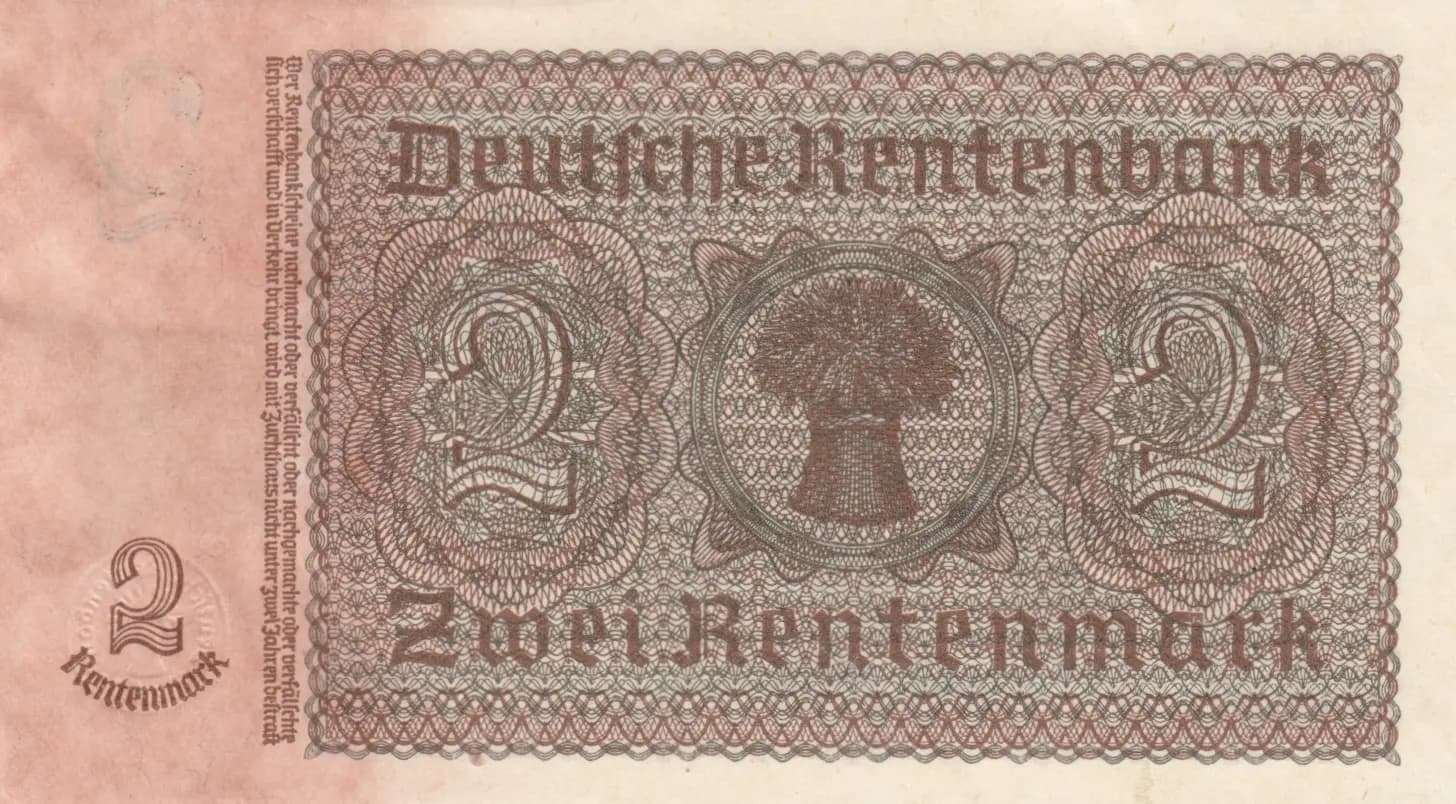
This is a 2 Rentenmark banknote from the German Rentenbank, dated January 20, 1927, representing an important transitional currency during the Weimar Republic's stabilization period. The note displays excellent condition with vibrant tan and brown coloration, ornate security borders, and intricate geometric patterns typical of high-quality 1920s German engraving. The presence of a postage stamp on the front and dual profile portraits on the reverse, combined with the central heraldic eagle medallion, makes this an attractive example of interwar German monetary design.
Common. The Rentenmark circulated widely during its period of issue (1923-1937), and while this specific January 1927 dated 2 Rentenmark variety may not be encountered in every collection, surviving examples are readily available in the numismatic market. The UNC condition grade increases desirability somewhat, but 2 Rentenmark notes from this period are not scarce. Print runs for Rentenbank denominations were substantial given the currency's essential role in economic stabilization.
The Rentenmark was created in October 1923 as an emergency currency to stabilize Germany's hyperinflated economy following World War I, backed by a mortgage on German land and industrial assets rather than gold. This January 1927 issue represents the currency's maturation phase, issued by the Deutsche Rentenbank under strict regulations outlined in the October 15, 1923 ordinance referenced on the note's front. The neoclassical portrait imagery and heraldic eagle symbolism reflect Weimar-era efforts to project governmental legitimacy and economic stability during a period of relative prosperity before the 1929 crash.
The obverse features an ornate rectangular border with repeating geometric and floral patterns in brown and dark red against a tan background, with a large stylized numeral '2' prominently positioned on the right edge and a small green postage stamp bearing the denomination in the upper right corner. The reverse displays the note's most distinctive artistic element: a large circular central medallion containing a detailed heraldic eagle (Reichsadler) in neoclassical style, flanked by two profile portrait heads facing inward in refined engraved style, characteristic of German Rentenbank design. Both sides feature complex geometric mesh patterns as security elements and extensive decorative borders with fine line work throughout, exemplifying the high-quality intaglio engraving standards of Weimar-era currency production.
FRONT: 'Deutsche Rentenbank' (German Rentenbank) / 'Zwei Rentenmark' (Two Rentenmark) / 'Rentenbankhein' (Rentenbank designation) / 'Ausgegeben auf Grund der Verordnung vom 15. Oktober 1923' (Issued pursuant to the ordinance of October 15, 1923) / 'BERLIN, den 20. Januar 1927' (Berlin, January 20, 1927) / 'Präsident und Vizekanzler' (President and Vice Chancellor) / Serial reference 'P 8341 15 503'. BACK: 'Deutsche Rentenbank' (German Rentenbank) / 'Zwei Rentenmark' (Two Rentenmark) / Denomination numeral '2' / 'Rentenmark'.
Intaglio engraving (copperplate), the standard method for Rentenbank notes. The intricate fine-line geometric patterns, precise detail work in the portrait profiles and central eagle medallion, and the complex decorative borders visible in both images are characteristic of high-quality intaglio production. The security printing was performed by established German security printers contracted by the Rentenbank, likely Giesecke+Devrient or similar firms, though specific printer identification marks are not clearly visible in the provided images.
This example is identifiable as the January 20, 1927 issue date variant of the 2 Rentenmark. The serial number prefix 'P 8341 15 503' may indicate a specific printing batch. Known varieties of this Pick number (P-2) include different signature combinations of Rentenbank officials and potential serial number series variations, though without access to comprehensive variety catalogs, the exact variety classification cannot be definitively stated from the images alone. The presence of the postage stamp design element on the front is consistent with standard Rentenmark design rather than indicating an overprint or provisional variety.