100 mark 1955 specimen
About This Note
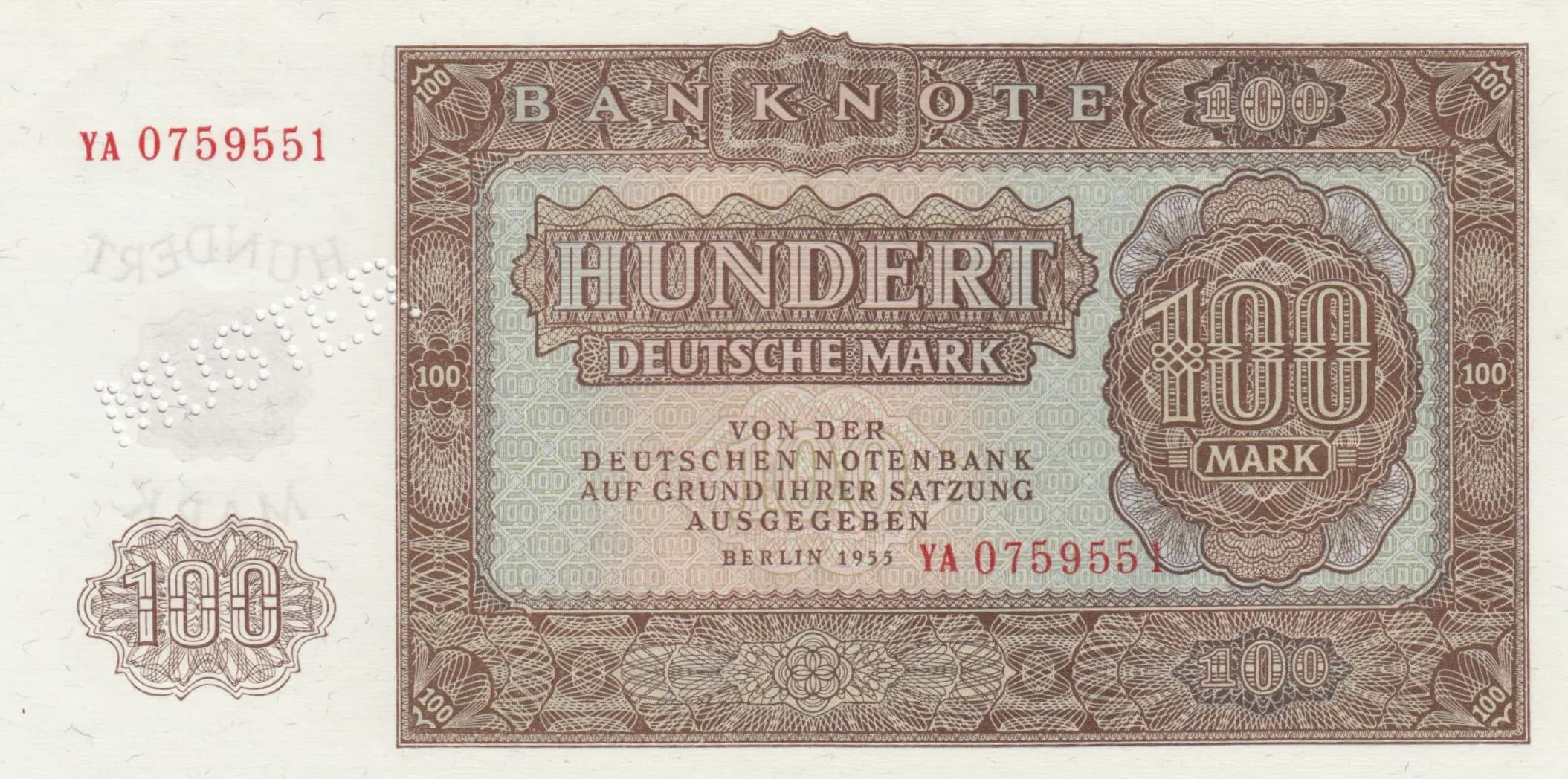
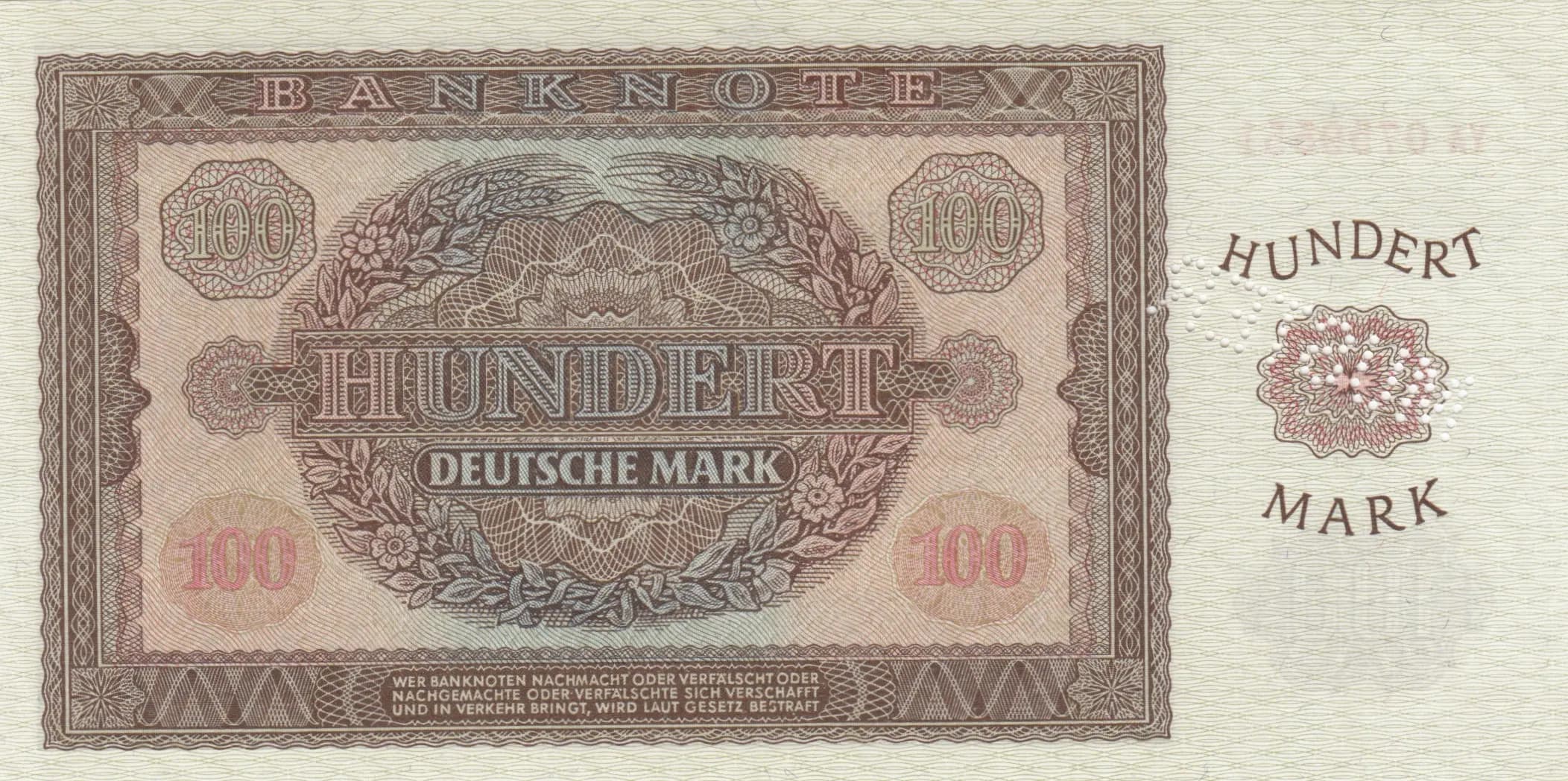
This is an exceptional specimen example of the East German 100 Deutsche Mark note from 1955, issued by the Deutsche Notenbank in Berlin. The note displays pristine uncirculated condition with sharp printing details, complex engraved ornamentation in brown and tan tones, and intact security features throughout. As a specimen note (indicated by the Pick P-21s designation), this represents an officially produced example likely distributed to banks and collectors rather than general circulation, making it a significant piece of German Democratic Republic monetary history.
Common. The 100 Deutsche Mark note (P-21) from 1955 was produced in substantial quantities to serve as a standard circulation denomination for the German Democratic Republic. While specimen notes (P-21s) were produced in smaller numbers than standard circulation issues, they were still regularly created for banking and numismatic distribution and remain relatively available in the modern collector market. No evidence of limited print runs, recalls, or scarcity exists for this denomination from this period.
The Deutsche Notenbank issued this 100 Mark note in 1955, during the early years of the German Democratic Republic's monetary independence following the 1950 currency reform. The deliberate design emphasizes German heritage through ornate floral wreaths and classical decorative motifs—specifically the elaborate botanical elements on the reverse—reflecting the East German state's attempt to establish monetary legitimacy and stability during the Cold War era. The note's issuance from Berlin represents the GDR's assertion of sovereignty in the divided city.
The 100 Deutsche Mark banknote features a symmetrical, ornate design centered on classical allegorical and botanical imagery rather than portraits. The front displays a large rectangular central panel framed by decorative borders, with 'HUNDERT DEUTSCHE MARK' prominently positioned and flanked by ornamental coat of arms elements and large rosette designs in the lower corners. The reverse showcases an elaborate floral wreath at the center containing diverse botanical elements—representing themes of agriculture and natural prosperity—with the denomination '100' repeated in decorative octagonal frames and red/pink rosette embellishments. The overall design philosophy emphasizes institutional authority through fine geometric and floral patterning rather than figurative representation, consistent with East German design aesthetic of the 1950s.
FRONT SIDE: 'VON DER DEUTSCHEN NOTENBANK AUF GRUND IHRER SATZUNG AUSGEGEBEN' (Issued by the German Central Bank pursuant to its statutes) | 'BERLIN 1955' (Berlin 1955) | 'DEUTSCHE MARK' (German Mark) | 'HUNDERT' (Hundred) | 'BANKNOTE' (Banknote) | Serial number: YA 0759551. BACK SIDE: 'HUNDERT DEUTSCHE MARK' (One Hundred German Mark) | 'HUNDERT MARK' (Hundred Mark) | 'BANKNOTE' (Banknote) | 'WER BANKNOTEN NACHMACHT ODER VERFÄLSCHT ODER NACHGEMACHTE ODER VERFÄLSCHTE BANKNOTEN IN VERKEHR BRINGT, WIRD LAUT GESETZ BESTRAFT' (Whoever counterfeits or forges banknotes or puts counterfeit or forged banknotes into circulation will be punished according to law).
Intaglio (copperplate engraving) printing, as evidenced by the fine line engraving details, complex geometric and floral patterns, and the depth of impression visible throughout the note. The multiple security layers including repetitive denomination displays, fine-line botanical elements, and intricate decorative borders are characteristic of high-security intaglio work. The Deutsche Notenbank contracted with established German security printers; for GDR banknotes of this period, Giesecke+Devrient was typically responsible, though documentation for specimen notes may vary.
This is a specimen example (P-21s designation), as opposed to the standard circulation issue (P-21). The serial number YA 0759551 with the 'YA' prefix is consistent with East German notes of this era. No major varieties in signature, date, or overprint differences are documented for this Pick number, as the 1955 issue represents a single standard design. The specimen designation itself is the primary variety distinction for collectors.