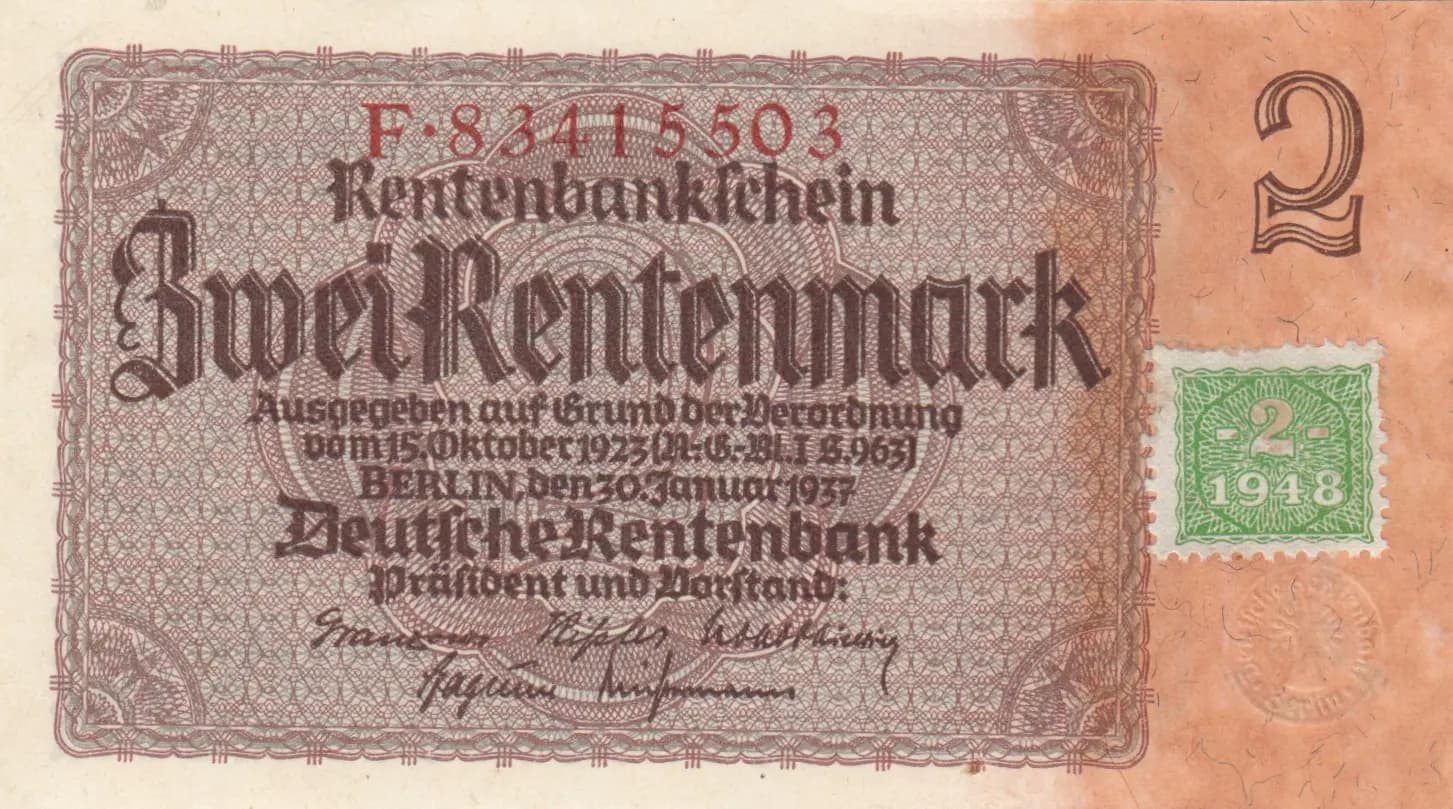
2 mark 1948
About This Note
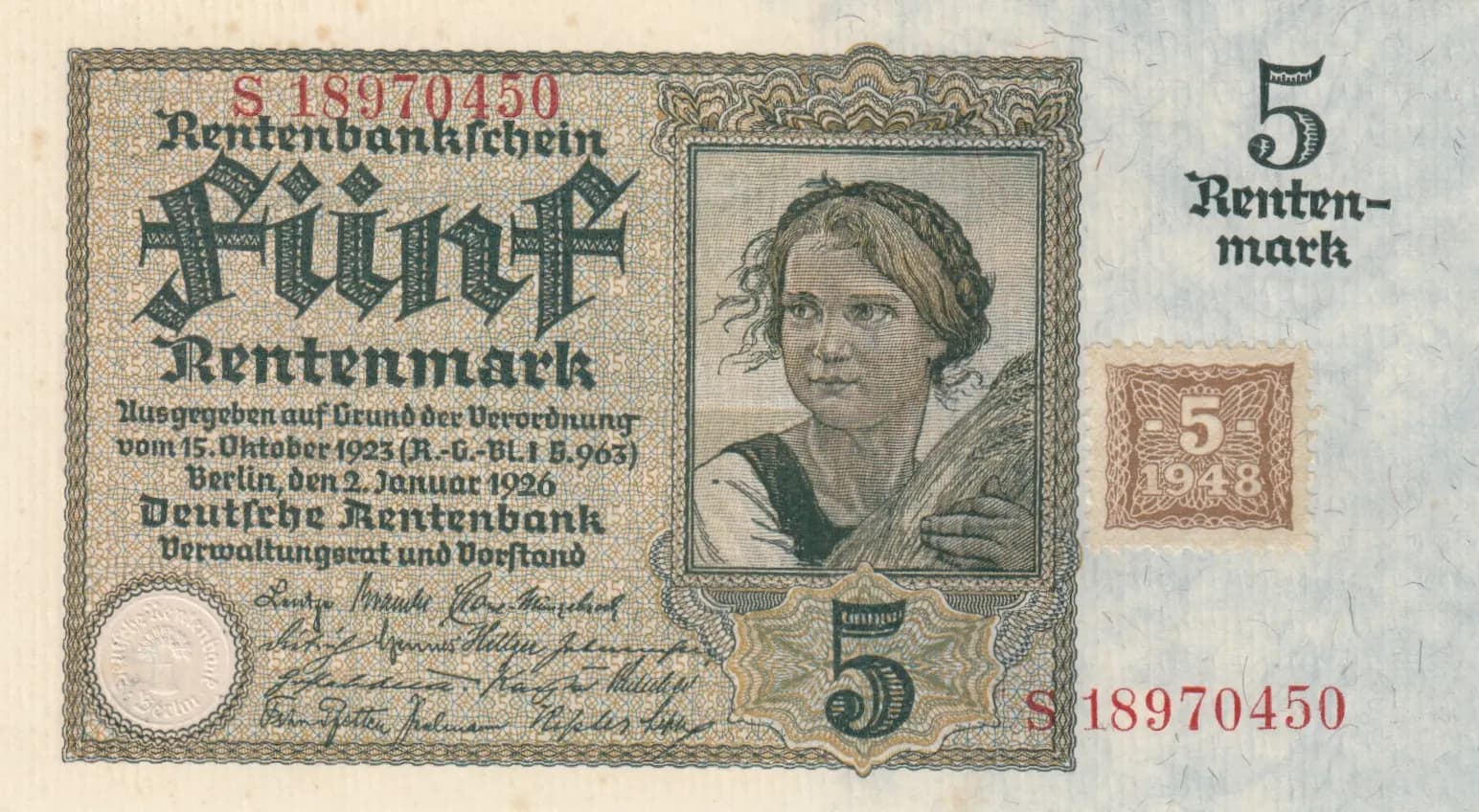
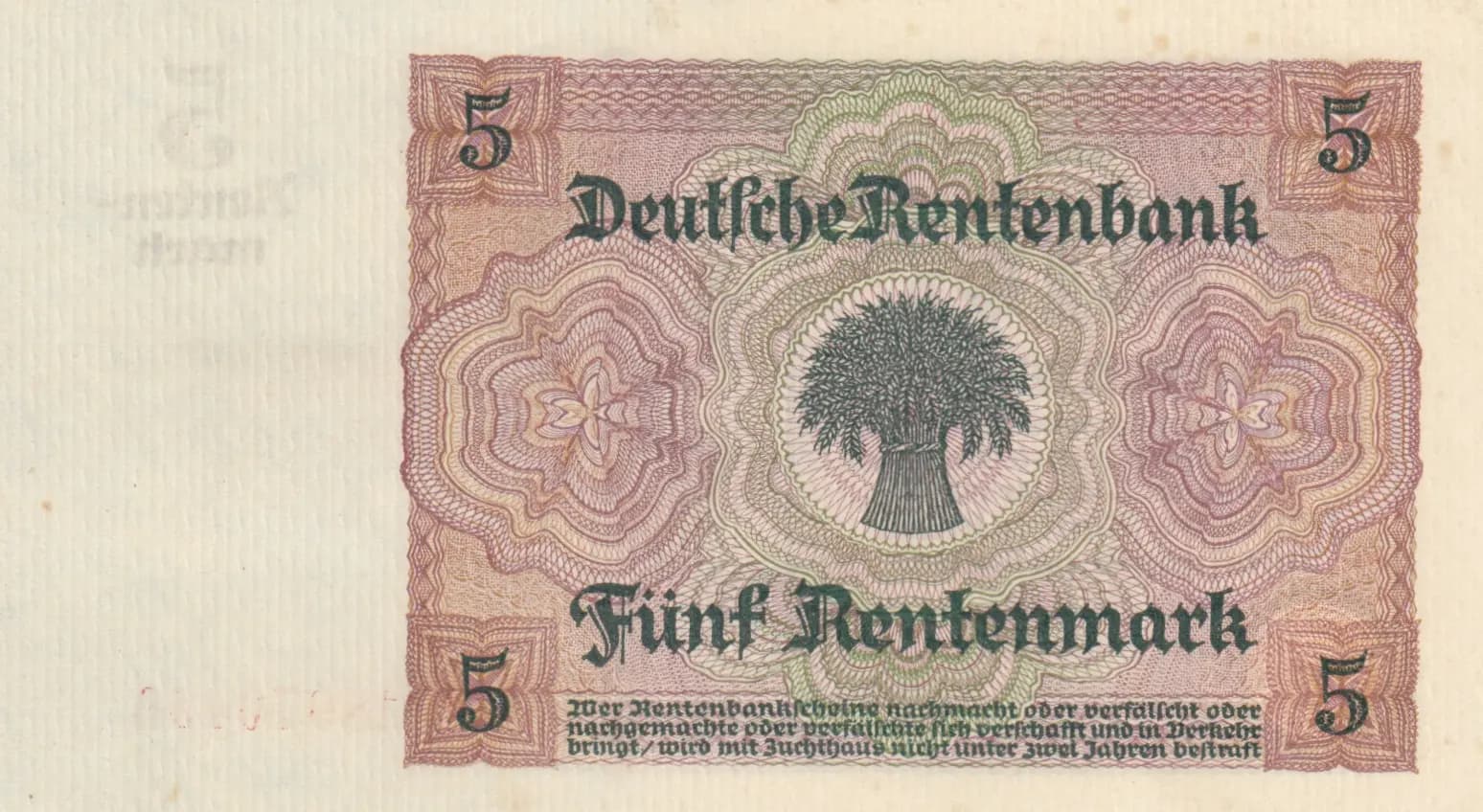
This is a 5 Rentenmark banknote from 1926, issued by the Deutsche Rentenbank during the Weimar Republic's economic stabilization period. The note displays excellent condition with well-preserved ornate engraving, featuring a female portrait on the obverse and a symbolic wheat sheaf on the reverse, characteristic of the Rentenmark series that temporarily restored confidence in German currency following hyperinflation.
Common. The Rentenmark series, while historically significant, was produced in substantial quantities during the mid-1920s to serve as stabilization currency. This 5 Rentenmark denomination from 1926 appears with reasonable frequency in the numismatic market and among institutional collections. The UNC condition grade and standard variety indicate no special scarcity premium.
The Rentenmark was introduced in October 1923 as an emergency currency backed by real estate rather than gold, designed to halt the catastrophic hyperinflation of the Weimar period. The wheat sheaf on the reverse symbolizes agricultural wealth and economic recovery, while the dignified female portrait represents the nation's stabilization. This January 1926 issue demonstrates the currency's successful establishment, issued well after the initial crisis, reflecting renewed economic confidence in the mid-1920s.
The obverse features a classical female portrait in three-quarter profile, rendered with fine engraved detail and wearing period dress with wavy hair, positioned center-right on a beige/tan field. The portrait is framed by ornate geometric and decorative borders with rosette patterns in the corners and circular seals on the lower left. The reverse presents a symbolic wheat sheaf or grain bundle within a central circular medallion, surrounded by concentric circular decorative patterns with floral and geometric motifs rendered in rose-pink and mauve tones. Both sides display the denomination '5' prominently in the corners and feature intricate fine-line engraving throughout, characteristic of Rentenmark security design. The woman depicted is likely an allegorical representation of prosperity or the German nation.
FRONT: 'S1897045O' (Serial number); 'Rentenbanklithein' (Rentenbank lithograph); 'Fünf' (Five); 'Rentenmark'; 'Ausgegeben auf Grund der Verordnung vom 15. Oktober 1923 (Rt.-G.-Bl. B. 963)' (Issued on the basis of the ordinance of October 15, 1923); 'Berlin, den 2. Januar 1926' (Berlin, January 2, 1926); 'Deutsche Rentenbank' (German Rentenbank); 'Verwaltungsrat und Vorstand' (Administrative Council and Board of Directors); '5' (denomination). BACK: 'Deutsche Rentenbank' (German Rentenbank); 'Fünf Rentenmark' (Five Rentenmark); 'Über Rentenbankscheine nachmacht oder verfälscht oder nachgemachte oder verfälschte sich verbreitet und in Deutsche Briefe / wird mit Zuchthaus nicht unter zwei Jahren bestraft' (Counterfeiting or falsifying Rentenbank notes or distributing counterfeit or falsified notes will be punished with hard labor not less than two years); '5' (in all four corners).
The Rentenmark series was produced using intaglio engraving (copperplate printing), as evidenced by the fine line work, detailed stippled backgrounds, and three-dimensional quality of the engraved elements visible throughout both sides. The color scheme (black and red on obverse; rose-pink with green and black on reverse) indicates multi-plate printing with careful registration. The Deutsche Rentenbank contracted with the Reichsdruckerei (German Imperial Printing Office) for production, though private security printers such as Giesecke & Devrient also produced Rentenmark notes.
This note is a standard issue 5 Rentenmark from the January 2, 1926 printing by Deutsche Rentenbank, Berlin. The serial number 'S1897045O' (with letter-number-letter format) is consistent with this series. Known varieties of the Rentenmark exist with different date printings and signature combinations, but without access to specialized Rentenmark catalogs, the precise variety designation within Pick 2A cannot be definitively established from the image alone. The visual characteristics (color, design layout, inscription date) confirm this as a mainline circulation version rather than a special variety or emergency overprint.