1 mark 1948
About This Note
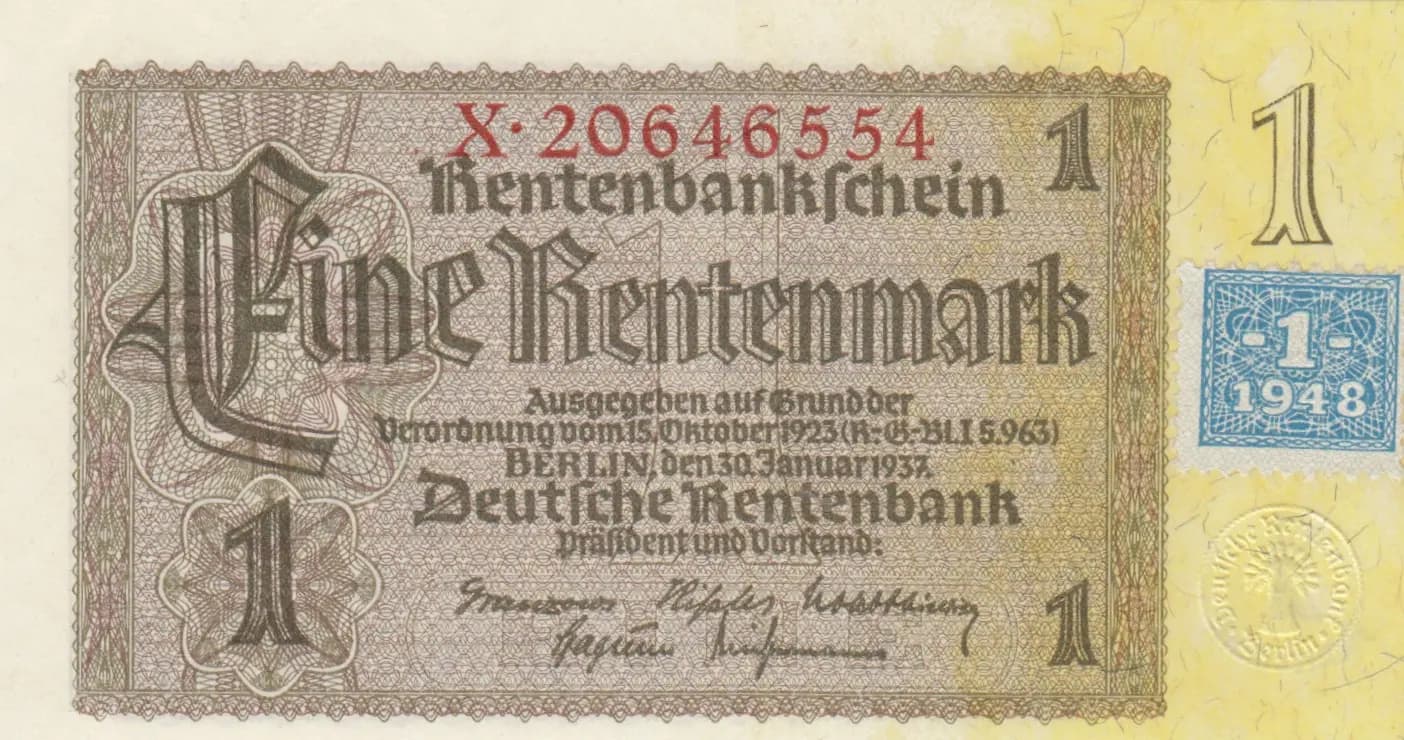
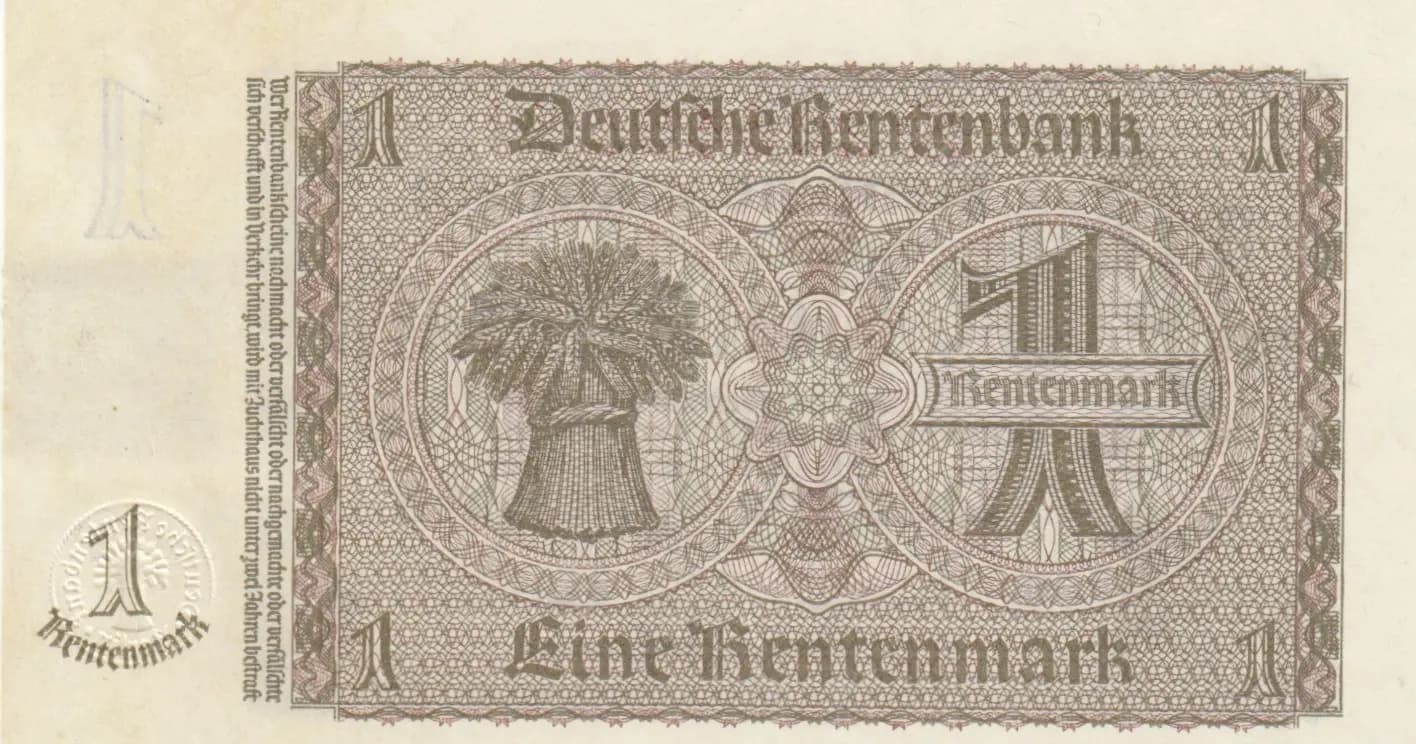
This is a 1 Rentenmark banknote from 1948, issued by the Soviet occupation zone of Germany during the post-WWII period. The note presents in UNC condition with excellent preservation, featuring the characteristic tan and beige coloring with intricate ornamental borders, a blue security stamp dated 1948, and fine line engraving throughout. The reverse displays symbolic imagery of agriculture (wheat sheaf) and industry (factory building), representing the economic foundation of the German state, making it an important artifact of the transitional post-war German monetary system.
Common. The Rentenmark 1 Mark denomination was produced in large quantities throughout its circulation period (1923-1948), and this 1948 overprinted version saw substantial issue across the Soviet occupation zone. These notes are regularly encountered in dealer inventories and collections, with no historical evidence of limited print runs or recall that would justify a rarity classification higher than common.
The Rentenmark was introduced in 1923 to stabilize the German currency during hyperinflation, backed by mortgages on agricultural and industrial property rather than precious metals. This 1948 example represents a reissue or circulation of the Rentenmark during Soviet occupation, when the original 1937-dated plates were overprinted with the blue security stamp to validate currency for the occupation zone. The reverse imagery deliberately emphasizes Germany's agricultural and industrial capacity, reflecting the economic reconstruction priorities of the immediate post-war period.
The obverse features a formal layout with the denomination '1' in large numerals at top right and bottom left, framed by an ornate geometric and floral border design executed in fine engraving. A heraldic device appears on the left side, and a prominent blue security stamp dated 1948 is positioned on the right, indicating the Soviet occupation zone's validation of the original 1937 currency plates. The reverse displays a symmetrical dual-medallion design: the left circular frame contains a sheaf of wheat representing agriculture, while the right circular frame depicts an industrial building/factory representing manufacturing and industry. A central decorative rosette separates these allegorical representations of economic production. The entire reverse background is covered with fine cross-hatch mesh engraving for security purposes.
FRONT: 'Eine Rentenmark' (One Rentenmark), 'Rentenbankschein' (Rentenmark note), 'Deutsche Rentenbank' (German Rentenbank), 'Ausgegebenaußergrundderverordnungvom15.Oktober1923(R.-G.-Bl.I S.963)' (Issued on the basis of the ordinance from October 15, 1923), 'BERLIN,denI30.Januar1937' (Berlin, January 30, 1937), 'präsident und vortand:' (President and Board), Serial number 'X'20646554', denomination '1'. BACK: 'Deutsche Rentenbank' (German Rentenbank), 'Eine Rentenmark' (One Rentenmark), 'Rentenmark' (Rentenmark, appearing multiple times), denomination '1'.
Intaglio (line engraving) printing, evident from the fine line work, detailed border designs, and complex geometric patterns visible throughout both sides. The cross-hatch background security pattern on the reverse and the intricate engraving of the wheat sheaf and industrial building are characteristic of high-security intaglio production. The 1948 blue occupation zone stamp was applied as an overprint to the original 1937-printed plates, indicating a secondary validation mechanism during the Soviet occupation period.
This specific note is identified as a 1948 Soviet occupation zone overprint variety of the original 1923 Rentenmark design. The key variety identifier is the blue security stamp dated '1948' applied to validate the note for occupation zone circulation. The original issue date of 'Berlin, den 30.Januar1937' appears on the front, with the 1948 overprint stamp serving to authenticate reissue. Serial number prefix 'X' and the specific serial sequence may indicate a particular printing batch for occupation zone distribution. This represents the final iteration of Rentenmark circulation before currency reform in 1948-1949.