10 mark 1964
About This Note
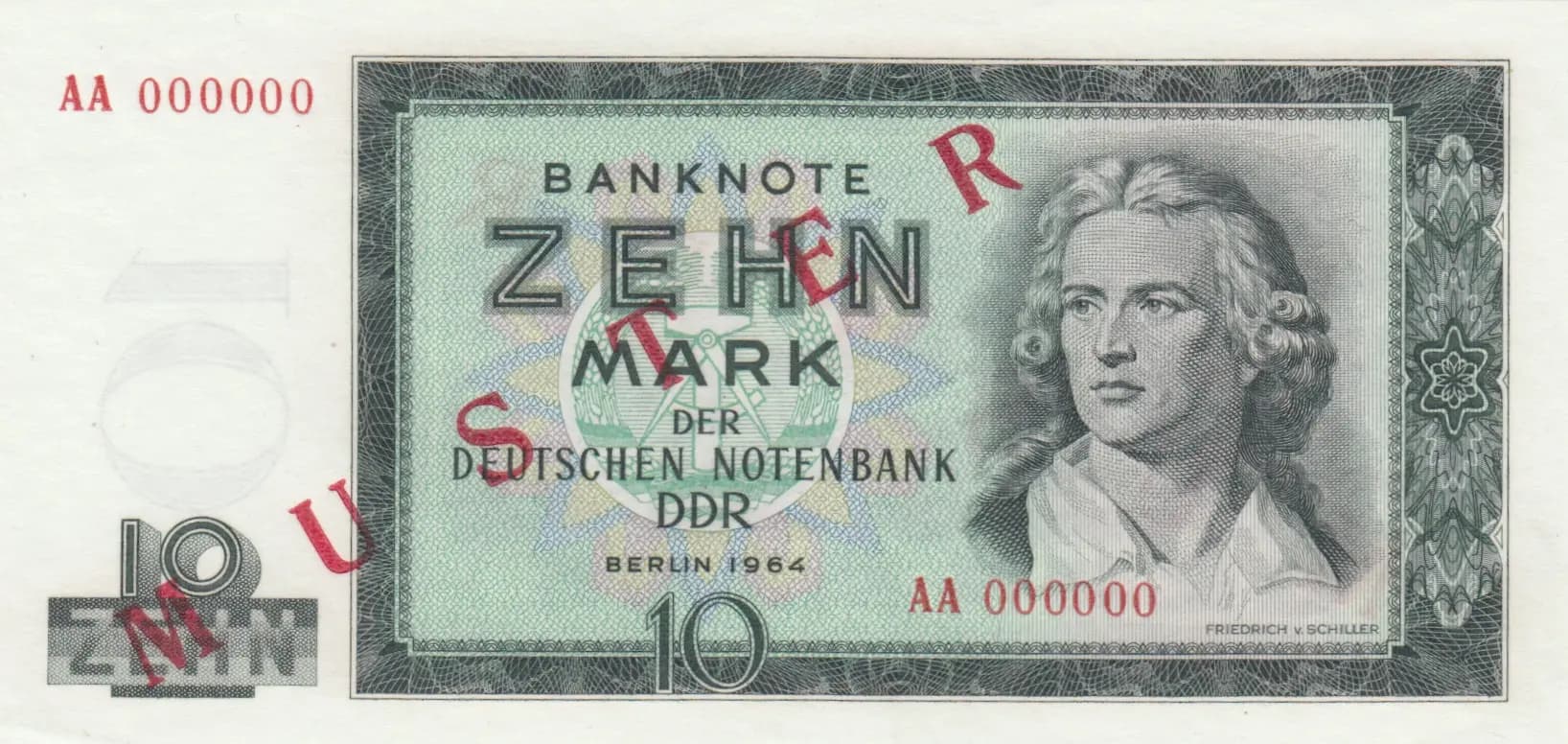
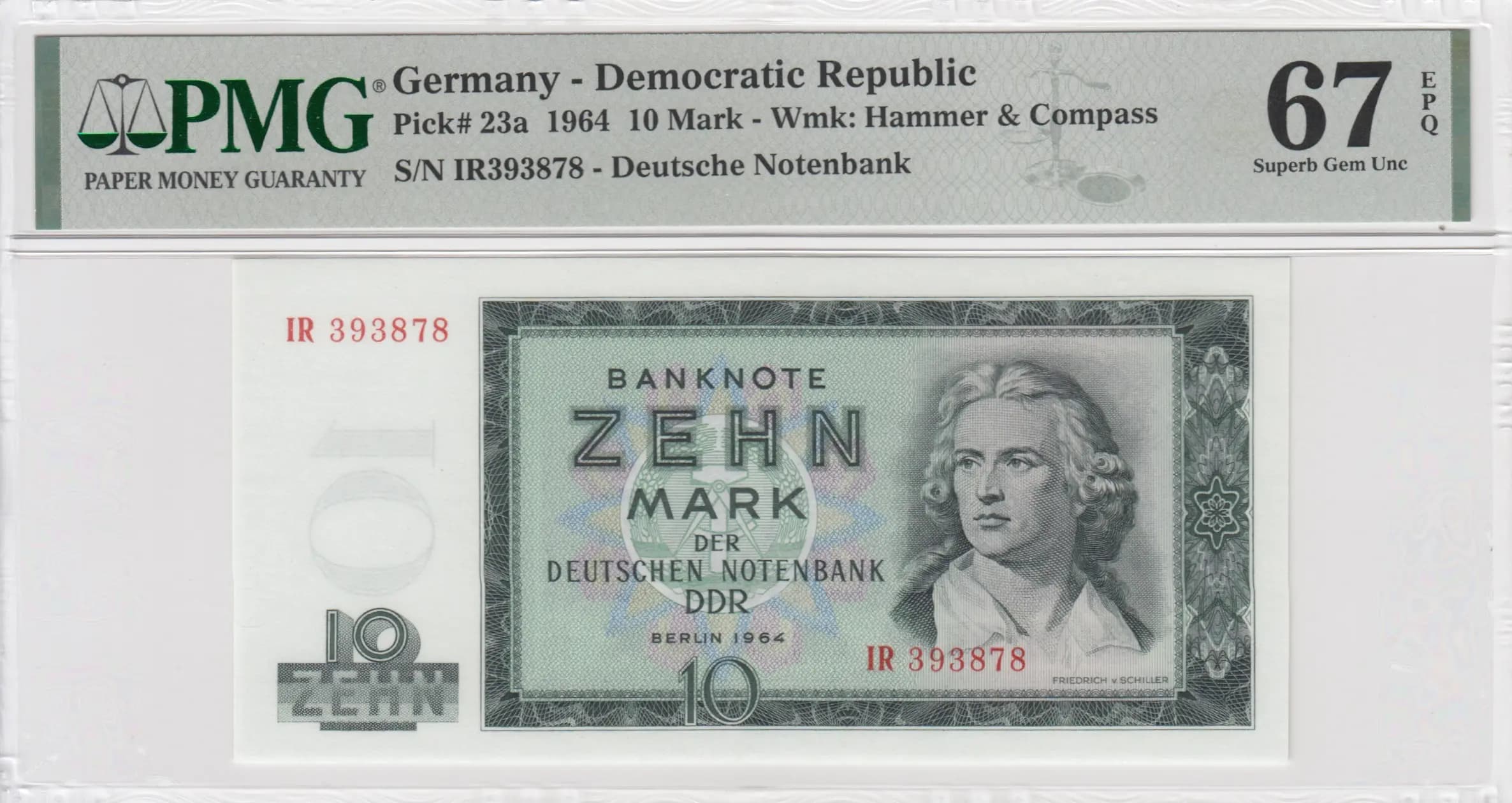
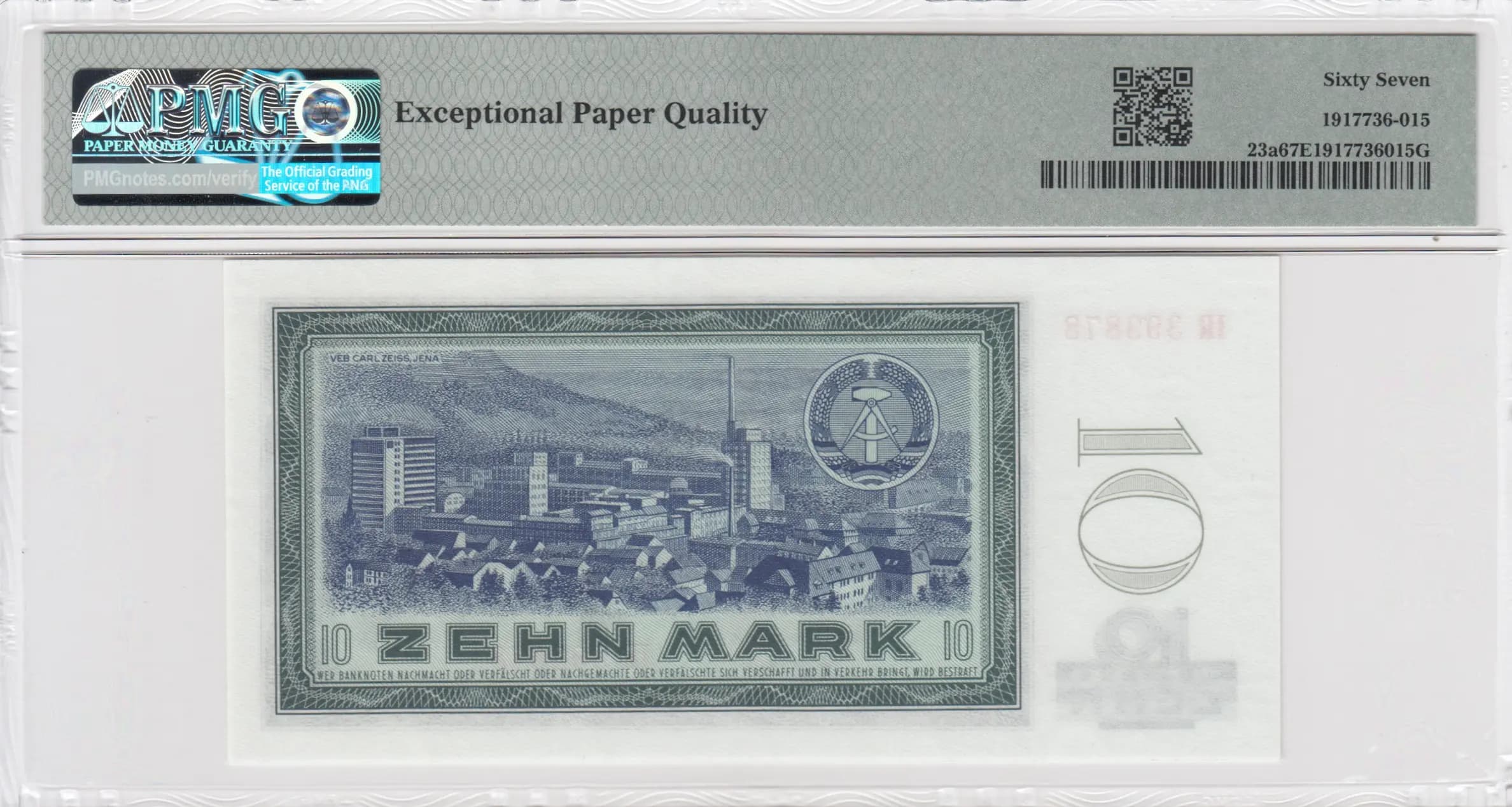
This is a PMG 67 EPQ graded 10 Mark banknote from the Deutsche Notenbank of East Germany (DDR), issued in 1964. The note features a striking portrait of Friedrich von Schiller on the obverse and a detailed cityscape of Jena (home to the famous Carl Zeiss optical works) on the reverse, reflecting the industrial pride of the German Democratic Republic. In this exceptional near-gem uncirculated condition, the note displays pristine paper quality with crisp engraving and vibrant color, making it a desirable example for collectors of Cold War-era East German currency.
Common. The 10 Mark denomination from 1964 (Pick 23a) was issued in substantial quantities by the Deutsche Notenbank during the early DDR period and remains readily available in the numismatic market. Even in PMG 67 EPQ condition (representing an exceptional uncirculated example with exceptional paper quality), specimens are obtainable from specialized dealers and auctions at moderate prices. The note was not subject to recall or withdrawal, and East German currency circulated extensively until reunification in 1990, after which large quantities entered the collector market. This specific grade represents the upper end of quality for circulating notes but does not command the premium prices associated with true rarities.
Issued during the height of the Cold War by the Deutsche Notenbank of East Germany, this 1964 note reflects the DDR's emphasis on national heroes and industrial achievement. The inclusion of Friedrich von Schiller, the famous German poet and dramatist, on the obverse honored cultural heritage, while the reverse depicts the industrial landscape of Jena, home to the prestigious Carl Zeiss optical manufacturing enterprise—a symbol of East German technological capability and socialist industrial progress. The East German state emblem (hammer and compass) prominently displayed on the reverse reinforced the state's communist ideology and authority.
The obverse features a portrait of Friedrich von Schiller (1759-1805), the renowned German classical poet, philosopher, and dramatist, rendered in fine grayscale engraving and positioned on the right side of the note. The portrait displays Schiller with characteristic shoulder-length wavy hair, facing slightly left in classical engraving style. The center of the note contains the denomination and issuer information in German text. A decorative shield-like emblem appears in the upper right corner with ornamental patterns framing the design. The reverse depicts a panoramic landscape of the city of Jena in Thuringia, featuring multiple buildings including a prominent church or cathedral with a spire, modern industrial multi-story structures, factories with smokestacks representing the region's manufacturing heritage, and mountains in the distant background. The East German state emblem—a compass circle containing a hammer symbol within a laurel wreath—is prominently positioned in the upper right corner as an official seal of the Deutsche Notenbank DDR. The overall color scheme is light green-gray on the obverse and light blue-gray on the reverse, with darker borders and fine decorative patterns throughout.
OBVERSE: 'BANKNOTE' (Banknote), 'ZEHN MARK' (Ten Mark), 'DER DEUTSCHEN NOTENBANK DDR' (Of the German Note Bank DDR), 'BERLIN 1964' (Berlin 1964), 'FRIEDRICH v SCHILLER' (Friedrich von Schiller), serial number 'IR 393878', denomination '10'. REVERSE: '10 ZEHN MARK' (10 Ten Mark), 'VEB CARL ZEISS JENA' (VEB Carl Zeiss Jena—reference to the state-owned optical works), PMG certification details including 'Exceptional Paper Quality' (EPQ designation), grade '67', and certification reference number '1917736-015'.
The note was produced using intaglio engraving (line engraving), the standard security printing technique for East German banknotes of this period. The fine line engraving is evident throughout both sides, creating the detailed portraiture of Schiller and the intricate landscape imagery of Jena. The Complex background patterns, decorative borders, and ornamental designs served both aesthetic and security purposes. East German banknotes of this era were typically printed by the state security printing authority (Staatsdruckerei der DDR), though specific printer attribution for Pick 23a is not definitively documented in standard references.
This specific example is Pick 23a (not Pick 23 or Pick 23b), denoting the standard 1964 issue from Berlin. The serial number 'IR 393878' appears to follow standard DDR formatting conventions. No overprints, date variations, or signature variants are evident in this specimen. The PMG certification code '23a67E1917736015G' confirms the Pick number and grade. Known varieties of the 10 Mark 1964 are minimal; major varieties typically relate to printer changes or signature variations across subsequent issues. This appears to be a standard printing of the primary 1964 variety.