10 mark 1964 specimen
About This Note
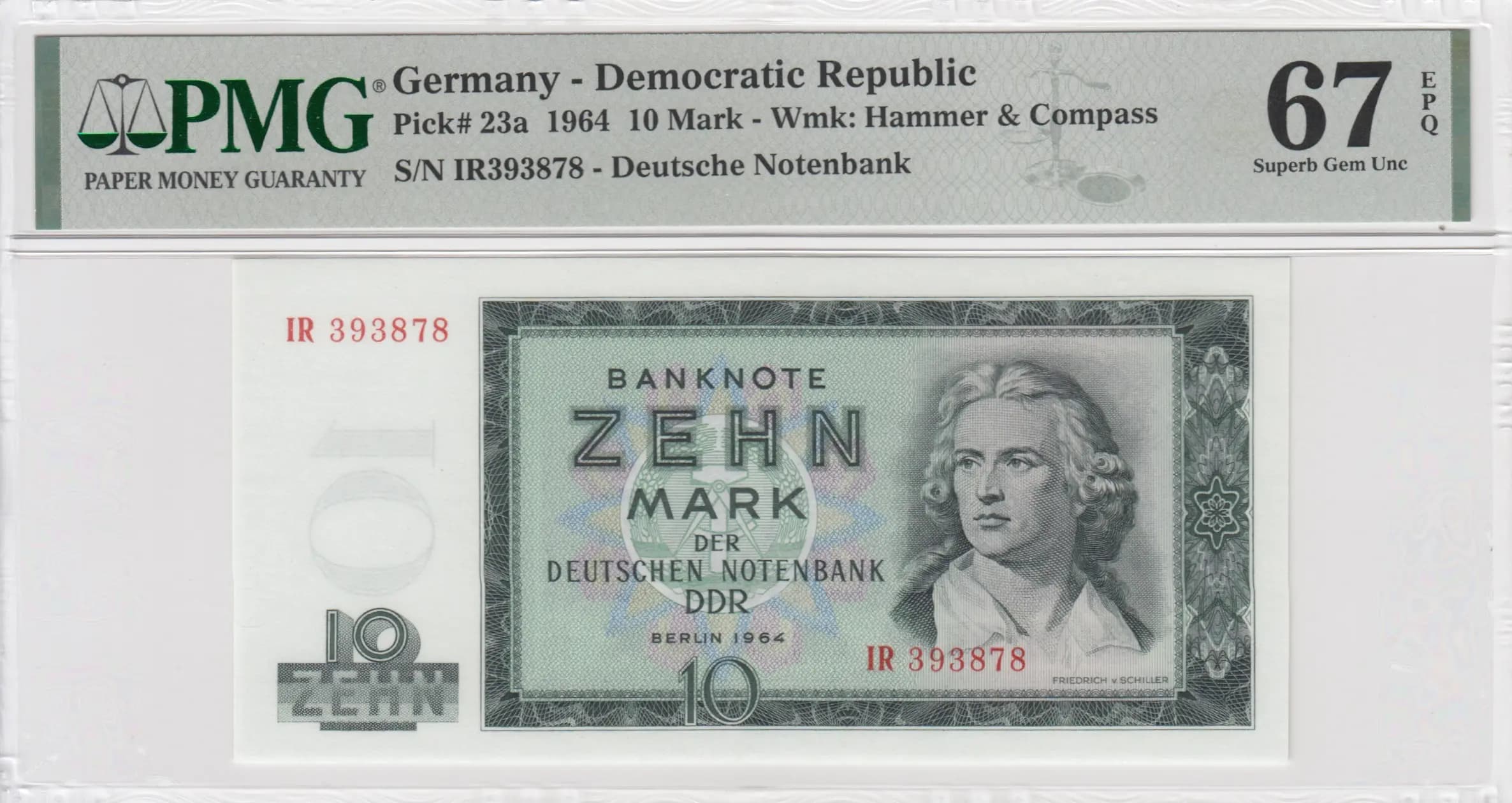
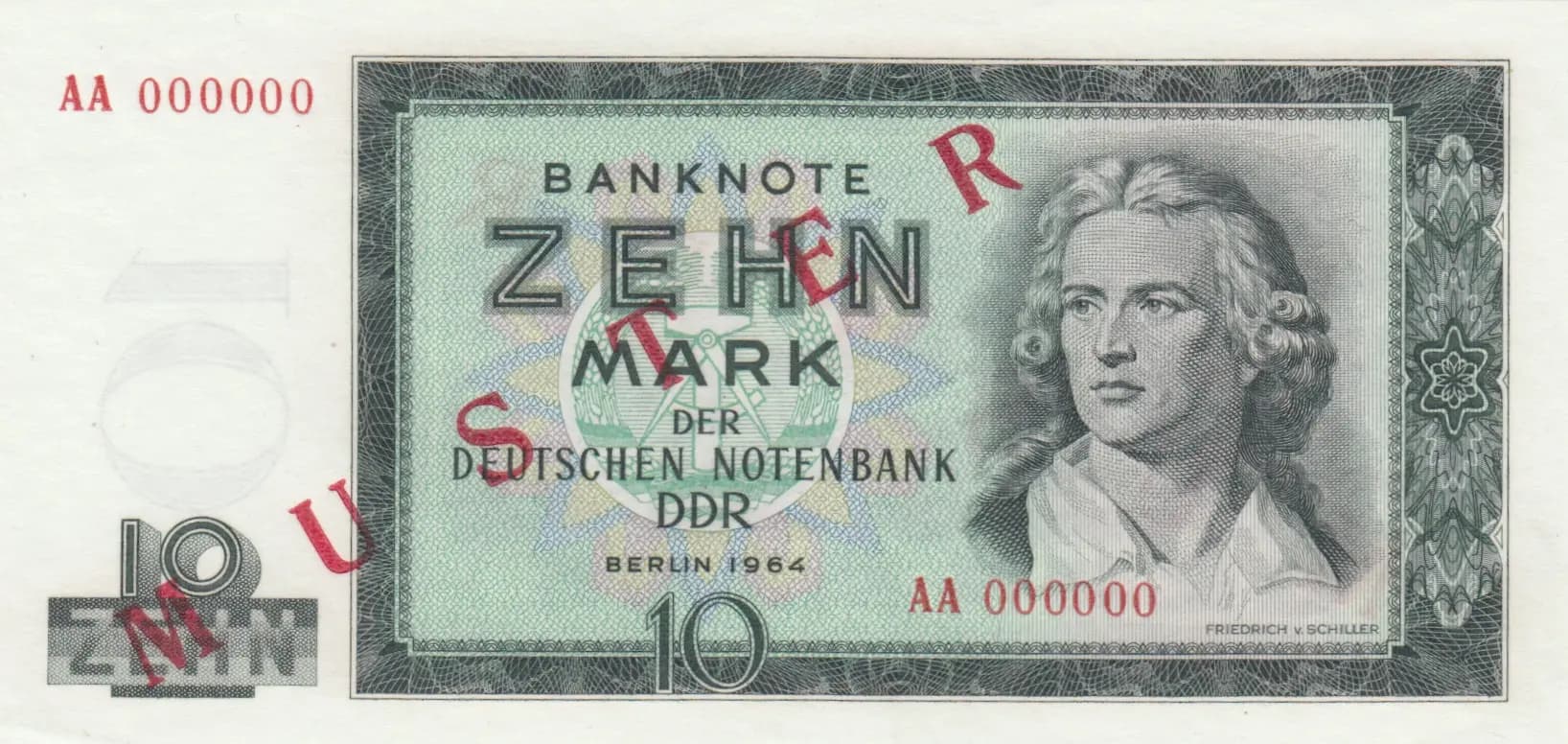
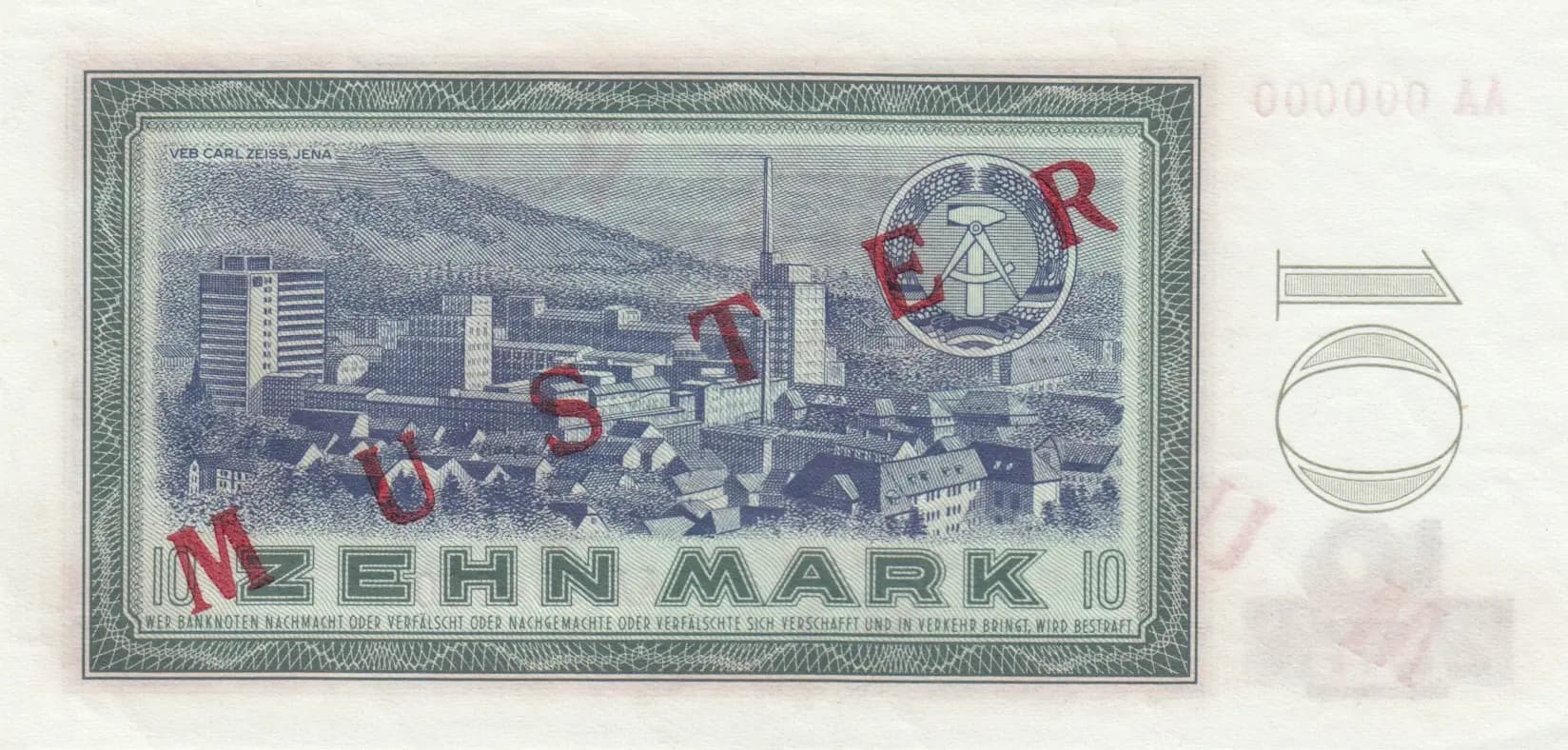
This is an exceptional East German 10 Mark specimen note from 1964, issued by the Deutsche Notenbank, presented in uncirculated condition with no signs of wear or handling. The note features a striking portrait of Friedrich von Schiller on the obverse and an industrial cityscape of Jena (VEB Carl Zeiss facility) on the reverse, both rendered in fine guilloche engraving. The prominent red diagonal 'MUSTER' (specimen) overprint and serial number AA 000000 confirm its status as a specimen note, making it a significant example of Cold War-era East German currency design.
Common. Specimen notes (marked 'MUSTER') with serial number AA 000000 were produced in significant quantities by the Deutsche Notenbank for distribution to banks, government offices, and numismatic institutions throughout the GDR. This particular denomination and issue year (1964) from Pick-23s represents standard production output. While specimen notes command a modest premium over circulation examples due to their pristine condition and collectible status, they are not scarce in the market. The UNC condition and specimen designation make it desirable to collectors but not rare; typical market values reflect common availability rather than scarcity.
Issued during the height of the German Democratic Republic's economic development, this 1964 note reflects the GDR's emphasis on industrial achievement and cultural heritage. The reverse depicts the VEB Carl Zeiss optical manufacturing facility in Jena, one of East Germany's most prestigious technological enterprises, symbolizing the state's commitment to precision engineering and scientific advancement. The choice of Friedrich von Schiller—Germany's classical poet and philosopher—on the obverse represents the GDR's claim to German cultural continuity despite Cold War division.
The obverse features a high-quality engraved portrait of Friedrich von Schiller (1759–1805), the celebrated German Romantic poet, historian, and philosopher, rendered in classical three-quarter profile with characteristic wavy shoulder-length hair. The portrait is rendered in fine black and white engraving style against a greenish background with elaborate guilloche patterning and ornamental floral borders on the right margin, including a circular seal medallion. The reverse depicts an industrial cityscape of Jena featuring the prominent VEB Carl Zeiss optical manufacturing facility with tall modern buildings, a distinctive transmission/communications tower in the center, and mountains visible in the distance—a celebration of East German technological prowess. The upper right bears the East German state emblem: a circle containing a hammer (symbolizing workers) and compass/triangle (symbolizing intellectuals) design, which served as the official symbol of the GDR. Both sides incorporate fine-line guilloche patterns throughout, enhancing security and visual appeal.
FRONT SIDE: 'ZEHN MARK' (Ten Mark) | 'DER DEUTSCHEN NOTENBANK DDR' (Of the German Note Bank GDR) | 'BERLIN 1964' (Berlin 1964) | 'FRIEDRICH v.SCHILLER' (Friedrich von Schiller) | 'AA 000000' (Serial number, specimen) | 'MUSTER' (Specimen — red diagonal overprint). BACK SIDE: 'VEB CARL ZEISS, JENA' (VEB Carl Zeiss, Jena) | 'ZEHN MARK' (Ten Mark) | '10' (denomination numeral) | 'WER BANKNOTEN NACHMACHTE ODER VERFÄLSCHT ODER NACHGEMACHTE ODER VERFÄLSCHTE SICH VERSCHAFFT UND IN VERKEHR BRINGT, WIRD BESTRAFT' (Whoever counterfeits banknotes or falsifies them or procures counterfeit or falsified notes and brings them into circulation will be punished — standard legal warning) | 'MUSTER' (Specimen — red diagonal overprint).
Intaglio engraving (copperplate/steel engraving), the traditional high-security method for currency production. The note exhibits sophisticated guilloche patterning, fine line engraving in the portrait and architectural details, and decorative border work characteristic of 1960s East German banknote production. The red 'MUSTER' (specimen) overprint was applied separately, likely through letterpress or offset printing. Deutsche Notenbank specimen notes of this era were typically produced by the GDR's state security printing facilities in Berlin.
This is a specimen variety (MUSTER overprint) of Pick-23, confirmed by the red diagonal 'MUSTER' text and serial number AA 000000. The standard circulation version (without specimen overprint) is Pick-23. No signature varieties are apparent on this note—Deutsche Notenbank notes from this period typically did not feature individual signatures. The 1964 Berlin date and Friedrich von Schiller obverse are standard for this pick number; no documented date or portrait varieties exist for the 10 Mark from this series.