50 pfennig 1948
About This Note
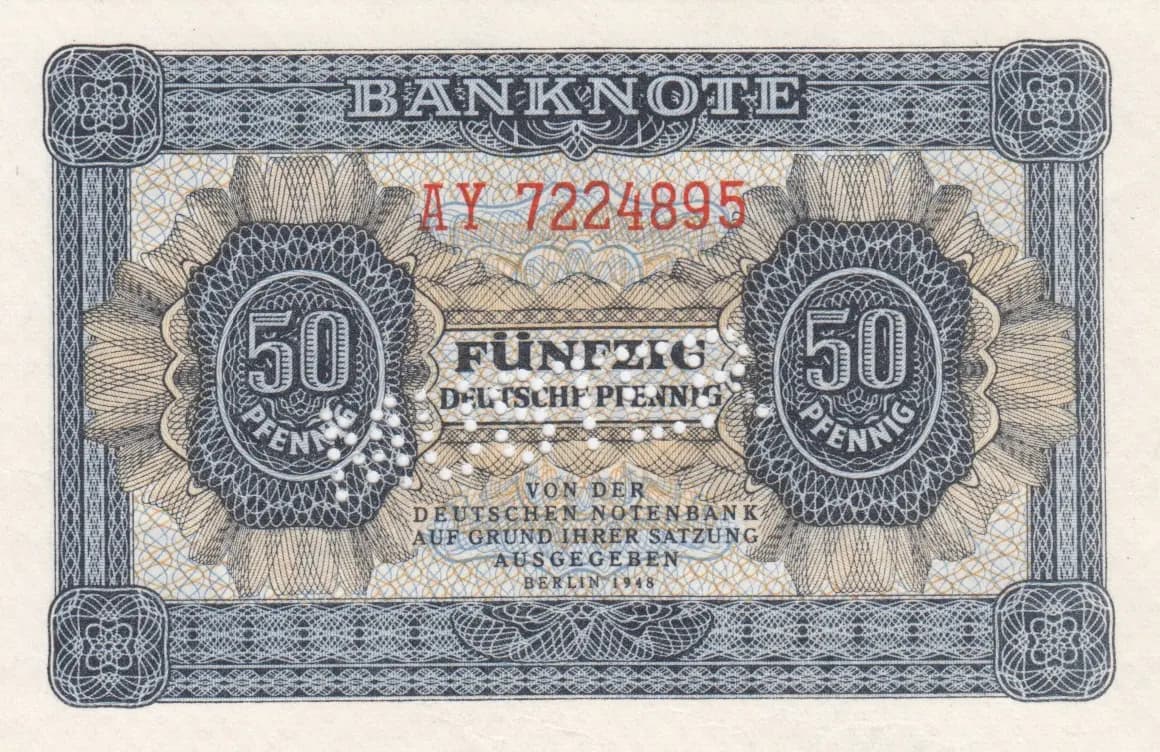
This 50 Pfennig banknote from 1948 represents an early post-war German currency issue by the Deutsche Notenbank during the Soviet occupation period of East Germany. The note exhibits exceptional condition, grading UNC with sharp printing, crisp borders, and no signs of circulation—characteristics that make well-preserved examples desirable to collectors of Cold War-era German currency. The ornate geometric design and fine engraving demonstrate the sophisticated security printing techniques employed even in the immediate post-war period.
Common. The 50 Pfennig 1948 (Pick P-8b) was issued in significant quantities as part of the standard circulating currency of the Soviet occupation zone. While this denomination is collectible and represents an important transitional currency issue, it is not scarce in any grade. UNC examples like this specimen are moderately available in the collector market, as the banknote's historical significance has encouraged preservation of examples.
Issued in Berlin in 1948 by the Deutsche Notenbank, this note represents the transitional currency phase following Germany's defeat in World War II and preceding the formal division of Germany. The 1948 50 Pfennig denomination was part of the Soviet zone's monetary system before the Deutsche Demokratische Republik (East Germany) was formally established in October 1949. The prominent display of 'Deutsche Notenbank' and the Berlin 1948 date inscriptions reflect the post-war institutional reorganization under Soviet administration.
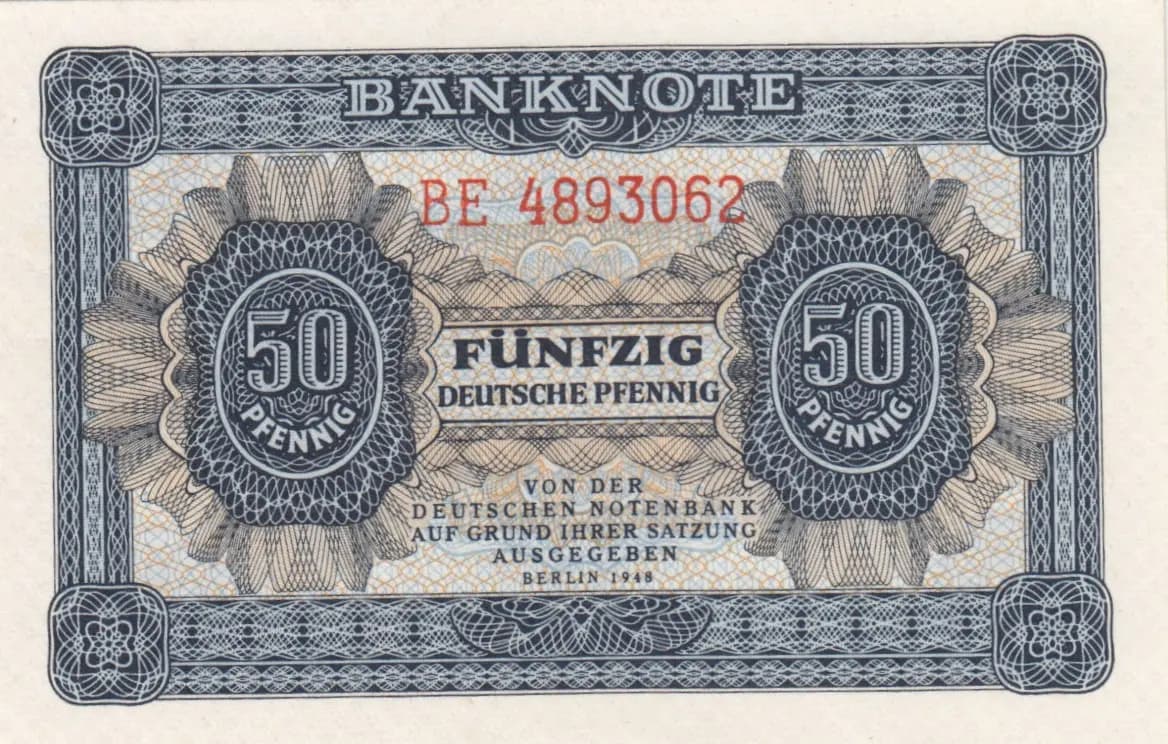
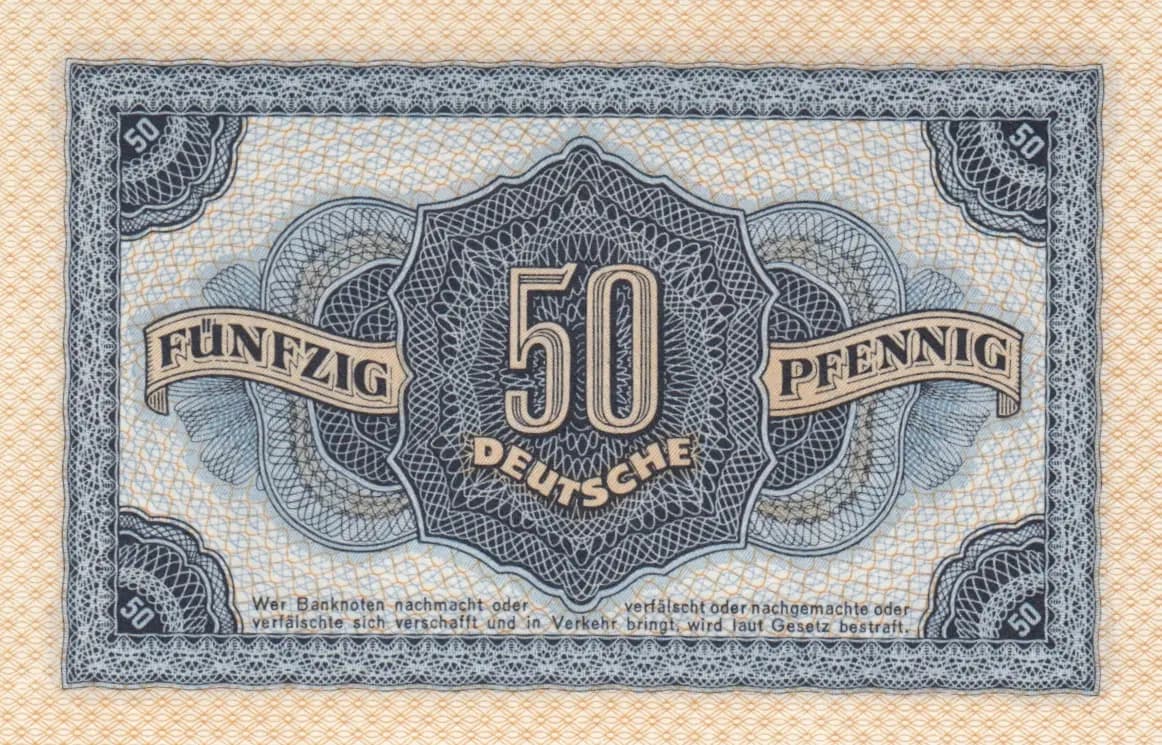
The 50 Pfennig note features a symmetrical, ornamental design typical of mid-20th century German currency. The front displays two large circular medallions containing the denomination '50' and 'PFENNIG' in rosette patterns, flanking the central text declaration. Ornate quatrefoil and geometric corner decorations frame the composition. The reverse presents a dominant shield-shaped cartouche containing the numeral '50' with 'FÜNFZIG DEUTSCHE PFENNIG' arranged in banner-like ribbons around it, accompanied by elaborate scrollwork and botanical ornamental frames. No portraits or specific landmarks are depicted; instead, the design relies entirely on abstract geometric patterns, fine crosshatching, and decorative heraldic elements for visual impact and security. The color scheme of blue-grey and cream with red serial numbers and black text creates a harmonious, dignified presentation.
FRONT SIDE: 'BANKNOTE' (Banknote); 'BE 4893062' (Serial number); 'FÜNFZIG DEUTSCHE PFENNIG' (Fifty German Pfennig); 'VON DER DEUTSCHEN NOTENBANK AUF GRUND IHRER SATZUNG AUSGEGEBEN BERLIN 1948' (Issued by the German Notenbank on the basis of their statutes, Berlin 1948). BACK SIDE: 'FÜNFZIG' (Fifty); 'DEUTSCHE PFENNIG' (German Pfennig); 'Wer Banknoten nachmacht oder verfälscht oder nachgemachte oder verfälschte sich verschafft und in Verkehr bringt, wird laut Gesetz bestraft.' (Whoever counterfeits banknotes or forges them, or procures counterfeit or forged notes and puts them into circulation, will be punished according to law.)
This banknote was produced using intaglio/engraving methods, evidenced by the fine line work, complex crosshatching, intricate ornamental details, and sharp registration visible throughout both sides. The layered geometric patterns, decorative borders, and precise hatching typical of security printing are characteristic of professional banknote engraving houses. Post-war German currency printing for the Soviet zone was typically handled by state printing facilities, with the Deutsche Notenbank maintaining strict quality control standards.
The specimen displays the serial number 'BE 4893062' in red. Pick P-8b encompasses the standard 1948 issue without major known varieties beyond normal serial number variations and potential minor printing differences across production runs. The 'BE' prefix suggests a specific printing sequence but does not denote a separately cataloged variety. No overprints, signature variations, or other distinguishing features are evident that would constitute a separate Pick number classification.