20 mark 1975 specimen
About This Note
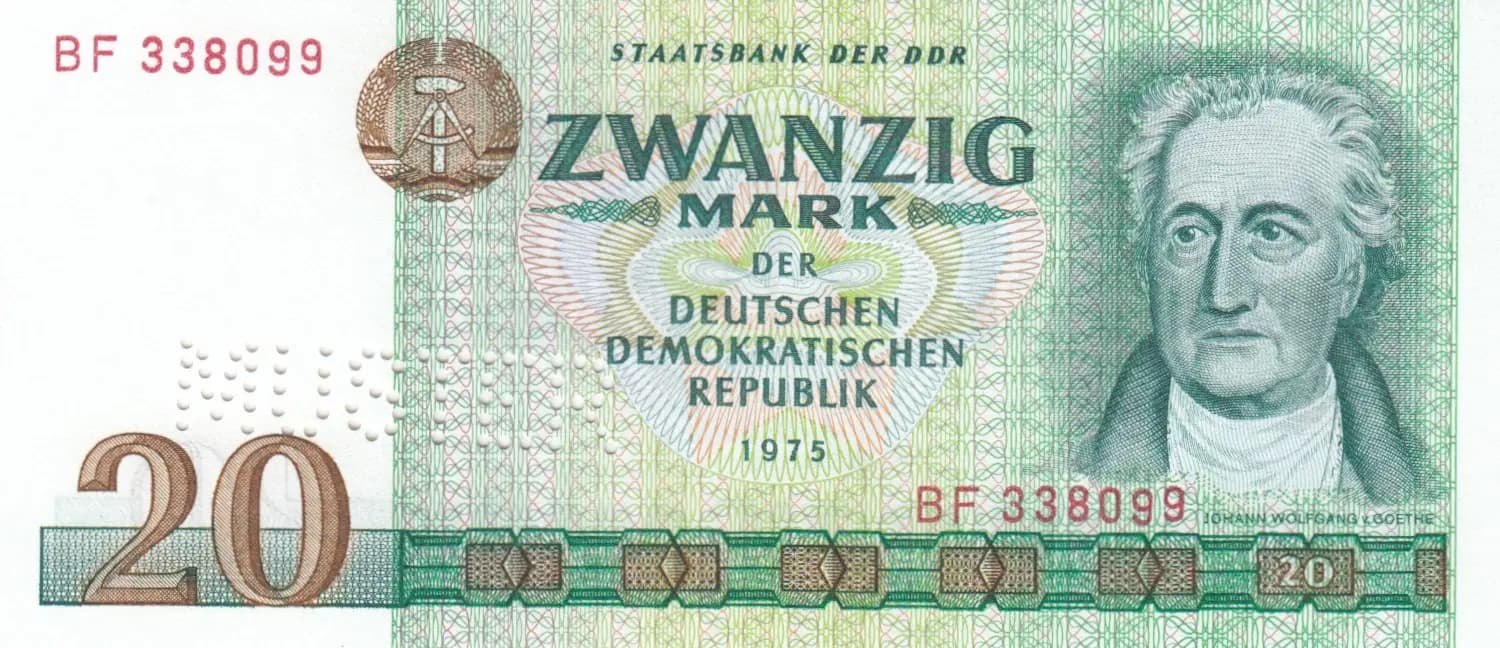
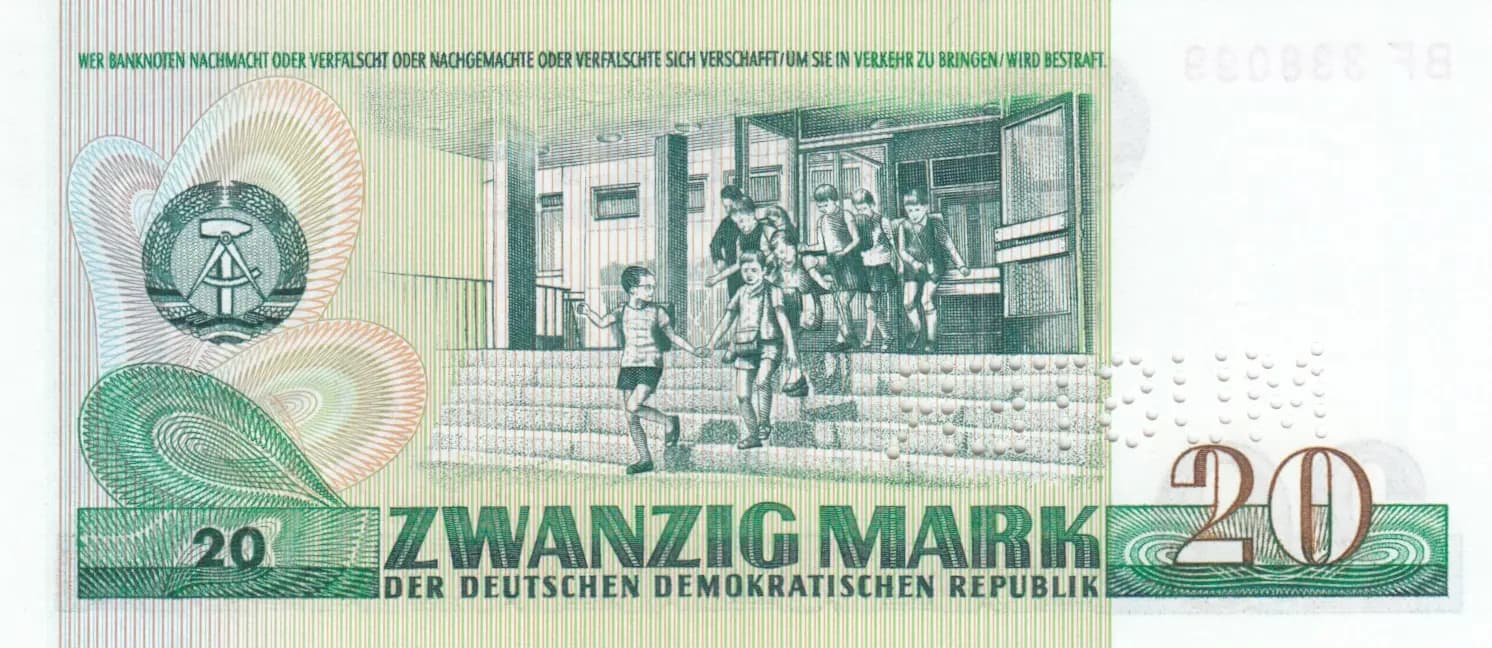
This is a pristine uncirculated 1975 specimen 20 Mark banknote from the German Democratic Republic (East Germany), issued by the Staatsbank der DDR. The note features Johann Wolfgang Goethe on the obverse and a scene of children at an institutional building on the reverse, both rendered in the characteristic green and tan color scheme of GDR currency. As a specimen note (indicated by the P-29as designation), this represents an official presentation example in flawless condition with no signs of circulation.
Common. The 20 Mark 1975 denomination (P-29) was part of the GDR's standard circulation currency issued in substantial quantities throughout the mid-to-late 1970s. Even in the specimen condition grade (P-29as), these notes remain common in the numismatic market as GDR banknotes were produced in large print runs and substantial quantities survive today. Specimen notes from this era and series typically trade at modest premiums over regular circulated examples but do not command significant collector premiums.
Issued during the height of the German Democratic Republic's existence, this 1975 banknote reflects the GDR's cultural priorities and socialist values. The choice of Goethe, Germany's greatest literary figure, on the obverse honored German cultural heritage despite Cold War division, while the reverse's depiction of children at a building symbolized the state's emphasis on youth education and socialist community development. The Staatsbank der DDR maintained this design series throughout the 1970s as part of its standard circulation currency.
The obverse features a finely engraved portrait of Johann Wolfgang Goethe (1749-1832), the celebrated German poet and playwright, rendered in three-quarter profile showing an elderly gentleman with characteristic wavy hair and 18th-19th century style clothing. The composition places Goethe's portrait on the right side of the note. The reverse depicts a scene of multiple children of varying ages engaged in outdoor play and activity before a multi-story institutional building (representative of a school or community center), symbolizing GDR socialist values of youth education and collective upbringing. Both sides incorporate the East German state coat of arms (hammer and compass within a wreath) and elaborate security printing including decorative circular emblems with radiating lines and intricate geometric guilloché patterns in green and beige/tan. Braille accessibility dots are visible on both sides.
FRONT SIDE: 'STAATSBANK DER DDR' (State Bank of the GDR); 'ZWANZIG MARK' (Twenty Mark); 'DER DEUTSCHEN DEMOKRATISCHEN REPUBLIK' (of the German Democratic Republic); '1975' (Year of issue); 'JOHANN WOLFGANG GOETHE' (name of portrayed person); '20' (denomination, multiple instances); Serial number 'BF 338099' (appears twice). REVERSE SIDE: 'ZWANZIG MARK' (Twenty Mark); 'DER DEUTSCHEN DEMOKRATISCHEN REPUBLIK' (of the German Democratic Republic); '20' (denomination, left and right); 'WER BANKNOTEN NACHMACHT ODER VERFÄLSCHT ODER NACHGEMACHTE ODER VERFÄLSCHTE SICH VERSCHAFFT UM SIE IN VERKEHR ZU BRINGEN WIRD BESTRAFT' (Whoever counterfeits or falsifies banknotes or procures counterfeit or falsified notes in order to put them into circulation will be punished).
Intaglio (line engraving) combined with color offset lithography, characteristic of GDR banknote production in the 1970s. The note exhibits fine line security printing, guilloché patterns, and geometric background designs typical of centrally planned economy security currency production. The Staatsbank der DDR employed East German state security printers for this series; specific printer attribution for Pick-29 typically involved the VEB Giesecke and Devrient affiliate operations or domestic GDR printing facilities.
This is identified as a specimen note (P-29as, indicated by the 'as' suffix in the Pick catalog number), which signifies it was an official presentation example produced by the Staatsbank der DDR for archival, display, or diplomatic purposes. The serial number prefix 'BF 338099' may indicate a specific printing batch, though GDR serial numbering systems are not extensively documented in standard references. Specimen notes may carry distinguishing marks or special overprints; examination of the actual note would reveal if 'SPECIMEN' or similar overprint/perforation is present, which is typical for official specimen releases.