20 mark 1964 specimen
About This Note
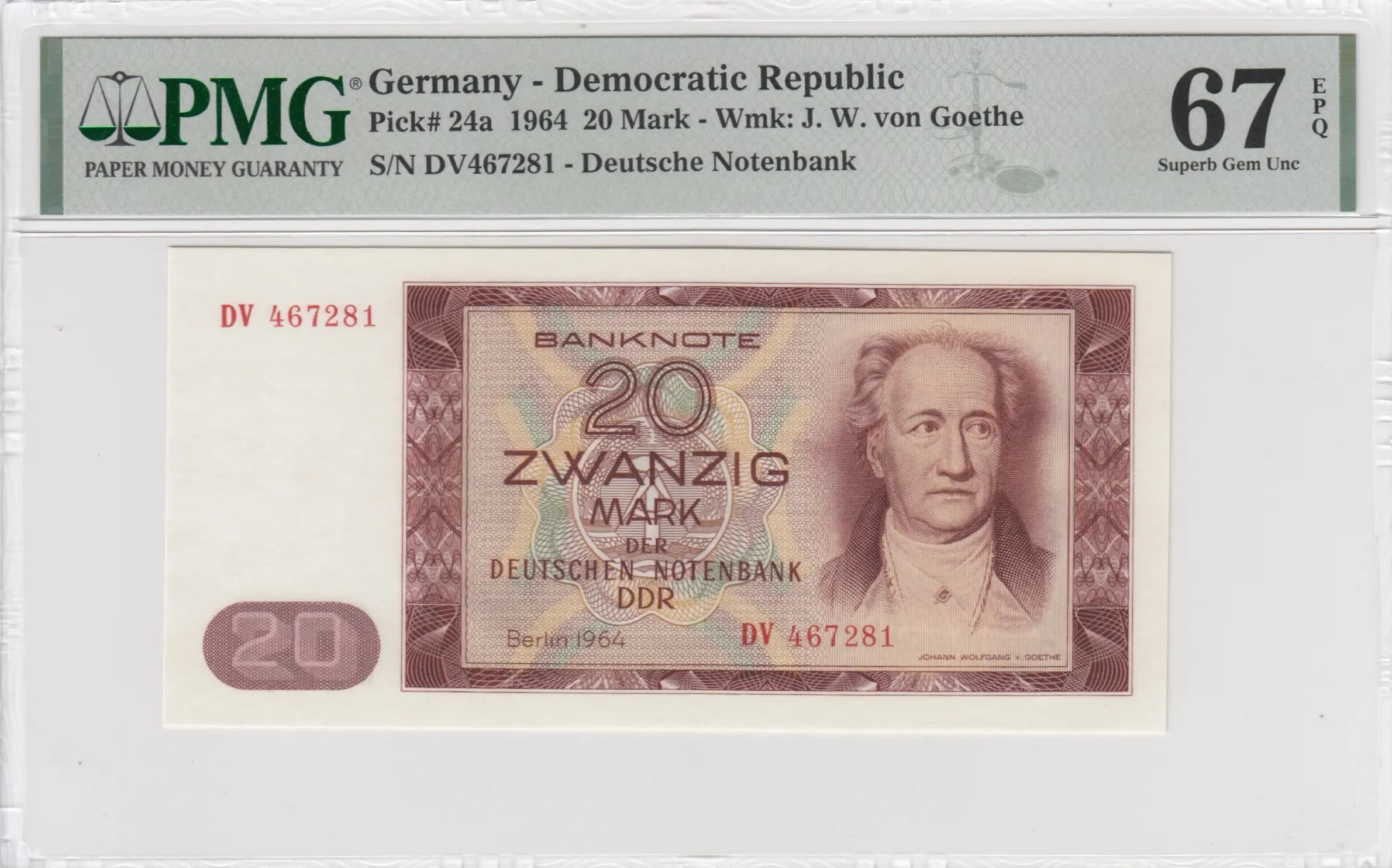
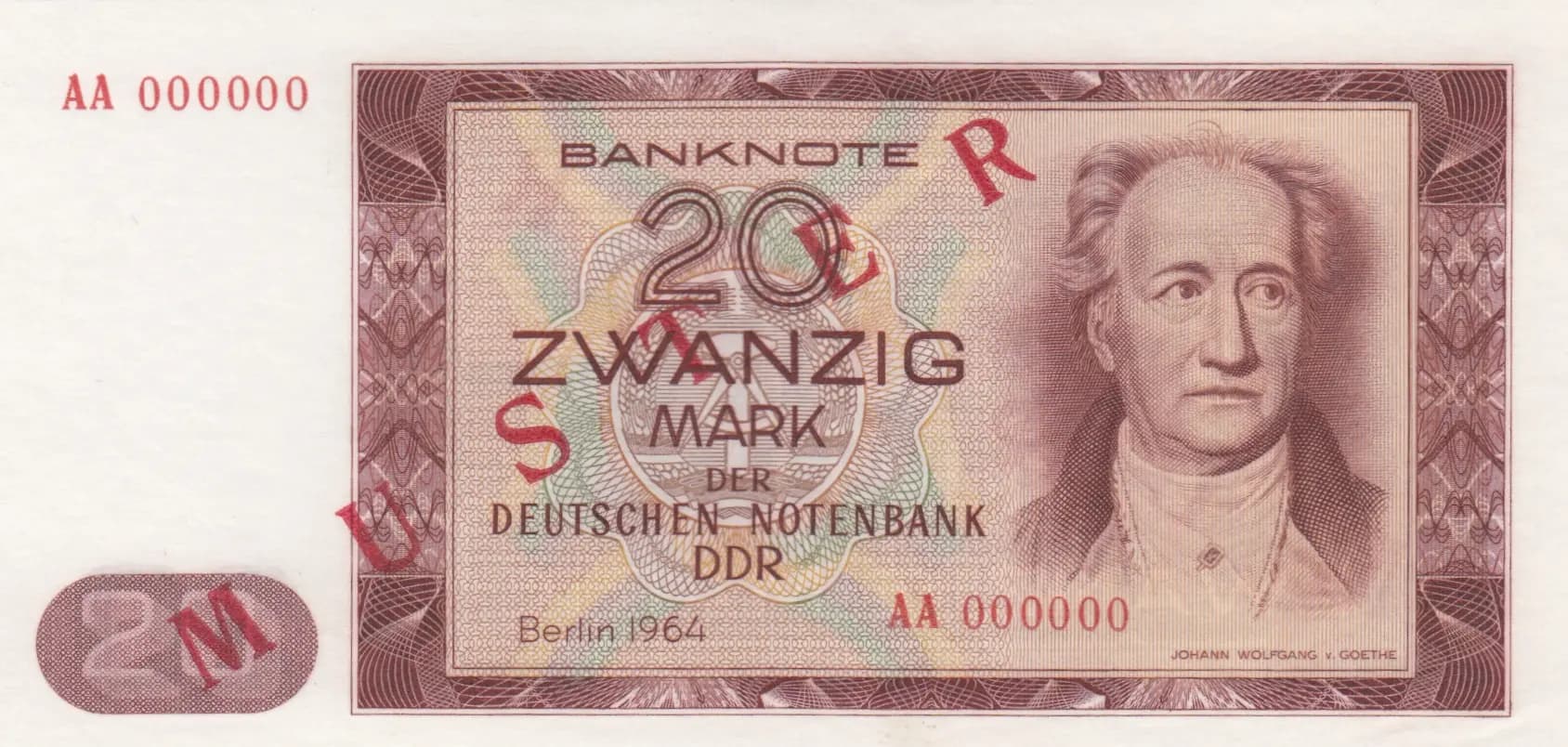
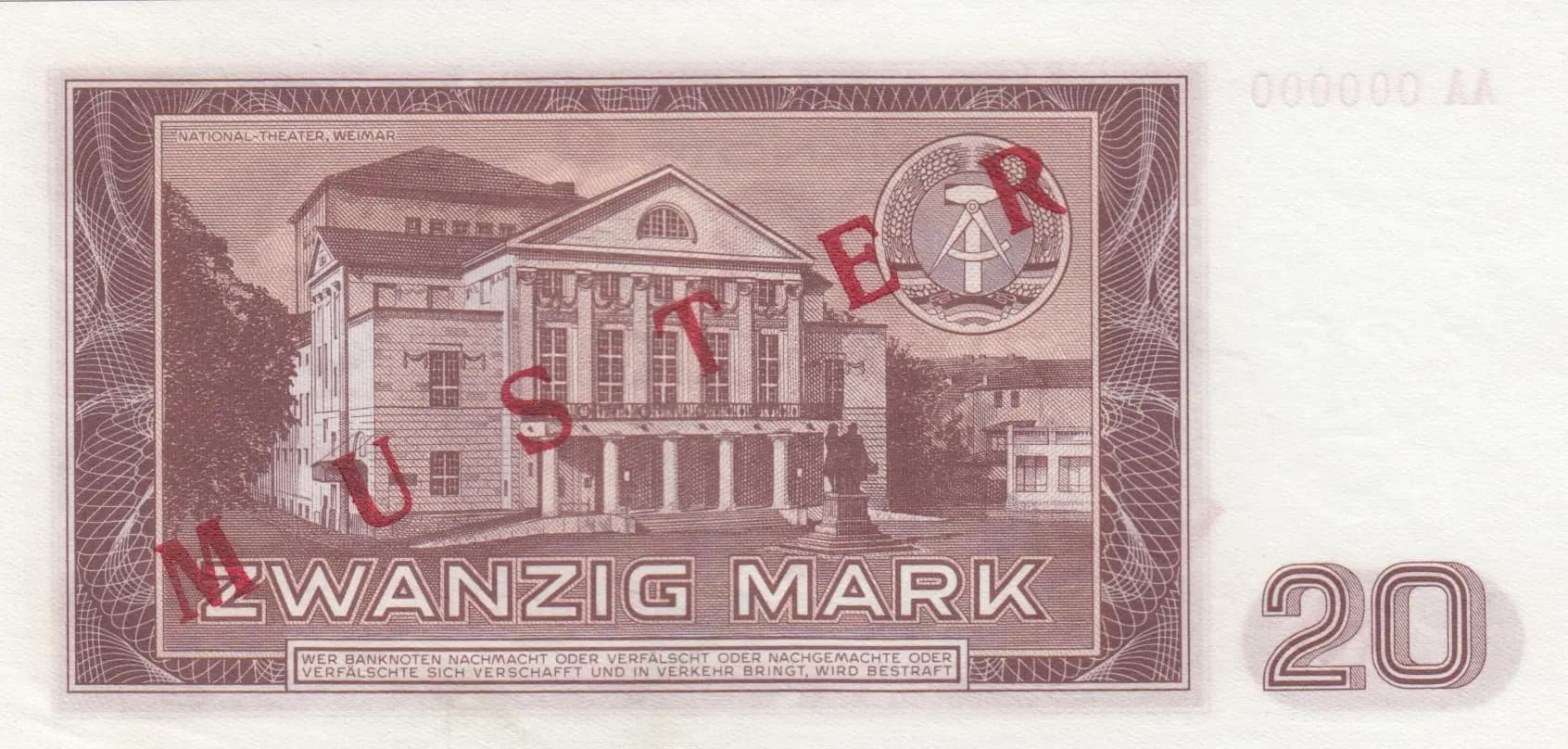
This is an uncirculated 1964 specimen 20 Mark banknote from the Deutsche Notenbank of East Germany (DDR), cataloged as Pick P-24s. The note features a portrait of Johann Wolfgang von Goethe on the obverse and the National Theater in Weimar on the reverse, printed in an elegant mauve, rose, and brown color scheme with fine security engraving throughout. As a specimen note with red 'R', 'S', and 'U' overprints and serial number AA 000000, this represents a bank distribution sample rather than currency intended for circulation, making it a significant piece of East German numismatic history.
Common. Specimen notes from this series are regularly encountered in the collector market. While specimen versions were not circulated, they were produced in substantial quantities as bank distribution samples and are not scarce. The 20 Mark denomination from 1964 remains relatively affordable and accessible to collectors, with specimen examples readily available in the numismatic marketplace.
This note was issued during the early years of the German Democratic Republic's independent monetary policy, shortly after the Deutsche Notenbank replaced the Soviet-controlled currency authority. The selection of Goethe, Germany's greatest literary figure, reflects the DDR's attempt to claim cultural legitimacy and continuity with German heritage despite political division. The prominently featured National Theater in Weimar—a symbol of German classical culture and the seat of the Weimar Republic—further underscores the regime's desire to connect itself to broader German historical traditions.
The obverse features a three-quarter profile portrait of Johann Wolfgang von Goethe, the 18th-century German poet, playwright, and philosopher, rendered in fine detail with characteristic period attire including a high collar, positioned on the right side of the note. Ornate decorative borders with repeating geometric and floral patterns frame both sides, and a circular seal containing the denomination '20' appears in the center. The reverse showcases the National Theater (Nationaltheater) in Weimar, a neoclassical structure built in 1907 featuring a prominent portico with columns and triangular pediment, rendered in detailed architectural engraving with surrounding landscape elements. The East German state emblem—featuring a hammer and compass within a wreath—appears in the upper right of the reverse, identifying this as an official DDR issue.
FRONT SIDE: '20' (denomination in numerals); 'ZWANZIG MARK' (Twenty Mark in German); 'DER DEUTSCHEN NOTENBANK' (Of the German Central Bank); 'DDR' (German Democratic Republic); 'Berlin 1964' (place and date of issue); 'JOHANN WOLFGANG v. GOETHE' (portrait identification); 'AA 000000' (specimen serial number, repeated). BACK SIDE: 'NATIONAL-THEATER, WEIMAR' (landmark identification); '20' and 'ZWANZIG MARK' (denomination); 'WER BANKNOTEN NACHMACHT ODER VERFÄLSCHT ODER NACHGEMACHTE ODER VERFÄLSCHTE SICH VERSCHAFFT UND IN VERKEHR BRINGT, WIRD BESTRAFT' (Whoever counterfeits or falsifies banknotes or procures counterfeit or falsified banknotes and puts them into circulation will be punished—standard anti-counterfeiting warning).
This note employs intaglio engraving (line-engraved printing), evidenced by the fine, intricate line work visible throughout the borders, backgrounds, and architectural details. The security features include complex parallel line patterns, radial line work, and detailed ornamental frames characteristic of high-security banknote production of the era. The specimen markings (red letter stamps 'R', 'S', and 'U') were applied as overprints after the primary intaglio printing. The Deutsche Notenbank employed established East German security printers for this series.
This is a specimen note variant (Pick P-24s designation indicates 'specimen'/'Muster' status), distinguished by the red overprint stamps and the AA 000000 serial number, which was standard for specimen notes. The specimen overprints ('R', 'S', 'U') may appear in varying positions on individual examples, but this represents the standard specimen variety rather than a significant rarity variant. No signature varieties are applicable to this mechanical note design. The 1964 date and 'Berlin' location marking are consistent across this issue.