20 mark 1964
About This Note
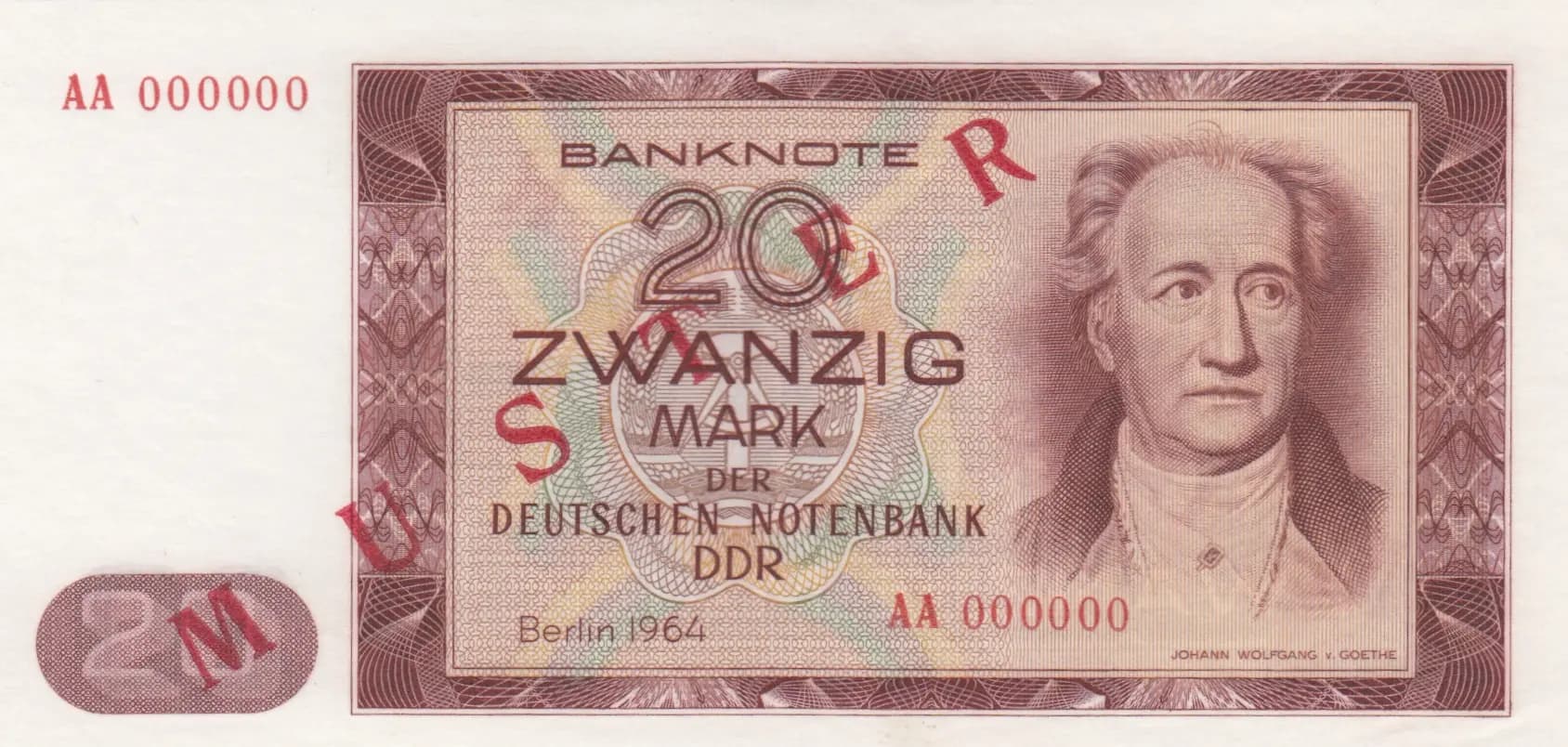
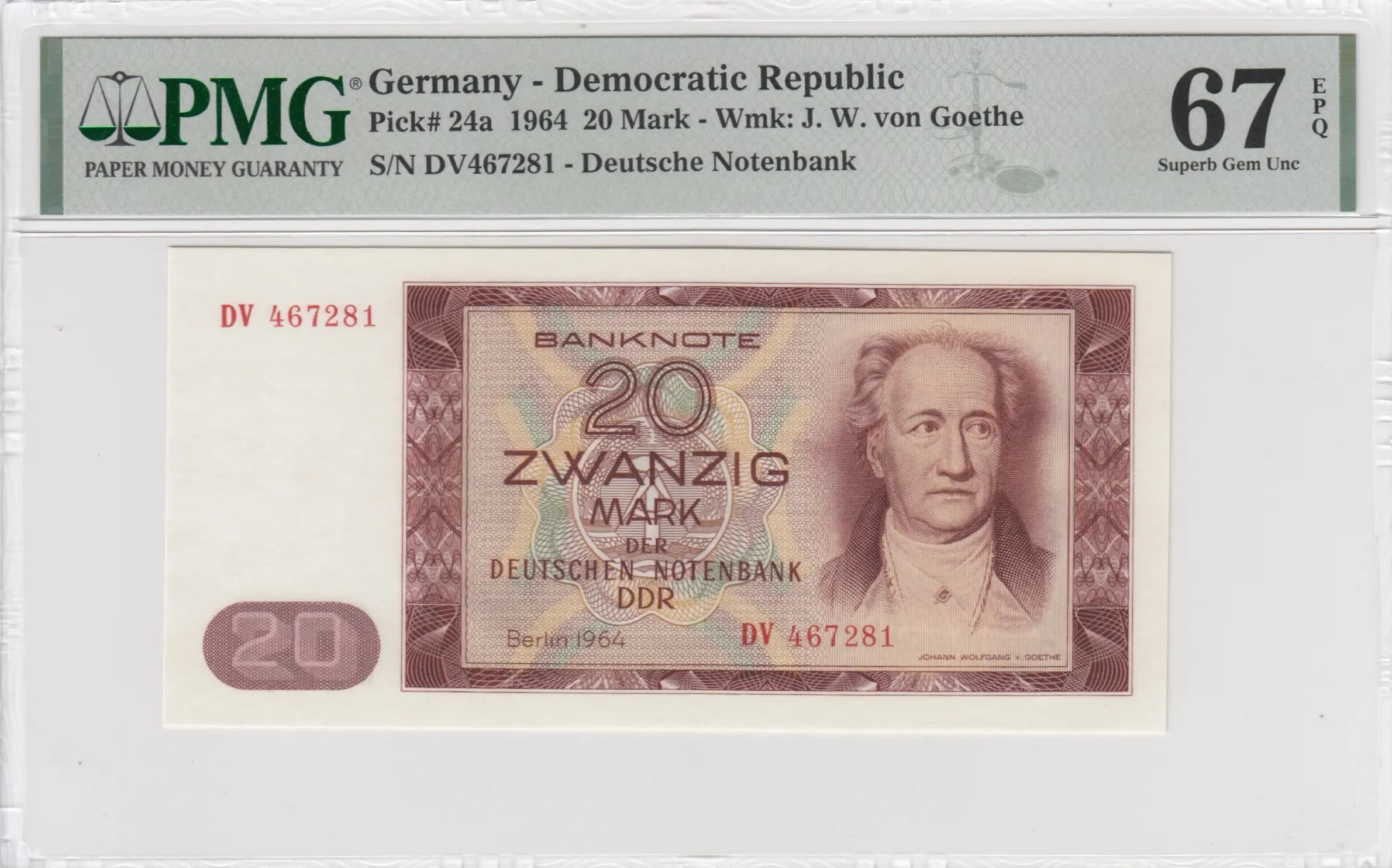
An exceptional example of East Germany's 1964 20 Mark note featuring Johann Wolfgang von Goethe, one of the most significant figures in German cultural history. The note displays pristine condition with sharp printing, vibrant reddish-brown coloration, and no evidence of wear or circulation. This PMG 67 EPQ specimen represents the high-quality currency production standards of the Deutsche Notenbank during the early Cold War period.
Common. The 20 Mark 1964 (Pick 24a) from the Deutsche Notenbank DDR was produced in substantial quantities as a standard denomination of East German currency in circulation during the 1960s. While individual notes in PMG 67 EPQ condition represent exceptional preservation and are more desirable than circulated examples, the underlying note itself remains common in the GDR banknote catalog. High-grade survivors are valued by collectors but do not command premiums associated with scarce or rare issues.
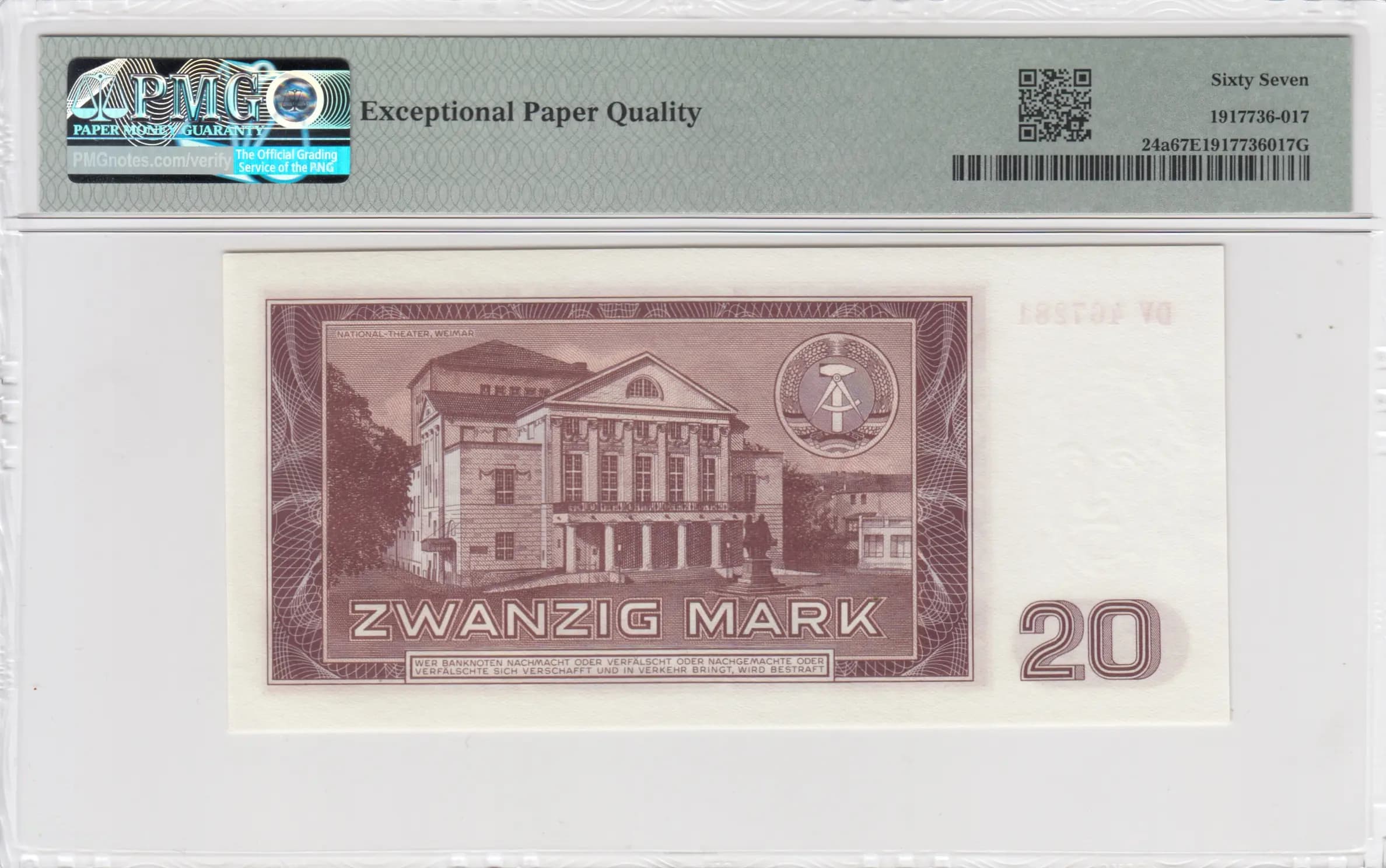
Issued by the Deutsche Notenbank DDR in 1964, this note reflects the German Democratic Republic's effort to establish its own distinct currency identity separate from West Germany. The choice of Johann Wolfgang von Goethe as the obverse portrait honors the shared cultural heritage of the German people, while the classical building depicted on the reverse (likely the Goethe House or a similar cultural institution) reinforces the GDR's claim to German cultural legitimacy during the ideologically divided Cold War era.
The obverse features a dignified right-facing portrait of Johann Wolfgang von Goethe, the 18th-19th century poet, playwright, and polymath who represents the pinnacle of German Romantic literature and intellectual achievement. Goethe's portrait occupies the right portion of the note, with his name clearly inscribed beneath. The reverse depicts a classical architectural monument with columned portico and triangular pediment, representing either the Goethe House (Goethe's birthplace in Frankfurt) or another significant German cultural institution, set against a landscape background. Both sides feature ornate decorative border patterns with geometric and floral motifs in the reddish-brown color scheme. The East German state emblem (hammer and compass) appears in the upper right of the reverse, reinforcing the socialist authority of the issuer.
FRONT: 'BANKNOTE' (Banknote), '20' and 'ZWANZIG MARK' (Twenty Mark), 'DER DEUTSCHEN NOTENBANK DDR' (Of the German Note Bank GDR), 'Berlin 1964' (Berlin 1964), Serial number 'DV 467281', 'JOHANN WOLFGANG V. GOETHE' (Johann Wolfgang von Goethe). BACK: 'ZWANZIG MARK' (Twenty Mark), '20' (20), 'WER BANKNOTEN NACHDRUCKT ODER VERFÄLSCHT ODER NACHGEMACHTE ODER VERFÄLSCHTE SICH VERSCHAFFT T UND IN VERKEHR BRINGT, WIRD BESTRAFT' (Whoever prints counterfeit banknotes or counterfeits them, or obtains counterfeit or counterfeited ones and puts them into circulation will be punished).
Intaglio (copperplate) printing, characteristic of GDR banknote production. The fine line work visible in the border patterns, the sharp detail in Goethe's facial features, and the crisp text all indicate traditional intaglio engraving. The Deutsche Notenbank employed East German state printing facilities, likely VEB Giesecke+Devrient's operations or the Berlin Banknote Printing Works (Berliner Geldscheindruckerei).
This specific example exhibits the standard design of Pick 24a with Berlin 1964 date and serial number prefix 'DV'. The note represents the main variety without known overprints or significant variants. Serial number DV 467281 falls within the typical range for 1964 production. No exceptional varieties or printing anomalies are evident from the visual analysis.