20 mark 1955 specimen
About This Note
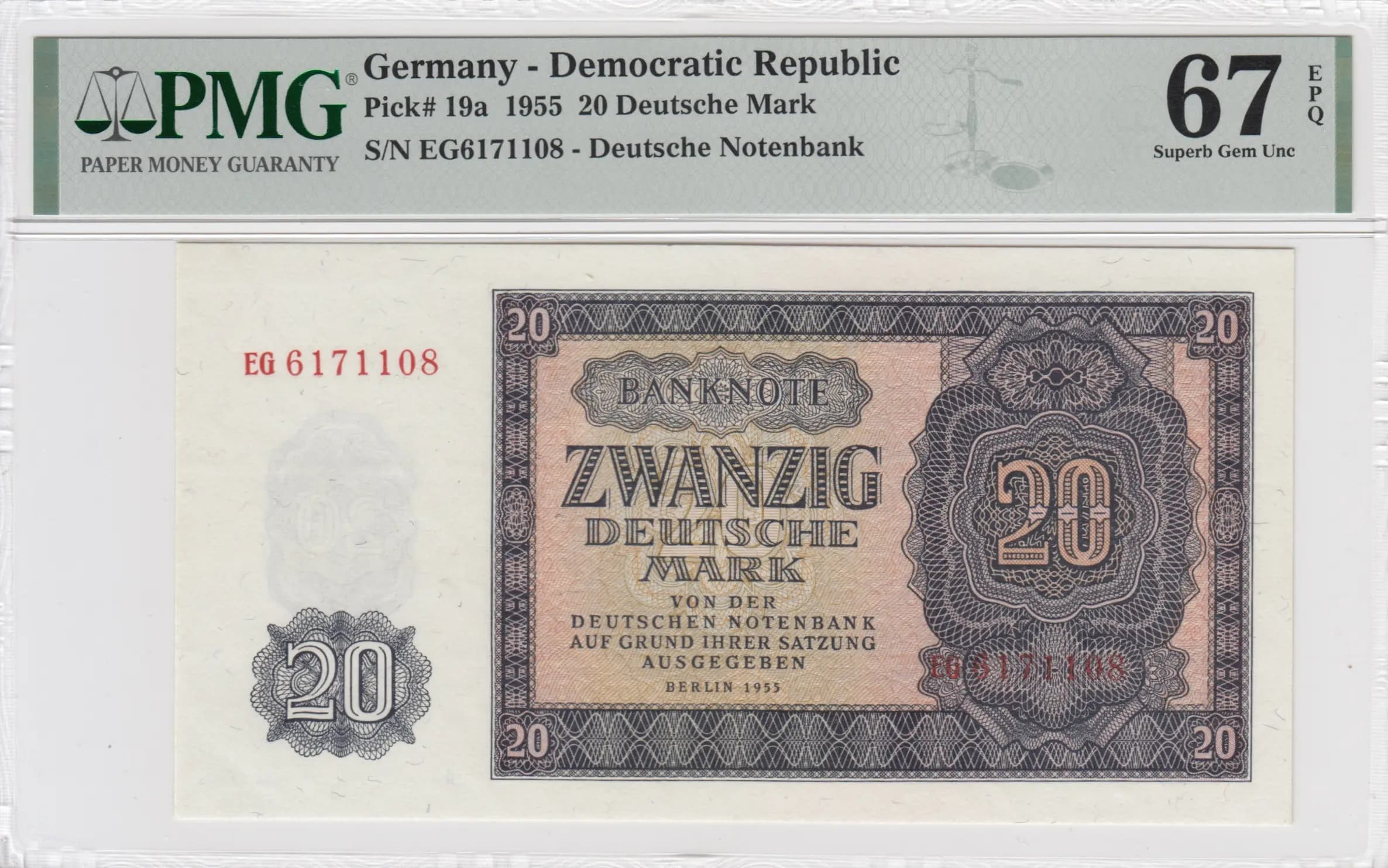
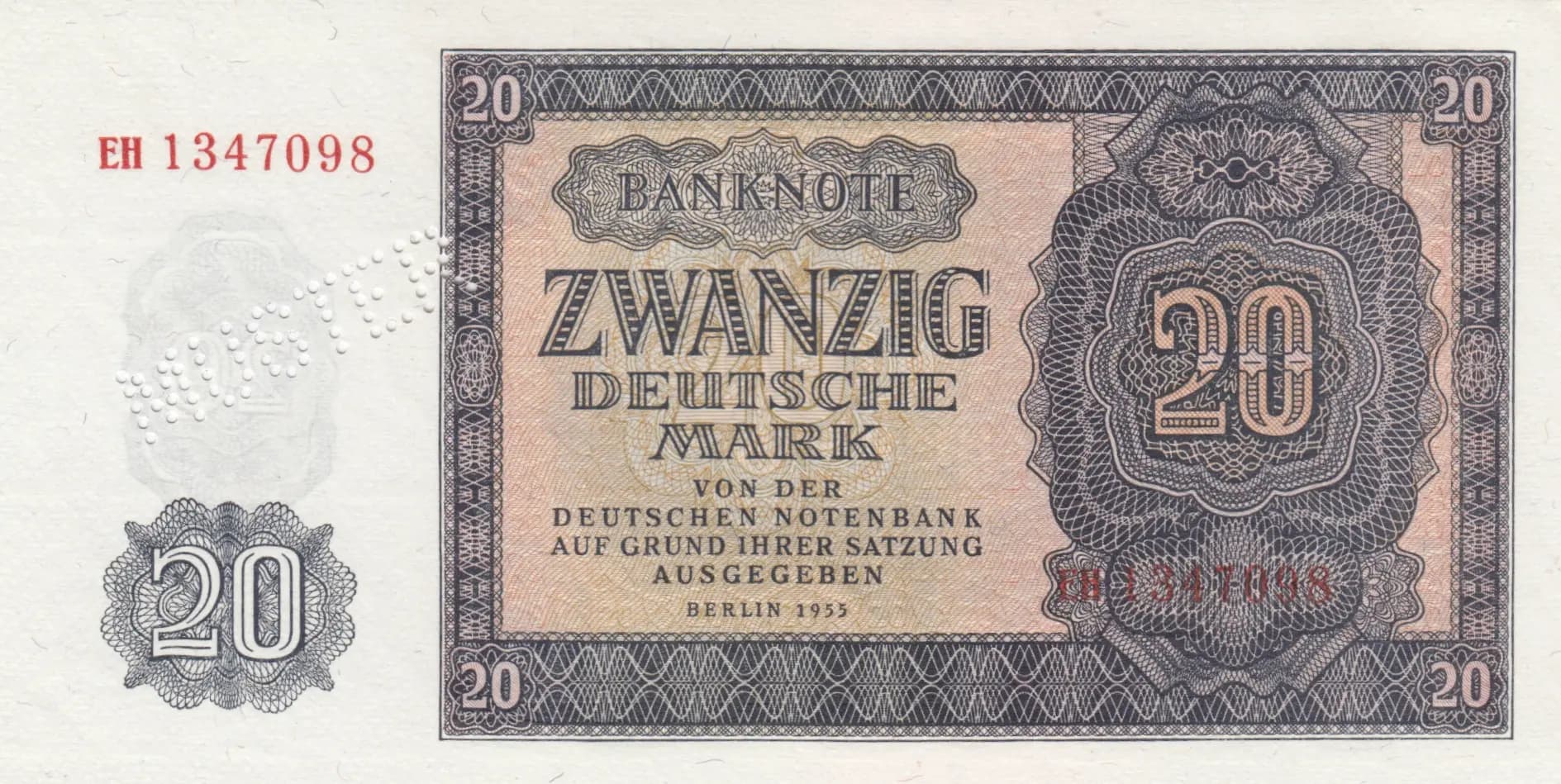
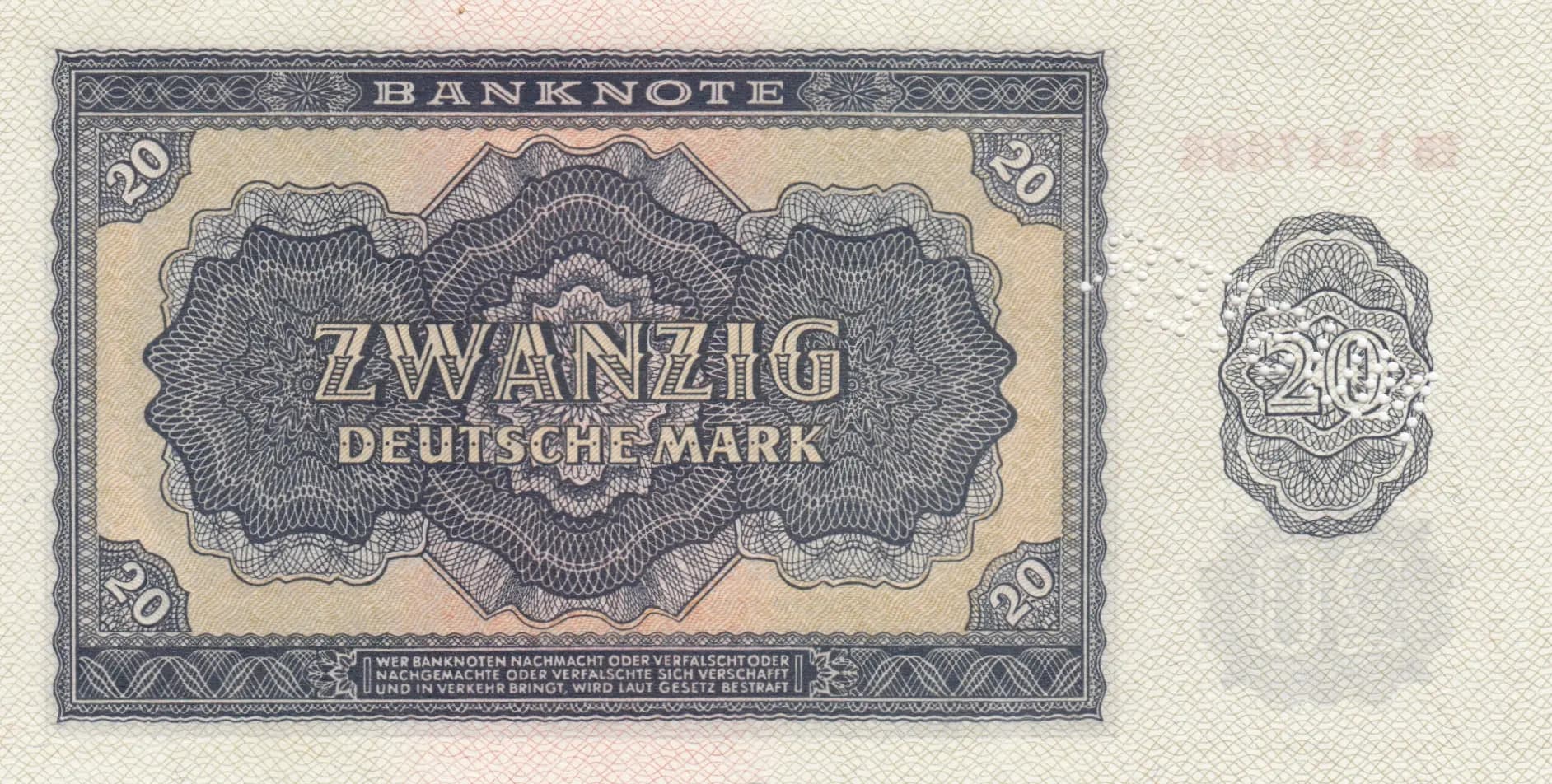
This is a 1955 Deutsche Notenbank 20 Mark specimen note (Pick P-19s) in uncirculated condition, featuring the characteristic ornate geometric and floral design aesthetic of early East German currency. The note displays crisp printing with sharp detail work, minimal aging, and a symmetrical beige and dark gray color scheme with decorative sunburst motifs on both sides. As a specimen note (indicated by the 's' designation), this represents an official presentation or archival example from the Deutsche Notenbank, making it a significant piece of GDR monetary history.
Common. This is a standard-issue banknote from the Deutsche Notenbank's regular 1955 emission of the 20 Mark denomination. The print run for this note was substantial, and examples survive in reasonable quantities in the collector market. While specimen notes (P-19s) are technically distinct from regular circulation notes (P-19), they were produced in meaningful quantities for archival and official distribution purposes and do not command significant premiums over circulated examples of the same denomination.
Issued in Berlin in 1955, this banknote represents the Deutsche Notenbank's early currency production for the newly formed German Democratic Republic, which had been established just four years prior. The purely ornamental design—eschewing portraits of political figures—reflects the transitional monetary policies of the early GDR and demonstrates the bank's commitment to decorative security features through elaborate geometric and floral patterns rather than figurative elements. The counterfeiting penalty text printed on the reverse underscores the serious efforts to establish confidence in the nascent East German currency during the Cold War era.
The 20 Mark note features an entirely ornamental design with no portraits or specific landmarks. The front and back both employ a symmetrical layout with the denomination '20' presented in ornate decorative frames at all four corners. The dominant visual element is an elaborate central mandala or sunburst motif featuring radiating geometric patterns with floral undertones. The design is constructed from precise line work and cross-hatching in dark gray and black against a beige/tan background, creating a sophisticated anti-counterfeiting aesthetic through complexity and symmetry rather than figurative imagery. The border frames on all sides contain continuous geometric and ornamental patterning that reinforces the note's formal, architectural quality.
FRONT SIDE: 'ZWANZIG DEUTSCHE MARK' (Twenty German Mark); 'VON DER DEUTSCHEN NOTENBANK AUF GRUND IHRER SATZUNG AUSGEGEBEN' (Issued by the German Note Bank by virtue of its regulations); 'BERLIN 1955' (Berlin 1955); Serial number 'EH 1347098'. BACK SIDE: 'BANKNOTE ZWANZIG DEUTSCHE MARK' (Banknote Twenty German Mark); 'WER BANKNOTEN NACHMACHT ODER VERFÄLSCHT ODER NACHGEMACHTE ODER VERFÄLSCHTE SICH VERSCHAFFT UND IN VERKEHR BRINGT, WIRD LAUT GESETZ BESTRAFT' (Whoever counterfeits or forges banknotes or obtains counterfeit or forged ones and puts them into circulation will be punished according to law).
Intaglio (relief) printing, evident from the sharp detail reproduction, crisp line work, and the embossing-like impression marks visible on the left side of the front. The ornate geometric patterns and fine cross-hatching characteristic of intaglio engraving are clearly preserved in the examples shown. This was standard for Deutsche Notenbank production of the period. The printer for Pick P-19s is typically recorded as VEB Giesecke & Devrient (Leipzig), the primary security printer for the GDR.
This is identified as a specimen note based on the 's' designation in Pick P-19s. Specimen notes of this series typically lack the special perforation or 'SPECIMEN' overprints found on some banknote specimens, instead being distinguished by their archival production and distribution. The serial number prefix 'EH' appears consistent with Deutsche Notenbank numbering conventions for this period. No overprints or special markings are visible on the examples provided. Researchers should note that the 1955 20 Mark exists in both regular circulation (P-19) and specimen (P-19s) varieties.