5000 mark 1922
About This Note
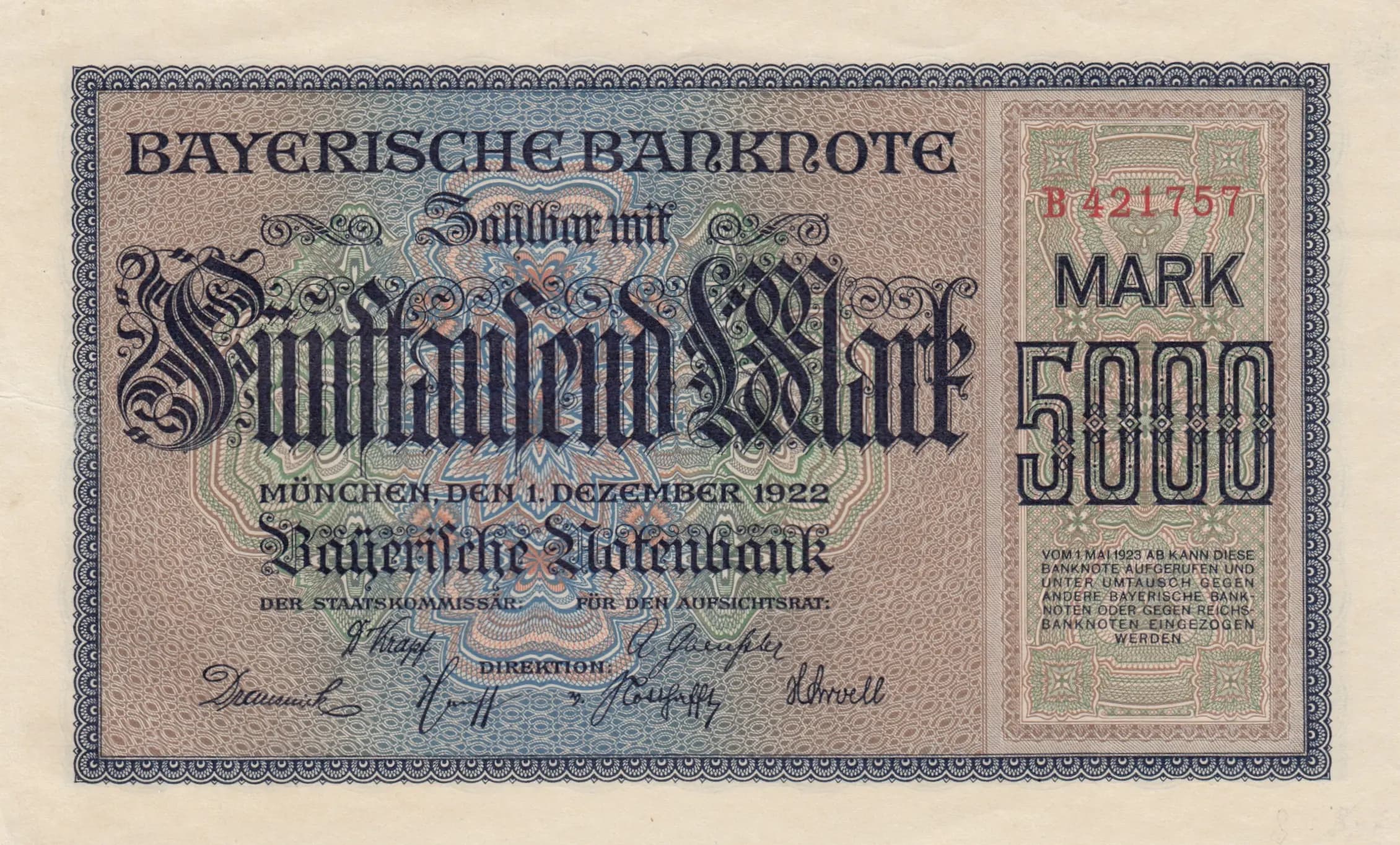
This Bavarian 5000 Mark note from December 1, 1922 (Pick S925) displays the characteristic ornate design of Weimar-era German regional banknotes, featuring elaborate Gothic typography and decorative borders in blue and tan colorations. The note presents in AU condition with sharp, well-defined printing and minimal wear, showing excellent preservation of the fine line engraving details and complex ornamental patterns. As a product of the Bayerische Notenbank during the hyperinflation period, this note represents an important transitional currency issued just months before the monetary stabilization of 1923.
Common. The Bavarian Note Bank issued large quantities of regional currency during the hyperinflation period of 1922-1923 to meet demand for medium and large denominations. While 5000 Mark notes are more substantial than smaller denominations, they were produced in significant numbers and survive in reasonable quantities today. Regional Bavarian banknotes from this period, while specialized collectibles, are readily available in the numismatic market and do not command premiums associated with rare issues. The AU condition grade is desirable but not unusual for well-preserved examples of this series.
Issued by the Bavarian Note Bank (Bayerische Notenbank) on December 1, 1922, this 5000 Mark note represents a crucial moment in Weimar monetary history—the final phase of hyperinflation before currency stabilization. The inscription noting the note's validity only until May 1, 1923, for exchange against Reichsbank notes reflects the Federal government's plan to consolidate regional note circulation and introduce the Rentenmark. Bavaria's independent banking authority is prominently displayed, reflecting the federal structure of the German Reich during this turbulent economic period.
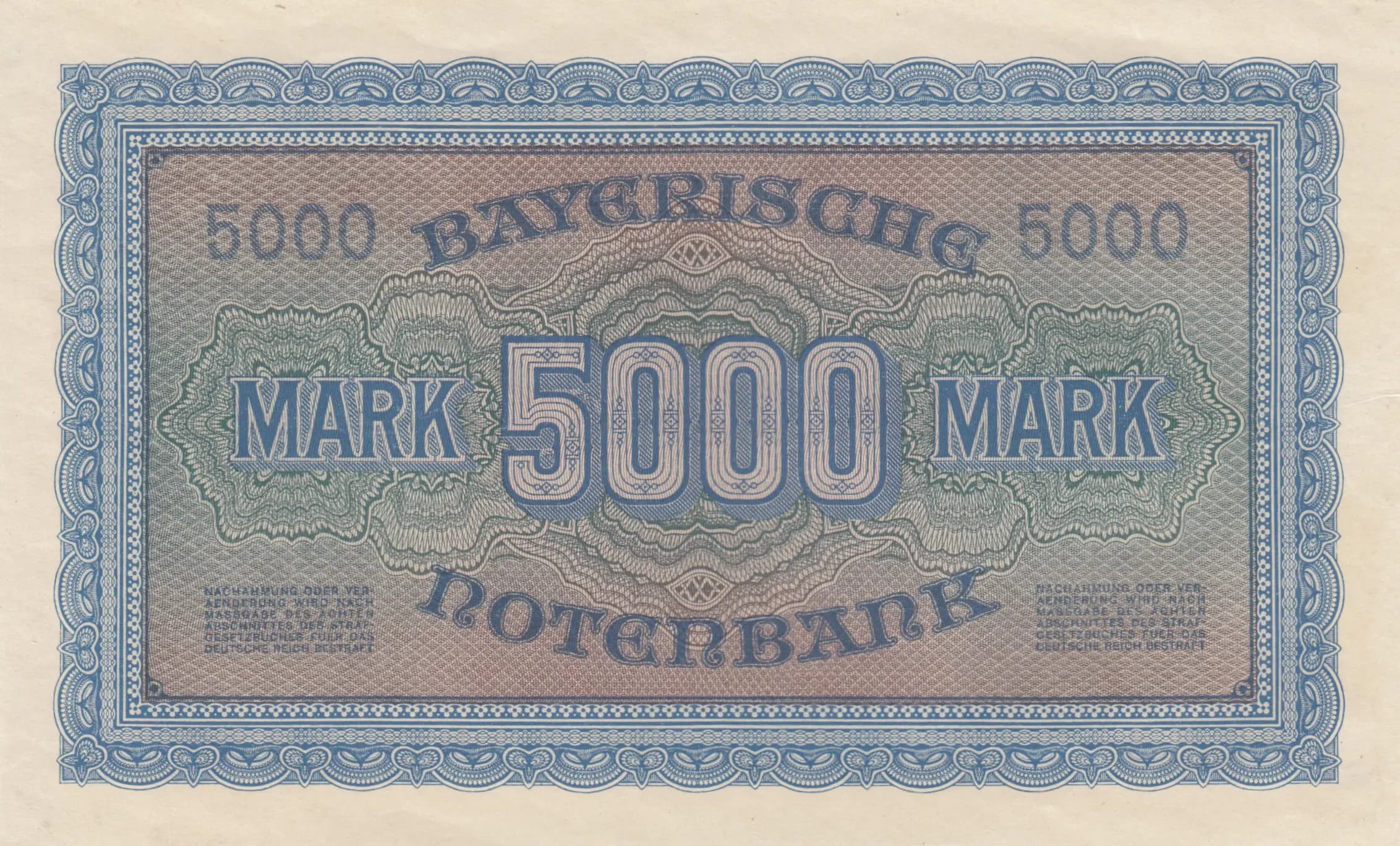
The 5000 Mark note features the characteristic security design of Bavarian regional currency from the hyperinflation period. The obverse displays an elaborate ornamental framework with Gothic Fraktur typography announcing the denomination and issuer authority. A rectangular denomination panel on the right side contains critical issuing information and the serial number (B 421757). The reverse presents a dominant central ornamental medallion design containing the denomination, surrounded by repeating geometric and floral border patterns. No portraits or specific landmarks are depicted; instead, the design relies on heraldic ornamental elements and intricate fine-line engraving as security measures. The color scheme of blue, tan, beige, and green inks across both sides creates visual complexity designed to resist counterfeiting during an economically unstable period.
FRONT SIDE: 'Bayerische Banknote' (Bavarian Banknote); 'Eintausend Mark' (One Thousand Mark) [Note: Visual analysis shows 5000 denomination]; 'München, den 1. Dezember 1922' (Munich, December 1, 1922); 'Bayerische Notenbank' (Bavarian Note Bank); 'Der Staatskommissar für den Aufsichtsrat' (The State Commissioner for the Supervisory Board); 'Direktion' (Direction/Management); Serial number: B 421757. Legal notice: 'Vom 1. Mai 1923 ab kann diese Banknote aufgerufen und unter Umtausch gegen Reichsbanknoten oder gegen Reichsschatzanweisungen anderer Bayerischer Banknoten oder gegen Reichsbanknoten eingezogen werden' (From May 1, 1923, this banknote can be called in and exchanged for Reichsbank notes or Reichstreasury bills or other Bavarian banknotes or Reichsbank notes). BACK SIDE: '5000 Mark' (5000 Mark) [appears multiple times]; 'Bayerische' (Bavarian); Legal warning: 'Nachahmer oder Verfälscher dieser Banknote oder der technischen Ausführungszeichen des Staats unterliegen nach der geltenden Gesetzgebung Deutscher Reich bestraft' (Counterfeiters or falsifiers of this banknote or the technical execution marks of the state are punished according to current German Reich legislation).
This note was produced using intaglio (engraved) printing, evidenced by the fine line details, sharp typography in Gothic script, and the precise ornamental border work visible in both the visual analysis and the security features described. The multiple color applications (blue, tan, beige, green) indicate multi-pass printing typical of high-security banknote production. The Bavarian Note Bank contracted with established security printers of the period; for this regional issue, the printer was likely Giesecke+Devrient or a similar German security printer specializing in Reichsmark-era currency.
Pick S925 designates the 5000 Mark denomination issued December 1, 1922. The observed serial number prefix 'B' is consistent with regular circulation issues from the Bavarian Note Bank. Varieties of this note may exist based on signature combinations (State Commissioner and Director signatures visible on the obverse), though the visual analysis does not provide sufficient detail to identify specific signature varieties. The note's design remained consistent throughout its brief validity period (December 1922 to May 1923), with the single-date issue (1. Dezember 1922) being the standard for this denomination.