10 rubel 1916
Market Prices
8 salesAbout This Note
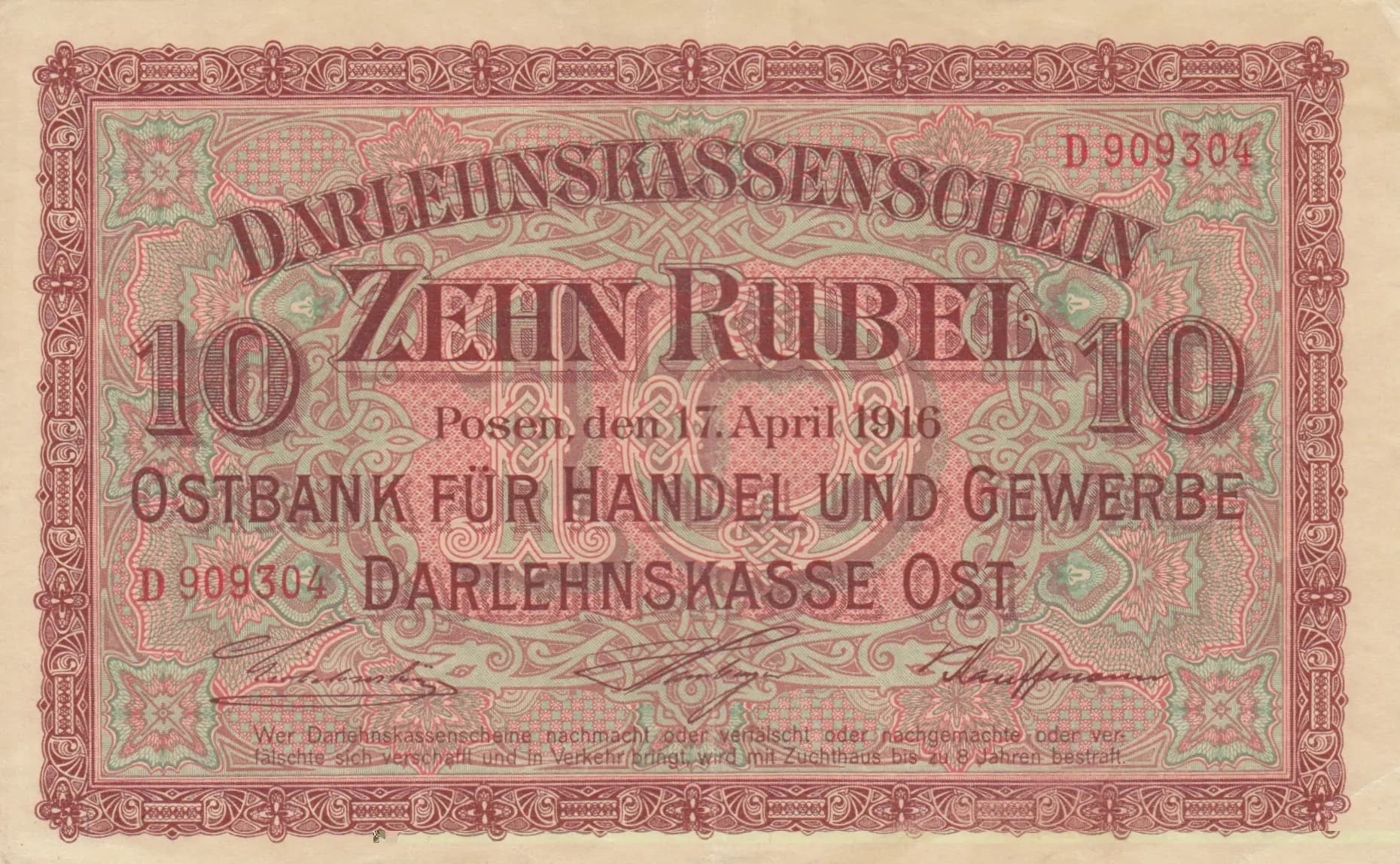
This is a German regional banknote issued by Darlehnskasse Ost in Posen on April 17, 1916, denominated in 10 rubles. The note displays exceptional design quality with symmetrical ornate borders in red/pink and green/teal, featuring intricate floral and geometric patterns throughout both sides. In VF condition, this example shows minimal wear with well-preserved colors and crisp printing, representing a fascinating artifact of early 20th-century occupied Eastern European currency.
Common. Despite being a regional German occupation currency with limited geographic circulation, eBay market data shows consistent sales in the $10-$30 range for circulated examples (F and VF grades), with a 2008 catalogue value of $150 for VF. The regular appearance of these notes in online auctions at modest price points, combined with the reference source noting they 'circulated in Lithuania until 1922' (suggesting reasonable production runs), indicates adequate availability in the collector market. This Pick-R124 note is not scarce or difficult to obtain for collectors interested in German occupation or Eastern European WWI-era currency.
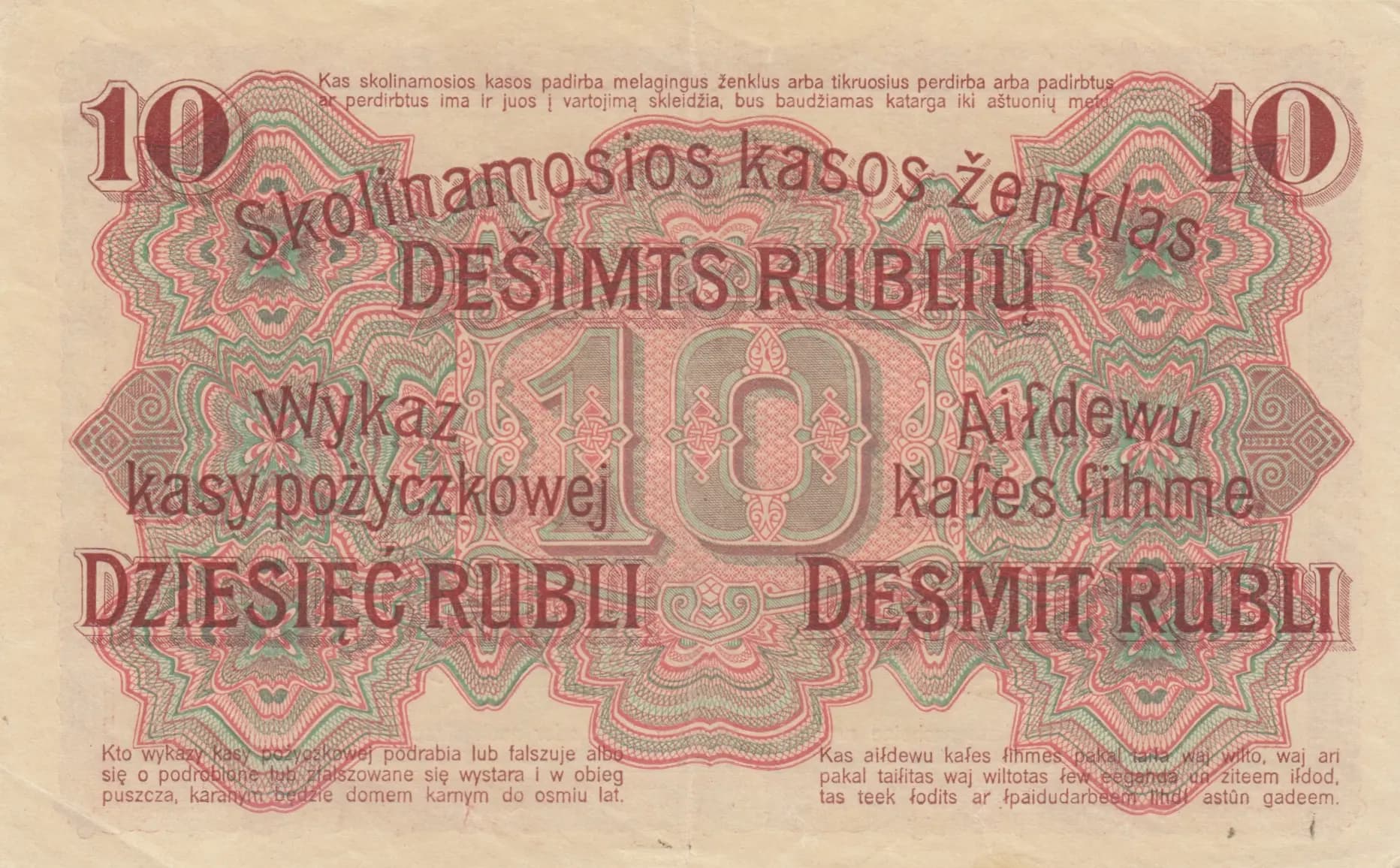
This banknote was issued by the German-controlled Darlehnskasse Ost (East Loan Office) during World War I occupation of Russian Poland, specifically in the city of Posen. The multilingual reverse inscriptions in German, Lithuanian, Polish, and Estonian reflect the diverse occupied territories administered from this regional financial center. The note remained in circulation in Lithuania until 1922, serving as a crucial monetary instrument during the transitional period following the Russian Revolution and German withdrawal from Eastern Europe.
The note features a classically restrained yet ornate Art Nouveau-influenced design characteristic of early 20th-century Central European banknotes. The obverse displays the denomination '10' prominently positioned within decorative ornamental frames, with 'ZEHN RUBEL' in German script. The corners are anchored by symmetrical rosette and floral patterns rendered in red/pink tones against a cream background, while green and teal underprinting provides depth. The reverse emphasizes the same ornamental cartouche design with the large numeral '10' as the focal point, surrounded by geometric and floral border work. The multilingual text sections on the reverse—in German, Lithuanian, Polish, and Estonian—are carefully integrated into the overall symmetrical composition. No portraits or specific landmarks appear on this design; instead, the aesthetic relies entirely on decorative security printing and complex typographic elements. The paper exhibits fine line patterns and complex ornamental borders throughout, creating visual complexity intended to deter counterfeiting.
FRONT SIDE: 'DARLEHNSKASSENSCHEIN' (Loan Certificate); 'ZEHN RUBEL' (Ten Rubles); 'Posen, den 17. April 1916' (Posen, April 17, 1916); 'OSTBANK FÜR HANDEL UND GEWERBE' (East Bank for Trade and Commerce); 'DARLEHNSKASSE OST' (East Loan Office); Serial number 'D 909304'; Counterfeiting warning: 'Wer Darlehnskassenscheine nachmacht oder verfälscht oder nachgemachte oder verfälschte sich verschafft und in Verkehr bringt, wird ihm Zuchthaus bis zu 8 Jahren bestraft' (Whoever counterfeits or falsifies loan certificates or acquires and puts such counterfeited or falsified notes into circulation will be punished with imprisonment for up to 8 years). BACK SIDE: 'Skolinamosios kasos ženklas' (Lithuanian: Loan office certificate); 'DESIMIT RUBLEI' (Lithuanian: Ten rubles); 'DZIESIĘCI RUBLEI' (Polish: Ten rubles); 'DESMITRUBLII' (Estonian: Ten rubles); Counterfeiting warnings in Lithuanian, Polish, and Estonian with substantially similar legal penalties for counterfeiting and circulation of forged notes.
This note employs intaglio letterpress printing with colored underprinting, a standard security technique for banknotes of the WWI era. The fine line work, delicate border patterns, and sharp registration visible in both the red/pink and green/teal colored areas indicate multicolor intaglio processes. The complexity of the ornamental designs and the precision of the multiple language texts suggest production by a specialized European security printer, likely contracted by the German Imperial Treasury for occupation currency. The quality of the printing is consistent with high-security banknote production standards of 1916.
The observed specimen displays serial number 'D 909304', with the 'D' prefix characteristic of this issue. The specific date of April 17, 1916 matches the catalog date. Varieties for P-R124 may exist with different serial number prefixes and date variants, though the visual analysis does not reveal overprints or significant modifications that would indicate distinct sub-varieties. The multilingual reverse (German/Lithuanian/Polish/Estonian) appears to be the standard design for this Pick number, representing a single major variety intended for broad circulation across all occupied territories.