100 rubel 1916
Market Prices
6 salesAbout This Note
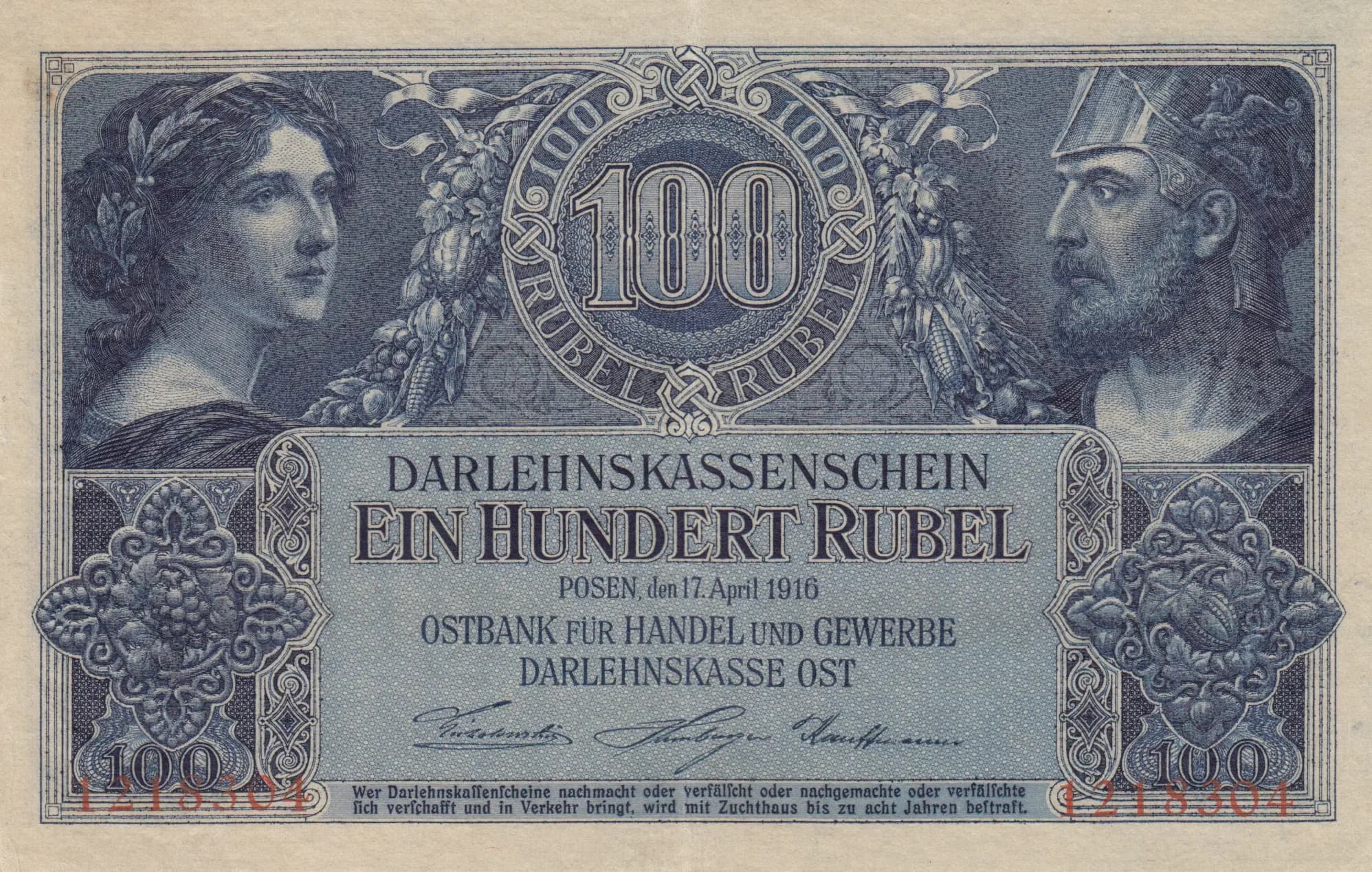
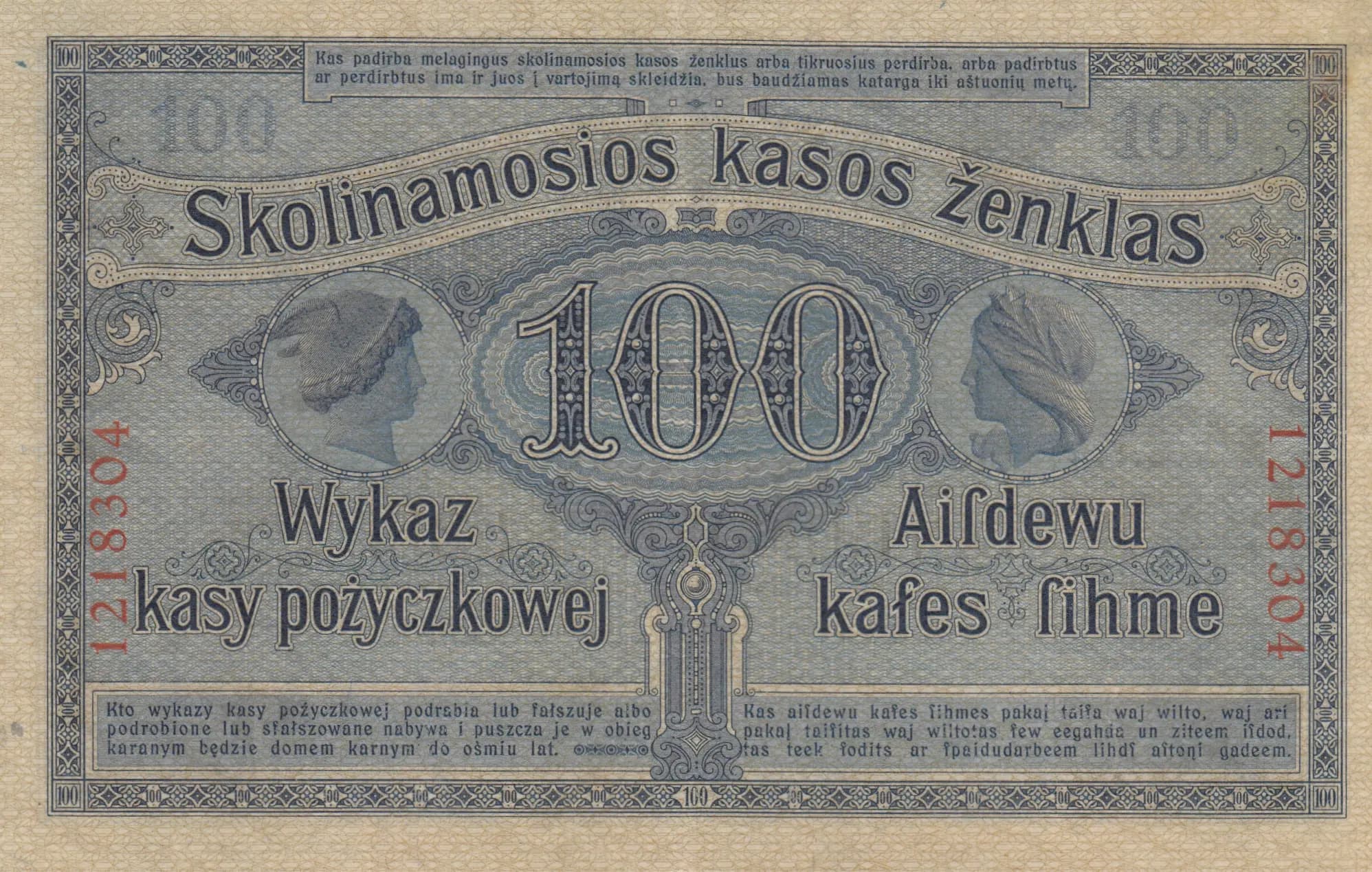
This is a 100 Rubel note issued by Darlehnskasse Ost in Posen on April 17, 1916, a regional German loan bank certificate from the World War I occupation period. The note displays exceptional Art Nouveau design with dual classical portraits (female with laurel wreath and bearded male figure) flanking an ornate central denomination marker, rendered in intaglio engraving with fine detail work and intricate Celtic knotwork borders. The example graded EF shows moderate age-related discoloration and some fold marks consistent with light circulation, yet maintains excellent clarity of design and legibility of the complex multilingual inscriptions across German, Lithuanian, Polish, and Yiddish text.
Common. While regionally issued and historically specific to the German occupation period in Poland during WWI, this Pick R126 note shows up regularly in the market with documented eBay sales across multiple condition grades (F to EF specimens) between 2017 and 2026 at modest prices ranging from $49 to $92. The 2008 catalog value of $500 UNC appears inflated relative to actual market performance; the EF specimen sold for $83.05 in 2017, well below catalog estimate. The existence of multiple sales events and the regular appearance in commerce indicate this was produced in sufficient quantity to remain accessible to collectors. No evidence of extreme scarcity, short print run, or recall status that would elevate rarity classification.
This note represents a fascinating artifact of German Imperial occupation during World War I, issued by the Darlehnskasse Ost (East Loan Bank) established to finance military operations in the Eastern Theater. The multilingual inscriptions in German, Lithuanian, Polish, and Yiddish reflect the ethnically diverse population of the Posen region (now Poznań, Poland), which was under German control during the war. The classical allegorical portraits and elaborate Art Nouveau design underscore the formal authority and legitimacy the occupying German authorities sought to project through this regional scrip currency.
The obverse features a symmetrical composition with allegorical figures representing classical ideals of commerce and civilization. The left portrait depicts a classical female head with curled hair adorned with a laurel wreath, symbolizing peace or victory. The right portrait shows a bearded male head wearing an ornamental eastern-style headpiece, possibly representing Mercury or a merchant figure, with styling that evokes eastern European cultural elements. Between these dual portraits stands a large ornate circular frame containing the denomination '100' with 'RUBEL RUBEL' inscribed around the perimeter. The design incorporates elaborate Art Nouveau elements including Celtic-inspired knotwork patterns in the corners, grape vine and wheat bundle motifs flanking the central denomination (symbolizing agricultural prosperity and commerce), and decorative leaf flourishes. The reverse repeats the dual portrait medallions in circular frames flanking a central denomination '100' within an ornamental circular cartouche, maintaining the Art Nouveau geometric and floral border patterns. The multilingual text presentation on both sides reflects the heterogeneous imperial territory.
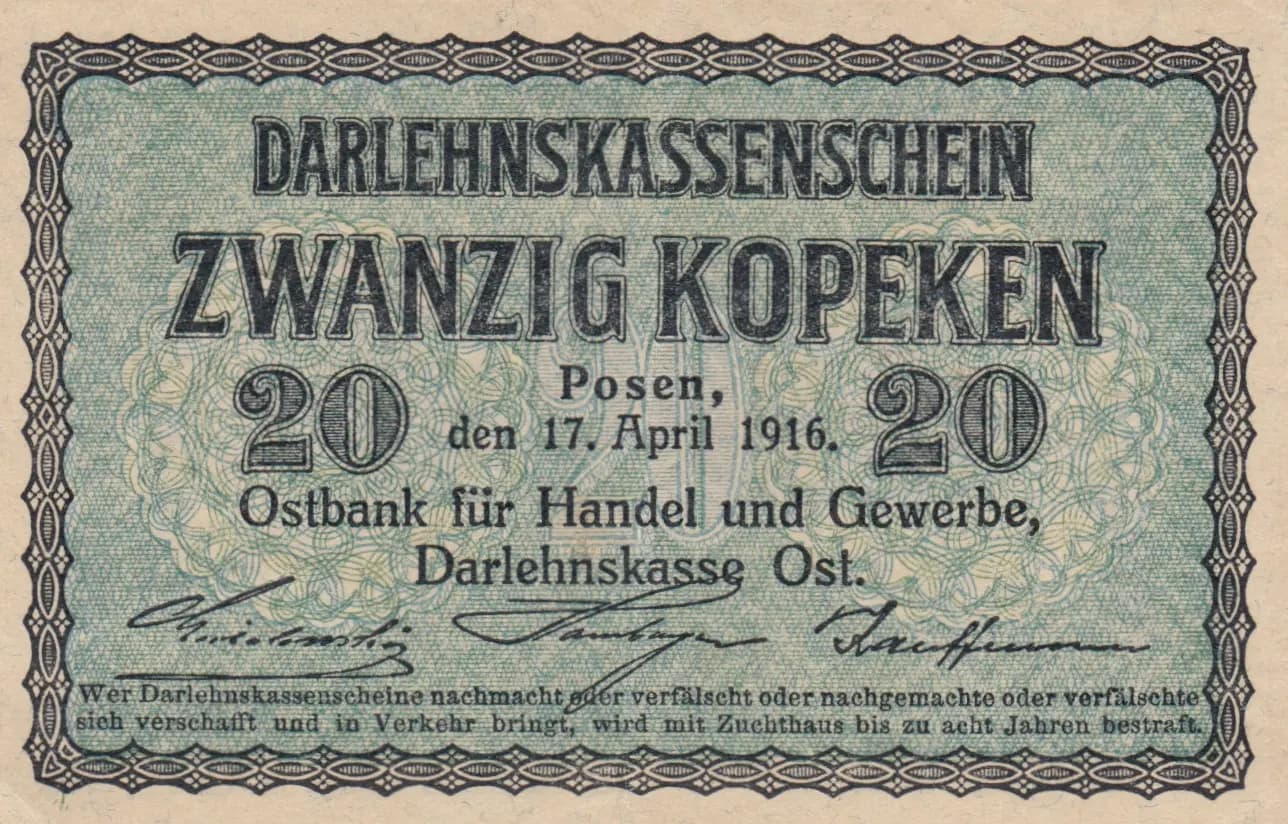
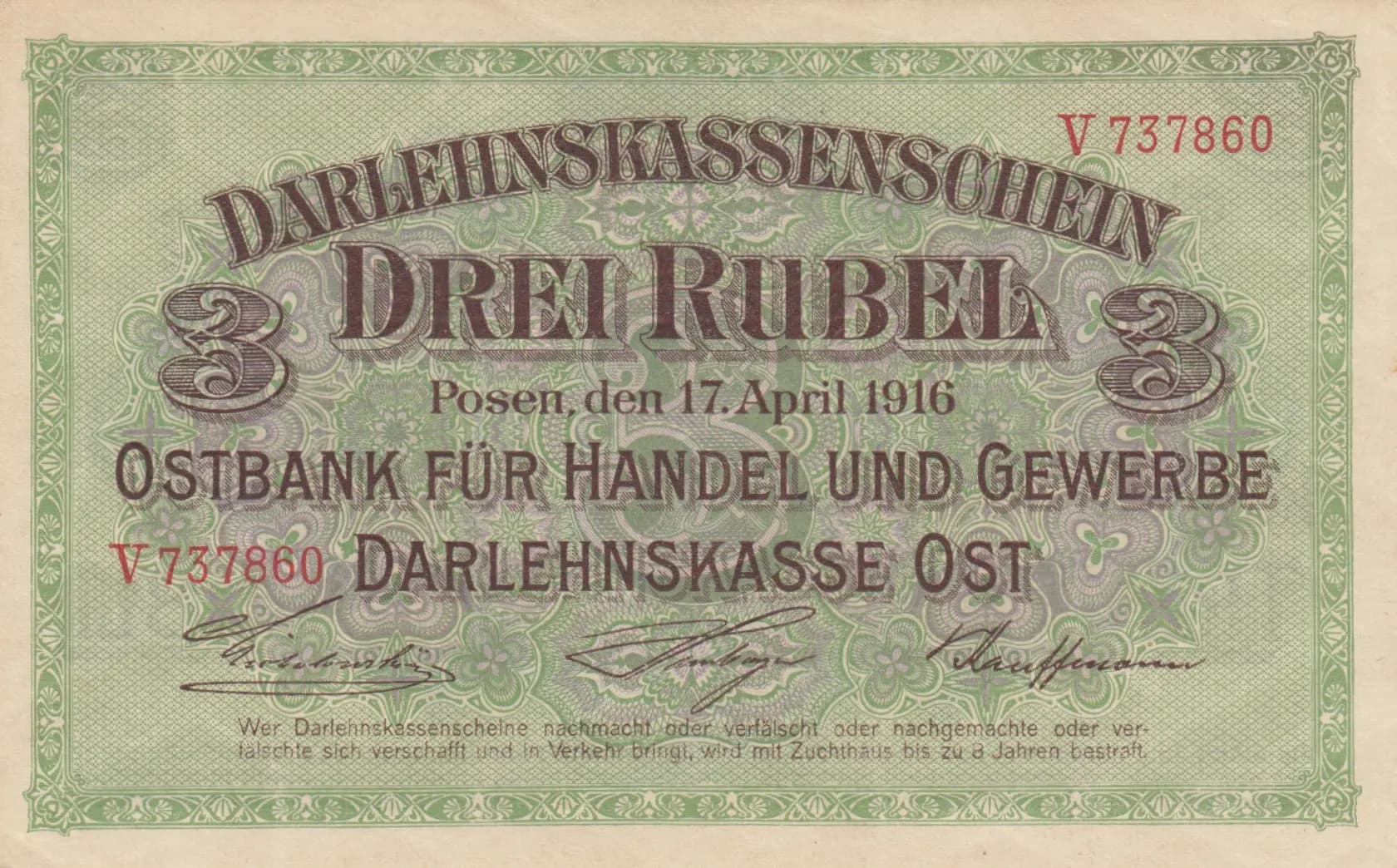
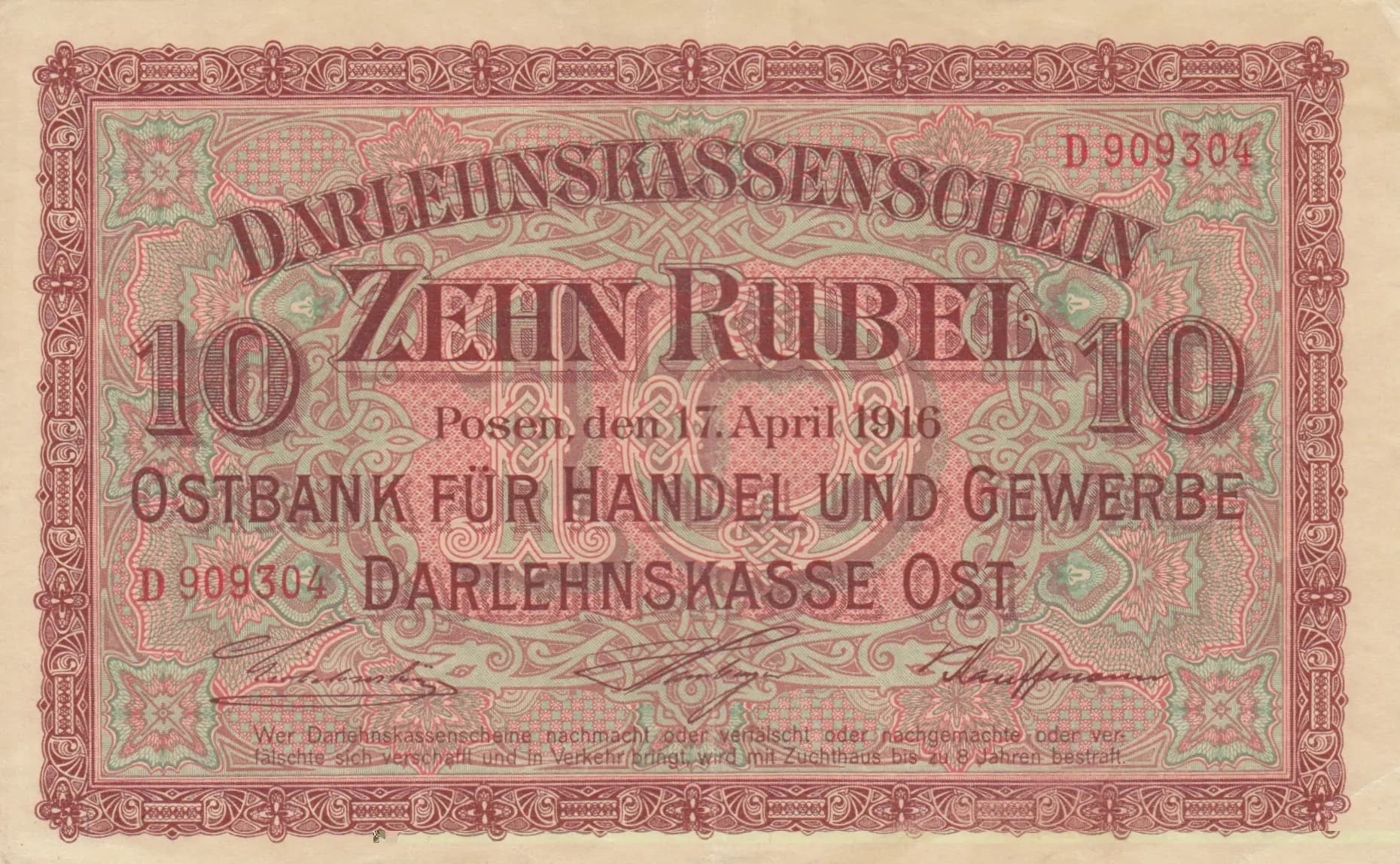
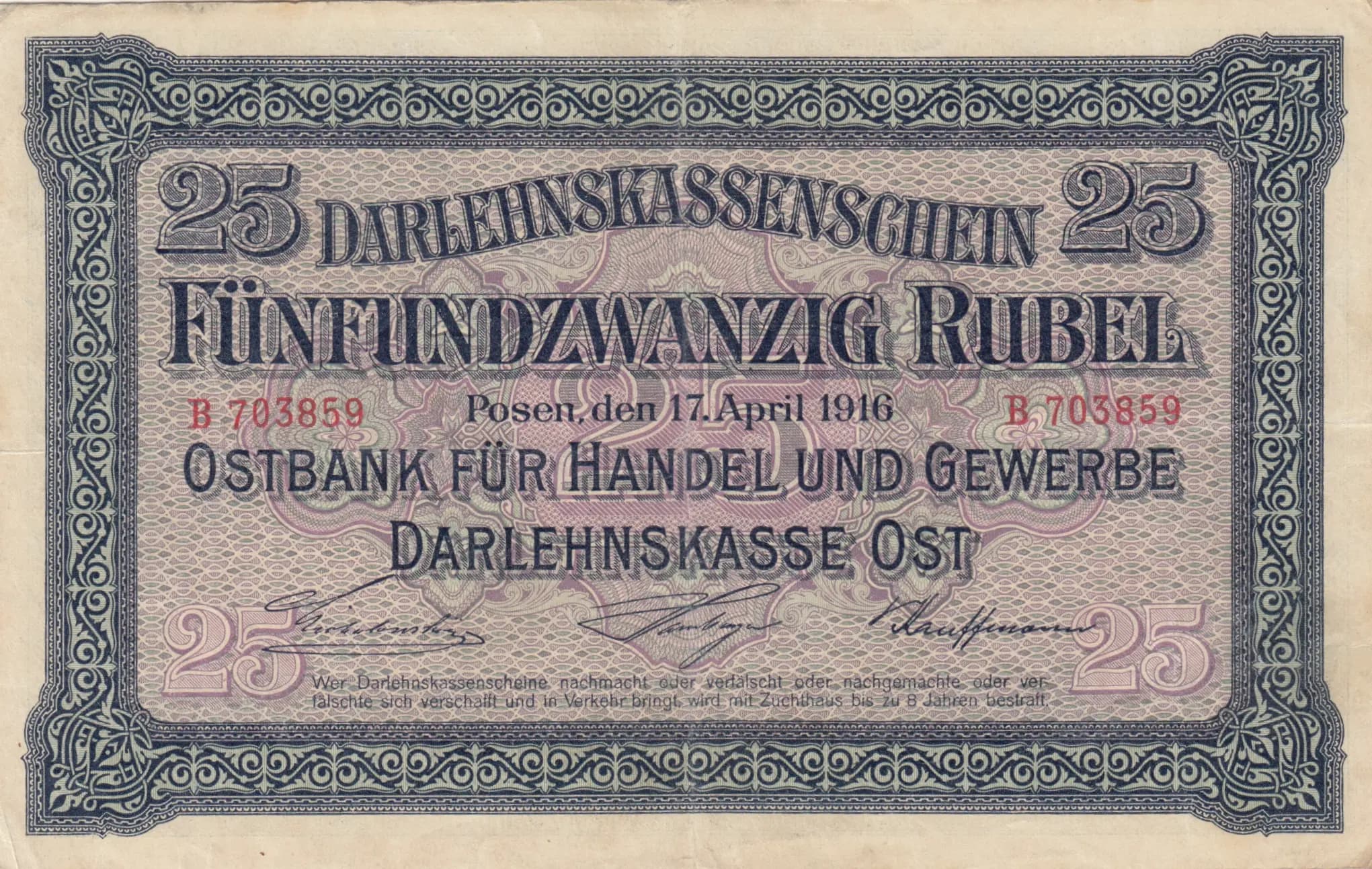
FRONT SIDE: 'DARLEHNSKASSENSCHEIN' (Loan Bank Certificate), '100 RUBEL / EINHUNDERT RUBEL' (100 Rubles / One Hundred Rubles), 'POSEN, den 17. April 1916' (Posen, April 17, 1916), 'OSTBANK FÜR HANDEL UND GEWERBE' (East Bank for Trade and Commerce), 'DARLEHNSKASSE OST' (East Loan Bank), and a counterfeiting warning: 'Wer Darlehnskassenscheine nachgemacht oder verfälscht oder nachgemachte oder verfälschte Noten verbreitet und in Verkehr bringt, wird mit Zuchthaus bis zu acht Jahren bestraft' (Whoever counterfeits or falsifies loan bank notes or distributes and brings counterfeited or falsified notes into circulation will be punished with imprisonment for up to eight years). BACK SIDE: Multilingual inscriptions including 'Skolinamosios kasos ženklas' (Lithuanian: Loan Fund Certificate), 'Wykaz kasy pożyczkowej' (Polish: Loan Fund Certificate), with counterfeiting warnings in Lithuanian, Polish, and Yiddish texts, all carrying similar penalties of up to eight years hard labor or imprisonment.
This note was produced using intaglio engraving, evidenced by the fine line detail work, elaborate border patterns, and the characteristic depth and precision visible in the portrait rendering and denomination markers. The complexity of the multi-language text and intricate decorative elements required professional security printing, typical of German state and regional bank note production during WWI. The multiple signature lines visible on the obverse indicate a formal institutional production by an established security printer, likely one of the major German printing houses contracted by the Darlehnskasse Ost.
The specific variety would be identified by the signature combination and serial number if visible in high resolution. The dated issue of April 17, 1916, from Posen is consistent with Pick catalog listing R126. Varieties of this series are typically distinguished by different signature combinations of authorized officials, signature placement variations, and serial number prefix schemes. The multilingual presentation (German/Lithuanian/Polish/Yiddish) represents the standard variety for circulation in the Posen region. No overprints or unusual denominations variants are apparent in this specimen. Additional research into signature authentication and serial number sequences would be required to pinpoint a specific sub-variety within the Pick R126 designation.