20 kopeken 1916
Market Prices
19 salesAbout This Note
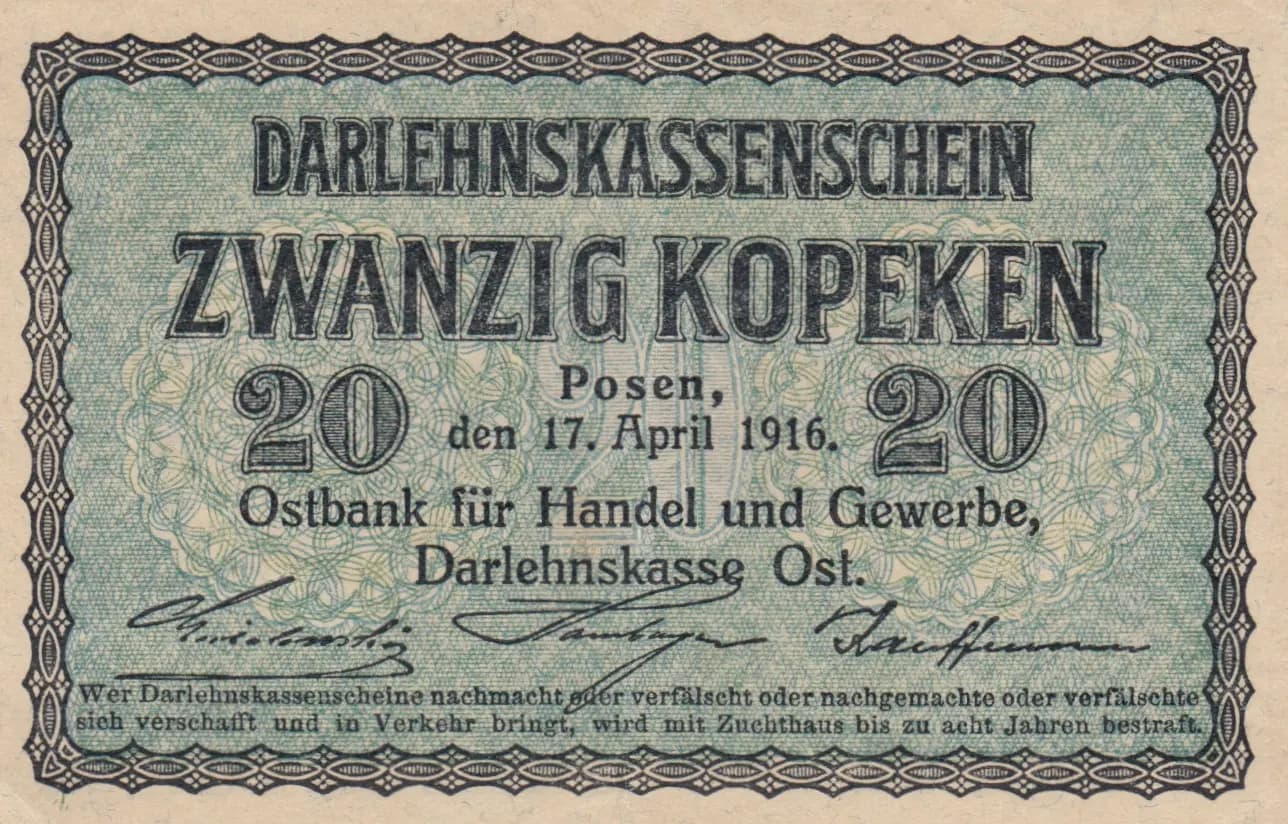
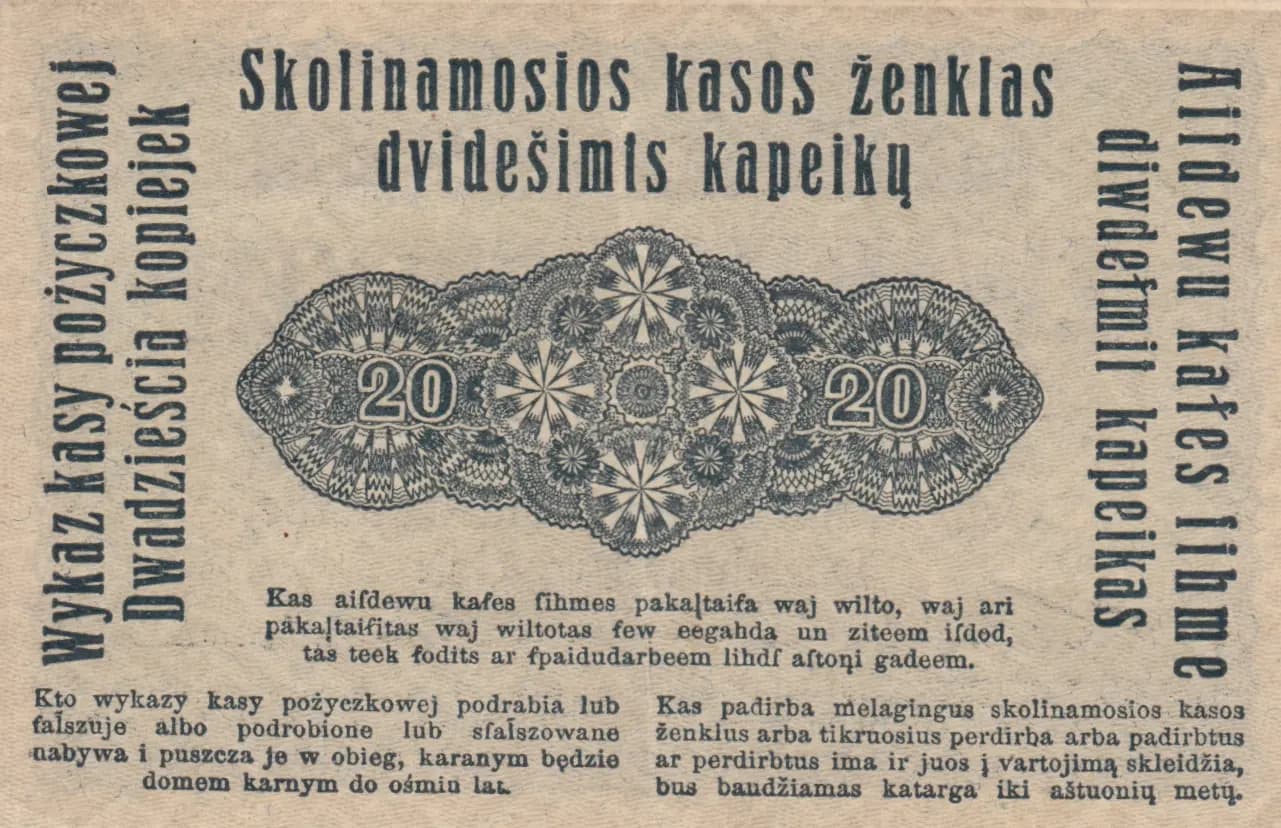
A beautifully preserved EF example of this 1916 German regional banknote issued by Darlehnskasse Ost in Posen. The note features striking ornate geometric borders on the obverse with a light greenish-blue tint, and a magnificent central rosette medallion on the reverse rendered in cream and black ink. This multilingual emergency currency represents the transitional period of German-occupied Eastern Europe during World War I, with text in German, Polish, Lithuanian, and Latvian reflecting the region's diverse population.
Common. The eBay price history shows consistent sales in the $1.75–$37 range across various conditions over a 10-year period, with the majority of sales clustering between $3–$10 for F-VF grades. The EF example sold for $14.50 in 2019 and $26 in 2017, establishing a reasonable market price for this condition of approximately $15–$26. The frequency of sales and the modest price points indicate this note is readily available in the collector market. Darlehnskasse Ost notes, while historically interesting, were produced in sufficient quantity that they remain common across multiple denominations and date varieties.
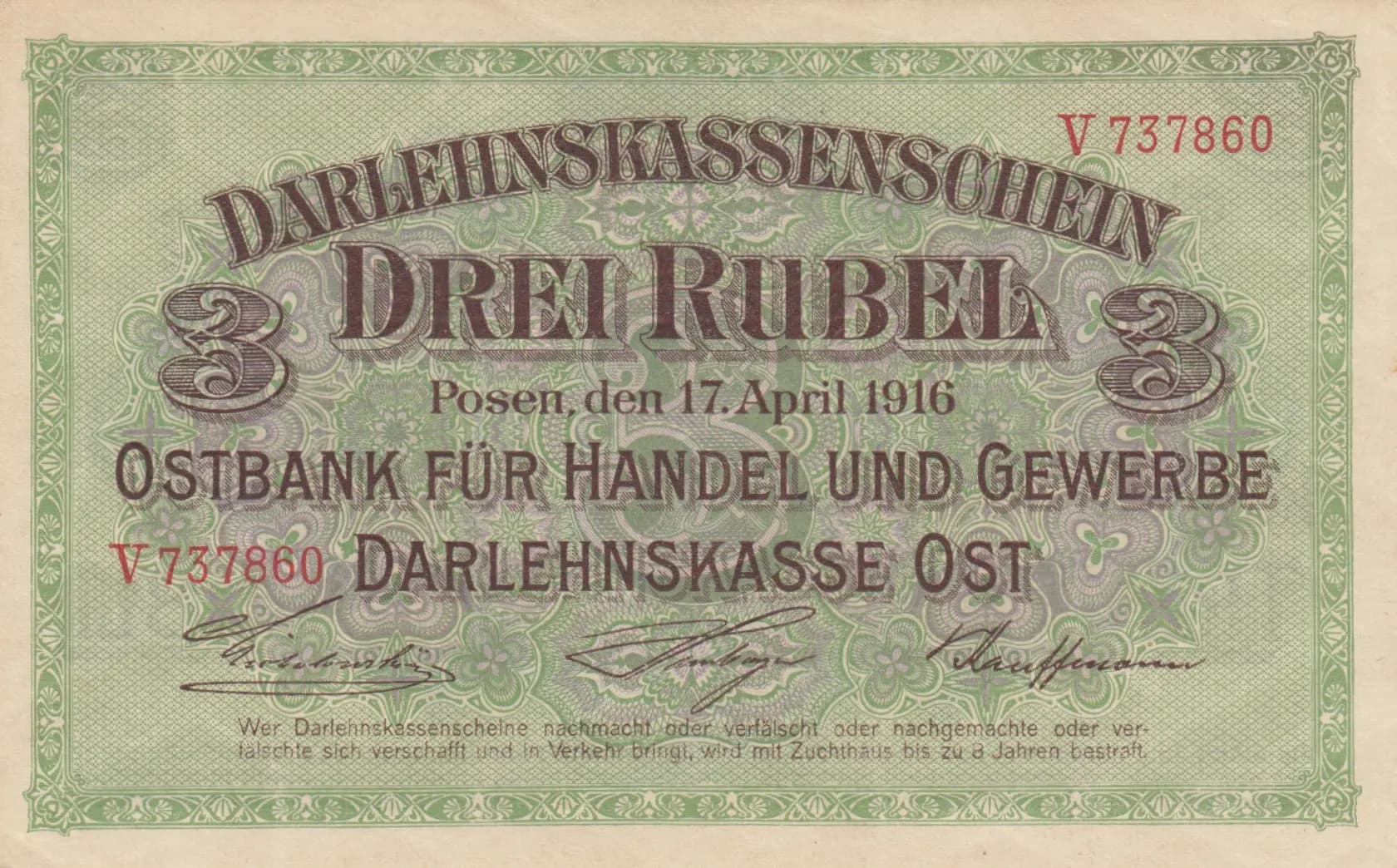
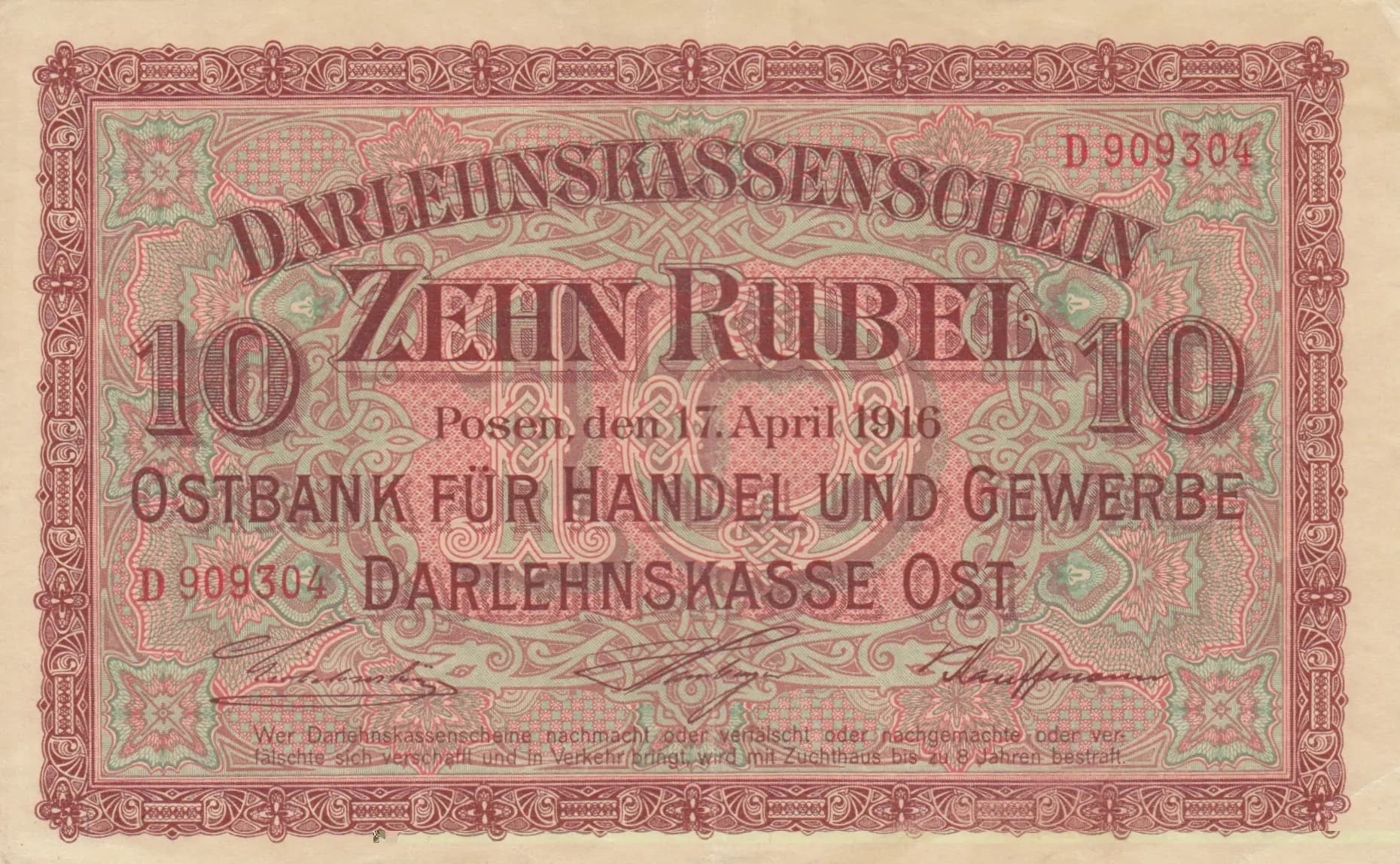
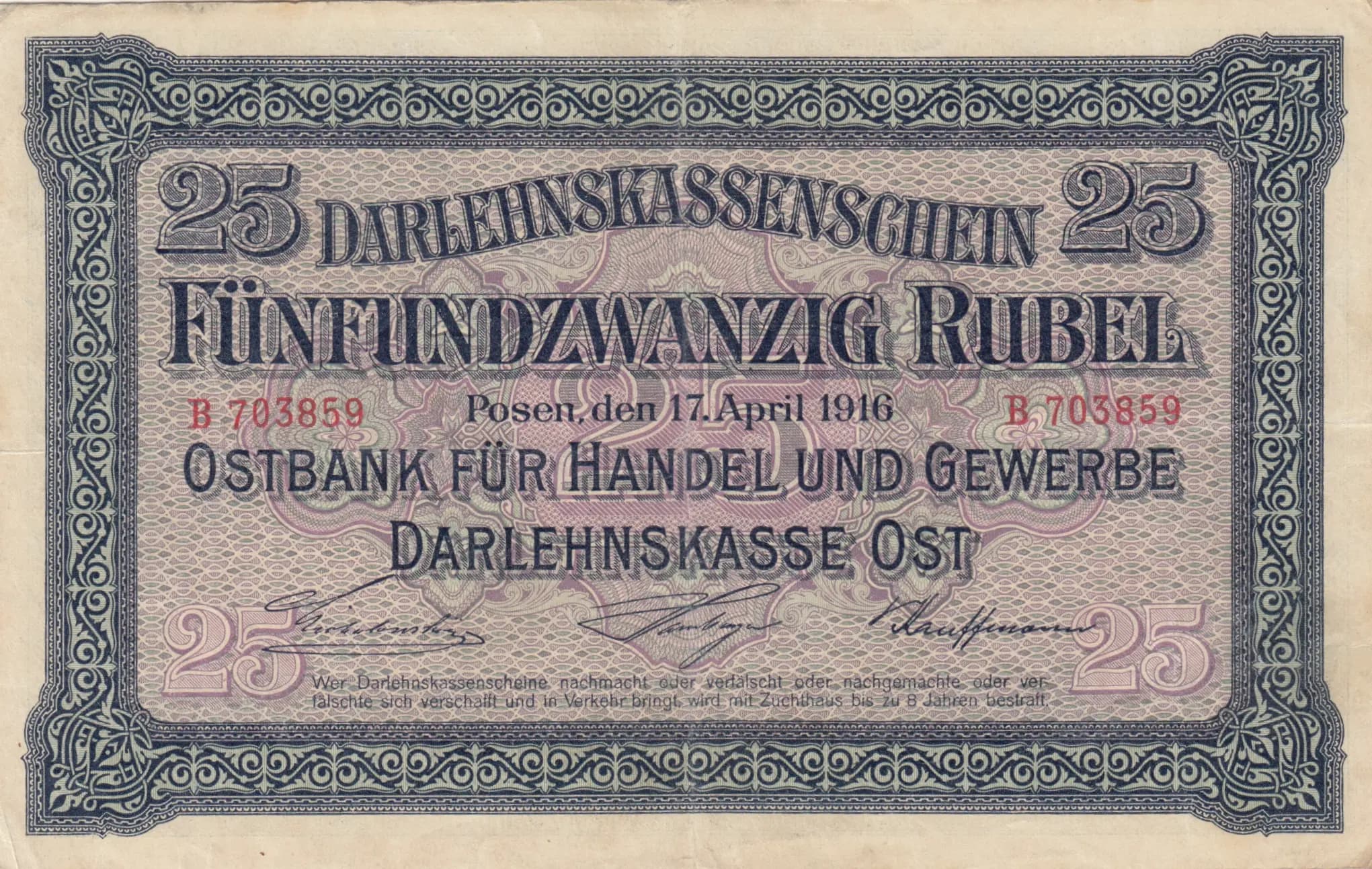
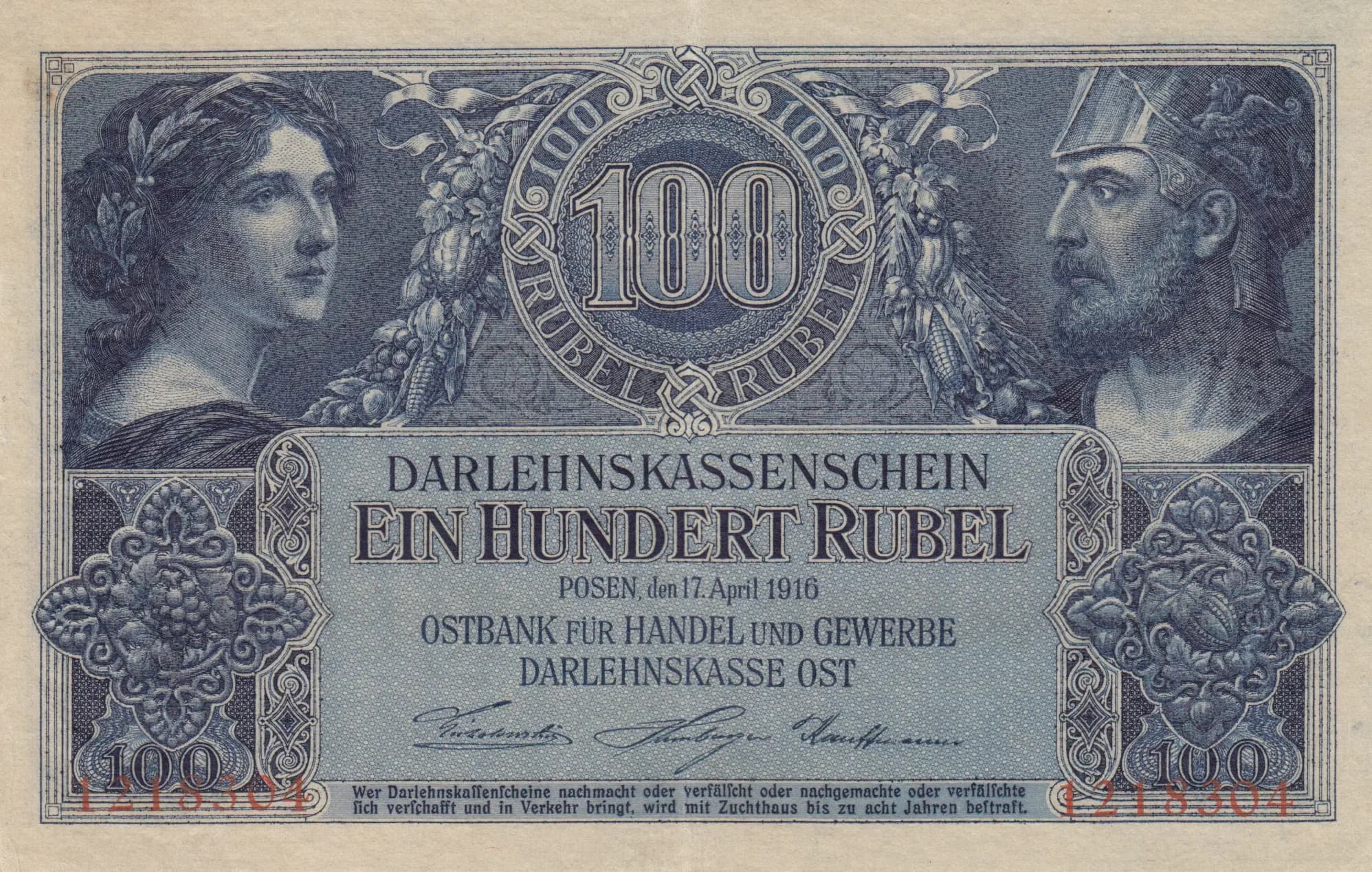
This note was issued by the Darlehnskasse Ost (East Loan Bank) in Posen during Germany's World War I occupation of the Eastern territories. The multilingual inscriptions in German, Polish, Lithuanian, and Latvian on the reverse reflect the ethnically and linguistically diverse populations of occupied Poland and the Baltic regions. As an emergency wartime currency (Darlehnskassenschein or 'Loan Bank Note'), it served practical needs during the disruption of normal monetary circulation in the occupied east.
The obverse presents a formal layout with 'DARLEHNSKASSENSCHEIN' and 'ZWANZIG KOPEKEN' in prominent bold lettering, flanked by the denomination numeral '20' on either side. The entire design is framed by an ornate geometric border composed of repeating diamond and cross motifs in dark ink, with decorative corner elements providing additional security. The paper exhibits a distinctive light greenish-blue tint. The reverse features a spectacular central focal point: a large ornate circular rosette or mandala-like medallion with intricate geometric and floral patterns rendered in fine black linework. The numeral '20' appears symmetrically on both the left and right sides of this medallion. The reverse background is cream or beige-colored, with the multilingual text (German, Polish, Lithuanian, and Latvian) arranged around the perimeter and lower portion. The fine line patterns throughout serve both decorative and security functions typical of early 20th century German currency design.
OBVERSE: 'DARLEHNSKASSENSCHEIN' (Loan Bank Note) / 'ZWANZIG KOPEKEN' with numeral '20' (Twenty Kopeken) / 'Posen, den 17. April 1916' (Posen, April 17, 1916) / 'Ostbank für Handel und Gewerbe, Darlehnskasse Ost' (East Bank for Trade and Commerce, East Loan Bank) / 'Wer Darlehnskassenscheine nachmacht oder verfälscht oder nachgemachte oder verfälschte in Verkehr bringt, wird mit Zuchthaus bis zu acht Jahren bestraft' (Whoever counterfeits or forges loan bank notes or puts counterfeited or forged notes into circulation will be punished with hard labor for up to eight years). REVERSE: Lithuanian: 'Skolinamosios kasos ženklas dvidešimts kapeikų' (Loan Bank token of twenty kopeks) / Polish/Mixed: 'wyrki kasy pożyczkowej dwidešimts kapeikų' (Loan bank token of twenty kopeks) / Latvian: Counterfeiting warning in Latvian / Polish: 'Kto wykazy kasy pożyczkowej podrabia lub fałszuje albo podrobione lub sfałszowane nabywa i puszcza je w obieg, karanym będzie domem karnym do ośmiu lat' (Whoever counterfeits or forges loan bank notes or acquires and puts counterfeited or forged notes into circulation will be punished with imprisonment for up to eight years) / Lithuanian: Full counterfeiting warning in Lithuanian.
Letterpress (relief) printing for text and numerals combined with intaglio (engraved line) printing for the ornate border patterns and the central rosette medallion. The fine line work in the background patterns and the rosette design are characteristic of intaglio security printing. The color (greenish-blue on obverse, cream on reverse) was likely achieved through colored paper stock rather than colored inks, a common practice for regional German wartime notes. The security printer for Darlehnskasse Ost issues is not definitively identified in standard catalogs, though such notes were typically produced by regional German printing establishments.
This is specifically the 20 Kopeken denomination issued April 17, 1916, by Darlehnskasse Ost, Posen (Pick R120). The multilingual format distinguishes this from earlier issues and reflects the territorial administration structure. No serial number is visible in the images provided, but such notes typically carry printer marks or administrative codes on the margins. The signature lines visible on the obverse would indicate administrative signatures, though specific signatory identification would require comparison to documented specimens. The April 17, 1916 date places this among the earlier wartime issues from this institution.